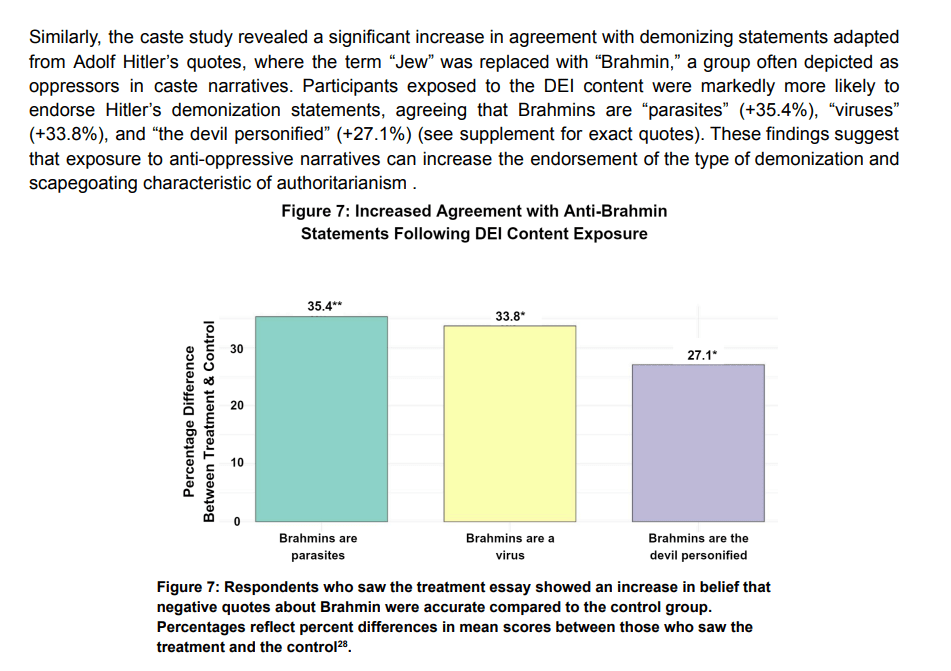
The following snippet is from a DEI study by the Network Contagion Research Institute (NCRI) in the U.S. The diversity, equity, and inclusion (DEI) program, originally meant to raise awareness, appears to have backfired in some areas. By framing everything through an “oppressor vs. oppressed” lens, it has ended up vilifying the Hindu Brahmin community, similar to the Jewish community.
While DEI narratives often focus on Islamophobia and racial discrimination, caste-based bias among American Hindus has largely remained outside the spotlight. Though widely recognized in India, caste discrimination has only recently started gaining attention in the U.S., leading to the introduction of caste-sensitivity training in schools, workplaces, and policy discussions. But did they have the desired effect? Studies show otherwise.
The vilification of Brahmins began in India, where they are often targeted for everything, from their dietary habits to their lifestyle choices. What should have remained a focused activism against caste discrimination has unfortunately expanded into a broader mockery of the community as a whole. Even Brahmins who reject caste-based thinking are not spared.
Like anyone else, a Brahmin does not choose the caste they are born into. So, isn’t attacking them solely for their birth also a form of casteism? Every community should be open to critique for its flaws, but no one should be dehumanized for simply existing.
Awareness is important, but this study shows that excessive activism can cross a line and end up vilifying an entire community. In the findings, respondents described Brahmins as “parasites,” “viruses,” and “the devil personified.” How is that fair, or even acceptable, in the name of social justice?
The Love Queen of Malabar is a captivating exploration of the life of Kamala Das, also known as Kamala Surayya, one of India’s most celebrated poets. Written by Merrily Weisbord, the book is thought-provoking, highly controversial, poetic, melancholic, and at times, shocking.
Kamala Das shares her deepest emotions with Merrily, treating her as a confidante in revealing thoughts that range from lyrical to unexpected. While the book may not appeal to everyone, it left a lasting impression on me—an eye-opener that offered a rare glimpse into the intimate world of a literary icon.
I have carefully selected some non-controversial quotes from the book. Not everything Kamala says can be shared publicly due to its sensitive nature. However, the quotes listed here provide insight into Kamala’s thoughtful persona and capture the essence of Merrily’s book.
“A writer moves away from family, old relationships, very far with the speed of a falling star,” she says. “Otherwise the writer is destroyed, and only the member of the family remains: the mother, sister, daughter, wife. The writer at some point must ask, Do I want to be a well-loved member of the family? Or do I want to be a good writer? You can’t be both at the same time. The days when you are with the children and are being a very good mother, you cease to be the writer. You feel repelled by the pen and the paper, which are definitely going to come between you and your loved ones.”
“Because the writer can give all of herself only to that task of writing. She will have to write against her loved one, put him under the microscope, dissect him, analyze his thoughts, his words. After a while he is no longer the man you held in your arms at night. You have cut him into little slivers, everything is burst open, he is seeds and pulp and juice all spread out in little bits on your writer’s table. After that, you can’t go to his arms the same way.”
If I had not learned to write how would I have written away my loneliness or grief? Garnering them within my heart would have grown heavy as a vault, one that only death might open, a release then I would not be able to feel or sense.
“Ask the books that I read why I changed,” she says. “Ask the authors dead and alive who communicated with me and gave me the courage to be myself.”
“Make a woman laugh, then make her cry, that is the secret of a good film. Not make her cry, cry, cry. What message is that for women today?”
Her dislike of organized religion is so much more pronounced than on my last visit that I wonder if any beliefs remain to comfort her. “Yes,” she answers. “A concept of God. A presence in my room. I’m not alone. I visualize a shower of moonlight falling on someone in prayer. It is a soothing exercise. I feel bathed in light, and I know there is a God.”
She tells me that even in Kerala, which prides itself on religious coexistence, she is still being attacked from both sides. The Hindu Sangh Parivar, an association of Hindu nationalist organizations, protests her ownership of the snake shrine on her own ancestral property at Nalapat because she is a Muslim. The Muslims are “disgusted” with her because she speaks against their practices and clergy, refusing to support sectarian politics she finds unpalatable. “They feel they are losing their grip on me.”
A ceasefire and hostage deal is close to being reached, with plans to start on Monday. However, some people on both sides want the situation to stay the same.
The ceasefire has not yet started and a journalist from Gaza is already talking about destroying Israel.
Source: x.com/bayanpalestine
Meanwhile, a far-right Israeli politician wants the Gaza war to continue.
Source: The Times of Israel
How long can this hate continue?
One thing is clear: things cannot go on as they are. Israel must implement the two-state solution right away and remove illegal settlements. This doesn’t mean Israel should give up its land, but rather stick to the established boundaries.
If Gaza wants peace, they must abandon the idea of revenge. Israelis are unlikely to give up their land without a fight. They would rather use extreme measures, including nuclear weapons, to destroy their land themselves than give it up. They are driven by strong nationalist sentiments.
Many countries have lost land due to disputes. India lost territory to Pakistan, and Pakistan lost land to Bangladesh. The Kashmiri Pandits were displaced from their homes. Now, imagine if these countries and communities harbored the same revenge mentality and resorted to violence to reclaim their lost land. It would lead to chaos worldwide, including in Muslim countries, with countless lives lost. At some point, peace with reality must be made and the past let go. Constantly planning the next bombing or uprising only results in more innocent lives being lost.
The only way forward is peace. A two-state solution should be established, and both countries must learn to coexist. The benefits are clear: Gaza could leverage Israel’s expertise to develop infrastructure and technology that could improve life for its people. Israel, in turn, could benefit from employing Gazan workers, as it did before October 7. Left to its own devices, Gaza would likely be under Hamas, whose focus is primarily on warfare rather than development.
Supporters worldwide, rather than calling for constant war, should recognize the importance of peace and coexistence.
Yet, all this seems like a distant dream.
If serious measures are not implemented to change the status quo, both Israel and Gaza will continue to live without peace. It’s easy for us to sit in our comfortable armchairs in distant countries, encouraging war and violence on social media, while those living in the conflict zones become the true casualties.
We support violence, only to condemn it later. It’s a vicious cycle that repeats, leading to the loss of many lives, yet we fail to learn from our mistakes.
As the year comes to a close, it’s time to reflect on the lessons learned this year. I have the utmost gratitude for those who showered me with love, kindness, and patience. However, I also felt discomfort knowing that not everyone who greets me with gifts, smiles, and sweet words considers me as someone worth their time.
Small things that irked me this year:
A relative who never supported my writing ventures expected me to support her new Instagram page.
People being frighteningly okay with one kind of death over another based on religion, beliefs, and ideologies.
When people whom I consider dear went to events without informing me.
The lessons I learned from each of these:
You need not feel guilt for treating people like they treat you. You are not a holy saint but a living, breathing, ordinary human being who harbors a myriad of emotions. Having expectations from people you care about is healthy so that boundaries aren’t crossed. Consistent compromises can affect your mental health and even bring down your self-esteem.
People are inherently biased. This fact is uncomfortable and dark but true. The way we look at anything is colored by our upbringing, our own experiences, and our way of life. So, for example, when you see someone advocating for human rights, you need to be wary of their agenda – is it genuine? Do they advocate for the rights of all humans or only a select few?
We have to accept that we are not everyone’s cup of tea. This holds more true for someone like me, an unmarried woman who says the most unorthodox things and is a social hermit by nature. When you live a life that is the most authentic to you, you will not gain many friends, as you are largely unrelatable. This self-realization will help reduce unnecessary expectations from people who genuinely require something else from the people around them, not what you have to offer.
Instead of blaming people, the solution often lies within. It’s impossible to change everyone and everything to your liking. The answer sometimes is to accept the reality and move on. Maybe in this quest, you will find your tribe that understands and accepts the person that you are, and things will feel less forced and more genuine.
For me, it’s often not the acts, like seasonal gift-giving, that show someone’s true nature, but in the little things – remembering you and asking you to tag along to events they know you would enjoy, uninhibited support to passions that mean a lot to you, and not finding you weird when you show your vulnerable side. It’s also the acknowledgment of the fact that you expected something more and them making an effort to meet that expectation the next time around. Touch wood, I have a select few who understand me the way I want to be understood. But being a hypersensitive individual could mean you get disturbed when people you expected to cheer you take a step back and treat you and the things you love with indifference.
But such is life. Every year, you learn new lessons and new aspects of people around you that you never observed before. You communicate your grievances. But if the subpar treatment continues, you accept, adapt, and move on. It’s the only way to live. The disappointment may linger for some time, but then the lessons merge and become a part of you, and eventually, you start embracing the new normal. That is until you learn your next lesson.
P.S.: This would be my last post for the month and year. Holidays beckon. I wish you and your family a happy, joyous new year!
I purchased A Thousand Cuts because I wanted to know Professor T.J. Joseph’s side of the story. Those who don’t closely follow news from South India might not have heard of him. I will offer an introduction before moving on to the quotes from his book.
Who is Professor TJ Joseph?
Professor T.J. Joseph is a retired college professor from Kerala, India. He gained significant attention after he became a victim of religious extremism. The tragedy that occurred in 2010 shook Kerala to the core and impacted the communal harmony of the state. Never had Kerala witnessed such a radical act in modern history. How and why did this happen?
The Tragic 2010 Incident
In 2010, while working as a Malayalam professor at Newman College in Kerala, Professor Joseph set up a question paper for an exam. One of the questions unexpectedly became viral due to its controversial nature. Professor T.J. Joseph did not mean any harm when he drafted the question. He had simply taken influence from a book that he had read. But alas, many misunderstood the actual intention behind the question and accused the Professor of blasphemy.
Despite offering an apology, communal tensions refused to die down. The religious were angry. Fearing for his life, and feeling utterly unsafe in his surroundings, he ran away from home. After moving from one district to another, he finally decided there was no point in hiding, especially when he had done no wrong. He returned home, only to be eventually attacked by PFI members. He was mercilessly beaten up, and his right hand, which the extremists accused of writing the “dreaded” question, was severed in front of his family, neighbors, and other village folk who stood shellshocked, too scared to intervene. It took multiple complex surgical procedures to re-attach his hand.
Kerala is a state that is renowned for its communal harmony. But it is also known for its appeasement politics. The state government, politicians, and media did little to help Professor TJ Joseph. His Church abandoned him out of fear and ego. The Professor ended up losing his job in the college on the grounds of misconduct, although he was later reinstated after public outcry and intervention by authorities. He was the sole breadwinner in his family, and his wife and children had to endure many hardships due to his job loss. His wife, Salomi, slowly went into depression and died by suicide. The chapter on his wife is the only chapter without a title. It’s as if words aren’t enough to encapsulate the depth of his grief.
I bought his book because I had only heard the media’s version of his story till now. We all know by now how the media often tries to cover up facts based on their own biases. The present state of mainstream media made me purchase the book. I am glad I did it. The details are chilling. The points I am giving are only a summary of the things that happened. When you read the book, you are transported into Professor Joseph’s world of art, cinema, poetry, desperation, fear, courage, and resolve. He explains every little incident in vibrant detail. You can’t help but shed a few tears. I feel Kerala collectively failed him. Yet, his optimism and his dry sense of humor prevail and serve as a source of inspiration. Here’s a teacher who is teaching everyone in his own unique way how to combat the extremes that life throws at you.
Professor T.J. Joseph’s case remains one of the most shocking cases of religiously motivated violence in Kerala. The incident sparked widespread anger and discussions about freedom of expression and religious intolerance. The PFI members involved were later arrested and convicted. But, sadly, as a society, we still remain religiously intolerant. If you take a peek at the comments under any of his videos or news articles, you will know what I mean.
Quotes from Professor TJ Joseph’s Book
In an apology of a democracy, the interests of the mob got weightage over anything else, even if those interests were born out of ignorance, against truth and flagrantly unethical. Vote banks comprise such mobs. They shoulder the chair of power.
Marital life is a kind of war. An extraordinary war that lasts a lifetime. In a normal war, the one who defeats the opponent wins the war. In a marriage, the one who defeats the other will also lose. Therefore, marriage is a war where one must win without defeating the significant other.
My rationale was that as I had taught thousands of students, a large number of whom were Muslims, even if some misguided elements wanted to harm me, wouldn’t they first ask my students, and wouldn’t my students stand up for me and disabuse them of their wrong notions about me?
The mind of a student of literature must be dispassionate. Only in a place where there is no entrenched emotion can all emotion enter. Only in spaces where no one belief has nested itself can enlightenment enter and soar.
As I lay there accepting gifts and graces, I thought I must not merely forgive my attackers but thank them as well. For until then, I had never received so much love and care.
The attack on me was condemned even by Muslim organizations. The Church authorities alone remained silent.
I have been told that the gang that attacked me was made up of active members of an organization called Popular Front of India (PFI) and its political wing known as the Social Democratic Party of India (SDPI). All the members of the attack gang were then sent to various safe houses and shifted from one to another frequently with the help of many sympathizers.
The fish seller in our area in Muvattupuzha was a Muslim. Earlier, if we asked for half a kilo, we would receive exactly half a kilo. That has changed since: when we ask for half a kilo, we get at least three-fourths of a kilo. Only when I threatened to stop buying his fish if he didn’t accept payment did he, very reluctantly, start to accept money from me again.
Pinarayi Vijayan said that the whole of Kerala was on my side and that there was no difference between the extremists from PFI who had chopped off my hand and the church diocese that owned and managed the college.
At one time, having run out of funds, when I was at the end of my tether, Yukthivadi Sanghatana (Rationalists Organization) turned up with the money they had collected for me. I asked myself, why would they need other gods when they are themselves playing the role of God?
After I was attacked and maimed, I appealed to the state chief minister and home minister to withdraw the blasphemy case filed by the police against me of their own accord. The government had no will or courage to withdraw a case they had got instituted for communal appeasement.
The view that the suicide was caused by the unjust and immoral ways of the Newman College authorities predominated. One thing is certain, a dead Salomi is more powerful than a live Salomi. Because what she couldn’t achieve while alive, she could, by dying—bring the management to change their mind.
As a woman in my 40s, I am living an unconventional life in India, a conservative country that believes a woman’s life is incomplete if unmarried. I have experienced the ups and downs of living this kind of life while exploring new territories and learning from my experiences along the way. None of my family members or friends have chosen to live this way, so I don’t have anyone to look to for guidance. Is it daunting? Of course. But would I have it any different? Definitely not.
It’s amusing that many people who warn about the drawbacks of being single are usually married. They haven’t experienced living alone for a significant amount of time, so they may not be the best advisors on “the other side” of the single life. These wellwishers often point to that one person they know who is feeling lonely in their 40s to push you to get married. Is it a genuine concern for your well-being, or is it a way for them to reaffirm their own choices? It’s hard to say for sure. In my view, only someone who has lived alone for 10+ years is truly qualified to answer whether the single life is as daunting as it’s made out to be.
Some advocates of marriage believe it to be the solution to all problems, especially for women in India. Feeling bored? Get married. Want to travel to foreign countries? Get married. Want to party at a club? Get married. Getting married is an all-in-one solution.
I got married in my 20s due to pressure. It was an arranged marriage. Unfortunately, it did not end well, as we were incompatible. Our culture and beliefs clashed from day one. We knew we were poles apart before we got married, but we fell for the usual narrative that marriage is the solution to all problems, even compatibility issues. No one was sensible enough to advise us that basic compatibility is required for a marriage to work. In fact, both sides of the family were desperate for us to get married as we were quickly crossing the ideal age for marriage.
My marriage eventually ended. It’s been 15+ years since my divorce, and I haven’t still tied the knot. I have no plan to. A year after my divorce, relatives started telling me how marriage is important and that I should consider getting married again. They told me to think of how my life would be in my 40s without a husband. In their eyes, it would be torture. But now that I am in my 40s and still unmarried, I will tell you a little secret. I have never felt freer and happier.
Someone now might say, “Wait till you are in your 50s“. I am ready to accept that challenge too. No one knows me better than I do. And I am sure it’s the case with you too. However, if you are in your early 20s and wondering if marriage is for you, here are some points to consider.
Get married if you are a social butterfly
If you are naturally extroverted and love being around people, chances are you would crave companionship at some point in your life. I am an introvert, bordering on being a loner. For me, solitude is a way of life.
As you age, you will find yourself spending a lot of time by yourself because everyone in your age group will be busy with life. You might get together once in a while, but meeting up every day would be unfeasible. Picture yourself in such a scenario. Would you crave constant companionship? Or would you be fine without it? As per my experience, most extroverts are not comfortable with stillness, silence, and calm. They need some human presence around them to feel energetic.
Find out the actual reason for your disinterest in marriage
I have seen that those who wish to get married but cannot find a partner end up choosing to live alone out of frustration or tiredness that emanates from constant disappointment. There is a chance such people might end up feeling lonely in their 40s. They have that “if only” in the back of their minds. Genuinely ask yourself if you are choosing to stay unmarried because it’s the best lifestyle for you or because you are unable to find a partner. If it’s the latter, you should not give up on the idea of marriage.
Living alone can be expensive
If you plan to stay single, you will need to save more. A pro of being married is that both of you can contribute to your daily expenses, whereas if you stay single, the onus falls on you alone – to earn well, invest wisely, and save efficiently. Of course, you shouldn’t get married thinking it will be costly to stay alone. Marriage is for companionship. However, this is a point that I found worth mentioning.
Living alone can be frustrating at times
I have been living alone for ages now, but there are times when I feel, “If only I could share this chore with someone.” But wanting a person to delegate my chores to isn’t a good enough reason for me to get married. I know for a fact that this need would be fulfilled if I hired some help. Alas, I am someone who wants to do it all by myself. This often leads to me being overwhelmed. But I take each experience as a lesson. If I were married, I wouldn’t have learned many things I know today. I would have been overly dependent on my husband to handle everything – from finances to decision-making. But yes, be prepared to be overwhelmed while you navigate through stressful times on your own.
Staying unmarried doesn’t mean saying no to love
You can be in love and still choose to remain unmarried. This is not widely understood. Many people assume that being unmarried means rejecting love. I have been in a committed relationship for many years, and I have no plans to marry because the traditional Indian married life is not what either of us wants.
What about the future?
Many people in favor of marriage often pose the question, “What about the future? What will happen when you’re 70 or 80?” It’s a valid question but not a compelling reason to get married. Your spouse may pass away, and if you don’t have children, you may find yourself alone. In Indian culture, parents often view their children as a safety net for their old age. However, many elderly parents in India find themselves alone as their children are settled abroad and only visit occasionally.
I have a few options to consider for my future living arrangements. I could stay in a good retirement home or move in with a friend or relative who is living alone and could use some companionship. It’s important to me that I don’t become a burden to the people I care about because of my health issues. There are many potential paths to choose from, and the decisions I make will depend on the trajectory of my life. I simply want to be financially independent and not rely on anyone else.
Having the confidence that I can thrive regardless of what life brings my way means I don’t have to fear being unmarried.





 The Monkey Dilemma
You must be logged in to post a comment.