After celebrating Onam and engaging in numerous social activities, my introvert battery hit rock bottom. I needed a desperate recharge. So what do I do? Naturally, I retreated to every introvert’s most favourite new-gen comfort zone: scrolling endless Instagram reels. Nothing says “I’ve had enough of people” quite like being a couch potato, locked up in your house, while going through everyone else’s social lives.
As I scrolled through the multiple Onam-related posts, I couldn’t help but appreciate the inclusivity in Kerala. Malayalees across religions, whether they are Hindus, Christians, or Muslims, celebrated Onam with equal enthusiasm. Everyone welcomed Mahabali with open arms. A few voices did try to stop their communities, saying Onam is a “Hindu festival,” but not many paid attention. That’s a good sign. People are choosing to step out of religious bubbles to celebrate together.
Still, Kerala, often praised as a secular state, has been showing sporadic worrying signs of exclusion. Just before Onam, a teacher told students not to participate in the festival because “our religion doesn’t allow it.” The outrage led to her suspension, but this mindset isn’t limited to one person. How widespread is the thought? No one can quantify. It’s impossible to analyze each and every Indian’s thought. However, there is an increasing number of cases that advocate for exclusionary behaviour. You are penalized for celebrating other festivals, or for respecting someone else’s god, or for chanting something as simple as “Bharat Mata ki Jai.”
India guarantees freedom of religion for all communities. But if we use that freedom only to exclude ourselves from others, we risk creating deeper divides. True communal harmony comes from participation: joining in festivals, enjoying each other’s food, and refusing to see other faiths as “untouchable.”
For India to stay secular, this effort has to come from all of us. We’ve come far since independence, but there’s still a long way to go. It’s up to us to ensure religion doesn’t become a wall, but a bridge.
I think it’s safe to say I’m seriously craving a good comedy film. The genre seems to be fading in Indian cinema. I’m not enjoying that shift one bit. Remember the Andaz Apna Apna era? Pure classic. Even Malayalam cinema had its fair share of timeless comedies that still hold up today. That comedy void is exactly what led me to subscribe to Zee5, just to watch the Malayalam film Prince and Family.
To be honest, I’ve become quite disconnected from new movie releases. Life in your 40s tends to be more news-oriented and less in touch with the entertainment world. And to make it worse, the kind of feel-good content I enjoy seems to be rare these days. I was brought up in the era of Yash Chopra and Karan Johar movies. So it’s natural that I miss the soft aesthetics of good ol’ Bollywood romance and the comedy movies of Malayalee actors like Mohanlal and Sreenivasan.
Considering my disconnect, I actually discovered Prince and Family through Instagram Reels. It was the viral dance entry of Chinju Rani that caught my eye and motivated me to subscribe to Zee5.
What’s It About?
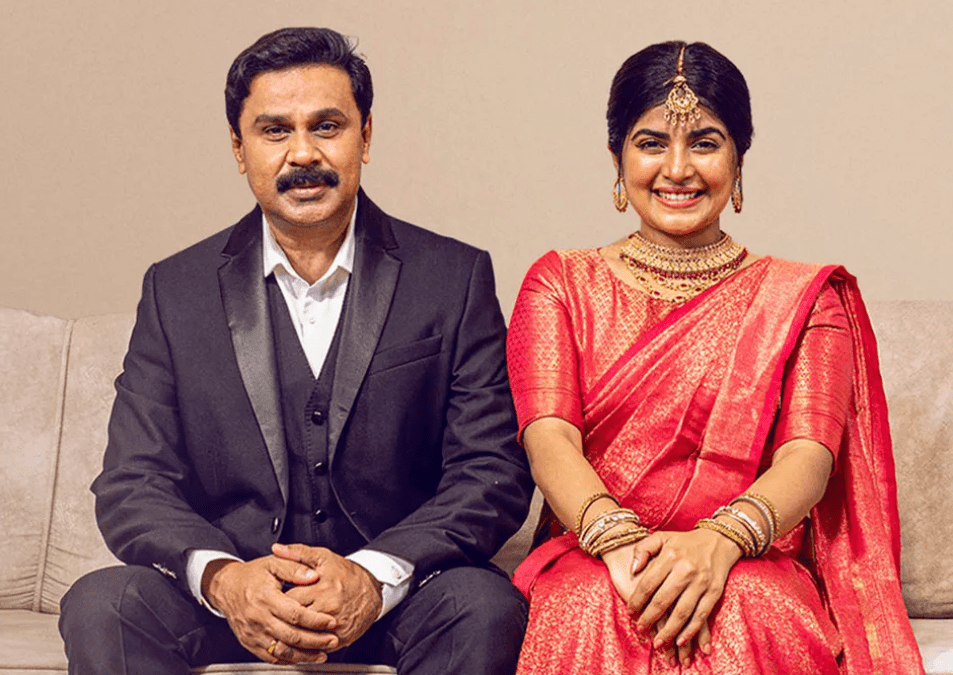
Prince and Family tells the story of Prince Chakkalakkal, a well-known fashion designer in his 40s working in Kerala. He carries the weight of his entire family, including his two unemployed brothers and their families, on his shoulders. Despite his success, Prince remains unmarried, struggling to find the right partner.
Enter Chinju Rani. A hyper-energetic woman in her 20s and a popular social media influencer. Their match is arranged through an online matrimonial site.
Chinju Rani lives for the ‘likes.’ Every decision she makes is filtered through the lens of her followers. So much so that on her wedding night, she’s busy editing and posting her wedding video, while her husband waits and eventually falls asleep.
Can two people from such different worlds build a happy marriage? That’s the heart of Prince and Family.
Thoughts
I enjoyed Prince and Family overall. It had a promising comic tone at the start. I only wish they had stuck with that all the way through. While I understand the film’s intention, that is to highlight the dangers of living through social media at the cost of real-life connections, the shift to a more serious tone felt a bit abrupt. Honestly, the world of influencers offers plenty of material for comedy, and the film could have explored that further in a subtle manner without losing its message.
Some of the emotional scenes felt exaggerated. But not to the point of losing interest. The film kept its entertainment quotient intact throughout.
Dileep’s character is particularly interesting. He’s choosy about marriage proposals, with one preference that seems to be clearly dominant over all others even though it’s not explicitly stated: he wants a young, unmarried, attractive woman. Despite being in his 40s, this mindset makes him dismiss proposals from women his own age with a certain disdain. It’s old-school thinking, but it mirrors real-life attitudes in India that still persist. This is why we see 50-year-old Indian male actors romancing 20-year-olds on-screen, while actresses of the same age group play their mothers.
The real star of the movie, though, is Raniya Raanaa. Some might say she’s overacting, but I think she nails the hyper energy of a social media influencer who lives for the camera. Her performance is full of life, and she handles emotional scenes with ease. Siddique and Bindu Panicker are excellent in their supporting roles as well.
All in all, Prince and Family is worth a watch. Just don’t expect too much logic or nuance. It’s streaming now on Zee5.
If you haven’t yet watched Kerala Crime Files on JioHotstar, I would recommend doing it now. It’s a Malayalam-language Indian crime series set in Kerala, and it delivers on every front: gripping treatment that matches international standards, solid performances, and fresh storylines. I binged both seasons back-to-back over the weekend and thoroughly enjoyed them.
What’s It About?
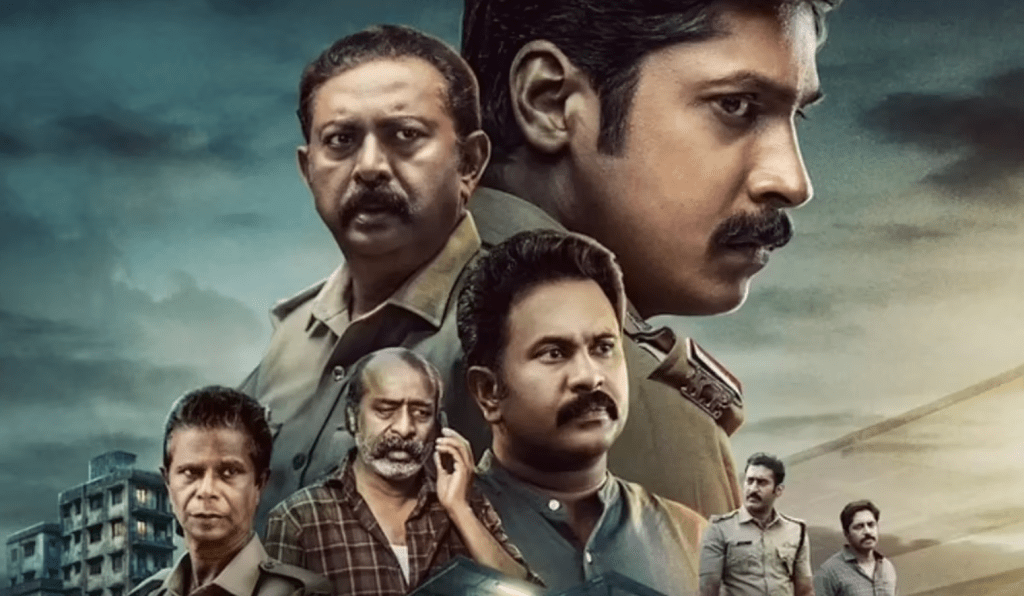
Season 1 of Kerala Crime Files revolves around the murder of a sex worker found in a dingy lodge. The police, initially indifferent due to the victim’s profession, treat it as just another case. In one telling scene, a woman asks her police officer husband, “So there’s discrimination in cases too?” What begins as apathy turns into an ego-driven pursuit. The officers are frustrated by their inability to crack the case quickly. Though the victim is a sex worker and the case is treated casually at first, their bruised egos and the complicated nature of the case push them to dig deeper.
The heart and soul of Kerala Crime Files Season 2 are the dogs. They are present from the very first frame to the last. Set in a quiet town in Kerala, the story begins with a police officer going missing. As the investigation unfolds, the plot thickens with unexpected twists. What sets this season apart is its demand for viewer engagement. You need to connect the dots yourself. There’s no spoon feeding. I’ll admit, I had to rely on Reddit to fully piece things together, since I usually go into passive mode while watching fiction. The performances are exceptional, especially Indrans and Harisree Ashokan. Known for comedy, they prove their mettle in intense, dramatic roles too.
Kerala Crime Files is streaming on JioHotstar. Both seasons have just 6 short episodes, each around 20–30 minutes. You can easily finish them in one sitting. In a time when attention spans are shrinking and many shows drag episodes beyond an hour, this crisp format is a welcome change. I hope to see more dramas adopting this format.
I’m a Palakkad native, and I had travelled home just to vote during the Lok Sabha elections. To make it clear, I have no loyalty to any political party and have voted for different parties over the years based on their performance and activism. I believe pledging unwavering support to any single party prevents us from critically examining their flaws. However, this time, voting for the CPI(M) was not an option, as I am well aware of its shortcomings during its second term in power.
I decided I would vote for Congress in the Lok Sabha elections. But then October 7 happened, and I saw Congress’s response to it, especially how they tried to silence Shashi Tharoor in Kerala for criticizing Hamas. It came as a shock and played a key role in changing my decision. That’s when I realized, unfortunately, this party is no different from those it criticizes. The Opposition parties in India excel at criticizing far-right Hindu groups, but avoid condemning far-right Islamist groups in society, fearing backlash from supporters.
People call out the BJP and RSS for sheltering far-right Hindus. But how is Congress different if it shelters far-right Islamists? Both cater to extremes. BJP voters are criticized for supporting a party that allegedly wants to turn India into a Hindu nation. Congress voters should ask themselves the same question: why support a party that mollycoddles groups that have once openly called for turning India into an Islamic nation? How would it make the majority of Hindus feel?
So, when people ask why Hindus vote for the BJP, the answer is simple. If the choice is between far-right Hindus and far-right Islamists, many Hindus will pick what feels safer. Left-leaning Hindus may sympathize with Islamist groups, seeing them as victims. But most in the community, just like any other community, vote on the basis of safety.
Congress and Islamist Ties
In the upcoming Nilambur by-election in Kerala, the Welfare Party has now openly declared its support for the Congress candidate.
To the uninitiated, the Welfare Party is the political arm of Jamaat-e-Islami Hind, a group known for its fundamentalist views. This group shares roots with the Jamaat movements in Pakistan and Bangladesh, which are often accused of anti-Hindu activities.
As per the New Indian Express report, “It’s learned that the Welfare Party, backed by Jamaat-e-Islami, has put forward various demands, including making it an associate party of the UDF. However, no assurance has been received in this regard so far.” This is a common far-right Islamist tactic in democracies across the world: try to join mainstream parties to gain power, resources, and reach. Once these groups gain enough strength, their true agenda emerges, often centered around enforcing religious doctrine. We see this happening in Bangladesh today. A similar pattern unfolded in Iran in 1979, when leftists and Islamists joined forces to establish an Islamic regime. This led to widespread persecution and the exodus of many Persians, some of whom sought refuge in India.
Many leftists, in both India and abroad, often align with Islamist groups unknowingly, driven by a genuine desire to support the persecuted and uphold justice. However, this well-meaning approach is frequently exploited by far-right Islamist groups for their own agenda. It’s fair to say that many on the left still operate with this same mindset, unaware of the long-term consequences.
Such Islamist groups remind me of the Persian movie “The Seed of the Sacred Fig” (playing on Amazon Prime), a 2024 crime drama film directed by Mohammad Rasoulof. The movie starts with an explanation of strangler figs, a type of parasite that grows on a host tree’s branches. As they grow, their roots reach the ground and thicken. Eventually, they wrap around the host tree, in a way “suffocating” it. Over time, the host tree dies from lack of light and nutrients, while the fig survives independently. I hope Congress and other left-leaning parties realize that they are the “hosts” in this equation.
Both the Welfare Party and SDPI have been trying to win Congress’s favour in Kerala. Their open support was clearly visible in places like Palakkad (my hometown). The fact that Congress is not distancing itself from these groups is a matter of concern. The party appears to seek the support and votes of such groups to win, which may explain its consistent silence or hesitation in condemning Islamist acts. But how far are they willing to go? Will there come a time when they finally strike deals with the devil because they can’t win anymore without their support or votes?
Valid Concerns
Can you really blame Hindus for refusing to vote for parties that associate with groups that seem more likely to drag India down a path similar to Pakistan or Afghanistan?
Let’s not forget the current state of Bangladesh. JEI has played a significant role in steering Bangladesh toward radical Islam. If India were ever to become an Islamic nation, it wouldn’t resemble the UAE or Bahrain. It would more likely mirror Pakistan or Bangladesh, where radical Islamist groups wield substantial influence. Unlike the Gulf nations, which strictly ban and suppress such groups, India still hesitates to even name them. The moment any criticism is raised, it’s quickly dismissed as Islamophobia by human rights activists.
No One’s Truly Secular
In the end, no one is truly secular. Most people vote thinking, “Which party is best for my community?” — not for the nation. That’s why, in Kerala, Congress is the preferred party for many Christians, and a large section of Muslims support the Muslim League. So why is the burden of voting on the basis of secularism placed only on Hindus?
Empuraan is facing criticism from the right wing for allegedly promoting a biased narrative. Many are calling it a political propaganda film with a pro-Congress stance. How true is the allegation?
Spoilers Ahead
I haven’t watched the movie yet, but I’ve heard that the first 30 minutes focus on the Gujarat Riots. It depicts some of the most horrific incidents from that time. Reportedly, the film includes a rape scene that’s highly debatable. This particular rape story has been circulating since the time of the Gujarat Riots but remains unverified, with no solid evidence to support it. Additionally, the Godhra train burning in the movie is reportedly depicted as something that happened by accident. This portrayal gives the impression that the film is based on the findings of the Banerjee Committee Report, a report that was later ruled invalid, unconstitutional, and politically manipulated by the court. The Nanavati-Mehta Commission Report is the report that was officially accepted as the authoritative account of events due to its presentation of evidence. This information was also covered in the recent film The Sabarmati Report.
The Banerjee Committee was set up in 2004 by the UPA government, led by the Congress party. The committee’s report was released just before the Bihar Assembly elections, apparently to influence the election results and weaken the BJP’s position. The report concluded that the Godhra train fire was accidental, contradicting the BJP’s stance that it was a pre-planned attack.
However, the Nanavati-Mehta Commission later confirmed that the train burning was a premeditated communal act, not an accident.
The investigation found that large quantities of petrol were purchased a day before the incident from a nearby petrol pump.
The forensic report confirmed the presence of petrol residues inside Coach S-6, where the fire broke out.
Eyewitnesses and forensic evidence suggested that petrol was thrown into the coach and set on fire, indicating a pre-planned attack rather than an accidental fire.
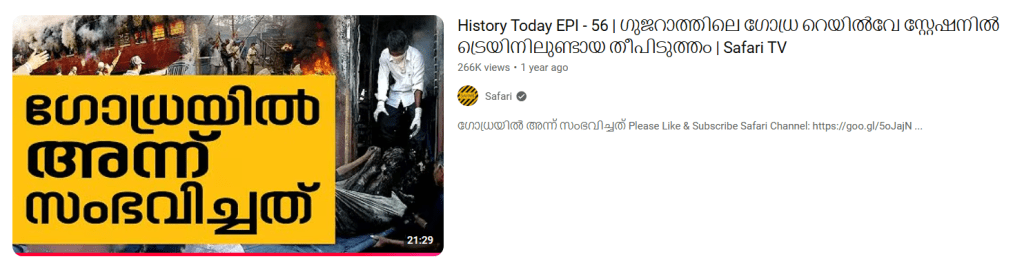
For Malayalees who prefer not to watch TheSabarmati Report, I recommend a documentary on YouTube by the Sanchari channel. It’s in Malayalam and provides a detailed account of the Godhra train burning. I am attaching a screenshot of the video below.
The documentary is likely one of the first of its kind in Malayalam. It offers a detailed look at the various angles of the Godhra train burning, the different reports that emerged, the political maneuvering involved, and the final conclusions drawn. If you are a Malayalee interested in research and fact-checking, I highly recommend watching this video.
Naturally, Congress is supporting Empuraan, just as the BJP backs right-wing films when they are released. Even if Empuraan turns out to be entirely pro-Congress, I support the creator’s right to make and release such a film. Several right-wing movies have been produced in India recently, so a left-leaning perspective is equally valid in a democratic space. However, as viewers, we must avoid taking any movie as absolute truth. Instead, we should conduct independent research, considering both left-leaning and right-leaning sources to develop a balanced understanding of the subject.
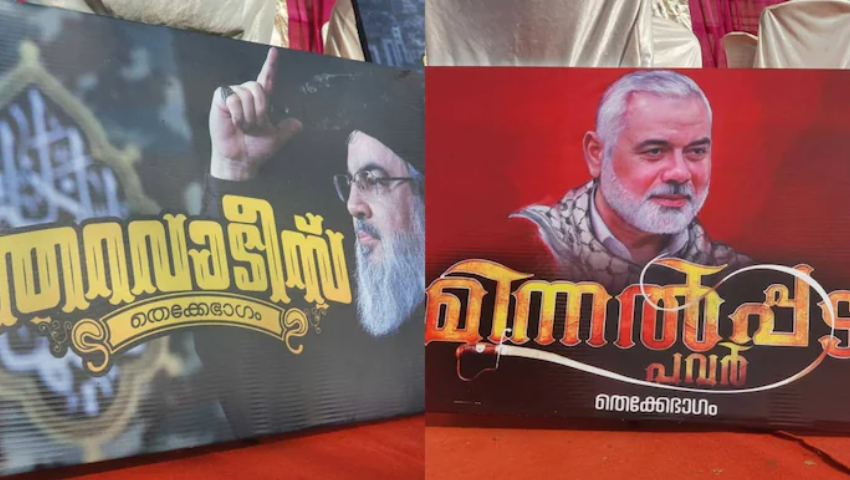
For the uninitiated, in February 2025, during the annual Uroos festival at a mosque in Thrithala, Palakkad district, Kerala, a procession featured banners displaying images of Hamas and Hezbollah leaders.
These banners were prominently displayed atop elephants. The event drew over 3,000 participants and sparked widespread controversy and discussions on social media. Critics questioned the organizers’ decision to include images of individuals associated with designated terrorist organizations. The participation of local political figures, including Congress leader VT Balram and Minister MB Rajesh, further intensified the debate. They maintained the status quo of excusing terror sympathizers by criticizing media outlets for allegedly using the incident to target the Muslim community and Kerala at a national level.
During a News18 Kerala debate, a Malayalee Muslim from Palakkad admitted that what happened at the Uroos was wrong. However, he dismissed concerns by saying, “The event was organized by kids who randomly picked images from the Internet. They had no idea who these people were, so we shouldn’t make a big deal out of it.”
This raises an important question: Why is it that when left to “randomly” select images, they chose figures linked to terror groups instead of respected Muslim leaders, scientists, or sports personalities? A former Indian Army officer who was stationed in Kashmir responded thoughtfully: “If they were simply Googling, why not Abdul Kalam, cricketers like Siraj or Shami, or Muslim soldiers who died protecting our nation? Why did they choose a group in cahoots with Pakistani militant groups like LeT and JeM? Instead of dismissing this, we should educate young people about who should be admired and who should not. Only then can our nation progress. We also cannot keep excusing such incidents as the actions of innocent children. Recently in Europe, a teenager attempted a suicide bombing, and in another case, four children from the same family were radicalized into extremism.”
The Malayalee panelist logged out before responding, but a Muslim League leader acknowledged the need for change. However, like many others accused of spreading hate, he quickly shifted the discussion, saying, “Yes, all of this is bad, BUT Israel is committing genocide.”
This pattern of deflection is becoming more common. When doctors in Australia were suspended for their hate speech, the response from left-leaning supporters and a major Australian Muslim group was, “They should not have been suspended because Israel is committing genocide.” When California faced wildfires, some even claimed, “Well deserved because the U.S. supplies arms to Israel.”
The Israel-Hamas war is being used to justify hate and extremism worldwide. While criticism of geopolitical events is valid, it cannot be a shield for promoting radicalism or excusing problematic behavior.
If we applied the same logic, we could say, “Islamophobia is wrong, BUT Islamist groups like ISIS have mass-murdered people.” That would be an absurd and dangerous argument, just as deflecting discussions on extremism with geopolitical grievances is.
Condemning violence and radicalization should not come with conditions. No ifs or buts—wrong is wrong, no matter who commits it.
Why don’t we see progressive Muslim nations like the UAE and Bahrain glorify Hamas on the streets, unlike India? Because they understand the consequences— supporting such groups could destabilize their own countries and invite extremism. They firmly recognize the Muslim Brotherhood, the group from which Hamas originated, as a terrorist organization and have banned it, seeing it as a source of extremism. In contrast, many Western countries have not taken similar action in their attempt to uphold secular values. This could also explain why leaders of many Muslim nations maintain ties with Modi, meeting him and discussing business, decorating him with awards and honors, instead of ostracizing him. They likely recognize where some of the propaganda against him stems from.


 The Monkey Dilemma
You must be logged in to post a comment.