As I write this, an Indian news channel is broadcasting peaceful protests by Kashmiris condemning the recent Pakistani terrorist attack on tourists in Pahalgam. One protester says, “Pakistan doesn’t want us to live in peace. They’re destroying our livelihood by constantly sending terror into our land.”
After years, Kashmir was finally seeing progress. Businesses were recovering, and for the first time in ages, children completed a full academic year, attending school instead of being pulled into stone pelting and street violence funded by Pakistan’s terrorist groups.
So, who exactly are these Pakistani terrorists fighting for? Themselves? Their religion? What does Pakistan gain by funding terrorism or sheltering terrorists on its soil, other than being rebranded year after year globally as a “terrorist state”?
Where are the voices of Pakistani celebrities, many of whom have large Indian fan bases, when it comes to condemning this violence?
A quick scroll through Pakistani Reddit forums shows users justifying the attack as “resistance.” When will ordinary Pakistanis tell their government and military to stop sponsoring terrorism in Indian Kashmir?
When will they let Kashmir breathe in peace?
So many grievances. And yet, silence ensues.
When Indians express anger toward Pakistan, many Pakistanis act surprised. They are unable to understand why Indians harbour so much hatred for Pakistan (or they may be feigning ignorance). The answer lies in the reactions, the deafening silence that follows whenever India gets attacked. It’s easy to speak of peace and brotherhood when you’re not the one burying your loved ones. How many Indians, soldiers and civilians, Hindus and Muslims alike, have lost their lives to Pakistan-sponsored terrorism? And yet, we’re expected to keep our borders open, welcome Pakistani artists, and pretend everything is normal. Most of these artists haven’t even spoken a word against the radicals who spill Indian blood. They want our money and admiration, while their country fuels terror against us.
Every time Kashmiris speak out against Pakistan or wave the Indian flag, Islamabad spins the same tired excuse: “They’re being forced by the Hindutva government.” Really? Was the Kashmiri Muslim man who died trying to save Hindu tourists in Pahalgam doing it under pressure from the Indian government? Make it make sense.
Pakistan is to India what Hamas is to Israel. Friendship is a fantasy. We may share history, but there’s no future unless Pakistan first cleans up the terrorism it breeds. Until then, no dialogue, no gesture, no cultural exchange can bridge this gap. The course correction has to begin on Pakistan’s side. Let Kashmir live in peace.
Khalistanis demand a separate Sikh country called Khalistan which includes the Punjab region of India. However, they do not talk about including Pakistan’s Punjab as part of this homeland. Why?
Pakistan’s Punjab is four times larger than Indian Punjab in terms of land area.
Pakistan is also home to several important Sikh sites, such as Nankana Sahib, the birthplace of Guru Nanak (founder of Sikhism), and Kartarpur, where Guru Nanak spent his later years.
So why don’t Khalistanis demand a separate state that includes Pakistan’s Punjab if having a separate homeland for Sikhs is important?
The same reason why separatists in Kashmir and global leftists think only Indian Kashmir should be “freed,” not Pakistan-occupied Kashmir.
Also, as mentioned in a previous post, The Most Intriguing Fact in “Kashmir Narratives” by Colonel Ajay Raina, the first step toward a plebiscite in Kashmir requires Pakistani militants to fully disengage from the region. According to the UN resolution, once they leave, the Indian military must also withdraw, ensuring a fair plebiscite. Yet, no one is calling on Pakistani militants to step back.
This glaring omission of Pakistani elements raises questions about whether Pakistani influences are shaping the narrative.
While reading today’s newspapers, an interesting trend caught my eye. Most newspapers in India are left-leaning, so election results are primarily presented in a way that props up the left-leaning parties. For example, “NC got a thumping victory,” in contrast to a more subdued “BJP earned a hat-trick in Haryana.” No fancy adjectives. Another example is “J&K has rejected BJP’s politics” while failing to report that BJP’s vote share has been increasing in J&K with every passing election. In some newspapers, Vinesh Phogat’s win was highlighted more than the overall performances of individual parties.
The election results declared on 8th October have been filled with surprises. However, due to the media’s own biased leanings, not every fact made it to the papers. Here are some of the top surprises from the Haryana and J&K Elections 2024.
BJP getting more seats than Mehbooba Mufti’s PDP in J&K
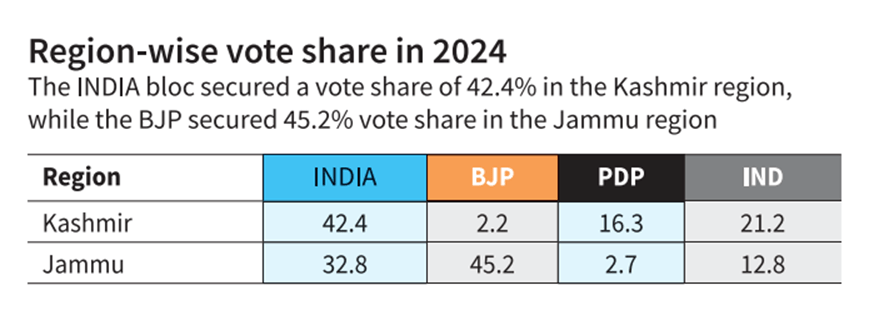
From a party that used to get single-digit votes in Kashmir, BJP’s vote count has now risen to four digits. The party came second in J&K, beating Mehbooba Mufti’s PDP.
PDP is an indigenous Kashmiri political party. The party has been on the political scene in Kashmir for ages. This time, most of the PDP’s votes went to NC in the Kashmir region. PDP’s association with the BJP in the recent past proved to be its undoing. Interestingly, this camaraderie did not have the same effect on the BJP, as its vote share increased from the 2014 elections.
Courtesy: The Hindu
No one, including BJP members, ever countered the fact that BJP would not win a single seat in Kashmir. It was reported that even the people of Jammu, along with Kashmiri Pandits, BJP’s primary vote base, were dissatisfied with the saffron party as their demands were left unaddressed.
Considering that politicians like Omar Abdullah were saying there was intense anger brewing in the valley beneath the surface of peace and tranquility, it was surprising to see the BJP not only increase its number of seats without an alliance but also its overall vote share in J&K albeit marginally, as compared to the 2014 elections.
If we were to analyze just Kashmir alone, the BJP neither lost nor gained its vote share (2.2%) in the region. So, in summary, the BJP increased its seats/vote share in Jammu while maintaining its vote share in Kashmir. If the Abrogation of Section 370 was indeed a major point of discontent for J&K locals, we should have seen a drastic decrease in BJP’s seat count/vote share. But that’s not what happened.
Courtesy: The Hindu
The media and politicians might paint the Kashmir election results as a big loss for the BJP and a “befitting reply to BJP by the people for the Abrogation of 370”, but the data seems to indicate otherwise. Yes, they did not win a seat, but the fact that in many seats of Muslim-dominated Kashmir, BJP came second, beating Congress and PDP, implies there’s far more to the story than what meets the eye.
BJP losing Gurez in Baramulla by a mere 1132 votes
Gurez is a seat that is 98% Muslim and where the BJP did not have any presence till now. Faqeer Mohammad Khan from the BJP lost by a mere 1132 votes to NC’s Nazir Ahmad Khan.
This close contest has been the biggest shocker from the Kashmir region, considering the BJP is always portrayed as an “anti-Muslim” party.
There is a misconception that Jammu is a “Hindu-only” area and Kashmir is a “Muslim-only” area. Jammu has areas with a significant Muslim population. One such area is Kishtwar, a district that has long been a hotbed of militant activities.
Shagun’s father and uncle were murdered by Hizbul Mujahideen terrorists in 2018. She initially had no plan to join politics, but after the murder of her father and uncle, she felt the need to bring about a change. Her victory, albeit by a small margin, proved to be sweet revenge.
Speaking to the media after the verdict, she said: “We have lost a large number of our soldiers. I have lost my father, and some have lost their brothers and sons. My first effort will be to ensure that every child here has the shadow of a father over his head and that there is peace and prosperity in the area. My efforts will be to bring happiness to every home.”
Jamaat-e-Islami and former separatists faced a big loss in J&K
When members from banned radical groups like Jamaat-e-Islami and former separatists were allowed to contest this election individually, many were worried.
As Kashmir continues to be a sensitive zone, analysts questioned the motive behind this move and the consequences of having radical elements elected into power. However, the people of J&K answered this pressing question through their votes, resoundingly rejecting the radicals and choosing a party like the National Conference instead, which believes in working democratically within the rules of the Indian constitution. This has come as a relief for many, especially since Engineer Rashid was elected as MP in the Lok Sabha elections.
The loss of Engineer Rashid’s party in the J&K election has provided ample proof that his victory in the Lok Sabha elections was a case of sympathy voting. His sons had extensively campaigned for him before general elections, saying the only way their father could escape jail was if he became an MP. However, in the case of the J&K elections, Kashmiris seemed to have drawn a line, and Rashid was unable to replicate his victorious stint in the general elections.
Congress in a way lost both Haryana and J&K
Even though Congress is an ally of the NC in J&K, their standalone performance proved to be lackluster. Congress managed to earn only 6 seats in J&K, compared to BJP’s 29. This cannot be considered a victory for Congress. In Jammu, too, an area where they were stationed to put up a strong fight against the BJP, they managed to win only one seat.
NC leader Omar Abdullah admitted post-election that, in hindsight, the alliance was unnecessary as they would have won the election anyway without the help of Congress.
Haryana outcome
Haryana’s election results came as a shock to everyone, including right-wingers. The trend was overwhelmingly leaning towards anti-incumbency in the state. BJP has been ruling Haryana for over a decade, and there were a plethora of issues surrounding “farmers, soldiers, and wrestlers” plaguing the state.
However, around a month back, it was reported that the non-Jats were having second thoughts about Jats supporting Congress and gaining power. This led to a consolidation of non-Jat votes against Congress. It is a simple case of caste-based politics gone wrong for the party.
Courtesy: The Hindu
RSS played a huge role in BJP’s victory
Reportedly, RSS went above and beyond in Haryana, campaigning door to door, distributing pamphlets that highlighted the dangers of caste-based divisive politics, ensuring everyone got their voter slips on time, and organizing outreach programs.
In the Lok Sabha Elections, it was reported that there had been a fallout between the BJP and RSS, which led to RSS members not making any effort to help the BJP. BJP seems to have realized its blunder post-election and made a conscious effort to re-establish connection with RSS, which is undeniably its backbone. Several changes were made in Haryana based on RSS’ recommendations. It ended up proving effective.
Conclusion
Yet again, Exit polls in India have turned out to be a disaster. You never know what the janta is thinking. There are silent voters who make their stance known only through their votes. Exit polls have been unable to infiltrate that section.
One thing is clear: this election has been a big win for democracy, especially in the Kashmir valley. The turnout was impressive. The trust they placed in the Indian democratic process is noteworthy. As Modi mentioned, the peaceful conduct of the J&K election has proven to be a victory in itself.
I recently bought a book titled Kashmir Narratives. It is authored by Colonel Ajay Raina, a retired Indian Army officer. To quote his bio on Amazon, “I am the only son of refugee parents who were young kids when the 1947 bloodied partition saw the creation of two new States of India and Pakistan and when the biggest ever migration of humans took place on this earth. Post my education, I got commissioned into the Indian Army as an officer in 1990 and served till the end of 2017.“
I happened to see his interview somewhere and decided to buy the book. It has a lot of information on Kashmir, focusing on its history, but what I found particularly interesting was the information on the condition of the plebiscite in Kashmir. Before we get to that, let’s understand what a plebiscite is.
What is a plebiscite?
A plebiscite is a direct vote by the people of a region (in this case, Kashmir) on an important public issue. In simpler words, in relation to Kashmir, a plebiscite allows Kashmiris to vote for its future – specifically, whether the region would join India or Pakistan. Interestingly, only these two options were presented, with no option explicitly listed of allowing Kashmir to function as an independent state.
How did the idea of a plebiscite in Kashmir emerge?
The idea of a plebiscite came into effect following the partition of British India in 1947 when the princely states were given the option to join either India or Pakistan.
Jammu and Kashmir initially chose to remain independent. However, after an invasion by tribal forces from Pakistan, Maharaja Hari Singh sought military assistance from India and signed the Instrument of Accession, formally acceding to India. This led to the first Indo-Pakistani war in 1947-48.
To resolve the conflict, the UN intervened, and the United Nations Security Council (UNSC) passed Resolution 47 in 1948. This resolution called for a ceasefire, the withdrawal of Pakistani forces from the region, and a significant reduction of Indian army officers. This was to allow for a free and fair plebiscite under UN supervision without any sort of intimidation. The plebiscite was supposed to let the people of Jammu and Kashmir decide their allegiance to either India or Pakistan. The result of the plebiscite would have depended on the majority vote.
However, the plebiscite was never conducted due to several reasons, including disagreements between India and Pakistan over the conditions set by the UN.
Clause (a) in Resolution 47
Most of us aren’t aware of Clause (a) in Resolution 47 passed by the UNSC. It states the condition of a plebiscite in Kashmir. Refer to UN Digital Library – Resolution 47 (1948) – Page 4:
To secure the withdrawal from the State of Jammu and Kashmir of tribesmen and Pakistani nationals not normally resident therein who have entered the State for the purpose of fighting, and to prevent any intrusion into the State of such elements and any furnishing of material aid to those fighting in the State.
The clause requires the complete withdrawal of Pakistani forces from the region. However, this condition remains unfulfilled as militants keep infiltrating the area.
Interestingly, India keeps getting the majority of the blame for not allowing a plebiscite, while it’s clear that Pakistan hasn’t fulfilled its part of the resolution. The resolution placed initial responsibility on Pakistan to withdraw its forces from the region. Only after this withdrawal was India supposed to reduce its military presence. This was then to be followed by a plebiscite. Because neither side fully complied with the conditions set out in the resolution, the situation has remained unresolved.
Final thoughts
I can’t help but wonder, had the “freedom seekers” in Kashmir known about this condition for a plebiscite, would they have applied more force on Pakistani militants to move out of the region? As stated, the first step toward a plebiscite is to ensure the Pakistani militants have withdrawn completely.
The UN has not formally retracted Resolution 47. It is currently in a dormant state. However, there is a possibility of Resolution 47 being re-invoked if the UNSC decides to revisit it.
It’s the fifth anniversary of the Abrogation of Section 370. I couldn’t help but reflect on differing opinions about this watershed moment in the nation’s history. There are politicians like Omar Abdullah and Mehbooba Mufti who consider it a disaster. Then, there are BJP supporters who think it’s the best thing that happened to Kashmir.
How do you know who is right?
It’s a given that our biases influence the sides we choose. When we believe something is unjust, we tend to seek out information that aligns with that perspective. Conversely, when we aim to be more optimistic, we focus on positive news.
In the context of Kashmir, you see different types of YouTube videos. If a vlogger or YouTuber seeks to demonstrate that the Abrogation of Article 370 was misguided, they will seek out discontented Kashmiri locals who share that viewpoint. On the other hand, those looking to justify the decision would seek out locals who support it. No matter one’s perspective, there will always be individuals who support each side of the story. Both sides are also convinced that only their version is the correct one.
However, it’s important to consider the facts.
As per Firstpost’s new article, “The incidents of organized stone pelting, connected with terrorist-separatist agendas, went from a staggering 1,767 in 2018 to zero in 2023“. More facts are provided in the article, which is worth a read.
The writer poses a valid question to Omar Abdullah, who keeps talking about how nothing has changed in Kashmir:
The question arises now that, for the first time in two decades, since four years, which is 1460 days and counting, not one youth has died, but you are saying that the situation overall is terrible. Are we then to assume that normalcy is stone-pelting and youngsters dying every week? The end of stone-pelting and no civilians dying is actually a terrible development for your politics.
Ultimately, your perception of a situation is influenced by your bias. But I can’t help but wonder with all the discontent over the Abrogation of 370: Is the prevention of youth fatalities from stone-pelting incidents of less importance than advocating a political agenda?






 The Monkey Dilemma
You must be logged in to post a comment.