Personal observation: In almost every war, there’s always someone who doesn’t want it to end.
In the India–Pakistan war, many in India didn’t want the fighting to stop because they felt Pakistan hadn’t learned its lesson yet. Some even wanted the government to reclaim PoK (Pakistan-occupied Kashmir) during this time (which I strongly oppose).
When Israel attacked Iran’s nuclear sites, many anti-regime Iranians wanted the war to continue because they hoped the regime would fall.
The Israel–Gaza conflict is even more unusual. Many who kept calling for a ceasefire suddenly went quiet or were openly against it when finally announced. Maybe they had expected Israel to be driven out and a new Palestinian state to rise “from the river to the sea.” But that idea is unrealistic and only calls for more violence. Just like India will never give up Kashmir, Israel will never give up its land. Both countries get a lot of criticism for putting their own interests first. But, over the years, Jews and Indians have learned an important lesson: if they want their interests protected, they can’t rely on anyone else. When Indians get murdered in America, there’s next to no backlash. It’s the same case with Jews. History is also proof that when Hindus face persecution or genocide (Kashmiri Pandits, Sandeshkhali, Bangladeshi, and Pakistani Hindus), the world stays silent. In a world shaped by selective activism, these two communities have gradually learned to shed their passivity and docile nature, standing up for themselves without guilt. Indians, in my view, are still learning. Our tendency to stay silent runs deep. But since 2014, that’s starting to change, much to the annoyance of some. Apparently, a “good” Indian is still largely expected to be a silent one in the face of persecution and bigotry.
Anyway, the point is that in any war, there’s always duality. Those who push for the conflict to continue aren’t always on the “far-right.” Sometimes, they are far-left or far-right figures from other communities, disguised as leftist liberals. Take, for example, the India-Pakistan war. Many leftists in India wanted it to end and for peace to prevail. Yet recently, some of those same voices wanted Hamas to reject the peace deal, even at the cost of many lives.
I’ve often felt that the far-left and far-right are just two sides of the same coin. The recent wars and reactions to them over the years only validate this claim.
Before I begin talking about this year’s elections, I would like to make my political leanings clear. I started as a staunch leftist, someone who observed politics from the surface level, never digging into details or paying much attention to the nuances. Currently, even though several “know your political leaning” quizzes position me as a centrist, I would describe myself as more center-right. I support infrastructure projects, national development, and improving defense strategies. However, I am not fond of communal politics, nor do I agree with the opposition’s appeasement/fearmongering politics. This puts me in a confusing political space where I am not completely satisfied with any one party.
Now that’s done, let’s get to the main story. As I have a lot to say about the elections, I will be dividing the post into several parts.
Observation #1: Democracy is alive. But not in the way you think.
This election proved that no one is invincible and politicians shouldn’t take the voters for granted.
The alliance performed exceptionally well. However, I would have to disagree with the narrative that “people voted against divisive, communal politics.” This is misleading. If you look at the CSDS-Lokniti Post-Poll data, the BJP got the most votes in urban areas, whereas it lagged in rural areas. People in villages are less influenced by communal politics. Their votes are based on their immediate environment and needs. Are they receiving basic essentials like ration, jobs, housing, and respect? These factors, along with caste-based politics, significantly influence their voting decisions.
A guarantee card was distributed by Congress that promised a 1 lakh salary, guaranteed jobs for freshers, 1 lakh rupees annually for women in economically backward families, etc.
It was never stated that these benefits would only be available if Congress won. If I were not financially well-off, my first choice would have been Congress solely because of these freebies. I wouldn’t care about roads or development. Refusing freebies is a luxury only the privileged can afford. This is where the BJP faltered. They did not offer any freebies for low-income people. While this might be good for the economy, it is detrimental for securing votes.
An interesting thing about this card is that it asks the recipient to jot down the number of voters in the family, booth number, constituency, etc. Was it a way to count the number of confirmed votes for their party? Is this how they knew a significant shift is to be expected in Uttar Pradesh?
BJP, on the other hand, has been accused of taking away land and destroying the houses of families settled around the Ayodhya temple. This may have significantly contributed to their loss of votes. The discontent with the BJP in this context is not rooted in communal politics but rather in the failure to meet basic needs.
Observation #2: EVMs are working
It is amusing that the parties who were hyper-worried about EVMs are now perfectly fine with the machines. No malfunctions were reported whatsoever.
This is one area where both Congress and BJP are happy. Or did the BJP secretly end up firing their EVM hacking unit, as mentioned in this satire post by The Fauxy? We will never know.
The recent controversy surrounding TM Krishna made me ponder: Is there a rise in intolerance in India, or are Hindus simply becoming more vocal about disrespect toward their culture and religion?
Nirmalyam, a Malayalam movie released in 1973, showed a man spitting on the idol of a goddess. There was no controversy back then. Maybe Hindus took offence but they endured the insult. No one can dare imagine releasing a movie with such a scene now. Some might call it the death of art, but is the survival of art dependent on humiliating Hindu religious beliefs? How often do you see an Indian artist scrutinizing other religions? If we’re going to engage in this game, let’s do so fairly. Selective activism is no longer accepted or praised.
Times have changed. Hindus are no longer silent. They are defending their religion. So does this mean Hindus have become intolerant? Or does this mean they have finally found their voice under the leadership of Modi after decades of suppression? It’s a matter of perspective, but one thing is certain: Criticizing Hinduism in India now comes with greater scrutiny and potential consequences. It’s no longer forgiven as easily as before.
There are two ways to check your MP’s contribution to your constituency in India.
MPLADs
In India, we have something called the Member of Parliament Local Area Development Scheme (MPLADS) funds. These funds are allocated to MPs for development projects in their respective constituencies. By tracking this data, you can check whether your MP’s words match his actions.
To track MPLADs fund utilization, you can go to the MPLADS website and generate MP-wise statements.
Please note there might be a lag in the data presented on the website. This means the data might not be the latest. However, you can get an inkling of how much funds were utilized by the MP for the development of your constituency.
I wish the website also displayed the exact work the MP did. Unfortunately, there is no way to know.
MP’s Performance in Parliament
Another highly useful website to check your MP’s performance in parliament is the PRS Website. You can search for your Lok Sabha or Rajya Sabha MP and analyze his parliamentary activity, attendance, questions raised, etc.
Tip
If you have difficulty understanding any of the terms used in the websites, use an AI bot like ChatGPT or Gemini to explain the terms to you.
Here’s to more informed voting!
If you use any other website to analyze an MP’s performance, let us know in the comments section below.
India is increasingly getting polarized. We have a pro-government clan and an anti-government clan. Both are equally stubborn in their own thoughts and action, believing with all their heart that the other is up to no good.
It has become impossible to be objective without offending someone. I hesitate before sharing a piece of good news about the country because the anti-government clan will attack me. It’s the same when you criticize the country because the pro-government clan will get offended.
As Indians, we have sadly lost the ability to differentiate between politics and the well-being of the nation. We are unable to take an objective stance or take a step back to consider ourselves as “one” instead of separate entities and are instead getting into petty fights and finger-pointing. Our national anthem talks beautifully of unity but the truth is we are increasingly becoming divided as the years go by. For a free thinker who cares only for the well-being of the country and not any political party, for someone who wants to see her nation prosper and become a global powerhouse in all aspects, the manner in which India is behaving currently is a huge disappointment.
The riots, hate, and division hardly boost the growth of the country. These elements throw us back financially and emotionally if at all they do something. So why are poeple engaging in them? Where is this polarization coming from? There are a few culprits here:
News Channels: No, I am not talking about only some channels. All are equally biased.
Social Media: The Modi clan supports the leader loyally; the non-Modi clan trolls the leader loyally. There is no middle ground.
Social Messengers: The WhatsApp University is relatively well-known. I need not elaborate on that.
When you subject yourself to a continuous flow of negative news from all three sources listed above, the frustration is imminent. The ground reality might be something else. Internet might be flooded with news of riots, outbursts, hysteria, and violence. However, in real life, you might be sitting in the comfort of your home, enjoying the peaceful surroundings, having a cordial relationship with your neighbors from all communities celebrating each other’s festivals with equal fervor. I have had people ask me if there’s an ongoing war in India, with people rioting 24×7. The fact is the media tends to highlight only the bad, not the good. So a person watching Indian news channels from abroad will end up thinking the country is a perpetual war zone with people getting beaten up or murdered every other second. This is quite extreme from reality. But it is an extreme that cannot be stopped. I happened to read this today in the Open magazine and I can’t agree more.
“The Noise Is Not The Conversation”
What can a citizen do in such situations? Each time you see a piece of polarizing news blasted across media, ask yourself a few questions:
Why do some incidents make it to the news, whereas others, like the Assam floods, do not get much coverage?
Why do we get only one-sided POVs from some social activists? They tend to hide the other side. What’s their agenda?
Why do we have debates on sensitive topics? And why are panelists who are well-known for making polarizing comments invited to such debates?
Always search for the other side, and not blindly follow what the media shows you. This mantra should be mainly applied when they are highlighting hatred or negativity. When you ask “why” to everything that’s happening, you will realize it’s all a game. A game where we are being played around like puppets. A game to spread hatred and disharmony, to cause division. Why? There might be political and personal reasons behind it. The motivation can also be business-oriented – negative news sells. We can never be 100% sure of the intention behind something, but that shouldn’t stop us from doubting and questioning someone’s agenda behind highlighting hatred – even if it’s coming from our favorite social activist or news channel.
The next step a citizen can take is to stop sharing hatred-inducing posts. We get tempted to share such posts because of the shock factor. I know I certainly do. But I had to step back and think, “Am I improving the situation by sharing this?” When we share polarizing news akin to “look what this person said about Islam/Hinduism” we are not promoting peace. We unknowingly encourage agitation and unrest as no person reads such posts with compassionate eyes.
I picture hatred as this greedy monster kept alive by our own dedicated, unwavering attention. We keep feeding this monster and recharging it with our own infinite supply of hatred. It then turns into an uncontainable being beyond our control. Maybe the only way to tame this monster is by ignoring it. We have given the monster so much attention till now, and it hasn’t worked. So maybe it’s time to do the opposite – ignore when someone is trying to divide us with hateful news or posts. Ignore when someone is trying to agitate you with spiteful comments. It is a long stretch because, as Indians, we are sensitive to a lot of things. But ignorance, sometimes, indeed can be bliss. If we learn to ignore the hatred and don’t give it enough attention, who knows, the greedy monster, with its excessive anger and polarization, might eventually die a slow, painful death.
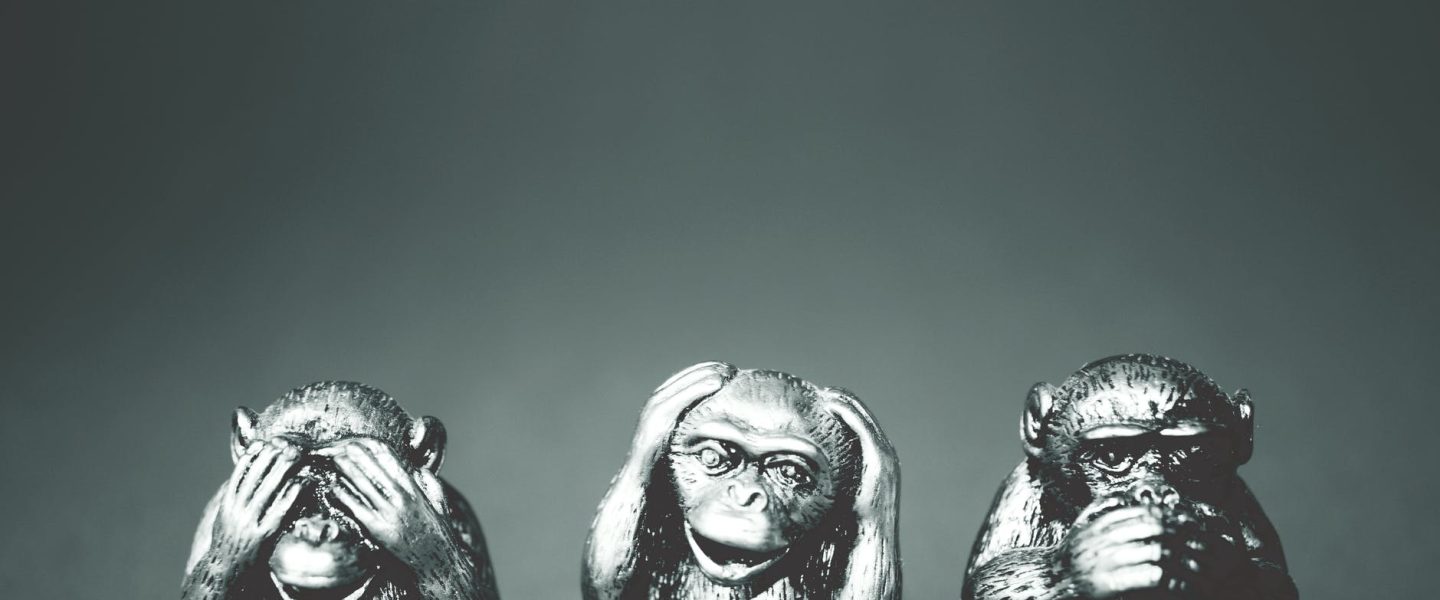


 The Monkey Dilemma
You must be logged in to post a comment.