An Ode to Feminichi Fathima

Feminichi Fathima Movie Poster

Feminichi Fathima is a Malayalam movie I had been waiting to watch for a long time. The film received strong appreciation at several film festivals. Many critics also spoke highly of it in their reviews. Now that it has finally released on OTT, the wait feels worth it. After watching the film, I can say it truly lives up to the praise it received.

The movie is a bold and thoughtful effort by director Fasil Muhammed to explore feminism from the perspective of a Muslim woman. This is a refreshing shift in Indian cinema, where feminist narratives are often shown through a cultural Hindu lens. Films like The Great Indian Kitchen (Mrs. in Hindi) and Thappad shaped much of that earlier conversation. Against that backdrop, this film feels timely and necessary. It adds a new voice to discussions on gender, faith, and everyday patriarchy.

What’s It About?

Fathima is married into a conservative and deeply religious family in the Malappuram district in Kerala. Her husband is a usthad (a religious leader) who expects his household to follow every rule without question. Life in the home is seen only through a strict, conservative lens.

Trouble begins when their young son wets the mattress. Fathima cleans it and leaves it outside to dry, but a dog later urinates on it. Since dogs are viewed as ritually impure, her husband reacts with anger and disgust. What follows is Fathima’s quiet struggle to fix the situation, facing resistance at every step.

The film makes a strong point that a woman in religious clothing can also be a feminichi (a slur often used by Malayalee misogynists to dismiss feminists).

Thoughts

Shamla Hamza and Kumar Sunil deliver standout performances. Shamla Hamza, in particular, is remarkable throughout the movie. It is hard to believe this is only her second project, after 1001 Nunakal, released in 2022. She performs with the ease and control of a seasoned actor. Her expressions carry much of the film’s emotional weight. Shamla winning the Kerala State Film Award for Best Actress feels well deserved. The storyline is fresh and quietly rebellious, which makes her performance even more powerful.

In many ways, the film feels braver than other feminist movies. Dissent is rarely encouraged in conservative Muslim families, which makes this narrative more powerful. The story shows how questioning norms itself becomes an act of courage. That is what sets this Malayalam feminist film apart. It opens space for conversations that are often silenced. Ideally, it will inspire more Feminichi Fathimas to speak up and stand for their rights.

Even though the subject is heavy, the movie never becomes overwhelming. It avoids melodrama and keeps emotions grounded. Light comedy is woven into the narrative. This balance makes the film feel surprisingly breezy. The pacing is tight and engaging throughout. You can easily watch the full 1.5 hours in one sitting without needing a break.

I would call this movie a must-watch for anyone interested in meaningful Malayalam cinema. Feminichi Fathima is now streaming on Manorama Max. You can also watch it via Amazon Prime with a Manorama Max subscription. English subtitles are available.

I Watched Homebound… and Ended Up Thinking About India Beyond the Film

Homebound Photograph

I waited a while before watching Neeraj Ghaywan’s Homebound on Netflix. Even with glowing reviews and friends urging me to watch it, I knew it wouldn’t be an easy experience. It’s heavy in more ways than one, because the film doesn’t just explore caste discrimination, it also shines a light on the prejudice faced by Muslims in India. So from the beginning, you know you’re stepping into something intense and uncomfortable.

Neeraj Ghaywan holds an important place in Indian cinema as he’s one of the very few Dalit directors who publicly acknowledge his Dalit identity. As viewers, most of us don’t sit and think about a filmmaker’s caste or religion when watching a movie. But the uncomfortable truth is that opportunities in the film industry still seem to be uneven. If he is the first Dalit filmmaker in decades because of gatekeeping rather than lack of talent, then that says a lot about how deep systemic bias still runs in India, even in an artistic platform like the film industry. This is something the film industries across India need to acknowledge and work on.

As expected, the story in Homebound was heartwrenching. It’s based on a real incident, which sadly doesn’t come as a surprise. The film also draws inspiration from the Bhim-Meem idea, a political expression that promotes Dalit-Muslim unity, adding another layer of depth and context to its narrative.

For me, the most heartbreaking scene was when Ishaan’s character, a young Muslim boy, is accused of being Pakistani after an India vs Pakistan cricket match. That moment was infuriating and hard to sit through.

At the same time, I feel Indian films need to move beyond the usual “General Category vs Dalit” and “Hindu vs Muslim” framework when addressing oppression. Recent incidents, including the honour killing of a Dalit man by an OBC family because he dared to love their girl, show that reality is much more complex in India, and discrimination doesn’t come from one direction. It exists across castes and religions. Dalit Christians, Pasmanda Muslims, and many others face layered forms of exclusion, yet these conversations rarely enter mainstream media or pop culture.

I recently spoke to someone from the Yadav community who felt that Yadavs should be getting more opportunities than others in Bihar. It surprised me, because it shows how deeply caste identity shapes expectations, even among groups that aren’t “upper caste.” It’s even sadder to see communities that once faced discrimination now repeating the same mindset toward those they see as lower in the hierarchy. Many people assume caste hierarchy is a simple top-to-bottom structure, but in reality, it behaves more like overlapping layers of status, power, and regional identity.

I also think about the discrimination that exists within minority communities. My neighbour, a very liberal Muslim woman in Kerala, once told me that some of her extended family members won’t eat food cooked by non-Muslims. So who addresses that side of prejudice?

If we want a more equal and united India, we need to acknowledge and call out all forms of discrimination. But if someone tries to make a film exploring other angles, it often gets labelled propaganda or agenda-driven. That makes honest conversation difficult.

We’ve seen similar themes in films like Dhadak 2 this year, and even the first Dhadak explored the same kind of social divide. Something that stood out to me across movies in this space was the prominent placement of Ambedkar’s photograph. It’s a small detail, but it says a lot. Ambedkar himself is a layered and complex figure. His critique was not limited to Hinduism, and he questioned multiple belief systems with the same sharpness. But that side of him rarely enters public discussion, because even many of his admirers seem hesitant or defensive about acknowledging it.

Many of us are ready to recognise discrimination against Muslims and Dalits, and those conversations are important. But there should also be space to talk about other traumatic histories like the Kashmiri Pandit exodus without being dismissed or judged. Empathy and understanding shouldn’t stop at one group. If injustice matters, it should matter universally.

This isn’t a rant. Just a hope that our films, stories, and discussions grow braver and more layered. Because India isn’t simple. It’s diverse, complicated, emotional, and full of uncomfortable truths. And storytelling feels meaningful when it reflects that reality rather than just one slice of it.

An Ode to Unrestricted Quality Education for Indian Muslim Women

Indian Muslim Women Education

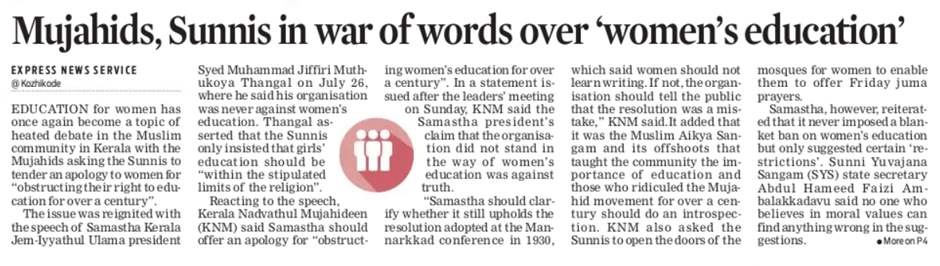
I came across this news today. It is comforting to know that there are members of the Muslim community in India who are fighting for unrestricted women’s education.

Samastha earlier had conveyed that a Muslim woman’s education should be encouraged but within religious restrictions. This became a point of debate across the state of Kerala, with many progressives calling it problematic. However, the most striking response came from a group within the community – the KNM. The organization is demanding that Samastha apologize for its take. KNM is not without its faults, but the stand they took on this particular issue is noteworthy.

Samastha and KNM

To the uninitiated, the “Samastha” group in Kerala refers to “Samastha Kerala Jamiyyathul Ulama,” an influential Sunni Muslim scholarly body in the state. Samastha plays a significant role in managing religious and educational institutions, including madrasas and mosques, and often issues guidelines on religious matters.

The term “Mujahids” in the context of Kerala typically refers to the Kerala Nadvathul Mujahideen (KNM), a prominent Islamic reformist organization in the state. The KNM often contrasts with traditionalist groups like Samastha, promoting a more modern interpretation of Islam, such as advocating the opening of the doors of mosques for Muslim women to enable them to offer Friday juma prayers.

Restricting Women’s Education on Religious Lines

If we connect religion with education, the progress of women in our country will be hindered. Afghanistan is a live example of this. Currently, girls in Afghanistan are generally allowed to attend school only up to the sixth grade. The Taliban, who regained control of the country in August 2021, have imposed severe restrictions on girls’ education beyond this level. Secondary education for girls (grades 7-12) has been largely suspended, and there have also been significant restrictions on female university students, including the closure of universities to women in late 2022. These measures have been widely condemned by international organizations and human rights groups. The global campaign #LetHerLearn, which advocates for Afghan women’s right to education, is gaining traction.

India is no Afghanistan. Here, women are allowed to study without restrictions regardless of religion. Women who are limited to religious studies may face challenges in the corporate world. It would severely restrict their job opportunities in a secular country like India, where well-paid corporate jobs often require you to engage with a global audience and follow strict academic and professional protocols that might not always adhere to religious lines.

Jobs cannot be built around religion in a democracy. Corporate jobs often require specific skills such as critical thinking, teamwork, leadership, and digital literacy. Religious studies may not always focus on developing these skills, which can impact the ability to perform effectively in a corporate setting.

Unfortunate Consequences

What happens when there are limited job opportunities for women due to religious restrictions? They will end up staying at home. Marriage becomes the only option. Financial independence becomes a distant dream.

It is ultimately up to the Indian Muslim woman to decide. If she wishes to pursue further studies, she should not be shamed.

Indian Muslim women deserve quality education, just like anyone else in India. We should have more Indian Muslim women in top positions in the corporate world. Currently, they are practically non-existent outside of Muslim countries. However, to make this happen, there need to be some reforms within the community that will help the women integrate more seamlessly into the existing corporate structure.

***

Picture Courtesy: The New Indian Express (July 2nd 2024, Kerala Edition)