As I write this, an Indian news channel is broadcasting peaceful protests by Kashmiris condemning the recent Pakistani terrorist attack on tourists in Pahalgam. One protester says, “Pakistan doesn’t want us to live in peace. They’re destroying our livelihood by constantly sending terror into our land.”
After years, Kashmir was finally seeing progress. Businesses were recovering, and for the first time in ages, children completed a full academic year, attending school instead of being pulled into stone pelting and street violence funded by Pakistan’s terrorist groups.
So, who exactly are these Pakistani terrorists fighting for? Themselves? Their religion? What does Pakistan gain by funding terrorism or sheltering terrorists on its soil, other than being rebranded year after year globally as a “terrorist state”?
Where are the voices of Pakistani celebrities, many of whom have large Indian fan bases, when it comes to condemning this violence?
A quick scroll through Pakistani Reddit forums shows users justifying the attack as “resistance.” When will ordinary Pakistanis tell their government and military to stop sponsoring terrorism in Indian Kashmir?
When will they let Kashmir breathe in peace?
So many grievances. And yet, silence ensues.
When Indians express anger toward Pakistan, many Pakistanis act surprised. They are unable to understand why Indians harbour so much hatred for Pakistan (or they may be feigning ignorance). The answer lies in the reactions, the deafening silence that follows whenever India gets attacked. It’s easy to speak of peace and brotherhood when you’re not the one burying your loved ones. How many Indians, soldiers and civilians, Hindus and Muslims alike, have lost their lives to Pakistan-sponsored terrorism? And yet, we’re expected to keep our borders open, welcome Pakistani artists, and pretend everything is normal. Most of these artists haven’t even spoken a word against the radicals who spill Indian blood. They want our money and admiration, while their country fuels terror against us.
Every time Kashmiris speak out against Pakistan or wave the Indian flag, Islamabad spins the same tired excuse: “They’re being forced by the Hindutva government.” Really? Was the Kashmiri Muslim man who died trying to save Hindu tourists in Pahalgam doing it under pressure from the Indian government? Make it make sense.
Pakistan is to India what Hamas is to Israel. Friendship is a fantasy. We may share history, but there’s no future unless Pakistan first cleans up the terrorism it breeds. Until then, no dialogue, no gesture, no cultural exchange can bridge this gap. The course correction has to begin on Pakistan’s side. Let Kashmir live in peace.
The 2023 report “Anti-Hindu Hate in Schools” by Charlotte Littlewood highlights a critical but under-researched issue: the presence of anti-Hindu sentiment in UK schools.
While this blog post draws upon insights from the report, the broader focus is on Hinduphobia as a global phenomenon – what it means, how it manifests, and the constructive steps that are being taken to address its rise.
The full report can be accessed here: henryjacksonsociety.org/wp-content/uploads/2023/04/HJS-Anti-Hindu-Hate-in-Schools-Briefing-final.pdf
The urgency to examine Hinduphobia stems from the way Hinduism is being misunderstood or misrepresented in Western societies. Many people, lacking a nuanced understanding of the religion, make casual remarks that are often bigoted in nature. They may be considered harmless or culturally acceptable in Western contexts.
This gap in awareness often results in prejudices being normalized, with little accountability or recognition of the harm caused.
What is Hinduphobia?
Hinduphobia is not a term widely recognized in mainstream discourse. In my view, “anti-Hindu bigotry” is a more accurate description, as the issue is not rooted in fear, but in prejudice, hostility, and a lack of understanding. It often stems from the fact that Hinduism operates differently from Abrahamic religious frameworks. This unfamiliarity can lead to stereotyping, dismissal, or open hostility, rather than genuine inquiry or respect.
As per the study, the working definition of Hinduphobia is as follows:
Hinduphobia is a set of antagonistic, destructive, and derogatory attitudes and behaviours towards Sanatana Dharma (Hinduism) and Hindus that may manifest as prejudice, fear, or hatred.
Hinduphobic rhetoric reduces the entirety of Sanatana Dharma to a rigid, oppressive, and regressive tradition. This discourse actively erases and denies the persecution of Hindus while disproportionately painting Hindus as violent. These stereotypes are used to justify the dissolution, external reformation, and demonization of the range of indigenous Indic knowledge traditions known as Sanatana Dharma.
The complete range of Hinduphobic acts extends from microaggressions to genocide. Hinduphobic projects include the destruction and desecration of Hindu sacred spaces; aggressive and forced proselytization of Hindu populations; targeted violence towards Hindu people, community institutions, and organizations; and ethnic cleansing and genocide.
Examples of Hinduphobia
The study lays out several examples that can be identified as Hinduphobia, many of which occur casually in everyday settings. These instances often go unnoticed or unchallenged, largely because Hinduphobia is not yet treated as a serious form of bigotry.
Calling for, encouraging, or justifying violence against Hindus, often rooted in extremist or distorted views of religion and history.
Kidnapping Hindu women and children for forced marriage and religious conversion.
Denying, downplaying, or accusing Hindus of fabricating their persecution, including instances of genocide.
Advocating for the destruction of Hinduism, framing it as inherently irredeemable.
Discrediting individuals who speak about Hinduphobia by labeling them as agents of violent or oppressive ideologies.
Attributing all social issues in Indian society, such as caste, misogyny, sati, communal violence, or temple destruction, solely to Hinduism.
Evoking historical trauma (e.g., iconoclasm, cow slaughter, forced conversions) to intimidate Hindus in modern discourse.
Making baseless claims about the political motives of those simply practicing Hinduism.
Linking antisocial behavior directly to Hinduism, often by selectively sampling data or falsely attributing individual actions to the faith as a whole.
Caricaturing Hindu scriptures through selective citation, mistranslation, or exaggeration, and presenting these distortions as representative of the entire tradition.
Claiming that Hinduism or Sanatana Dharma is not a valid or cohesive spiritual system.
Erasing Hindu civilizational contributions and superimposing Western norms over its historical and cultural identity.
Conflating diasporic Hindu identity with Indian citizenship, nationalism, or ethnicity.
As per my own observation, a contributing factor is the lens through which Hindus are viewed. The bigotry is shaped by the globalized “oppressor vs. oppressed” narrative, often based on selective or misunderstood portrayals of India. As a result, anti-Hindu activities at home or anywhere else are often seen as justified acts of revenge, grounded in the belief that “Hindus in India are oppressing minorities.” A quick look at social media during incidents involving anti-Hindu sentiments offers clear evidence of this bias.
Reactions often downplay or dismiss the issue, and in many cases, even justify the hatred by invoking political narratives, rather than addressing the prejudice for what it is.
Context and Need of the Study
The context and need for the study on rising Hinduphobia in UK schools are explained as follows:
“Hinduism is the third largest religion in the UK making up 1.7% of the population according to the most recent census. From 4 to 20 September 2022, there was civil unrest in Leicester, extending to Birmingham, including vandalism of property, assaults, stabbings, and attacks on places of worship.
The Henry Jackson Society briefing paper, “Hindu-Muslim civil unrest in Leicester: Hindutva and the creation of a false narrative,” evidenced community tensions relating to youth violence and noise control issues in relation to festivals that had been falsely dressed as “Hindutva extremism” and even “Hindu terrorism”, creating fear and resulting in attacks on Hindu temples and properties.
The Network Contagion Research Institute (NCRI) investigated the role social media played in the civil unrest. It concluded that social media narratives have characterised “a vulnerable, diasporic community – British Hindus – as an aggressive, hypernationalist, and fascist threat. Other narratives depicted Leicester Hindus as heretically evil and filthy, playing on age-old Hinduphobic tropes.”
Both the HJS report and the NCRI report noted the use of anti-Hindu slurs such as “cow piss drinkers” and references to polytheism, vegetarianism, physical weakness and mocking of Hindu deities and symbols.
When researchers began examining the unrest between Hindu and Muslim communities in Leicester, they encountered a notable gap: a lack of existing studies on anti-Hindu hate. This absence of research was one of the key motivations behind conducting a dedicated study on the subject.
The report also highlights how Hinduphobia has historically appeared in popular literature and academic discourse. For instance, E. M. Forster’s 1924 novel A Passage to India is cited as portraying Hindus as “perverted,” “clownish,” and “queer.”
Similarly, sociologist Max Weber viewed Hinduism as excessively otherworldly, a perception that contributed to the broader “theological othering” of Hindus. This form of othering continues today in the form of anti-Hindu slurs that mock the religion’s many deities and unique customs.
Another example comes from Allen Greenberger’s 1969 study on Indian stereotypes, where he described common portrayals of Indians as a “childlike race” who were “happy in their passivity, fatalistically so.”
Such characterizations may still influence how the media interprets Hindu behavior and presence. For instance, during and after the Leicester unrest, the press in the UK was criticized for failing to engage with the local Hindu community, instead relying on self-identified Muslim spokespersons who reportedly spread false narratives about Hindus in Leicester.
Moreover, rather than addressing the specific complexities on the ground, mainstream media coverage often diverted attention to political issues in India, as though those could explain or justify tensions in the UK. This approach not only homogenizes Hindus globally but also dismisses their individual and community experiences in diverse contexts like Leicester.
Abrahamic Othering
An interesting terminology used in the report was “Abrahamic Othering.”
The term ‘Hinduism’ was coined by British writers to refer to the family of Vedic religious traditions. Some modern Hindus prefer the name ‘Vedic religion’ or ‘Sanatana Dharma’ (‘eternal law’) rather than the label ‘Hinduism’.
Hinduism has multiple deities understood to be expressions of one ultimate Reality, be it God for theists or consciousness for monists. Hinduism does not follow one scripture but a number of scriptures that are given different emphases by different branches of the faith. Some argue the differences in the denominations are so great that they are separate religions entirely.
The preconceptions of Abrahamic faiths do not map neatly onto Hindu belief. Articulating Hinduism through the Abrahamic lens of Gods and scriptures is therefore problematic.
Respondents to this survey suggested that at least some UK schools continue to teach Hinduism through an Abrahamic lens without appreciating the limits of this approach. This fits with the findings and concerns of the Commission on Religious Education. Given the decentralised nature of religious curriculums in England and the lack of subject inspections in maintained schools, and given the considerable challenge of treating Hinduism sensitively in a UK context, such a finding is disappointing but unsurprising.
There are reports from some surveyed parents that lessons about Hinduism produce confusion and misconceptions about the Hindu belief in the existence of multiple Gods – 106 references were made to inaccurate perceptions of Hinduism with respect to polytheism/idol worship/multiple Gods.
Discrimination Against Hindus in UK Classrooms
Some of the discrimination observed in UK classrooms mirrored the forms of hate witnessed during the Leicester unrest between Hindu and Muslim communities.
In both settings, derogatory remarks were directed at Hindu identity and practices, including mockery of vegetarianism and the belittling of Hindu deities. These same types of insults were used by Islamist extremists during the rallies targeting the Hindu community in Leicester, highlighting a disturbing continuity between localized classroom prejudice and broader communal tensions.
Conclusion Based on Case Studies
Many case studies were conducted as part of the research, and based on these, the following conclusion was drawn:
This report highlights the prevalence of discrimination against Hindus in British schools, with 51% of Hindu parents surveyed reporting that their child has suffered anti-Hindu hate at school.
It is alarming that it is so hard to access information from schools on patterns of religiously-motivated bullying, and that the schools who did respond to this study’s FOI request either did not keep records of faith-based hate incidents or appeared to record very few incidents.
It is also alarming that only 19% of parents surveyed believe schools are able to identify anti-Hindu hate, indicating that the issue is not being addressed adequately. It may be that there is a tendency to downplay such incidents as ‘playground banter’.
However, several studies have observed that faith-based bullying has the potential to be more impactful than other forms of bullying, precisely because it targets not just the victim, but “their entire family, heritage, and culture”.
Schools should reflect on the harm such slurs cause, as well as the wider community divisions they may be helping to foster.
Constructive Steps
Small but significant steps are being taken to address Hinduphobia in Western nations.
Georgia recently became the first U.S. state to introduce a bill formally recognizing Hinduphobia and anti-Hindu bigotry. Similarly, the Scottish Parliament passed its first-ever motion to combat Hinduphobia, marking an important milestone in acknowledging the issue. The motion was influenced by a report on Hinduphobia in Scotland, which can be accessed here: nen.press/2025/02/28/gandhian-peace-society-shares-new-report.
These developments are a positive step toward challenging anti-Hindu bias and promoting awareness that, like all faiths, Hinduism, or Sanatan Dharma, deserves equal respect and protection from discrimination.
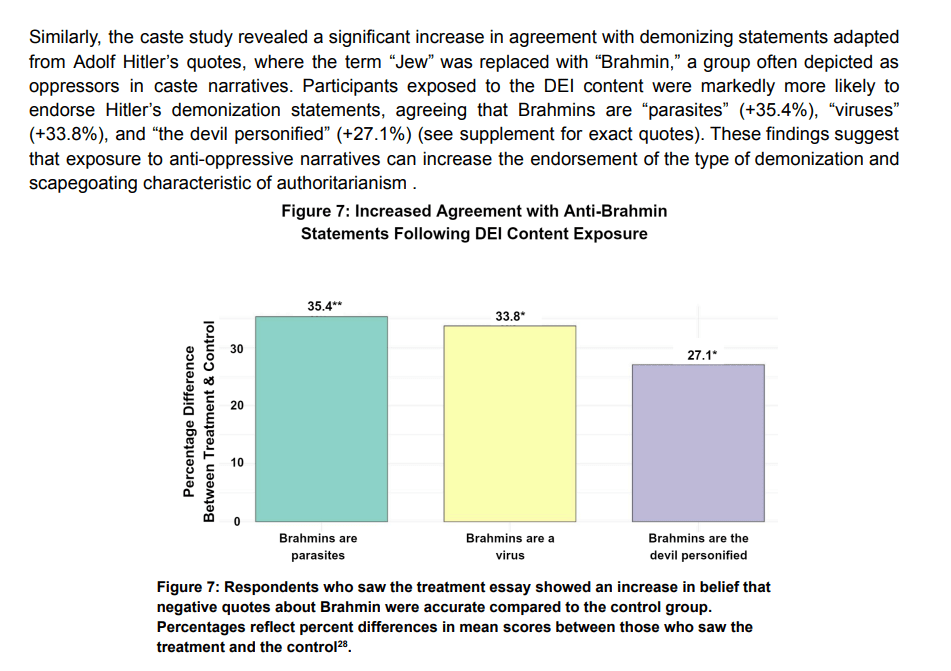
The following snippet is from a DEI study by the Network Contagion Research Institute (NCRI) in the U.S. The diversity, equity, and inclusion (DEI) program, originally meant to raise awareness, appears to have backfired in some areas. By framing everything through an “oppressor vs. oppressed” lens, it has ended up vilifying the Hindu Brahmin community, similar to the Jewish community.
While DEI narratives often focus on Islamophobia and racial discrimination, caste-based bias among American Hindus has largely remained outside the spotlight. Though widely recognized in India, caste discrimination has only recently started gaining attention in the U.S., leading to the introduction of caste-sensitivity training in schools, workplaces, and policy discussions. But did they have the desired effect? Studies show otherwise.
The vilification of Brahmins began in India, where they are often targeted for everything, from their dietary habits to their lifestyle choices. What should have remained a focused activism against caste discrimination has unfortunately expanded into a broader mockery of the community as a whole. Even Brahmins who reject caste-based thinking are not spared.
Like anyone else, a Brahmin does not choose the caste they are born into. So, isn’t attacking them solely for their birth also a form of casteism? Every community should be open to critique for its flaws, but no one should be dehumanized for simply existing.
Awareness is important, but this study shows that excessive activism can cross a line and end up vilifying an entire community. In the findings, respondents described Brahmins as “parasites,” “viruses,” and “the devil personified.” How is that fair, or even acceptable, in the name of social justice?
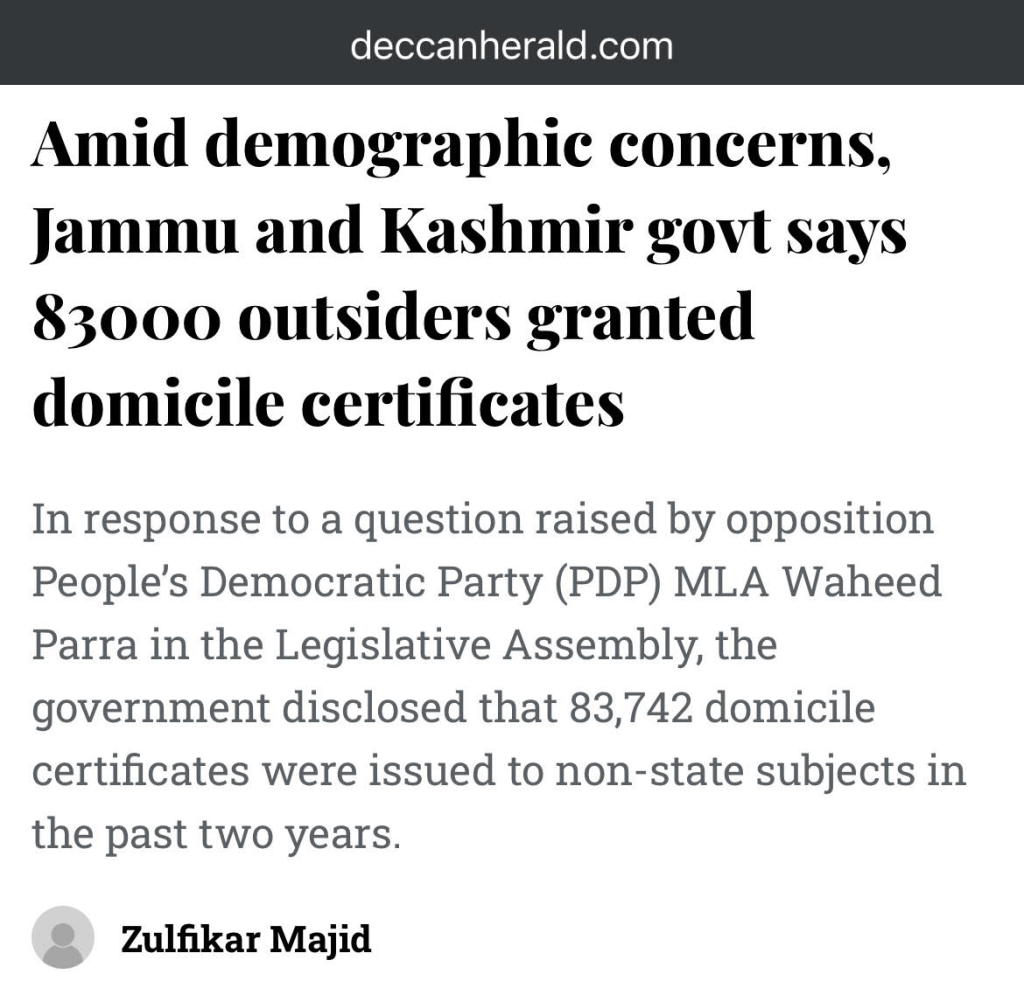
Say the words “demographic concerns” in any other Indian state, and you’d likely be branded a bigot. But in Kashmir, the “insider vs outsider” narrative is not only common, it’s actively pushed. If the Chief Minister, Omar Abdullah, has sworn allegiance to the Constitution of India, why the reluctance to openly embrace fellow Indians as equals? Kashmiris are free to work and settle anywhere in the country without being called outsiders. So why can’t someone from another Indian state do the same in Kashmir without facing hostility?
What India needs now more than ever is a spirit of unity. Not this constant “us vs them” divide.
These incidents make it clear: no one is truly secular, not even those who constantly criticize Hindu majoritarianism like Omar Abdullah. Let’s be honest. In Muslim-majority Kashmir, a fashion show during Ramadan sparked outrage, with people claiming it was against their “culture.” In parts of Malappuram and Kozhikode in Kerala, there have been cases where people were told not to eat in public during Ramadan. Meanwhile, in some Hindu-majority regions of North India, meat shops are ordered shut during Hindu festivals. Different standards, same mindset.
This isn’t just an Indian phenomenon. In the UK and the US, you’ll often hear people say, “We are a Christian country. This isn’t our culture!” whenever Hindu or Muslim festivals are celebrated in public spaces. The reaction is the same, just the setting changes.
Wherever you go, majority vs minority dynamics are always at play. What feels like a “religious restriction” to one person might feel like cultural protection to another. It all depends on your bias and perspective. Take Iran, for instance. Many of us might see it as deeply restrictive for women. But some Iranian Muslim women might see it as ideal because it strictly upholds their religious values. That’s religious bias in action – shaped by belief, identity, and comfort with the dominant culture.
Most people are secular only on paper. In reality, they tend to place their own religious beliefs a notch above others. They’re usually comfortable with the rules their faith imposes, no matter how restrictive those rules might seem to someone outside that belief system. It’s less about universal values and more about what feels familiar and justified to them.
Empuraan is facing criticism from the right wing for allegedly promoting a biased narrative. Many are calling it a political propaganda film with a pro-Congress stance. How true is the allegation?
Spoilers Ahead
I haven’t watched the movie yet, but I’ve heard that the first 30 minutes focus on the Gujarat Riots. It depicts some of the most horrific incidents from that time. Reportedly, the film includes a rape scene that’s highly debatable. This particular rape story has been circulating since the time of the Gujarat Riots but remains unverified, with no solid evidence to support it. Additionally, the Godhra train burning in the movie is reportedly depicted as something that happened by accident. This portrayal gives the impression that the film is based on the findings of the Banerjee Committee Report, a report that was later ruled invalid, unconstitutional, and politically manipulated by the court. The Nanavati-Mehta Commission Report is the report that was officially accepted as the authoritative account of events due to its presentation of evidence. This information was also covered in the recent film The Sabarmati Report.
The Banerjee Committee was set up in 2004 by the UPA government, led by the Congress party. The committee’s report was released just before the Bihar Assembly elections, apparently to influence the election results and weaken the BJP’s position. The report concluded that the Godhra train fire was accidental, contradicting the BJP’s stance that it was a pre-planned attack.
However, the Nanavati-Mehta Commission later confirmed that the train burning was a premeditated communal act, not an accident.
The investigation found that large quantities of petrol were purchased a day before the incident from a nearby petrol pump.
The forensic report confirmed the presence of petrol residues inside Coach S-6, where the fire broke out.
Eyewitnesses and forensic evidence suggested that petrol was thrown into the coach and set on fire, indicating a pre-planned attack rather than an accidental fire.
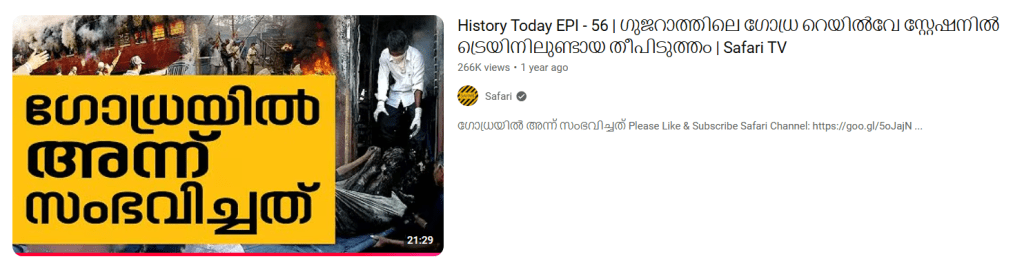
For Malayalees who prefer not to watch TheSabarmati Report, I recommend a documentary on YouTube by the Sanchari channel. It’s in Malayalam and provides a detailed account of the Godhra train burning. I am attaching a screenshot of the video below.
The documentary is likely one of the first of its kind in Malayalam. It offers a detailed look at the various angles of the Godhra train burning, the different reports that emerged, the political maneuvering involved, and the final conclusions drawn. If you are a Malayalee interested in research and fact-checking, I highly recommend watching this video.
Naturally, Congress is supporting Empuraan, just as the BJP backs right-wing films when they are released. Even if Empuraan turns out to be entirely pro-Congress, I support the creator’s right to make and release such a film. Several right-wing movies have been produced in India recently, so a left-leaning perspective is equally valid in a democratic space. However, as viewers, we must avoid taking any movie as absolute truth. Instead, we should conduct independent research, considering both left-leaning and right-leaning sources to develop a balanced understanding of the subject.
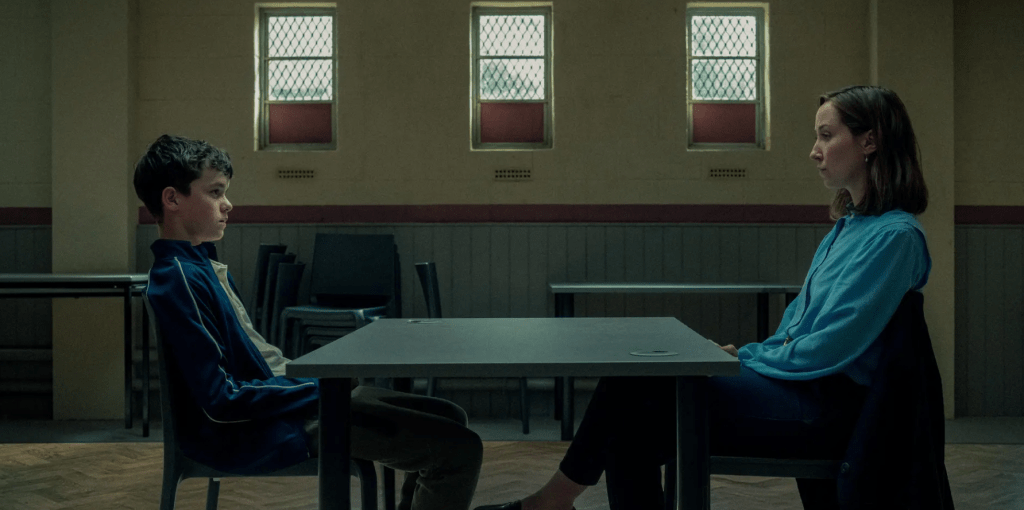
The Netflix series Adolescence is a wake-up call. It shook me to the core and shed light on the stark realities the new generation faces.
I grew up in a time when online influence was non-existent, and our worldview was shaped by the people around us. Today, that has changed. Algorithms dictate perspectives, feeding you opinions from across the world. Knowledge is no longer derived from just parents, teachers, or elders. This is a positive thing, but it has also resulted in an information overload.
There are several social media accounts trying to dump different perspectives on you. For every argument supporting point A, there’s another endorsing point B. Ultimately, it depends on which perspective you resonate with the most. Once you decide, the algorithm ensures you see more of it, reinforcing your beliefs. Sometimes, without you even realizing it. This can be dangerous. What if a child interacts with harmful content? The algorithm ensures they see more of it, shaping their beliefs in a troubling direction. We risk raising a generation programmed by these echo chambers. It’s a challenge we can’t ignore.
**Spoilers Ahead**
Every plus comes with a downside. Today, we have information at our fingertips, but this convenience comes at a cost. This is a reality that Adolescent portrays with unsettling accuracy. Jamie retreats to his room as soon as he gets home, immersing himself in his online world. His parents remain unaware of what he consumes, assuming, like many modern parents, that giving him complete freedom is the right approach. However, this unchecked digital exposure can shape young minds in ways they don’t anticipate, often with troubling consequences. It’s a new-age problem.
The series also introduced me to terms like Manosphere, Red Pill, and the 80-20 rule, making me realize how rapidly digital ideologies evolve. Figures like Andrew Tate are shaping young men’s perceptions of masculinity, often promoting the idea that being “alpha” means suppressing emotions. He preaches that men are providers and should be respected without being “given a headache.” This mindset isn’t foreign to India. I’ve noticed how men in my household particularly often express fewer emotions. When I was hospitalized recently, only the women in my family directly checked on me, while the men relied on them for updates. The burden of emotions lies on the women, whereas men are expected to be mere providers. Ironically, when men fall ill, women are expected to inquire directly. This emotional divide is ingrained in my household. I am unsure of other households. However, male-to-male interactions may differ. A “bro” might feel more comfortable checking in on a fellow “bro”.
I believe Adolescence should be screened in Indian classrooms with regional language dubbing. Andrew Tate-inspired accounts are emerging in India, pushing narratives that degrade women. If we don’t educate our youth about the dangers of such ideologies, we risk fostering a generation of men who lack empathy for women’s concerns, some of whom may even resort to violence to assert their views. The time to act is now.
The social message aside, this was Owen’s debut performance, yet he delivered with astonishing depth. It made me wonder how much the Indian film industry could thrive if it prioritized raw talent over nepotism, giving opportunities to newcomers who truly have the skill.
One of the most unsettling moments for me was Jamie’s chilling question to Briony with a steely, mocking gaze: “Are you afraid of a 13-year-old?” Owen Cooper’s portrayal was so disturbingly real that it made even a viewer like me uncomfortable. That’s the power of natural acting. His transformation, from an innocent boy insisting he has done nothing wrong, to someone consumed by uncontrollable rage, is nothing short of remarkable. It’s a performance that leaves a lasting impact.



 The Monkey Dilemma
You must be logged in to post a comment.