The Congress party’s performance in the Lok Sabha Elections 2024, with a win of 99 seats, is a notable improvement from 2019. However, it still pales in comparison to the BJP’s reduced 240 seats. The alliance, as a whole, played a pivotal role in forming a strong opposition. Yet, it is evident that no single party can claim sole credit for the alliance’s success.
Samajwadi Party (SP) – The Unsung Hero
In Uttar Pradesh, it was the Samajwadi Party (SP) that was the game-changer with its 37 seats. BJP came a close second with 33 seats. Congress managed 6. In the end, it is not how many seats you gained or lost that matters, but whether you won. I have my grievances with the SP, but if credit is to be given to any party, it should go to the SP. It was Akhilesh Yadav who turned things around.
Despite Congress’ lackluster performance (this was its third-worst performance overall), you often hear the party nowadays boasting about its “achievements” and how Rahul Gandhi single-handedly saved democracy. Ironically, this narrative has also been picked up by the West.
It seems that the party is trying to present this as a Congress victory as a way to save Rahul Gandhi. This may have been his final opportunity to get things right, and by insinuating that Rahul was the driving force behind the alliance’s success, Congress managed to secure his leadership position.
Nyay Yatra Results
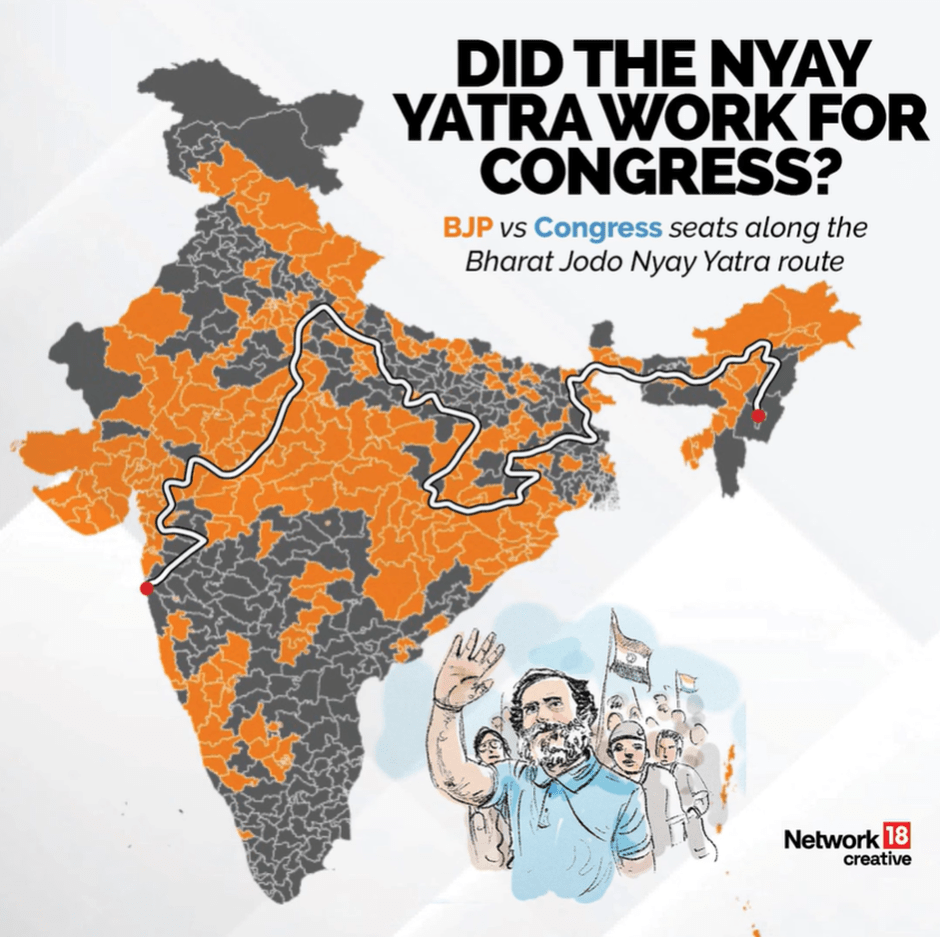
If you look at the route of Rahul’s Nyay Yatra, you will see that BJP won most of the areas where Rahul Gandhi campaigned. This map was shared by Moneycontrol.
The white line was the route taken by Rahul Gandhi. It went well in Manipur, but as his journey progressed, his yatra seemed to have had less impact on the common man.
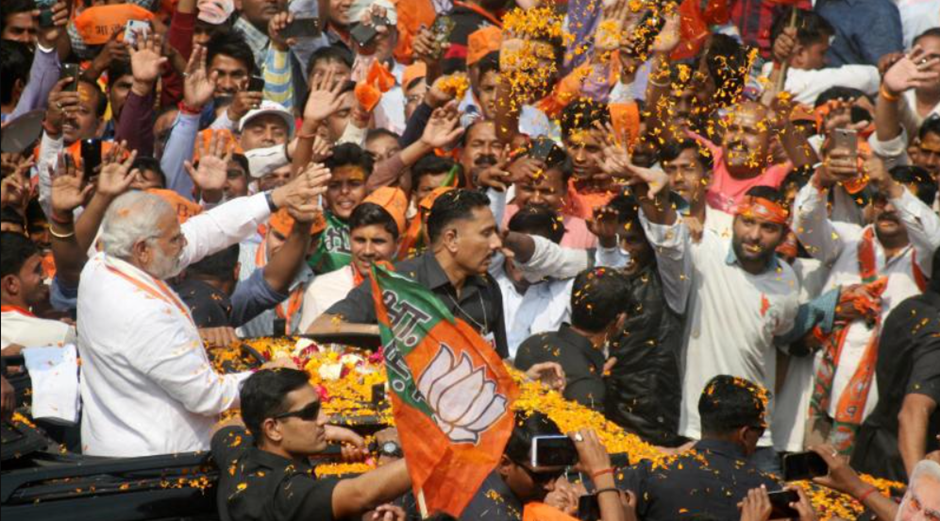
This is BJP’s performance in the same areas for comparison purposes:
As you can see, most of the areas were dominated by the BJP.
Questioning Congress’ Performance
The irony is that no journalist has questioned his performance and is projecting him as a hero. I am pointing this out because Congress prefers to believe that Rahul Gandhi is the best Prime Ministerial candidate. However, if you replace him with someone much more competent, votes will flow from the BJP to Congress naturally without much work or unending yatras. Many I know only opt for the BJP because they dislike the Gandhis, a sentiment that could be leveraged by a stronger Congress leader.
In India, there is a lack of a strong opposition party (not an alliance) with consistent and solid ideologies that do not vary among party members. Consistency brings confidence. Personally, I was not sure if I was voting for the left’s or Congress’ ideologies in the INDI alliance. The manifesto of CPI(M), one of the members of the INDI alliance, is one of the most dangerous I have ever seen. It does not inspire confidence. If I support the Congress but not the CPI(M), should I still vote for the INDI alliance? This is the skepticism I feel.
The question remains whether Congress is planning to continue working with an alliance and take credit for the alliance’s victories. We should question the party and demand improvements. Celebrating the current situation as a victory could prevent the emergence of a much more competent opposition party. The citizens of India deserve more.
Before I begin talking about this year’s elections, I would like to make my political leanings clear. I started as a staunch leftist, someone who observed politics from the surface level, never digging into details or paying much attention to the nuances. Currently, even though several “know your political leaning” quizzes position me as a centrist, I would describe myself as more center-right. I support infrastructure projects, national development, and improving defense strategies. However, I am not fond of communal politics, nor do I agree with the opposition’s appeasement/fearmongering politics. This puts me in a confusing political space where I am not completely satisfied with any one party.
Now that’s done, let’s get to the main story. As I have a lot to say about the elections, I will be dividing the post into several parts.
Observation #1: Democracy is alive. But not in the way you think.
This election proved that no one is invincible and politicians shouldn’t take the voters for granted.
The alliance performed exceptionally well. However, I would have to disagree with the narrative that “people voted against divisive, communal politics.” This is misleading. If you look at the CSDS-Lokniti Post-Poll data, the BJP got the most votes in urban areas, whereas it lagged in rural areas. People in villages are less influenced by communal politics. Their votes are based on their immediate environment and needs. Are they receiving basic essentials like ration, jobs, housing, and respect? These factors, along with caste-based politics, significantly influence their voting decisions.
A guarantee card was distributed by Congress that promised a 1 lakh salary, guaranteed jobs for freshers, 1 lakh rupees annually for women in economically backward families, etc.
It was never stated that these benefits would only be available if Congress won. If I were not financially well-off, my first choice would have been Congress solely because of these freebies. I wouldn’t care about roads or development. Refusing freebies is a luxury only the privileged can afford. This is where the BJP faltered. They did not offer any freebies for low-income people. While this might be good for the economy, it is detrimental for securing votes.
An interesting thing about this card is that it asks the recipient to jot down the number of voters in the family, booth number, constituency, etc. Was it a way to count the number of confirmed votes for their party? Is this how they knew a significant shift is to be expected in Uttar Pradesh?
BJP, on the other hand, has been accused of taking away land and destroying the houses of families settled around the Ayodhya temple. This may have significantly contributed to their loss of votes. The discontent with the BJP in this context is not rooted in communal politics but rather in the failure to meet basic needs.
Observation #2: EVMs are working
It is amusing that the parties who were hyper-worried about EVMs are now perfectly fine with the machines. No malfunctions were reported whatsoever.
This is one area where both Congress and BJP are happy. Or did the BJP secretly end up firing their EVM hacking unit, as mentioned in this satire post by The Fauxy? We will never know.
It’s the election season again in India, the largest democracy in the world. Politicians are tirelessly running hither and thither promoting their campaigns, often resorting to divisive tactics to seal their votes. As a layman, you find yourself wondering during these times whether the political parties’ agenda is to divide citizens rather than win elections.
Over the past ten years, there’s been a steady rise in discomfort over the rising popularity of the right wing. Most minorities and leftists want the BJP to be voted out this year. There’s a sense of dread about what would happen if the BJP takes control for the third consecutive term. You see and read incidents of Christians and Muslims in rural areas crying, “Hindus will kill us if they come into power. Please don’t vote for the BJP.” This cry for help is alarming. Minorities do face discrimination in India, but to make it sound like a genocide is far-fetched. Most people live in harmony with each other, while some tyrants across communities try to create problems. However, the negative stories are most prominently highlighted making it look like the norm. It is not a systematic persecution, as seen in neighboring countries.
Who is spreading this hate narrative? Who is inflicting this unfound fear on everyone? Politicians and the media are to blame—both the right and left. One makes controversial statements, and the other spreads hate and discord by amplifying them out of context. The reasons are purely agenda-driven. I say this with confidence because of the ease with which they seem to overlook their own preferred party’s faults, irrespective of the severity. The bias is crystal clear.
Someone like me, who is engrossed in reading both left and right narratives day in and out, can now finally figure out when a party/media/journalist is playing games to drive their agenda. I have acquired a sense of indifference to polarizing or pseudo-secularist words. But an apolitical person, which many are, might not understand the game and fall prey to the hate narrative set by both sides. Ultimately, the narrative with the most media outreach wins: the right-wing within India and the left wing globally.
The opposition parties in India are going all out to convince everyone why democracy is in trouble in the country, resorting to fearmongering tactics, such as drilling down the point that there won’t be an election next time if BJP wins. The Western media is also trying to help the opposition by pushing the narratives of the leftist ecosystem to the world at large. An outsider might have already read several articles slamming the situation in India on popular portals like the BBC, Al Jazeera, and CNN. Rarely do you see a right-wing viewpoint, probably because the right wing is, by default, considered problematic. So, you never know precisely why the right wing has gained popularity in any country. You only get to see the uncomfortable outcomes of it.
A satire post from @the_fauxy
Is BJP a Far-Right Party?
Let’s get this straight: BJP being a “far-right” party is highly debated and contradicted by the actual far-right in India. They feel Modi is “soft,” so they label him “center-right.” According to them, he hasn’t yet reclaimed all the lost temple properties or got the temples out of government control; his party suspended Nupur Sharma when she made blasphemous comments in response to an equally blasphemous comment by a guest panelist, and the party hasn’t restricted welfare benefits to Muslims. For the hardliners, a legit far-right politician is someone like Geert Wilders.
You often see Modi making problematic statements to woo his far-right fan base and keep them happy. But his words don’t usually translate into actions. Muslims remain the biggest beneficiaries of welfare schemes under the BJP rule, Muslim businesses in Gujarat have prospered, Shias are now able to practice their religious rituals in Kashmir openly, and oppressive rules like the Triple Talaq have been banned, earning him a small but dedicated Muslim fan following in the country who have started to realize that Modi isn’t all that bad as he’s made out to be. In Kashmir, a Muslim-majority state, the Ayushman Bharat scheme is available to all citizens irrespective of social and economic status, a privilege not extended to other states in the country.
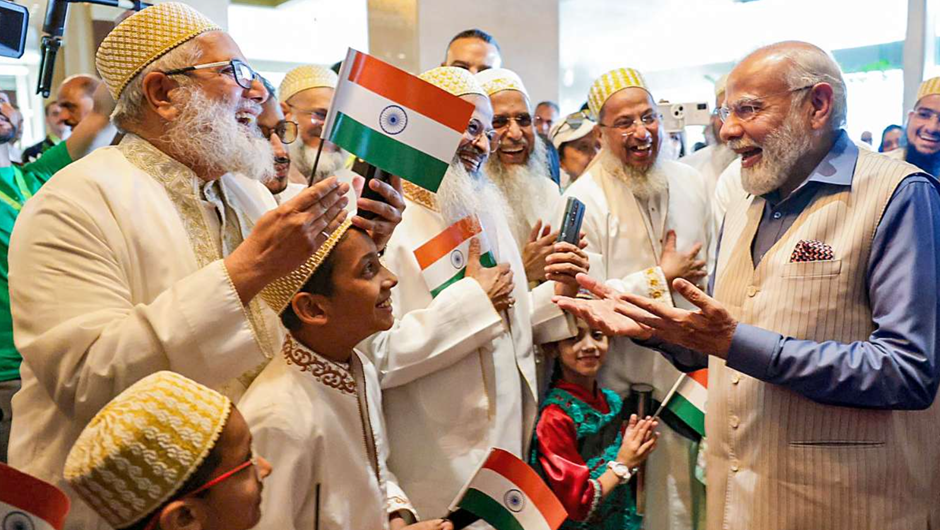
Narendra Modi with Bohra Muslims
These examples defy the popular notion that Modi is anti-Muslim. Some rightists jokingly call him “Moulana Modi” for the help he has extended to Muslims, especially the Pasmanda community, who had been ignored by other political parties to date in favor of the more prosperous Muslim elites.
Yes, Modi is serious about reclaiming revered temple properties lost during the Mughal rule, the ones that are highly deemed by the Hindu community, but he is offering an alternative, more spacious land for the construction of a new mosque as compensation to the Muslims. This is a trait characteristic of a practicing religious Hindu but not an Islamophobe who would not have offered, without doubt, any land as compensation.
However, the party doesn’t do much to contradict such claims of it being an anti-Muslim party. They don’t openly highlight the good they have done for the Muslim community. It appears as if they want this “anti-Islam” label to prevail. Probably because it pleases their far-right voters. A large number of individuals vote for Modi with the belief that he prioritizes Hinduism. Why would he want to tarnish that image? This is a primary con of democracy – you support narratives, even misleading ones, to consolidate a win by hook or crook. The focus is on power, not the people. The result is this: you end up winning by dividing the people further. The essence of “One India” becomes fainter as each election campaign ends.
Reasons for Rising Support
The reasons why the majority in India prefer Modi are multifold. It is not as straightforward as outsiders like to believe. There are primarily three types of BJP supporters:
Centrists: They dislike BJP’s communal politics but admire the party’s pro-development approach, solid implementation of social schemes, zero tolerance for terrorist activities/groups, no appeasement politics, increase in FDI, improved relationships with foreign countries that can prove beneficial to India, improved economic rankings, etc.
Anti-Opposition: They support the BJP primarily because they think the opposition is incompetent and not strong enough to take the country forward. They vehemently dislike the opposition’s weakness when it comes to tackling radical groups (something we are increasingly seeing in Western countries nowadays). The opposition was unable to control Kashmir’s terrorist activities or ban anti-national groups like PFI while they were in power. If given a better choice, the “Anti-Opposition” clan would gladly opt out of BJP. Currently, there are none.
Far Right: They like BJP’s communal politics and their pro-Hindu, capitalistic approach. They were highly unsatisfied with the opposition’s appeasement politics in the previous years. They felt their needs were unmet or unanswered when the opposition was in power, such as getting the temples out of government control. BJP gives them hope.
BJP rose to fame because of these three main target groups whose grievances were left unresolved by the opposition parties. For them, BJP is the only viable option. To defeat the BJP, the opposition parties should first seriously address the concerns of these groups. As long as they keep denying their negatives and gaslighting the concerns of voters, the right-wing will continue to reign supreme.
Conclusion
It is a trend we are seeing worldwide. Far-right parties are winning in Europe and are finding support in the US. This could be attributed mainly to the incompetency of the leftist ecosystems to curb extremism and violence, pushing people to support the right. When the issues are addressed and resolved, voters will likely shift their support towards a centrist political party. Till then, we await more concrete actions from the left to prove they can protect the country and its social fabric as reliably as the right.
The Kerala Story is back in the limelight. The right wing insists the movie is a must-watch, while the left wing is actively discouraging viewership. However, both sides could not have foreseen unexpected support emerging from unlikely sources – church factions in Kerala.
On Sunday, the Idukki Diocese of Syro-Malabar Catholic Church screened the movie for Class 10-12 children. Other factions are considering similar actions, although this remains unconfirmed at present.
Many seem to have taken offense to this move by the Church and are calling it “Islamophobic.” This opinion is indeed subjective. Personally, I do not think openly talking about extremist groups and their nefarious intentions is Islamophobic. It should not be eyed as such. When someone criticizes the RSS, it is not considered Hinduphobic. In the same way, openness to constructive criticism should be encouraged within all communities. Labeling discussions with terms like “phobia” can hinder healthy discourse about important issues. It’s essential to acknowledge and address problems, even if some individuals attempt to deny them.
Common Takes and Counter-Arguments
Here are a few common retaliations against The Kerala Story and my counter-arguments.
Take #1: The Kerala Story is all lies and propaganda
People who say this probably haven’t watched the movie or made an effort to fact-check the claims individually. Granted, the extrapolated count shown in the trailer was unnecessary. The makers have removed the count in the final cut. The acting and storytelling felt amateurish. There are other misleading claims in the movie. For instance, the movie makes it seem CM Achuthanthan predicted Kerala would become an Islamic state in 20 years. On the contrary, he was talking about PFI’s plan. He said, “They (PFI) want to turn Kerala into a Muslim-majority state in 20 years. They are using money and other inducements to convert people to Islam. They even marry women from outside their community in order to increase the Muslim population.“
That said, to dismiss the entire movie as a lie and propaganda is dangerous, considering there is evidence to show there are indeed some anti-national elements in the state who are actively working to convert and recruit members for not-so-peaceful intentions.
The Shahan Sha case file includes many of the atrocities portrayed in the movie. The following details are mentioned in the PDF, “The inquiry by the Special Branch reveals that fundamental outfits like NDF, PFI, and Campus Front have roots in the college campuses in the City referred to therein. Referring to Campus Front, it is stated in the report thus: As per the available information, the plan of this organization is to trap brilliant upper caste Hindu and Christian girls from well to do family, especially those who are studying for professional courses and employed in IT sectors.”
So, to say the entire story is a lie and propaganda is lazy reporting at its best.
As Ambedkar said, we cannot hide our heads in the sand just because the thought of it hurts our sentiments. The first step to resolving an issue is acknowledgment. Only then can there be proactive steps to prevent cases like Nimisha’s and Sonia’s from happening again. By outright denial, we risk leaving more people vulnerable to similar incidents, as they may not fully grasp the seriousness of the situation.
Take #2: The movie is Islamophobic
Is criticizing terrorists Islamophobic? Why is it that whenever a movie comes out that talks of terrorists, the left wing immediately calls it Islamophobic?
Terrorism has no religion. We should stop equating the two. I would say it’s Islamophobic to correlate the two – terrorism and religion – which is what the left often does with movies like The Kerala Story and Kashmir Files. Kashmir Files, in fact, starts with a Muslim child helping a Hindu child escape terrorists. The Kerala Story predominantly focuses on a radicalized group, not all Muslims. So, to claim the story as Islamophobic is unfair to the Muslims who have no part to play in all of this.
I would even go on to say that even Muslims should watch the movie as they are the most vulnerable. It’s crucial for individuals to recognize that there are extremist groups within the community who are determined to radicalize them. As per the PFI document, “Popular Front of India (PFI) is confident that even if 10% of the total Muslim population rally behind it, PFI would subjugate the coward majority community to their knees.”
TP Sulfath, the BJP member from Malappuram, bravely talked about such groups in Kerala in a video. Alas, the original Marunadan video was blocked or removed. The clip can now only be watched from a Reddit group.
Take #3: Only 2 or 3 cases have been recorded in Kerala
No one has an actual count. The existing ISIS cases in Kerala came to the limelight only when parents filed police cases. Many family members do not openly reveal such things out of shame and prestige issues. However, if you actively google for cases, you will find many. There are sufficient YouTube videos of Malayalee victims, not just two or three. Parents of radicalized children do not go to the police; instead, they seek help from centers like Arshya Vidya Samajam, as they wish to keep their concerns out of the limelight.
The official count of converts is taken from authorized conversion centers in Malappuram and Kozhikode in Kerala. These are state-approved centers. However, conversions happen outside such registered centers, so it is impossible to give an accurate number.
Take #4: We are too educated to fall for such traps, so we don’t need the guidance
I see the new generation saying this. However, love can make us, including the most educated, do illogical things. Anyone who has fallen in love madly and profoundly knows what it is like. We stop becoming rational. I often tell youngsters, “Follow your heart, but take your mind with you.” Love is at its most intense when we are teenagers. This is what radical groups look to exploit. They want you to fall so deep in love that you are ready to do anything, including convert, to be with them.
Maturity involves being open to advice from all sources, even those you may not initially consider necessary, as it equips you with the knowledge to handle similar situations that may arise in the future. The Kerala Story gives away the advice that in love you do not need to convert. If it does, it ceases to become love and more of a “You will get this, only if you do that” kind of transaction deal.
Take #5: The movie is vulgar and has adult scenes
I recently saw a politician saying this. The scenes are sourced from reality. The extremist group is known to enslave and rape women as they think it’s their right. It is a horrifying reality depicted in accounts like Nadia Murad’s The Last Girl. Further reading can offer more profound insight into the atrocities committed by ISIS.
Take #6: The Kerala Story has been released to make Kerala look bad
As a proud Keralite, I didn’t feel offended by the movie; instead, it made me more cautious.
We should reach a stage where not even one Keralite gets radicalized and joins ISIS. Then, we can claim victory as ours. Till then, we should be open to criticism and look for ways to rectify such problems, not hide them. What can we do to stop radicalization? How can we stop terrorist modules from cropping up in our state now and then (even as early as this year, 2024)? How can we stop Malayalee women like Nimisha and Sonia from joining such groups? Should we talk to our youngsters and spread awareness, or would we rather they find it out themselves (if at all they do)?
It’s like teaching kids the difference between good touch and bad touch. You cannot force anyone to follow your rulebook, but you can definitely advise them on what is good and bad. The decision on which route to take ultimately falls on them, but by encouraging active discussions, you are helping them to see through things that they would otherwise have failed to do on their own. At the same time, care should be taken not to generalize an entire community for the sins of a few. A nuanced approach is the need of the hour.
Dhruv Rathee’s recent videos have garnered much interest. Whenever he posts an anti-BJP or anti-Modi video, it trends on X. However, despite the popularity of his videos, here’s why these videos won’t have a significant impact.
Echo Chamber
The people who religiously watch Dhruv Rathee need no convincing on why the BJP is, in his words, a “danger to democracy.” They already wholeheartedly believe in this narrative. It must be acknowledged that Dhruv Rathee’s videos primarily cater to the anti-BJP audience. His videos might not have a significant impact outside this zone. Probably, he also means to reach out to fresh, impressionable minds. However, it remains to be seen how many Indian citizens are without political bias, considering the country is already significantly polarized.
Many people in India are Modi supporters, as evidenced by his victory in the last two elections. To overturn this support and for videos like Rathee’s to make an impact, the same set of Modi supporters responsible for his victory must be willing to consider viewing things from a different perspective, i.e., “the other side.” Asking right-wingers to go through leftist channels, including Dhruv Rathee’s videos, hoping to transform them, is like asking left-wingers to subscribe to right-wing media. It’s a lost cause. People who support the left call the right-wing press “Godi media” or “Sanghi media” and dismiss them. They refuse to even listen to a right-wing narrative. The same thing happens with the right-wing supporters. They dismiss videos from Dhruv Rathee and other left-leaning journalists.
So, who will these videos educate and reform? Takers are little.
Selective Activism
The main reason why even the center-right refuses to take Dhruv Rathee seriously is because of his selective news reporting. CPM’s rule in Kerala, the state I am from, is showing all signs of fascism, where freedom of speech and expression are routinely suppressed by the SFI activists (the youth wing of CPM), as seen recently in Sidharthan’s case. Still, Dhruv Rathee and several other left-leaning journalists hardly ever comment on this. It makes you question their agenda. More right-wing supporters would have taken him seriously if he had a more balanced approach to news reporting. In this matter, he fails.
Unquestioning Loyalty
As per surveys, Narendra Modi is the most popular leader globally. It’s a kind of hero worship that makes his supporters often ignore or justify his wrongs. But you usually see this with CPM and Congress supporters as well in Kerala. A kind of blind devotion engulfs them. Regardless of several corruption cases or scandals, party supporters refuse to waver. It is not easy to make someone shift their strong loyalties. This kind of worship is not just limited to politics. You see it with movie stars, singers, religious leaders, etc. People refuse to hear anything negative about a person they admire.
Recently, I came across a video on YouTube where a man was conversing with a couple in Kerala who earned their livelihood by selling tea near a beach. The conversation went something like this:
“How has it been for you the last five years? Has your life improved?”
“No, we are struggling financially. No changes have been made to the district. We continue to suffer.”
“So that means you are seeking a change?”
“Yes, we need a change for sure.”
“Who will you vote for then?”
“LDF! We have been staunch LDF supporters for years. No change in that.”
So basically, people are well aware of the problems they face and how things haven’t changed under the ruling party’s leadership, yet they refuse to stop their support. They might criticize the party but will not think about voting for another.
So, no matter how many videos Dhruv Rathee comes out with or how viral they become, the truth remains that he won’t be able to change the perspective of citizens who are already Modi fans. The videos will, however, solidify and intensify an anti-BJP person’s existing hatred towards the party.
For issues to be taken seriously, someone more nuanced, balanced, or unbiased needs to cover them. When people are convinced that the person reporting the news has no bias, the trust factor will naturally increase. However, this is a farfetched dream. In a world where biases are prevalent, only a newly created AI journalist might be capable of offering a completely neutral perspective. Unfortunately, even this AI journalist may develop biases over time, making it another unreliable source for obtaining news.
The recent controversy surrounding TM Krishna made me ponder: Is there a rise in intolerance in India, or are Hindus simply becoming more vocal about disrespect toward their culture and religion?
Nirmalyam, a Malayalam movie released in 1973, showed a man spitting on the idol of a goddess. There was no controversy back then. Maybe Hindus took offence but they endured the insult. No one can dare imagine releasing a movie with such a scene now. Some might call it the death of art, but is the survival of art dependent on humiliating Hindu religious beliefs? How often do you see an Indian artist scrutinizing other religions? If we’re going to engage in this game, let’s do so fairly. Selective activism is no longer accepted or praised.
Times have changed. Hindus are no longer silent. They are defending their religion. So does this mean Hindus have become intolerant? Or does this mean they have finally found their voice under the leadership of Modi after decades of suppression? It’s a matter of perspective, but one thing is certain: Criticizing Hinduism in India now comes with greater scrutiny and potential consequences. It’s no longer forgiven as easily as before.








 The Monkey Dilemma
You must be logged in to post a comment.