Shocking Anti-Hindu Hate in Western Societies

The 2023 report “Anti-Hindu Hate in Schools” by Charlotte Littlewood highlights a critical but under-researched issue: the presence of anti-Hindu sentiment in UK schools.

While this blog post draws upon insights from the report, the broader focus is on Hinduphobia as a global phenomenon – what it means, how it manifests, and the constructive steps that are being taken to address its rise.

The full report can be accessed here: henryjacksonsociety.org/wp-content/uploads/2023/04/HJS-Anti-Hindu-Hate-in-Schools-Briefing-final.pdf

The urgency to examine Hinduphobia stems from the way Hinduism is being misunderstood or misrepresented in Western societies. Many people, lacking a nuanced understanding of the religion, make casual remarks that are often bigoted in nature. They may be considered harmless or culturally acceptable in Western contexts.

This gap in awareness often results in prejudices being normalized, with little accountability or recognition of the harm caused.

What is Hinduphobia?

Hinduphobia is not a term widely recognized in mainstream discourse. In my view, “anti-Hindu bigotry” is a more accurate description, as the issue is not rooted in fear, but in prejudice, hostility, and a lack of understanding. It often stems from the fact that Hinduism operates differently from Abrahamic religious frameworks. This unfamiliarity can lead to stereotyping, dismissal, or open hostility, rather than genuine inquiry or respect.

As per the study, the working definition of Hinduphobia is as follows:

Hinduphobia is a set of antagonistic, destructive, and derogatory attitudes and behaviours towards Sanatana Dharma (Hinduism) and Hindus that may manifest as prejudice, fear, or hatred.

Hinduphobic rhetoric reduces the entirety of Sanatana Dharma to a rigid, oppressive, and regressive tradition. This discourse actively erases and denies the persecution of Hindus while disproportionately painting Hindus as violent. These stereotypes are used to justify the dissolution, external reformation, and demonization of the range of indigenous Indic knowledge traditions known as Sanatana Dharma.

The complete range of Hinduphobic acts extends from microaggressions to genocide. Hinduphobic projects include the destruction and desecration of Hindu sacred spaces; aggressive and forced proselytization of Hindu populations; targeted violence towards Hindu people, community institutions, and organizations; and ethnic cleansing and genocide.

Examples of Hinduphobia

The study lays out several examples that can be identified as Hinduphobia, many of which occur casually in everyday settings. These instances often go unnoticed or unchallenged, largely because Hinduphobia is not yet treated as a serious form of bigotry.

  • Calling for, encouraging, or justifying violence against Hindus, often rooted in extremist or distorted views of religion and history.
  • Kidnapping Hindu women and children for forced marriage and religious conversion.
  • Denying, downplaying, or accusing Hindus of fabricating their persecution, including instances of genocide.
  • Advocating for the destruction of Hinduism, framing it as inherently irredeemable.
  • Discrediting individuals who speak about Hinduphobia by labeling them as agents of violent or oppressive ideologies.
  • Attributing all social issues in Indian society, such as caste, misogyny, sati, communal violence, or temple destruction, solely to Hinduism.
  • Evoking historical trauma (e.g., iconoclasm, cow slaughter, forced conversions) to intimidate Hindus in modern discourse.
  • Making baseless claims about the political motives of those simply practicing Hinduism.
  • Linking antisocial behavior directly to Hinduism, often by selectively sampling data or falsely attributing individual actions to the faith as a whole.
  • Caricaturing Hindu scriptures through selective citation, mistranslation, or exaggeration, and presenting these distortions as representative of the entire tradition.
  • Claiming that Hinduism or Sanatana Dharma is not a valid or cohesive spiritual system.
  • Erasing Hindu civilizational contributions and superimposing Western norms over its historical and cultural identity.
  • Conflating diasporic Hindu identity with Indian citizenship, nationalism, or ethnicity.

As per my own observation, a contributing factor is the lens through which Hindus are viewed. The bigotry is shaped by the globalized “oppressor vs. oppressed” narrative, often based on selective or misunderstood portrayals of India. As a result, anti-Hindu activities at home or anywhere else are often seen as justified acts of revenge, grounded in the belief that “Hindus in India are oppressing minorities.” A quick look at social media during incidents involving anti-Hindu sentiments offers clear evidence of this bias.

Reactions often downplay or dismiss the issue, and in many cases, even justify the hatred by invoking political narratives, rather than addressing the prejudice for what it is.

Context and Need of the Study

The context and need for the study on rising Hinduphobia in UK schools are explained as follows: 

“Hinduism is the third largest religion in the UK making up 1.7% of the population according to the most recent census. From 4 to 20 September 2022, there was civil unrest in Leicester, extending to Birmingham, including vandalism of property, assaults, stabbings, and attacks on places of worship.

The Henry Jackson Society briefing paper, “Hindu-Muslim civil unrest in Leicester: Hindutva and the creation of a false narrative,” evidenced community tensions relating to youth violence and noise control issues in relation to festivals that had been falsely dressed as “Hindutva extremism” and even “Hindu terrorism”, creating fear and resulting in attacks on Hindu temples and properties.

The Network Contagion Research Institute (NCRI) investigated the role social media played in the civil unrest. It concluded that social media narratives have characterised “a vulnerable, diasporic community – British Hindus – as an aggressive, hypernationalist, and fascist threat. Other narratives depicted Leicester Hindus as heretically evil and filthy, playing on age-old Hinduphobic tropes.”

Both the HJS report and the NCRI report noted the use of anti-Hindu slurs such as “cow piss drinkers” and references to polytheism, vegetarianism, physical weakness and mocking of Hindu deities and symbols.   

When researchers began examining the unrest between Hindu and Muslim communities in Leicester, they encountered a notable gap: a lack of existing studies on anti-Hindu hate. This absence of research was one of the key motivations behind conducting a dedicated study on the subject.

The report also highlights how Hinduphobia has historically appeared in popular literature and academic discourse. For instance, E. M. Forster’s 1924 novel A Passage to India is cited as portraying Hindus as “perverted,” “clownish,” and “queer.”

Similarly, sociologist Max Weber viewed Hinduism as excessively otherworldly, a perception that contributed to the broader “theological othering” of Hindus. This form of othering continues today in the form of anti-Hindu slurs that mock the religion’s many deities and unique customs.

Another example comes from Allen Greenberger’s 1969 study on Indian stereotypes, where he described common portrayals of Indians as a “childlike race” who were “happy in their passivity, fatalistically so.”

Such characterizations may still influence how the media interprets Hindu behavior and presence. For instance, during and after the Leicester unrest, the press in the UK was criticized for failing to engage with the local Hindu community, instead relying on self-identified Muslim spokespersons who reportedly spread false narratives about Hindus in Leicester.

Moreover, rather than addressing the specific complexities on the ground, mainstream media coverage often diverted attention to political issues in India, as though those could explain or justify tensions in the UK. This approach not only homogenizes Hindus globally but also dismisses their individual and community experiences in diverse contexts like Leicester.

Abrahamic Othering

An interesting terminology used in the report was “Abrahamic Othering.”

The term ‘Hinduism’ was coined by British writers to refer to the family of Vedic religious traditions. Some modern Hindus prefer the name ‘Vedic religion’ or ‘Sanatana Dharma’ (‘eternal law’) rather than the label ‘Hinduism’.

Hinduism has multiple deities understood to be expressions of one ultimate Reality, be it God for theists or consciousness for monists. Hinduism does not follow one scripture but a number of scriptures that are given different emphases by different branches of the faith. Some argue the differences in the denominations are so great that they are separate religions entirely.

The preconceptions of Abrahamic faiths do not map neatly onto Hindu belief. Articulating Hinduism through the Abrahamic lens of Gods and scriptures is therefore problematic.

Respondents to this survey suggested that at least some UK schools continue to teach Hinduism through an Abrahamic lens without appreciating the limits of this approach. This fits with the findings and concerns of the Commission on Religious Education. Given the decentralised nature of religious curriculums in England and the lack of subject inspections in maintained schools, and given the considerable challenge of treating Hinduism sensitively in a UK context, such a finding is disappointing but unsurprising.

There are reports from some surveyed parents that lessons about Hinduism produce confusion and misconceptions about the Hindu belief in the existence of multiple Gods – 106 references were made to inaccurate perceptions of Hinduism with respect to polytheism/idol worship/multiple Gods.

Discrimination Against Hindus in UK Classrooms

Some of the discrimination observed in UK classrooms mirrored the forms of hate witnessed during the Leicester unrest between Hindu and Muslim communities.

In both settings, derogatory remarks were directed at Hindu identity and practices, including mockery of vegetarianism and the belittling of Hindu deities. These same types of insults were used by Islamist extremists during the rallies targeting the Hindu community in Leicester, highlighting a disturbing continuity between localized classroom prejudice and broader communal tensions.

Conclusion Based on Case Studies

Many case studies were conducted as part of the research, and based on these, the following conclusion was drawn:

This report highlights the prevalence of discrimination against Hindus in British schools, with 51% of Hindu parents surveyed reporting that their child has suffered anti-Hindu hate at school.

It is alarming that it is so hard to access information from schools on patterns of religiously-motivated bullying, and that the schools who did respond to this study’s FOI request either did not keep records of faith-based hate incidents or appeared to record very few incidents.

It is also alarming that only 19% of parents surveyed believe schools are able to identify anti-Hindu hate, indicating that the issue is not being addressed adequately. It may be that there is a tendency to downplay such incidents as ‘playground banter’.

However, several studies have observed that faith-based bullying has the potential to be more impactful than other forms of bullying, precisely because it targets not just the victim, but “their entire family, heritage, and culture”.

Schools should reflect on the harm such slurs cause, as well as the wider community divisions they may be helping to foster.

Constructive Steps

Small but significant steps are being taken to address Hinduphobia in Western nations.

Georgia recently became the first U.S. state to introduce a bill formally recognizing Hinduphobia and anti-Hindu bigotry. Similarly, the Scottish Parliament passed its first-ever motion to combat Hinduphobia, marking an important milestone in acknowledging the issue. The motion was influenced by a report on Hinduphobia in Scotland, which can be accessed here: nen.press/2025/02/28/gandhian-peace-society-shares-new-report.

These developments are a positive step toward challenging anti-Hindu bias and promoting awareness that, like all faiths, Hinduism, or Sanatan Dharma, deserves equal respect and protection from discrimination.

***

Main Photo by Himesh Mehta

The Demonization of Brahmins

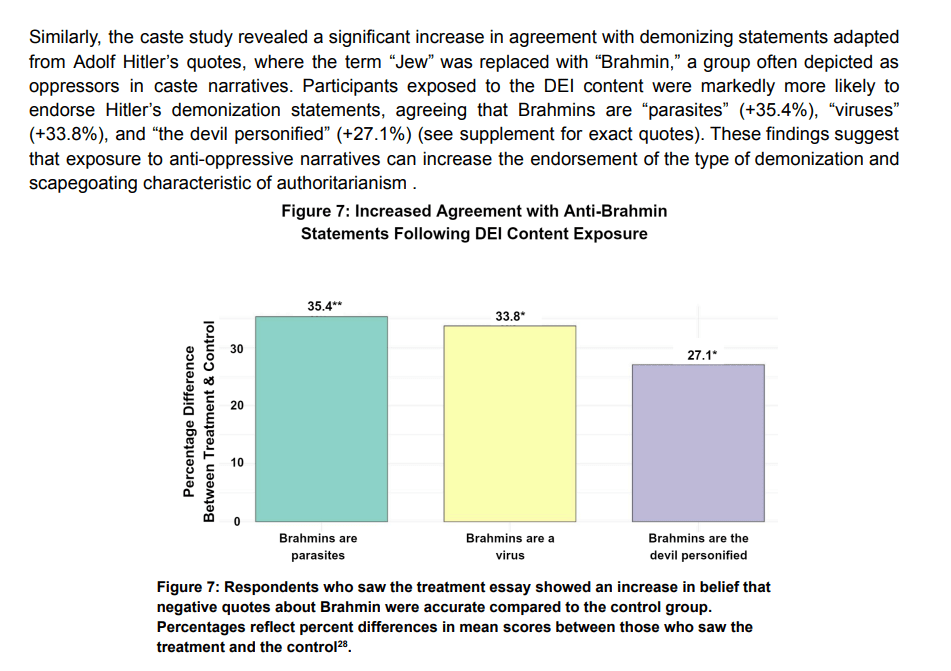
The following snippet is from a DEI study by the Network Contagion Research Institute (NCRI) in the U.S. The diversity, equity, and inclusion (DEI) program, originally meant to raise awareness, appears to have backfired in some areas. By framing everything through an “oppressor vs. oppressed” lens, it has ended up vilifying the Hindu Brahmin community, similar to the Jewish community.

Anti Oppressive DEI Report on Brahmins

Source: static.foxnews.com/foxnews.com/content/uploads/2024/11/anti-oppressive-dei-report-8.pdf

While DEI narratives often focus on Islamophobia and racial discrimination, caste-based bias among American Hindus has largely remained outside the spotlight. Though widely recognized in India, caste discrimination has only recently started gaining attention in the U.S., leading to the introduction of caste-sensitivity training in schools, workplaces, and policy discussions. But did they have the desired effect? Studies show otherwise.

Anti Oppressive DEI Report on Brahmins

The vilification of Brahmins began in India, where they are often targeted for everything, from their dietary habits to their lifestyle choices. What should have remained a focused activism against caste discrimination has unfortunately expanded into a broader mockery of the community as a whole. Even Brahmins who reject caste-based thinking are not spared.

Like anyone else, a Brahmin does not choose the caste they are born into. So, isn’t attacking them solely for their birth also a form of casteism? Every community should be open to critique for its flaws, but no one should be dehumanized for simply existing.

Awareness is important, but this study shows that excessive activism can cross a line and end up vilifying an entire community. In the findings, respondents described Brahmins as “parasites,” “viruses,” and “the devil personified.” How is that fair, or even acceptable, in the name of social justice?

No One’s Truly Secular in India

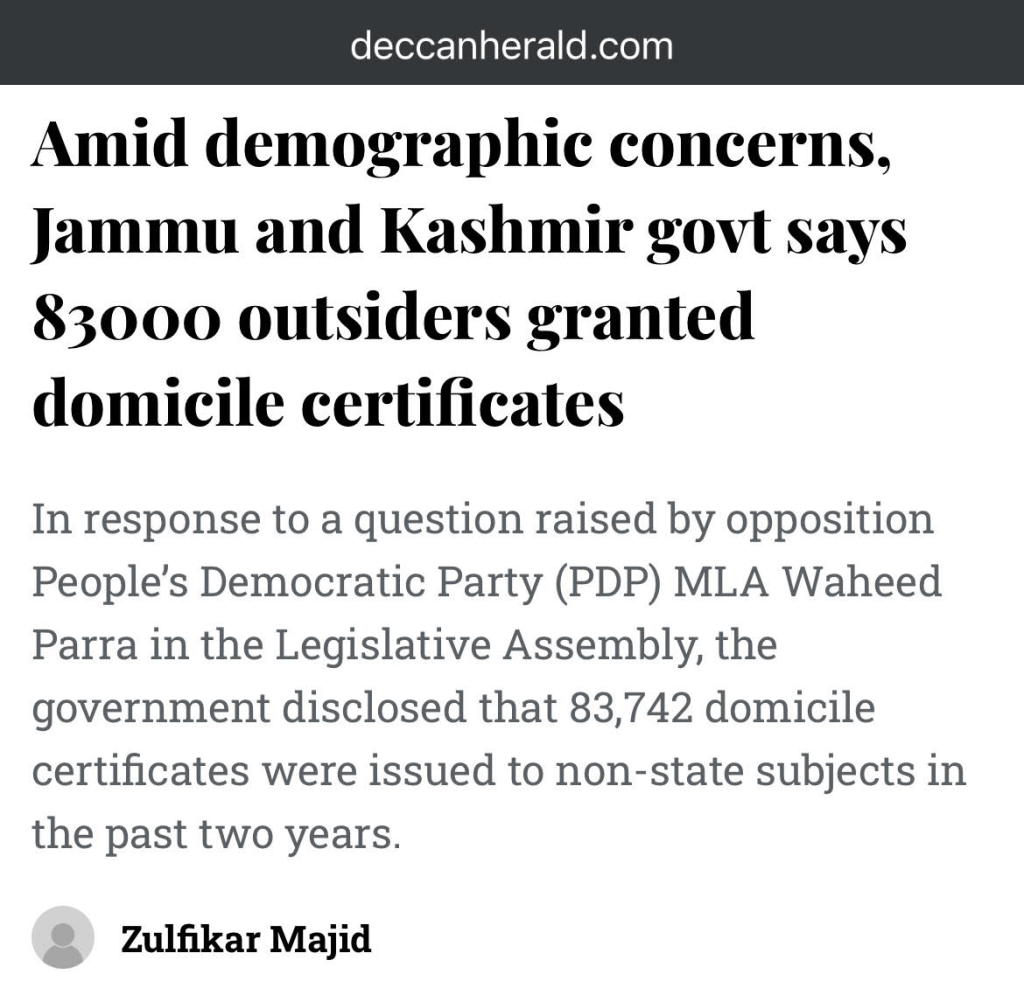
Newspaper clipping on demographic concerns in Kashmir

Say the words “demographic concerns” in any other Indian state, and you’d likely be branded a bigot. But in Kashmir, the “insider vs outsider” narrative is not only common, it’s actively pushed. If the Chief Minister, Omar Abdullah, has sworn allegiance to the Constitution of India, why the reluctance to openly embrace fellow Indians as equals? Kashmiris are free to work and settle anywhere in the country without being called outsiders. So why can’t someone from another Indian state do the same in Kashmir without facing hostility?

What India needs now more than ever is a spirit of unity. Not this constant “us vs them” divide.

These incidents make it clear: no one is truly secular, not even those who constantly criticize Hindu majoritarianism like Omar Abdullah. Let’s be honest. In Muslim-majority Kashmir, a fashion show during Ramadan sparked outrage, with people claiming it was against their “culture.” In parts of Malappuram and Kozhikode in Kerala, there have been cases where people were told not to eat in public during Ramadan. Meanwhile, in some Hindu-majority regions of North India, meat shops are ordered shut during Hindu festivals. Different standards, same mindset.

This isn’t just an Indian phenomenon. In the UK and the US, you’ll often hear people say, “We are a Christian country. This isn’t our culture!” whenever Hindu or Muslim festivals are celebrated in public spaces. The reaction is the same, just the setting changes.

Wherever you go, majority vs minority dynamics are always at play. What feels like a “religious restriction” to one person might feel like cultural protection to another. It all depends on your bias and perspective. Take Iran, for instance. Many of us might see it as deeply restrictive for women. But some Iranian Muslim women might see it as ideal because it strictly upholds their religious values. That’s religious bias in action – shaped by belief, identity, and comfort with the dominant culture.

Most people are secular only on paper. In reality, they tend to place their own religious beliefs a notch above others. They’re usually comfortable with the rules their faith imposes, no matter how restrictive those rules might seem to someone outside that belief system. It’s less about universal values and more about what feels familiar and justified to them.

Equal Inheritance Rights for Muslim Women

Social activist and NISA founder V.P. Suhara met Indian Minister Kiren Rijiju to demand equal inheritance rights for Muslim women in India, similar to those of Muslim men. Actor and BJP leader Suresh Gopi was also present at the meeting.

V.P. Suhara had earlier launched an indefinite hunger strike at Delhi’s Jantar Mantar, advocating for equal inheritance rights for Muslim women. However, the protest was forcibly stopped by the police. Before returning to Kerala, she announced plans to discuss the issue with key leaders in Delhi.

Did you see anyone in Kerala supporting her? Likely not. Instead, you’ll hear women with internalized misogyny saying, “We don’t want such reforms.” But these reforms aren’t for them. They are for women who seek more. Women who wish to follow traditional rules can continue to do so. Reforms do not prevent anyone from adhering to their beliefs, just as Triple Talaq is still practiced in India despite being banned. However, these reforms give Muslim women the legal option to seek justice if they are forced into following restrictive rules against their will.

When Muslim progressives like Suhara fight for women’s rights, you would expect so-called secular voices in India to stand with them. But these voices only seem to speak up when it comes to reforming Hinduism—whether it’s elephants in festivals, casteism, regressive practices, or allowing women in Brahmachari temples—because, let’s be honest, it’s far safer to push for changes in Hinduism. You see people from all communities, whether Hindu, Christian, or Muslim, openly advocate for these changes with confidence, knowing they face no serious repercussions. However, if you question some of the regressive practices in other communities, suddenly, you’re a bigot. The moment you point out that some proselytization techniques are predatory, you’re immediately accused of supporting the “restriction of religious freedom.” If you take a moment to observe people, you’ll notice countless little things that suddenly jolt you out of your slumber. You won’t need any political party to point this out to you. The double standards are there for the world to see.

When asked why the Muslim community largely does not openly advocate support for such reforms, progressive Muslims argue that it is dangerous to challenge established rules, unlike in other communities. They believe real change requires both internal and external pressure. While I acknowledge that speaking out within the Muslim community comes with risks, how long should we wait? Another century? Would it ever happen in our lifetime? Until then, are we expected to remain silent and unquestioning?

If the Indian government applies the “external pressure” suggested, it would inevitably lead to accusations of Islamophobia, further damaging the global perception of Indian Hindus and India’s image as a whole. Any attempt at reform would be spun as targeting a particular community, making meaningful change even harder to achieve.

Now, another group conveniently refuses to support this cause simply because the BJP—“the communal party”—is handling it. But name one other party that has ever stood up for Muslim women’s rights. The Opposition has always catered to Muslim men, not women, and will continue to dance to their tunes. This isn’t new; it has been the pattern for decades, ever since the Shah Bano case. If the BJP doesn’t take up the issue raised by Suhara, I can say with 100% certainty that no other party in India will.

***

Pic Source: Mathrubhumi.com (auto-translated from Malayalam)

How Long Must We Wait?

Religious fundamentalism is gradually rising in Kerala. Yet few dare to question it. Perhaps because it originates outside the Hindu community.

Members of the Muslim League, an ally of Congress in Kerala, now openly claim that the hijab is not a choice and are pushing for gender segregation in public spaces like the Mec7 exercise program. Recently, a religious leader criticized a Muslim widow for traveling to Manali, insisting that widows should remain at home and devote themselves to prayer. Others are now openly urging community members to refrain from participating in non-Muslim festivals, further deepening social divisions. Meanwhile, Hamas and Hezbollah supporters freely display posters of their leaders in Kerala, despite these groups’ ties to Pakistani terrorist organizations like JeM and LeT, which have carried out multiple attacks in India.

Was there any outrage from political parties or within the community? None at all.

When you point out the lack of internal criticism, the common response is that speaking out invites real danger and that reforms take time. While it’s true that advocating change within the Muslim community is difficult and radicals may threaten dissenters, how long must we wait? Another century? Should we remain silent and allow religious fundamentalism to grow unchecked? If no meaningful reforms have happened so far, what guarantees change in the future? If the community cannot challenge extremist views now, how will they resist when these forces become even stronger and impose their rules on others?

We are already seeing glimpses of this with the Waqf Board’s land disputes, where properties legally owned by other communities are being claimed. Why should non-Muslims be bound by Waqf rules? If the land originally belonged to Muslims, the claims may hold merit. However, many of these properties now belong to other communities. If they were encroachments, why did the Waqf Board fail to prevent them? In cases where the land was legally sold, why is it being reclaimed now? The Board’s mismanagement highlights the urgent need for Waqf reforms to prevent future disputes.

Unfortunately, political parties are misleading the Muslim community, falsely claiming that reforms would lead to property seizures. The reality is that corrupt politicians have more to lose than ordinary Muslims, especially the poor. Many are likely benefiting from Waqf properties, living in luxury through corruption. The revenue generated from Waqf assets is disproportionately low compared to their vast holdings, raising questions about where the money is going. Instead of being used for community development, it is likely being siphoned for personal gain.

This is why reforms are crucial. However, many in the community rely on their leaders for information, unaware that they are being misled. These leaders manipulate facts for their own interests, radicalizing and mobilizing people with lies. This is why it’s important that citizens seek information from multiple sources—both left- and right-leaning—to avoid being deceived.

It is a mistake to believe that only the BJP spreads communal hatred. Congress leaders have also exploited the Manipur issue, framing it as a Hindu vs. Christian conflict when it is, in fact, an ethnic dispute. When Hamas posters appear in Kerala and critics raise concerns, Congress dismisses them as “Islamophobia.” This selective outrage makes them unreliable as leaders. They are vocal against Hindu extremism but silent when it comes to Islamist fundamentalism.

Some progressive Muslims argue that meaningful reforms require both external pressure, such as government intervention, and internal efforts from within the community. However, in India, any government-led push for reform risks being labeled Islamophobic. This, in turn, gives radicals more ammunition and invites criticism from the Western world, which often misinterprets such actions as oppression rather than necessary change. Moreover, since Hindus form the majority, any move by the Indian government is framed as an attack on Muslims, further polarizing the discourse and making genuine reform even harder to achieve.

At this point, the situation feels like a deadlock. Either we wait indefinitely for internal reforms, which may never come, or the government steps in, triggering backlash and further polarization. Both paths are fraught with challenges, and in either case, things could turn messy. The fear of being labeled Islamophobic limits external intervention, while internal resistance to change keeps fundamentalist views unchecked. This leaves little room for meaningful progress, making the prospect of reform seem increasingly distant.

***

Photo by Pixabay

1921 Moplah Riots: False & Misleading Left-Wing Claims

In 1921, Kerala witnessed the Moplah Riots, where numerous Hindus were killed in communal violence. However, to this day, Congress and CPI(M) refuse to acknowledge it as a communal riot and instead label it a “class struggle between Hindu landlords and Muslim peasants.”

I also believed the class struggle narrative until I read B.R. Ambedkar’s book, The Partition of India. He clearly highlights the communal nature of the Moplah Riots, mentioning temple destruction, mass killings, and forced conversions of Hindus.

Some clippings from the book:

Source: Dr. Babasaheb Ambedkar : Writings and Speeches (Vol. 8)

If Hindus were specifically targeted, their temples destroyed, and they were forcibly converted, how can this not be considered a communal riot? Ambedkar’s account challenges the attempt to whitewash history by reducing it to just a landlord-peasant conflict.

Here is the question I asked AI and the response it generated:

Question: Were temples destroyed during the Moplah riots?

Answer: Yes, several temples were destroyed, looted, or desecrated during the Moplah Riots of 1921 in the Malabar region of Kerala.

Historical Accounts of Temple Destruction:

  1. Looting and Desecration:
    • Many Hindu temples were attacked, idols were broken, and valuables were looted.
    • Records mention temples like the Thirumandhamkunnu Bhagavathy Temple being desecrated.
  2. Forced Conversions and Killings:
    • The riots targeted Hindus, with reports of forced conversions, massacres, and mass displacement.
    • Many Hindus fled their villages, leaving temples unprotected.
  3. British Reports and Historical Records:
    • British colonial reports and contemporary eyewitness accounts mention temple destruction.
    • Annie Besant and Veer Savarkar documented attacks on Hindu religious sites.

Conclusion:

Yes, temples were destroyed and desecrated during the Moplah Riots, which started as an anti-British uprising but later turned into violent communal attacks against Hindus in Malabar.

So how can it be concluded as merely a class struggle? Next time, someone dismisses the communal angle of the Moplah Riots as propaganda, one should ask, “Why were temples destroyed if the riots weren’t communal? Why did conversions happen? Was Ambedkar lying in his book?

This is just one of the many lies spread by Congress and CPI(M). Why do they do it? Only they know. Perhaps to ensure Hindus keep supporting them, or maybe to prevent the majority community from developing resentment.

The second reason might have been understandable if only they didn’t paint Hindus as villains in other communal conflicts. The lack of consistency exposes their bias.

***

Photo by RDNE Stock project