In 1921, Kerala witnessed the Moplah Riots, where numerous Hindus were killed in communal violence. However, to this day, Congress and CPI(M) refuse to acknowledge it as a communal riot and instead label it a “class struggle between Hindu landlords and Muslim peasants.”
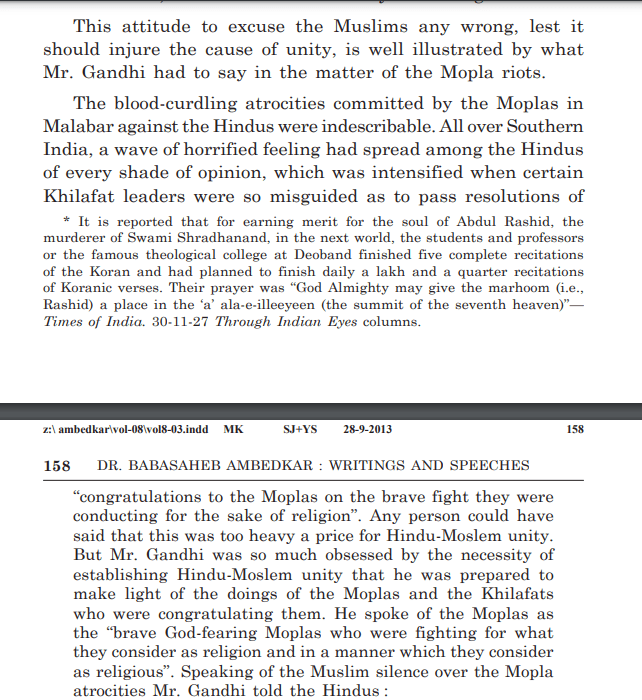
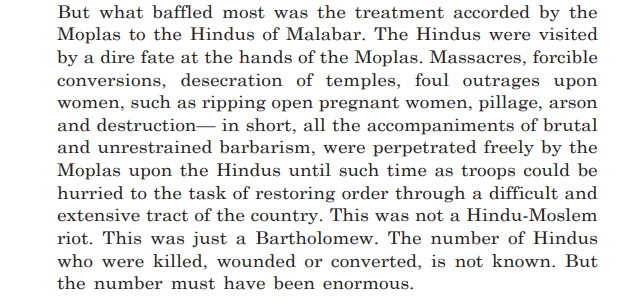
I also believed the class struggle narrative until I read B.R. Ambedkar’s book, The Partition of India. He clearly highlights the communal nature of the Moplah Riots, mentioning temple destruction, mass killings, and forced conversions of Hindus.
Some clippings from the book:
Source: Dr. Babasaheb Ambedkar : Writings and Speeches (Vol. 8)
If Hindus were specifically targeted, their temples destroyed, and they were forcibly converted, how can this not be considered a communal riot? Ambedkar’s account challenges the attempt to whitewash history by reducing it to just a landlord-peasant conflict.
Here is the question I asked AI and the response it generated:
Question: Were temples destroyed during the Moplah riots?
Answer: Yes, several temples were destroyed, looted, or desecrated during the Moplah Riots of 1921 in the Malabar region of Kerala.
Historical Accounts of Temple Destruction:
Looting and Desecration:
Many Hindu temples were attacked, idols were broken, and valuables were looted.
Records mention temples like the Thirumandhamkunnu Bhagavathy Temple being desecrated.
Forced Conversions and Killings:
The riots targeted Hindus, with reports of forced conversions, massacres, and mass displacement.
Many Hindus fled their villages, leaving temples unprotected.
British Reports and Historical Records:
British colonial reports and contemporary eyewitness accounts mention temple destruction.
Annie Besant and Veer Savarkar documented attacks on Hindu religious sites.
Conclusion:
Yes, temples were destroyed and desecrated during the Moplah Riots, which started as an anti-British uprising but later turned into violent communal attacks against Hindus in Malabar.
So how can it be concluded as merely a class struggle? Next time, someone dismisses the communal angle of the Moplah Riots as propaganda, one should ask, “Why were temples destroyed if the riots weren’t communal? Why did conversions happen? Was Ambedkar lying in his book?“
This is just one of the many lies spread by Congress and CPI(M). Why do they do it? Only they know. Perhaps to ensure Hindus keep supporting them, or maybe to prevent the majority community from developing resentment.
The second reason might have been understandable if only they didn’t paint Hindus as villains in other communal conflicts. The lack of consistency exposes their bias.
I was once a leftist. However, at that time, I didn’t consider all sides of a story. Even though I am a Hindu, I was often dismissive of conflicts in which Hindus were victims in India, such as the Kashmiri Pandit genocide, the 1992 Ajmer rapes, the Moplah riots, and others. I coldly labeled the narratives as right-wing propaganda. I was radicalized to the extent I wasn’t open to other perspectives.
On October 7th, 2023, I experienced a significant shift in my perspective. I witnessed people justifying acts of violence, including rape and saw secular politicians in my country referring to it as resistance. This left me shocked. It wasn’t the BJP that influenced my change, but rather the people around me. The only individuals expressing outrage about these events were from the right wing, which took me by surprise.
Over the next couple of months, I underwent a monumental shift in my ideology that startled me. It felt like old layers of my beliefs were peeling away, making way for new understandings—a painful process. I came to realize that the principles of fairness and equality I had believed in until then were merely a façade. I also understood that I would likely be alone in this revelation.
The world operates in a contradictory and troubling way. People often expect unwavering support from others, yet when it’s their turn to show empathy, they respond with scoffing, mockery, and belittlement towards heinous crimes. They easily justify acts of violence, murder, and rape with statements like, “So what? They deserved it.”
It took me months to calm my anger and process the betrayal I felt when I discovered that some of my friends had become radicalized to the point of believing that rapes were justified. Until that moment, I had viewed the world through rose-colored glasses, believing it to be a kind place.
I then looked at my country with a fresh perspective and realized that similar patterns were at play here. Hindus seemed to have to compromise more than other communities in the name of secularism. I observed that many conflicts where the victims were predominantly Hindus were dismissed as propaganda, belittled, mocked, or invalidated, much like the rapes of Israelis on October 7.
I now identify as a right-winger. I consider myself center-right and hold no animosity toward anyone. In the past, I hesitated to label myself as a right-winger because almost everyone I know leans left. However, over time, I’ve moved past the fear of labels. People can judge or categorize me as they wish; as we age, labels become less significant. My shift in ideology is not due to any political party or its propaganda, but rather my observations of people’s behavior and their viciousness.
I have become more patriotic and now want everyone in India to adopt a “nation first” mentality. This is something I missed when I was a leftist; I felt that people weren’t sufficiently pro-India. I realize now that the center-right community is where I truly belong.
We, the center-right, believe in the following principles:
We are patriotic and uphold a “nation first” mentality.
We reject extremism from both the far-right and the far-left.
We take pride in the achievements of India.
We advocate for equal rights for everyone, regardless of their community.
We oppose appeasement politics.
We strongly support enhanced security measures.
We have zero tolerance for radical groups.
There are several negative aspects of the far-right that frustrate people like me. They should be held accountable by the government. However, I still feel positive about my country under strong leadership that has the courage to confront extremism.
Unfortunately, in India, when you openly call out extremism, you are declared Islamophobic. When radicals get arrested due to active participation in extremist groups, the country is declared Islamophobic. The global media often gets their news about India from the local left-leaning media which is notorious for giving one-sided stories. In this day and age of media bias, it is imperative to refer to both the left and right-wing channels to get a full balanced view.
It’s true that Islamophobia exists in India and the country should do more to protect its minorities. However, even if the BJP takes positive steps, it is unlikely to reduce the extreme victim mentality prevalent in the community that refuses to acknowledge any good done by the party. For example, the BJP introduced the Shadi Shagun Yojana scheme in which a Muslim girl is given Rs 51000/ when she marries after her graduation (BA, BSc, BCom, BE etc.). BJP banned the Triple Talaq. This is for Muslims alone. Most of the recipients of other welfare schemes have been members of the Muslim community. No ruler would have tried to uplift the Muslim community if they were Islamophobic. Riots and young children getting murdered due to terrorist activities in Kashmir have also drastically reduced. But these plus points are often blatantly ignored and many choose to judge Modi by the actions of the far-right.
A question to consider is: If Modi is still judged for the 2002 Gujarat riots, why isn’t Congress held accountable for the 1984 Sikh riots that they enabled, which were equally horrific? Politicians have contributed to deepening societal divisions by fueling narratives. Riots and violence instigated by one party are often deemed forgivable, while those provoked by another are considered unforgivable.
My political ideology is not fixed. I may shift from center-right to center-left in the future if I find that the center-left in India has become bold enough to openly oppose Islamist extremism as well, not just Hindutva. As of now, they do not meet that standard.
To end with a quote on pseudo-secularism in India:
To those who claim we are now living in a totalitarian, fascist, Hindu Rashtra, one must ask:
What kind of Hindu Rashtra is this where Ram Navami, Hanuman Jayanti, Durga pooja processions, and even Garba celebrations, are attacked and stoned with impunity?
What kind of Hindu Rashtra is this where Hindus are forced to be refugees in their own land, where one can settle 40,000 Rohingya Muslims but not 700,000 Kashmiri Hindus, the land’s original inhabitants; where the judiciary says it is too late to prosecute those who raped, murdered, and ethnically cleansed lacs of Hindus?
What kind of Hindu Rashtra is this where Hindu temples are exclusively controlled by the State, and where the government usurps hundreds of thousands of acres of temple land and is responsible for more than 100,000 temples losing lakhs of crores in rental income?
What kind of Hindu Rashtra is this where the Right to Education Act discriminates only against Hindus and their schools, forcing tens of thousands of them to shut down?
What kind of Hindu Rashtra is this where a communal violence law was about to be enacted through with only the Hindus would have been held guilty in a communal riot even if they were in a minority for example in Kashmir?
What kind of Hindu Rashtra is this where court judgments like the Sabarimala and legislative enactments like the Hindu Code Bill purport to reform only Hindu religious practices but dare not touch practices of other religions, and if they do, the decisions are promptly reversed like in the Shah Bano case?
What kind of Hindu Rashtra is this where the Waqf Act gives overarching powers to Muslims to declare a 1500-year-old Hindu temple to be on Islamic land when Islam is only 1300 years old?
If this is how a Hindu is rewarded in a Hindu Rashtra, he’d much rather be in a Muslim Rashtra because then at least there’d be no pretence of equality.
Yesterday, a Muslim friend visited, and we ended up discussing religion. She’s a practicing Muslim but not overly devout; for instance, she only wears a hijab when her mother-in-law visits.
During our conversation, she shared something beautiful:
People do things in the hope of reaching paradise. There’s so much fear surrounding it. But no one has ever returned from death to confirm if paradise truly exists. What we have now is paradise, isn’t it? You and I, of different faiths, sitting here together, conversing, laughing, and enjoying each other’s company—what better paradise could there be?
I asked her how she developed this perspective when everyone around her follows religious rules so strictly. She said it might be because she attended a non-religious school instead of an Islamic one. She emphasized how important it is to interact with other communities rather than only associating with people from our own. Her husband shares the same outlook. While he offers Namaz five times a day, he hasn’t imposed any religious restrictions on his wife or children. They are the only ones in their family who approach religion this way.
This principle is applicable to all communities. The more we engage with people from different backgrounds, the more open-minded and accepting we become of diverse ideas and perspectives. Conversely, isolating ourselves can lead to more rigid and extreme viewpoints.
I believe this may be why Indians tend to integrate more easily in foreign countries. Growing up in a society where different faiths coexist has shaped our ability to adapt. This is why I feel we should be sharing our culture with the world rather than adopting foreign ones. India’s inclusive culture, which embraces all faiths, is truly beautiful. I hope we continue to honor and preserve it.
The recent controversy surrounding TM Krishna made me ponder: Is there a rise in intolerance in India, or are Hindus simply becoming more vocal about disrespect toward their culture and religion?
Nirmalyam, a Malayalam movie released in 1973, showed a man spitting on the idol of a goddess. There was no controversy back then. Maybe Hindus took offence but they endured the insult. No one can dare imagine releasing a movie with such a scene now. Some might call it the death of art, but is the survival of art dependent on humiliating Hindu religious beliefs? How often do you see an Indian artist scrutinizing other religions? If we’re going to engage in this game, let’s do so fairly. Selective activism is no longer accepted or praised.
Times have changed. Hindus are no longer silent. They are defending their religion. So does this mean Hindus have become intolerant? Or does this mean they have finally found their voice under the leadership of Modi after decades of suppression? It’s a matter of perspective, but one thing is certain: Criticizing Hinduism in India now comes with greater scrutiny and potential consequences. It’s no longer forgiven as easily as before.




 The Monkey Dilemma
You must be logged in to post a comment.