Biggest Surprises in Jammu Kashmir and Haryana Elections 2024

Jammu & Kashmir Election Results
Courtesy: ECI Website

While reading today’s newspapers, an interesting trend caught my eye. Most newspapers in India are left-leaning, so election results are primarily presented in a way that props up the left-leaning parties. For example, “NC got a thumping victory,” in contrast to a more subdued “BJP earned a hat-trick in Haryana.” No fancy adjectives. Another example is “J&K has rejected BJP’s politics” while failing to report that BJP’s vote share has been increasing in J&K with every passing election. In some newspapers, Vinesh Phogat’s win was highlighted more than the overall performances of individual parties.

The election results declared on 8th October have been filled with surprises. However, due to the media’s own biased leanings, not every fact made it to the papers. Here are some of the top surprises from the Haryana and J&K Elections 2024.

BJP getting more seats than Mehbooba Mufti’s PDP in J&K

From a party that used to get single-digit votes in Kashmir, BJP’s vote count has now risen to four digits. The party came second in J&K, beating Mehbooba Mufti’s PDP.

PDP is an indigenous Kashmiri political party. The party has been on the political scene in Kashmir for ages. This time, most of the PDP’s votes went to NC in the Kashmir region. PDP’s association with the BJP in the recent past proved to be its undoing. Interestingly, this camaraderie did not have the same effect on the BJP, as its vote share increased from the 2014 elections.

Jammu & Kashmir Seats and Vote Share
Courtesy: The Hindu

No one, including BJP members, ever countered the fact that BJP would not win a single seat in Kashmir. It was reported that even the people of Jammu, along with Kashmiri Pandits, BJP’s primary vote base, were dissatisfied with the saffron party as their demands were left unaddressed.

Considering that politicians like Omar Abdullah were saying there was intense anger brewing in the valley beneath the surface of peace and tranquility, it was surprising to see the BJP not only increase its number of seats without an alliance but also its overall vote share in J&K albeit marginally, as compared to the 2014 elections.

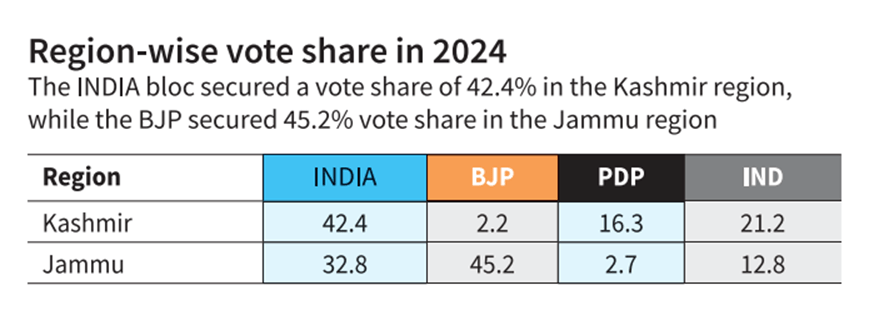
If we were to analyze just Kashmir alone, the BJP neither lost nor gained its vote share (2.2%) in the region. So, in summary, the BJP increased its seats/vote share in Jammu while maintaining its vote share in Kashmir. If the Abrogation of Section 370 was indeed a major point of discontent for J&K locals, we should have seen a drastic decrease in BJP’s seat count/vote share. But that’s not what happened.

Jammu & Kashmir Region-wise Vote Share
Courtesy: The Hindu

The media and politicians might paint the Kashmir election results as a big loss for the BJP and a “befitting reply to BJP by the people for the Abrogation of 370”, but the data seems to indicate otherwise. Yes, they did not win a seat, but the fact that in many seats of Muslim-dominated Kashmir, BJP came second, beating Congress and PDP, implies there’s far more to the story than what meets the eye.  

BJP losing Gurez in Baramulla by a mere 1132 votes

Gurez is a seat that is 98% Muslim and where the BJP did not have any presence till now. Faqeer Mohammad Khan from the BJP lost by a mere 1132 votes to NC’s Nazir Ahmad Khan.

This close contest has been the biggest shocker from the Kashmir region, considering the BJP is always portrayed as an “anti-Muslim” party.

Gurez Kashmir
Courtesy: ECI Website

BJP’s Shagun Parihar winning Muslim-dominated Kishtwar seat

Shagun Parihar BJP
Shagun Parihar

There is a misconception that Jammu is a “Hindu-only” area and Kashmir is a “Muslim-only” area. Jammu has areas with a significant Muslim population. One such area is Kishtwar, a district that has long been a hotbed of militant activities.

Shagun’s father and uncle were murdered by Hizbul Mujahideen terrorists in 2018. She initially had no plan to join politics, but after the murder of her father and uncle, she felt the need to bring about a change. Her victory, albeit by a small margin, proved to be sweet revenge.

Speaking to the media after the verdict, she said: “We have lost a large number of our soldiers. I have lost my father, and some have lost their brothers and sons. My first effort will be to ensure that every child here has the shadow of a father over his head and that there is peace and prosperity in the area. My efforts will be to bring happiness to every home.

Jamaat-e-Islami and former separatists faced a big loss in J&K

When members from banned radical groups like Jamaat-e-Islami and former separatists were allowed to contest this election individually, many were worried.

As Kashmir continues to be a sensitive zone, analysts questioned the motive behind this move and the consequences of having radical elements elected into power. However, the people of J&K answered this pressing question through their votes, resoundingly rejecting the radicals and choosing a party like the National Conference instead, which believes in working democratically within the rules of the Indian constitution. This has come as a relief for many, especially since Engineer Rashid was elected as MP in the Lok Sabha elections.

The loss of Engineer Rashid’s party in the J&K election has provided ample proof that his victory in the Lok Sabha elections was a case of sympathy voting. His sons had extensively campaigned for him before general elections, saying the only way their father could escape jail was if he became an MP. However, in the case of the J&K elections, Kashmiris seemed to have drawn a line, and Rashid was unable to replicate his victorious stint in the general elections.

Congress in a way lost both Haryana and J&K

Even though Congress is an ally of the NC in J&K, their standalone performance proved to be lackluster. Congress managed to earn only 6 seats in J&K, compared to BJP’s 29. This cannot be considered a victory for Congress. In Jammu, too, an area where they were stationed to put up a strong fight against the BJP, they managed to win only one seat.

NC leader Omar Abdullah admitted post-election that, in hindsight, the alliance was unnecessary as they would have won the election anyway without the help of Congress.

Haryana outcome

Haryana’s election results came as a shock to everyone, including right-wingers. The trend was overwhelmingly leaning towards anti-incumbency in the state. BJP has been ruling Haryana for over a decade, and there were a plethora of issues surrounding “farmers, soldiers, and wrestlers” plaguing the state.

However, around a month back, it was reported that the non-Jats were having second thoughts about Jats supporting Congress and gaining power. This led to a consolidation of non-Jat votes against Congress. It is a simple case of caste-based politics gone wrong for the party.

Haryana Election Results
Courtesy: The Hindu

RSS played a huge role in BJP’s victory

Reportedly, RSS went above and beyond in Haryana, campaigning door to door, distributing pamphlets that highlighted the dangers of caste-based divisive politics, ensuring everyone got their voter slips on time, and organizing outreach programs.

In the Lok Sabha Elections, it was reported that there had been a fallout between the BJP and RSS, which led to RSS members not making any effort to help the BJP. BJP seems to have realized its blunder post-election and made a conscious effort to re-establish connection with RSS, which is undeniably its backbone. Several changes were made in Haryana based on RSS’ recommendations. It ended up proving effective.

Conclusion

Yet again, Exit polls in India have turned out to be a disaster. You never know what the janta is thinking. There are silent voters who make their stance known only through their votes. Exit polls have been unable to infiltrate that section.

One thing is clear: this election has been a big win for democracy, especially in the Kashmir valley. The turnout was impressive. The trust they placed in the Indian democratic process is noteworthy. As Modi mentioned, the peaceful conduct of the J&K election has proven to be a victory in itself.

Why the Far-Right is Gaining Support in India

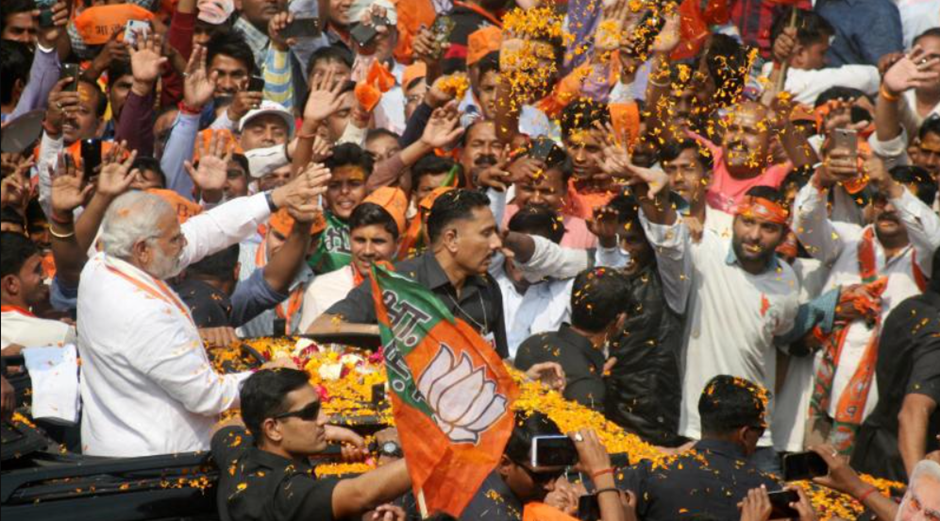
Narendra Modi Waving to Supporters

It’s the election season again in India, the largest democracy in the world. Politicians are tirelessly running hither and thither promoting their campaigns, often resorting to divisive tactics to seal their votes. As a layman, you find yourself wondering during these times whether the political parties’ agenda is to divide citizens rather than win elections.

Over the past ten years, there’s been a steady rise in discomfort over the rising popularity of the right wing. Most minorities and leftists want the BJP to be voted out this year. There’s a sense of dread about what would happen if the BJP takes control for the third consecutive term. You see and read incidents of Christians and Muslims in rural areas crying, “Hindus will kill us if they come into power. Please don’t vote for the BJP.” This cry for help is alarming. Minorities do face discrimination in India, but to make it sound like a genocide is far-fetched. Most people live in harmony with each other, while some tyrants across communities try to create problems. However, the negative stories are most prominently highlighted making it look like the norm. It is not a systematic persecution, as seen in neighboring countries.

Who is spreading this hate narrative? Who is inflicting this unfound fear on everyone? Politicians and the media are to blame—both the right and left. One makes controversial statements, and the other spreads hate and discord by amplifying them out of context. The reasons are purely agenda-driven. I say this with confidence because of the ease with which they seem to overlook their own preferred party’s faults, irrespective of the severity. The bias is crystal clear.

Someone like me, who is engrossed in reading both left and right narratives day in and out, can now finally figure out when a party/media/journalist is playing games to drive their agenda. I have acquired a sense of indifference to polarizing or pseudo-secularist words. But an apolitical person, which many are, might not understand the game and fall prey to the hate narrative set by both sides. Ultimately, the narrative with the most media outreach wins: the right-wing within India and the left wing globally.

The opposition parties in India are going all out to convince everyone why democracy is in trouble in the country, resorting to fearmongering tactics, such as drilling down the point that there won’t be an election next time if BJP wins. The Western media is also trying to help the opposition by pushing the narratives of the leftist ecosystem to the world at large. An outsider might have already read several articles slamming the situation in India on popular portals like the BBC, Al Jazeera, and CNN. Rarely do you see a right-wing viewpoint, probably because the right wing is, by default, considered problematic. So, you never know precisely why the right wing has gained popularity in any country. You only get to see the uncomfortable outcomes of it.

Narendra Modi and Kim Jong Un
A satire post from @the_fauxy

Is BJP a Far-Right Party?

Let’s get this straight: BJP being a “far-right” party is highly debated and contradicted by the actual far-right in India. They feel Modi is “soft,” so they label him “center-right.” According to them, he hasn’t yet reclaimed all the lost temple properties or got the temples out of government control; his party suspended Nupur Sharma when she made blasphemous comments in response to an equally blasphemous comment by a guest panelist, and the party hasn’t restricted welfare benefits to Muslims. For the hardliners, a legit far-right politician is someone like Geert Wilders.

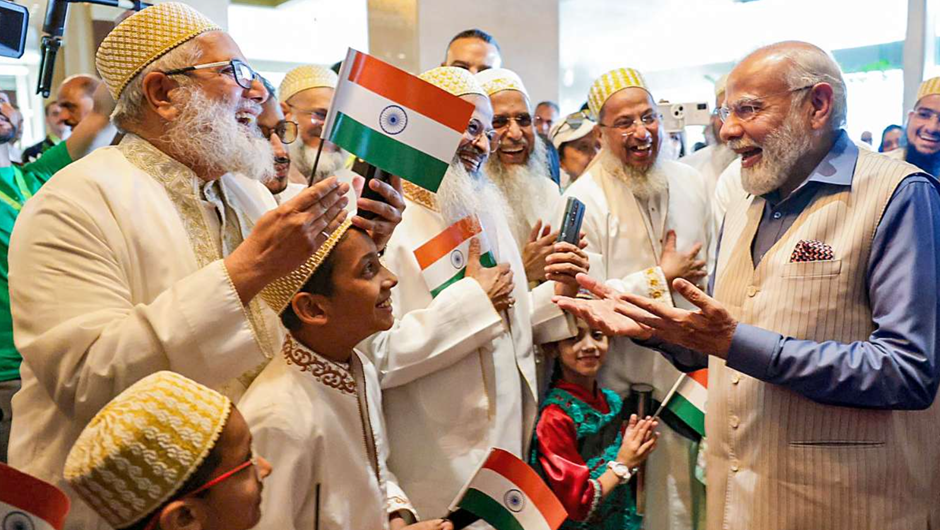
You often see Modi making problematic statements to woo his far-right fan base and keep them happy. But his words don’t usually translate into actions. Muslims remain the biggest beneficiaries of welfare schemes under the BJP rule, Muslim businesses in Gujarat have prospered, Shias are now able to practice their religious rituals in Kashmir openly, and oppressive rules like the Triple Talaq have been banned, earning him a small but dedicated Muslim fan following in the country who have started to realize that Modi isn’t all that bad as he’s made out to be. In Kashmir, a Muslim-majority state, the Ayushman Bharat scheme is available to all citizens irrespective of social and economic status, a privilege not extended to other states in the country.

Narendra Modi and Bohra Muslims
Narendra Modi with Bohra Muslims

These examples defy the popular notion that Modi is anti-Muslim. Some rightists jokingly call him “Moulana Modi” for the help he has extended to Muslims, especially the Pasmanda community, who had been ignored by other political parties to date in favor of the more prosperous Muslim elites.

Yes, Modi is serious about reclaiming revered temple properties lost during the Mughal rule, the ones that are highly deemed by the Hindu community, but he is offering an alternative, more spacious land for the construction of a new mosque as compensation to the Muslims. This is a trait characteristic of a practicing religious Hindu but not an Islamophobe who would not have offered, without doubt, any land as compensation.

However, the party doesn’t do much to contradict such claims of it being an anti-Muslim party. They don’t openly highlight the good they have done for the Muslim community. It appears as if they want this “anti-Islam” label to prevail. Probably because it pleases their far-right voters. A large number of individuals vote for Modi with the belief that he prioritizes Hinduism. Why would he want to tarnish that image? This is a primary con of democracy – you support narratives, even misleading ones, to consolidate a win by hook or crook. The focus is on power, not the people. The result is this: you end up winning by dividing the people further. The essence of “One India” becomes fainter as each election campaign ends.

Reasons for Rising Support

The reasons why the majority in India prefer Modi are multifold. It is not as straightforward as outsiders like to believe. There are primarily three types of BJP supporters:

  • Centrists: They dislike BJP’s communal politics but admire the party’s pro-development approach, solid implementation of social schemes, zero tolerance for terrorist activities/groups, no appeasement politics, increase in FDI, improved relationships with foreign countries that can prove beneficial to India, improved economic rankings, etc.
  • Anti-Opposition: They support the BJP primarily because they think the opposition is incompetent and not strong enough to take the country forward. They vehemently dislike the opposition’s weakness when it comes to tackling radical groups (something we are increasingly seeing in Western countries nowadays). The opposition was unable to control Kashmir’s terrorist activities or ban anti-national groups like PFI while they were in power. If given a better choice, the “Anti-Opposition” clan would gladly opt out of BJP. Currently, there are none.
  • Far Right: They like BJP’s communal politics and their pro-Hindu, capitalistic approach. They were highly unsatisfied with the opposition’s appeasement politics in the previous years. They felt their needs were unmet or unanswered when the opposition was in power, such as getting the temples out of government control. BJP gives them hope.

BJP rose to fame because of these three main target groups whose grievances were left unresolved by the opposition parties. For them, BJP is the only viable option. To defeat the BJP, the opposition parties should first seriously address the concerns of these groups. As long as they keep denying their negatives and gaslighting the concerns of voters, the right-wing will continue to reign supreme.

Conclusion

It is a trend we are seeing worldwide. Far-right parties are winning in Europe and are finding support in the US. This could be attributed mainly to the incompetency of the leftist ecosystems to curb extremism and violence, pushing people to support the right. When the issues are addressed and resolved, voters will likely shift their support towards a centrist political party. Till then, we await more concrete actions from the left to prove they can protect the country and its social fabric as reliably as the right.

Quick Bytes: Indian Journalists Should Stop Being Lazy

Indian Journalists Should Do More Research To Help Voters

Why are our Indian journalists so lazy? They refurbish stuff from news agencies like Reuters, hold some debates, and consider their job done. After a year or two, they forget what they reported in the past and make contradictory claims. Most are not well informed. They stick to one viewpoint. In the process, their viewers, i.e., us, suffer as we do not get a well-rounded perspective of current events, only a biased one.

When will we get a journalist who actually wants to help us understand the complete picture? At the moment, we have to resort to using multiple news sources for left, right, and centrist views. We are in dire need of a journalist who is pro-India in the sense they do not conduct any irresponsible journalism through hatemongering that can affect the social fabric of the country. Someone who gives us a side-by-side comparison of the rightist and leftist viewpoints and lets us, the viewer, decide what is right and wrong instead of feeding it to us in the form of polarizing “opinions”?

It’s almost election time, and no journalist or news media outlet has yet come out with a detailed study on what the parties have done for each state and its districts over the past five years. Where are the pros and cons? How many items in manifestos have been fulfilled so far?

We have so many journalists in this country. Yet, no one has made a detailed, well-researched, balanced list of achievements and criticisms of the various parties in the country. We get to see only the plain ol’ (but easy) hatemongering. They leave it upon us to do the hurdlesome, yet important, research.

I wish Indian journalists spent less time on debates and more time studying and providing citizens with material to help us, the voters, understand the actual work done by our politicians. By that, I mean a balanced take. Not a biased communal one. A tabled list of all the infra projects, health care, education facilities, and other tangible developments in the country, along with promises that weren’t fulfilled.

Do better, Indian media!

***

Photo by Pixabay

What Every Indian Voter Should Do Before Lok Sabha Elections 2024

Lok Sabha Elections 2024 Analysis

The Lok Sabha Election is around the corner. As with any other election, it is of prime importance that an Indian citizen makes informed decisions before casting their vote. By “informed decision,” I do not mean it should be based on what the media shows you. Or what your relative or friend tells you. It should be based on your own independent research. It is a prerequisite because almost every individual and media house is biased nowadays. They are responsible for spreading a particular narrative without looking at both sides.

We often look at a political party and vote. I believe voting for a party without considering their achievements and contributions could lead them to take us for a ride and get away with misusing our tax money. Instead, we should scrutinize performances. Real data. If we wish our country to prosper, we must be more vigilant and not blindly trust any political party, journalist, or media.

The most foolproof way to assess a party’s performance is by observing the changes in your immediate surroundings. Take a moment to observe—your neighborhood, people in your locality, infrastructure, law and order, and security. What aspects do you appreciate? What do you dislike? Who is responsible for this change that you like or dislike? The state or center? Consider creating a checklist. Form your opinion based on this checklist, not what a person from another district, state, or country tells you. If someone says the country isn’t peaceful because of selective news, but your own experience is positive, it’s best to rely on what you know firsthand to form a judgment. Because this is the most credible piece of news there is – it’s coming straight from your eyes.

Online research

During these times filled with agendas, it’s crucial to conduct independent online research. Google should be your best friend!

Keep in mind that most sources push specific narratives that suit their agenda, with left-leaning channels often criticizing the government and right-leaning ones rarely finding fault. If a source only focuses on one narrative, it’s likely biased. Avoid blindly trusting your favorite party, politician, or journalist. Instead, gather data from both left and right-leaning portals to get a more balanced picture. For this to effectively happen, you must keep your biases at bay.

I use Media Fact Check Bias to determine whether an online news portal is left or right-leaning. This information is helpful as it will give us a hint into what kind of bias to expect. The website also shows whether the portal is credible based on whether they have given proper credit, passed fact checks, etc.

An essential research doc to refer to is the RBI docs, such as the State Finances: A Study of Budgets of 2023-24. They provide insights into how your state government is managing your money. Look into their spending on infrastructure, education, research, wages, and salaries, how debt-ridden they are, etc. RBI is a neutral entity, so it’s the best place to get the most authentic information for your research. The doc also provides insightful information on how the states manage their funds.

To understand complex terms and sentences, AI chatbots like those found in Bing, ChatGPT, and Bard are a godsend. They simplify information, making it extremely helpful for research and learning. We’re fortunate to have these tools available to help us, making this an excellent time for conducting research and expanding our knowledge. Don’t know what “Revenue Deficit” is? Go on and ask a chatbot, “What is Revenue Deficit? Explain in simple language,” and watch the magic unfold.

What should I add to my checklist?

Here are some items to add to your checklist. Your answers, I repeat, should be based on your own personal experiences and individual research, not someone else’s.

Improvements in your locality

Do you see improvements in your locality?

If yes, who is responsible? The center or state?

Note down each improvement on an Excel sheet. Google to find out who is responsible for the achievement.

I recently did this for my state (Kerala). I was surprised that many developments were not due to my state government.  

I wish journalists or media provided this information, but unfortunately, you won’t find a single website with all the details. You’ll have to gather the information yourself.

2019 manifesto

Have you looked into the current government’s 2019 manifesto? Have they fulfilled all their promises? Research and find out. Even if you do not like the party, you should keep your biases aside and look into the data. If you are too tired to look into it, I recommend Think School’s YouTube video. It is a balanced “BJP Report Card” that looks into each item in the manifesto and provides results based on facts.

Safety and security

Is your locality mostly peaceful? Do you feel safe and secure?

How are extremist groups (across all religions/political affiliations) dealt with in your state?

Would you consider your leaders (state and center) as terror sympathizers? Are they strong enough to proactively take action against terrorists?

A diverse country like India cannot be harmonious 365 days a year. Conflicts may arise from time to time, which is normal. The media often exaggerates, making every issue seem urgent.

However, the external and internal security of the country should not be ignored or taken lightly by any government or citizen. In today’s world, safety and security are paramount for every country, given the increasing threat of extremism globally. A capable leader must possess the strength and determination to proactively address such challenges.

Communal politics?

Now, this is tricky. India has always been polarized. Religion is what tore India and Pakistan apart. Communal conflicts have been a part of our history, often at a higher intensity than what we observe today. It would be naive to consider polarization as a recent development. The rise of social media over the past decade has simply made us more aware of these issues.

Politicians have played us like puppets since time immemorial by using religion as a string for votes. It is a tool that politicians can easily use to manipulate us. Therefore, I think voters shouldn’t give them that power. We should look at the broader picture and put the political parties to the test based on their achievements, not the petty politics they play.

Personally, I prefer not to look into the communal angle because I have seen both the left and right trying to agitate people in the name of religion. In India, the right is considered pro-Hindu, whereas the left is considered pro-Muslim, and they select and spread news according to that bias. This, in my opinion, creates more polarization. As long as religion exists in India, communalism will exist. When we cease to give it importance, the politicians will stop playing this game.

Conclusion

The checkpoints listed above are my personal guidelines. When each of us works on a checklist that reflects our country’s priorities, we empower ourselves to make informed decisions, ultimately contributing to a brighter future for India. As individuals sharing the same homeland, it’s incumbent upon us to support our nation’s prosperity by voting for strong leaders who align with its progress.

Let’s work together for a better future. Jai Hind!

***

Photo by Darshak Pandya