Munambam Waqf Fight: Will BJP Finally Crack Christian Vote? (Legal Delays Inside)

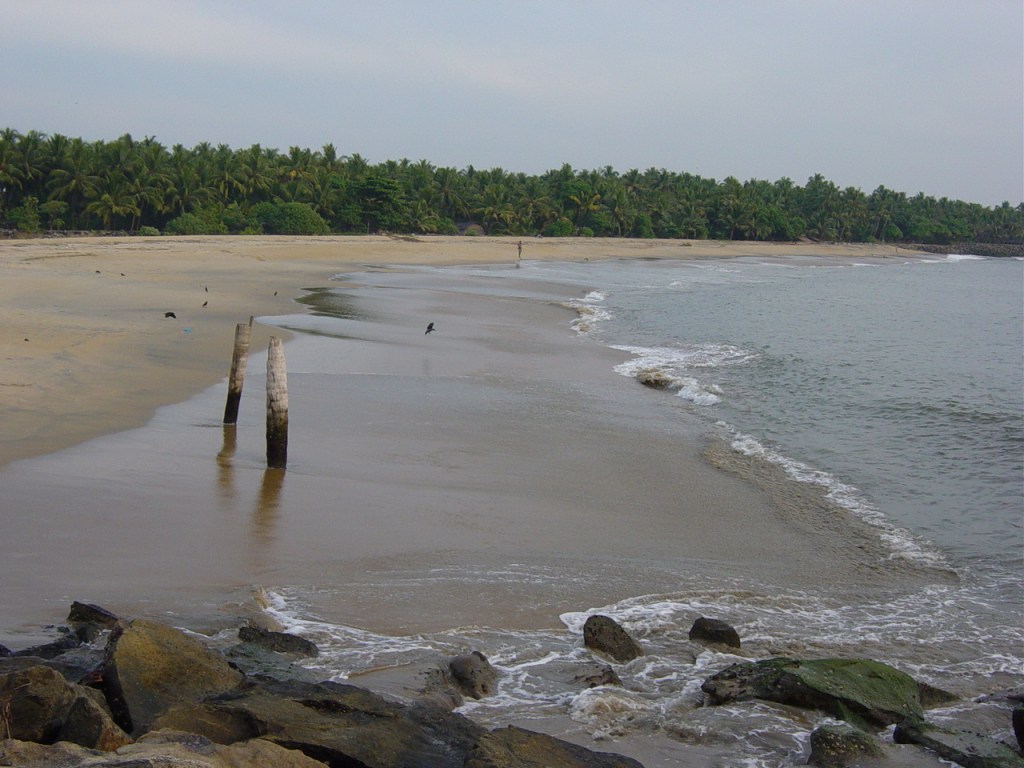
Munambam Beach

I recently came across a video featuring an interview with Stalin Devan, the activist managing the legal research and paperwork for Munambam. In this interview with Shajan Skariah, Stalin shares that Father Joshy added him to a WhatsApp group with the Munambam residents and said, “Explain one point from the Act every day in simple words.” Over time, Stalin became their legal guide, and his efforts are one of the main reasons the community now understands the law so well.

The interview was informative in many ways. At a time when there is still no clear update from politicians or the media on what is actually delaying the resolution for Munambam, even after the Waqf Amendment Bill was passed, Stalin explains the situation with complete clarity.

Stalin Devan Exclusive on Marunadan
A screenshot of the video

The Three Possible Legal Outcomes for Munambam

According to Stalin, there are three possible solutions for Munambam:

  • The government restores revenue rights immediately.
    This can be done at any time if the Chief Minister approves an administrative order restoring those rights.
  • If the Supreme Court upholds the High Court order declaring the land not Waqf, all cases, tribunal, revenue, and others will automatically end.
  • If the Supreme Court rules otherwise, the next legal step will rely on the amended law using Section 2A.

Why Section 2A Cannot Be Used Yet

Earlier, I assumed that recent positive court developments were on the basis of Section 2A. I later realised that was incorrect. Stalin’s interview clarified it. He said:

“We must wait for the rules to be notified. Only after the rules come into force can we use the amendment. As soon as the rules are published, we will file a new petition before the Waqf Tribunal. Once the new rules take effect, the Waqf Board’s order cannot survive.”

It was only through him that I learned the rules tied to the amendment have not yet been fully implemented (central rules were notified in July 2025, but further steps, such as central and state compliance and the ongoing Supreme Court matter, are still pending). Once implementation of the rules is complete, Munambam will be able to use the amendment (Section 2A) fully to establish its rights.

This is where politics begins to overlap with law.

Where Politics Meets Law

Stalin said:

“When everything is resolved, people should celebrate and then withdraw the protest with dignity. But politics entered the issue, and some withdrew support — not because the problem is unresolved, but because they feared the BJP might gain political mileage.”

This is why I feel that even though BJP is the party that helped Munambam with the establishment of new Waqf amendments that can prove favourable to Munambam residents, the Congress-led alliance (UDF) may still win the election there.

Strategically, it makes sense. Now that they’ve pushed the BJP to change the Waqf rules, Christian voters can continue supporting the party they feel protects their religious interests, especially one that does not interfere with missionary activity.

UDF has traditionally been the preferred choice of many Christian voters in Kerala. However, their position on the Waqf Amendment has not aligned with what Munambam residents expected or hoped for. Even so, Christian voters may still continue supporting UDF, largely because they align with the coalition’s lack of anti-conversion sentiment.

Why Timing Matters to BJP and CPM

Here’s where it gets interesting. What follows is only my analysis, not a confirmed claim:

As mentioned earlier, the amendment becomes fully usable only after the remaining implementation steps (central and state action, portal uploads, surveys, and Supreme Court clarity). That process can take months, sometimes more than a year.

Because of that, the timing is now in the hands of both the Central Government (BJP) and the Kerala Government (CPM). Residents say Rijiju has not been active recently. It is possible that the central leadership is waiting to see how the political situation evolves before re-engaging. The BJP may already understand that, even with the support they are offering, they might still not gain full trust or support from the Munambam Christian community. Religious identity often influences decisions more than political assistance. BJP may choose to wait and see whether their support translates into goodwill before offering more help or speeding up the process. In short, they might be waiting for election results to analyze public sentiment.

Meanwhile, CPM has not yet updated or published Waqf lists in the state gazette or uploaded them to the central portal. This is of utmost importance to implement the waqf amendment. CPM has not given explicit technical reasons for the delay.

Current Status of the Waqf Amendment Process (December 5, 2025)

Central Government (BJP)

The Act itself was published and came into force in April 2025. Rules were notified in July 2025. But implementation is still pending: WAMSI portal digitization is incomplete, nationwide surveys and audits have not been done, and the Supreme Court stay since September blocks key provisions.

The central government’s delay primarily reflects implementation challenges. However, political considerations may also play a role, as governments often pace sensitive rollouts based on election outcomes and political advantage.

Kerala Government (CPM)

CPM has not published Waqf lists in the Kerala state gazette. Nor have they uploaded lists to the central portal (90-day deadline under Section 2A). Waqf Tribunal and Board procedures are not aligned yet.

The Kerala government’s delay appears more political in nature. They seem to be officially resisting the amendment.

My view is that the full rollout (central setup, state compliance, and Supreme Court resolution) will now unfold at a pace influenced by political timing. Legally, the delay should not be indefinite, but in practice, regulations and execution can remain pending for a long time if the government chooses.

Why Munambam’s Leadership Is Remaining Neutral

Politics has made the situation complicated.

Many in the Munambam Land Protection Council do not want the BJP to gain politically, but they appear to be trying to remain neutral as the process is still unfinished. The ball is still in the court of both CPM and BJP. This may also explain why Church leaders reportedly asked Joseph Benny, the head of the Munambam Land Protection Council, to withdraw from the election as a UDF candidate. Any outright political affiliation may prove disadvantageous to Munambam residents at this stage.

***

Photo By നിരക്ഷരൻ at ml.wikipedia, CC BY-SA 3.0

Empuraan and Its Controversial Take on Gujarat Riots

Empuraan is facing criticism from the right wing for allegedly promoting a biased narrative. Many are calling it a political propaganda film with a pro-Congress stance. How true is the allegation?

Spoilers Ahead

I haven’t watched the movie yet, but I’ve heard that the first 30 minutes focus on the Gujarat Riots. It depicts some of the most horrific incidents from that time. Reportedly, the film includes a rape scene that’s highly debatable. This particular rape story has been circulating since the time of the Gujarat Riots but remains unverified, with no solid evidence to support it. Additionally, the Godhra train burning in the movie is reportedly depicted as something that happened by accident. This portrayal gives the impression that the film is based on the findings of the Banerjee Committee Report, a report that was later ruled invalid, unconstitutional, and politically manipulated by the court. The Nanavati-Mehta Commission Report is the report that was officially accepted as the authoritative account of events due to its presentation of evidence. This information was also covered in the recent film The Sabarmati Report.

The Banerjee Committee was set up in 2004 by the UPA government, led by the Congress party. The committee’s report was released just before the Bihar Assembly elections, apparently to influence the election results and weaken the BJP’s position. The report concluded that the Godhra train fire was accidental, contradicting the BJP’s stance that it was a pre-planned attack.

However, the Nanavati-Mehta Commission later confirmed that the train burning was a premeditated communal act, not an accident.

  • The investigation found that large quantities of petrol were purchased a day before the incident from a nearby petrol pump.
  • The forensic report confirmed the presence of petrol residues inside Coach S-6, where the fire broke out.
  • Eyewitnesses and forensic evidence suggested that petrol was thrown into the coach and set on fire, indicating a pre-planned attack rather than an accidental fire.

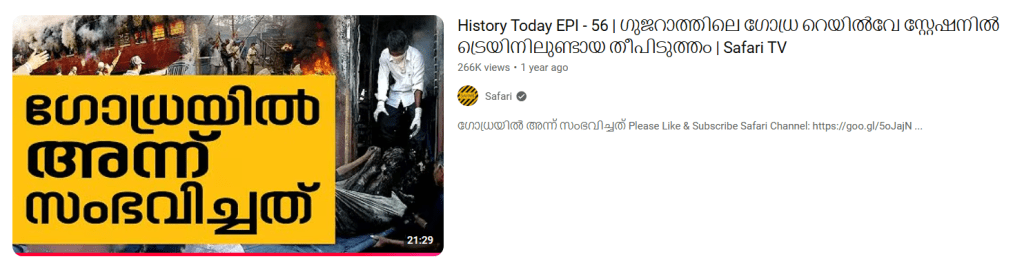
For Malayalees who prefer not to watch The Sabarmati Report, I recommend a documentary on YouTube by the Sanchari channel. It’s in Malayalam and provides a detailed account of the Godhra train burning. I am attaching a screenshot of the video below.

The documentary is likely one of the first of its kind in Malayalam. It offers a detailed look at the various angles of the Godhra train burning, the different reports that emerged, the political maneuvering involved, and the final conclusions drawn. If you are a Malayalee interested in research and fact-checking, I highly recommend watching this video.

Naturally, Congress is supporting Empuraan, just as the BJP backs right-wing films when they are released. Even if Empuraan turns out to be entirely pro-Congress, I support the creator’s right to make and release such a film. Several right-wing movies have been produced in India recently, so a left-leaning perspective is equally valid in a democratic space. However, as viewers, we must avoid taking any movie as absolute truth. Instead, we should conduct independent research, considering both left-leaning and right-leaning sources to develop a balanced understanding of the subject.

Justice for Sidharth – A Real Kerala Story

Justice for Sidharthan Wayanad

Sidharth was found dead at a college campus in Wayanad. The police initially downplayed things and declared that it was death by suicide. It was when a few friends visited Sidharth’s dad and emotionally told him there was more to the issue than what meets the eye that things started falling to light.

A post-mortem was conducted. Several attack wounds were found on Sidharth’s body. His stomach was found empty, indicating he had not eaten (or was not allowed to eat) for a day (or more). There were wounds on his neck, which experts say is unusual in a typical case of suicidal hanging (reference).

SFI students were found guilty of torturing Sidharth. He was stripped to his underwear, beaten mercilessly to exhaustion, had his phone taken away so he couldn’t contact anyone, and left without food and water (allegedly for days).

Why Was Sidharth Tortured?

Why SFI members in the Wayanad campus tortured Sidharth is unknown. Many stories are floating online:

  • Some SFI members say Sidharth was involved in a sexual molestation case (which was filed days after his death). SFI has been using that reason to justify the beatings and wounds.
  • Yet some others say it’s a severe case of ragging. However, which student faces ragging in his second year?
  • Some say it is because he proposed to a Muslim girl on Valentine’s Day. Prominent personalities, like the Governor of Kerala, have constantly accused SFI of harboring members of the PFI (a banned terrorist group) (reference). PFI (like ISIS) is said to be strictly against men from other communities pursuing Muslim women. They are said to “school” such people violently so that no one else would dare to commit such a “sin” again.
  • Then there are others who say it was a case of jealousy. The boys around Sidharth apparently did not like his growing popularity.
  • One section of the media says Sidharth was beaten up simply because he danced with senior female batchmates on Valentine’s Day.

However, nothing justifies his death. No student deserves to be brutally tortured this way, no matter what the issue.

Arrest of SFI Members

All SFI members accused of torturing Sidharth have been arrested (details).

Meanwhile, the Chief Minister of Kerala, Pinarayi Vijayan, is painfully silent. The champion of free speech and democracy has nothing to say about the issue. No condolences, no visits to Sidharth’s parents, and no strict actions against the SFI cadre. Why? Because his own student party is involved. If other parties had committed the same crime, he would have been the first person to thrash them.

Students in Kerala are scared to speak up against SFI. They wish to complete their studies in peace. It took a few North Indian students to report this case to the police. Only one Malayalee girl so far has been brave enough to come forward (details), requesting anonymity, condemning the SFI members of their crime. She revealed with tears how even friends turned foes and acted like vultures preying on the victim. She said she was scared, which is why she didn’t speak up sooner.

The same youngsters who are quick to criticize BJP and RSS maintain pin-drop silence when SFI/CPM is involved. This is concrete proof of the unprecedented authority SFI/CPM commands in Kerala – people are scared to criticize them. This stands in contrast to the type of authoritarianism attributed to the BJP, as criticism of the BJP does not evoke fear among the populace.

The Kerala Story

It is saddening that students in Kerala are threatened and bullied by party goons and are stopped from speaking against injustice.

How can parents send their kids to a college in Kerala with peace of mind if even our Chief Minister turns a blind eye to crimes in the state? Pinarayi has come up with many reforms to improve education, but why isn’t he focusing on the safety and security on college campuses? Why doesn’t his government take strict actions against SFI members who commit crimes as soon as he hears such news that is backed by concrete evidence? It took the governor, Mr Arif Khan, to suspend the VC after he was found incompetent to ensure decorum in the Wayanad campus.

SFI seems to have autonomy in many colleges. They are the only party present because they don’t allow the formation of other parties. Is this democracy? Is this freedom of speech?

Kerala is not the perfect peaceful state as it is portrayed to be.

Justice for Sidharth

How far will this case go? Will it be buried from the limelight in a few months? Will Sidharth’s parents get justice?

It’s heartbreaking to see his father’s emotional, tear-laden eyes in news channel discussions, while the SFI members watch on impassively without an iota of regret or compassion. Instead of defending their party, SFI and CPM members should be focusing on how to prevent such incidents in the future. Their lack of accountability is infuriating.

Congress party members, especially the Youth Wing, have shown remarkable solidarity by organizing marches against SFI and CPM in Kerala. In my opinion, Congress and other parties should call for the ouster of CPM from the I.N.D.I.A block until they ensure all criminals involved in Sidharth’s death are sentenced to several years of non-bailable imprisonment. They shouldn’t be released on meager grounds, which the CPM is capable of doing once the election is done and dusted. Many have lost hope in the state government. They don’t expect a fair trial.

BJP and RSS have been disappointingly absent. BJP members have supported Sidharth, but it is not the aggressive type we would have expected out of them. To win in Kerala, they must step up, be on the ground, and fight for causes with vigor. They should openly show solidarity, walk with the people, and address their issues.

Social Media Awareness

Social media is uncomfortably silent about this issue. Many in India would have fought for Sidharth if they knew there was a problem. But they aren’t aware because the media is not reporting the issue enough, and people in Kerala are scared to speak up about it. The ruling party in Kerala also knows how to cover up and downplay issues with lies and excuses, which their leftist supporters endorse without question.

I would request all political parties, whether the left or the right, and their supporters to forget their ideological & political differences and unite to fight against such crimes in Kerala. Only then will there be faith and forgiveness, a feeling of safety and security.

I wish I could link an explainer video for those unaware of Sidharth’s case. But sadly, no mainstream English-speaking or Hindi-speaking YouTuber, like Dhruv Rathee or Soch by Mohak Mangal, has covered this issue. More people should speak up so that no other student here again faces this kind of crime.

If you are a Keralite who prefers not to speak against political parties, I would advise you to use the most powerful tool in your possession – your vote – to express your disappointment. Similar crimes have happened way too often in Kerala, and we keep forgiving them. We should stop being lenient.

If you wish to learn more about Sidharth’s case, search for #JusticeForSidharth or #JusticeForSidharthan on Twitter or Facebook. Here’s hoping you would lend your voice to this fight against injustice.