Munambam Waqf Fight: Will BJP Finally Crack Christian Vote? (Legal Delays Inside)

Munambam Beach

I recently came across a video featuring an interview with Stalin Devan, the activist managing the legal research and paperwork for Munambam. In this interview with Shajan Skariah, Stalin shares that Father Joshy added him to a WhatsApp group with the Munambam residents and said, “Explain one point from the Act every day in simple words.” Over time, Stalin became their legal guide, and his efforts are one of the main reasons the community now understands the law so well.

The interview was informative in many ways. At a time when there is still no clear update from politicians or the media on what is actually delaying the resolution for Munambam, even after the Waqf Amendment Bill was passed, Stalin explains the situation with complete clarity.

Stalin Devan Exclusive on Marunadan
A screenshot of the video

The Three Possible Legal Outcomes for Munambam

According to Stalin, there are three possible solutions for Munambam:

  • The government restores revenue rights immediately.
    This can be done at any time if the Chief Minister approves an administrative order restoring those rights.
  • If the Supreme Court upholds the High Court order declaring the land not Waqf, all cases, tribunal, revenue, and others will automatically end.
  • If the Supreme Court rules otherwise, the next legal step will rely on the amended law using Section 2A.

Why Section 2A Cannot Be Used Yet

Earlier, I assumed that recent positive court developments were on the basis of Section 2A. I later realised that was incorrect. Stalin’s interview clarified it. He said:

“We must wait for the rules to be notified. Only after the rules come into force can we use the amendment. As soon as the rules are published, we will file a new petition before the Waqf Tribunal. Once the new rules take effect, the Waqf Board’s order cannot survive.”

It was only through him that I learned the rules tied to the amendment have not yet been fully implemented (central rules were notified in July 2025, but further steps, such as central and state compliance and the ongoing Supreme Court matter, are still pending). Once implementation of the rules is complete, Munambam will be able to use the amendment (Section 2A) fully to establish its rights.

This is where politics begins to overlap with law.

Where Politics Meets Law

Stalin said:

“When everything is resolved, people should celebrate and then withdraw the protest with dignity. But politics entered the issue, and some withdrew support — not because the problem is unresolved, but because they feared the BJP might gain political mileage.”

This is why I feel that even though BJP is the party that helped Munambam with the establishment of new Waqf amendments that can prove favourable to Munambam residents, the Congress-led alliance (UDF) may still win the election there.

Strategically, it makes sense. Now that they’ve pushed the BJP to change the Waqf rules, Christian voters can continue supporting the party they feel protects their religious interests, especially one that does not interfere with missionary activity.

UDF has traditionally been the preferred choice of many Christian voters in Kerala. However, their position on the Waqf Amendment has not aligned with what Munambam residents expected or hoped for. Even so, Christian voters may still continue supporting UDF, largely because they align with the coalition’s lack of anti-conversion sentiment.

Why Timing Matters to BJP and CPM

Here’s where it gets interesting. What follows is only my analysis, not a confirmed claim:

As mentioned earlier, the amendment becomes fully usable only after the remaining implementation steps (central and state action, portal uploads, surveys, and Supreme Court clarity). That process can take months, sometimes more than a year.

Because of that, the timing is now in the hands of both the Central Government (BJP) and the Kerala Government (CPM). Residents say Rijiju has not been active recently. It is possible that the central leadership is waiting to see how the political situation evolves before re-engaging. The BJP may already understand that, even with the support they are offering, they might still not gain full trust or support from the Munambam Christian community. Religious identity often influences decisions more than political assistance. BJP may choose to wait and see whether their support translates into goodwill before offering more help or speeding up the process. In short, they might be waiting for election results to analyze public sentiment.

Meanwhile, CPM has not yet updated or published Waqf lists in the state gazette or uploaded them to the central portal. This is of utmost importance to implement the waqf amendment. CPM has not given explicit technical reasons for the delay.

Current Status of the Waqf Amendment Process (December 5, 2025)

Central Government (BJP)

The Act itself was published and came into force in April 2025. Rules were notified in July 2025. But implementation is still pending: WAMSI portal digitization is incomplete, nationwide surveys and audits have not been done, and the Supreme Court stay since September blocks key provisions.

The central government’s delay primarily reflects implementation challenges. However, political considerations may also play a role, as governments often pace sensitive rollouts based on election outcomes and political advantage.

Kerala Government (CPM)

CPM has not published Waqf lists in the Kerala state gazette. Nor have they uploaded lists to the central portal (90-day deadline under Section 2A). Waqf Tribunal and Board procedures are not aligned yet.

The Kerala government’s delay appears more political in nature. They seem to be officially resisting the amendment.

My view is that the full rollout (central setup, state compliance, and Supreme Court resolution) will now unfold at a pace influenced by political timing. Legally, the delay should not be indefinite, but in practice, regulations and execution can remain pending for a long time if the government chooses.

Why Munambam’s Leadership Is Remaining Neutral

Politics has made the situation complicated.

Many in the Munambam Land Protection Council do not want the BJP to gain politically, but they appear to be trying to remain neutral as the process is still unfinished. The ball is still in the court of both CPM and BJP. This may also explain why Church leaders reportedly asked Joseph Benny, the head of the Munambam Land Protection Council, to withdraw from the election as a UDF candidate. Any outright political affiliation may prove disadvantageous to Munambam residents at this stage.

***

Photo By നിരക്ഷരൻ at ml.wikipedia, CC BY-SA 3.0

From 26/11 to Delhi Blasts: Why the “False Flag” Narrative Must End in India

What surprises me more than the terror attacks in India is the speed with which some Indians dismiss them as “false flag operations.” For instance, a look at the comments under Faye D’Souza’s Instagram post about the Delhi terror blasts shows several users mocking the incident and blaming the Indian government instead of the perpetrators. Many genuinely seem to believe it’s a political ploy to influence votes rather than an act of terror.

The “false flag” narrative isn’t new. It has surfaced after nearly every major terror attack in India. Even the 26/11 Mumbai attacks were, at first, misrepresented by some as an internal operation. The claim gained attention mainly because Ajmal Kasab, one of the attackers, wore a saffron thread on his wrist. Those spreading the theory strangely assumed such a thread could only belong to members of BJP or RSS. They overlooked the possibility that it might have been deliberately used to mislead investigators.

Ajmal Kasab with Saffron Thread on His Wrist

Kasab’s real plan, as later revealed, was to die appearing as a “Hindu” and thus shift suspicion away from Pakistan-based handlers, reinforcing the myth of “saffron terror.” Thankfully, due to the extraordinary courage and sacrifice of Assistant Sub-Inspector Tukaram Omble, Kasab was captured alive and later confessed to being a Pakistani national trained by terrorists.

Tukaram Omble and Mumbai 26/11 Attacks
Tukaram Omble

By then, however, the false-flag theory had already gained widespread circulation. Well-known public figures even released a book titled 26/11: RSS ki Saazish? that promoted the “false flag” theory surrounding the attacks.

Influential Figures Promoting RSS ki Saazish Book
Influential Indian Figures Promoting “26/11: RSS ki Saazish?” Book

The “false flag” narrative resurfaced after the Pulwama terror attack, when a suicide bomber from Jaish-e-Mohammed (JeM) drove an explosive-laden vehicle into a CRPF convoy in Pulwama, Jammu & Kashmir, killing 40 soldiers. Following the attack, some voices in Pakistan, including senior officials, suggested that India might have staged the incident to influence the upcoming 2019 elections. Commentators in India echoed similar theories online, framing the tragedy as politically motivated rather than acknowledging it as an act of cross-border terrorism.

Then came the recent Pahalgam attacks, where Pakistani media outlets and online commentators claimed that India had staged the incident to divert attention from domestic issues and influence elections. They described it as part of an alleged “Indian playbook” of false-flag operations. Soon after, similar talking points appeared in sections of Indian social media and commentary spaces.

In each case, claims of “false flag operations” lacked credible evidence and were primarily rooted in conspiracy theories first circulated in Pakistan and later amplified by certain opinion groups in India.

The Global “False Flag” Obsession

It’s worrying that many people in India tend to believe external narratives about terror attacks rather than trusting verified investigations at home.

This pattern might have been up for serious debate if it only happened locally, but the deflection from religious extremism appears to be a global trend. To cite a few examples:

  • The 9/11 attacks are still viewed by some as a “false flag” orchestrated by the U.S. or Israel to malign Muslims. This is a theory long disproved but still used by extremist groups to recruit followers. They thrive on anger, convincing vulnerable minds that violence is the only response to perceived oppression. In India, extremist recruiters have similarly exploited stories like the Babri Masjid while dismissing events like the Godhra train burning as conspiracies, weaving grievance into a tool for radicalization.
  • The October 7 attacks in Israel were also met with widespread conspiracy claims, framed as a false flag operation meant to discredit certain groups.
  • Likewise, criticism of regimes such as Iran’s leadership, the Taliban, or Hamas is often dismissed as Western propaganda. This is another form of deflection that prevents honest introspection.

Conspiracies Shield Extremists

It’s time to move past the overused “false flag” narrative.

Each time a terror attack is dismissed as a conspiracy, it insults the victims, weakens trust, and blurs the line between truth and propaganda. These baseless claims don’t protect anyone. They only embolden extremists and deepen divisions.

Real courage and national unity will come from confronting facts, condemning violence without bias, and demanding accountability from those who spread hate, no matter where it comes from.

Ending the false flag obsession is the first step toward restoring integrity in how we respond to terrorism.

Kerala Christians and Politics: Which Parties Really Stand With Them?

A picture of a church in India for an article on Kerala Christians and politics

As someone who’s chronically online and keeps up with news from all kinds of sources, mainstream, regional, left, and right, I’ve noticed something important: Christians in Kerala don’t really have a go-to political party anymore.

For a long time, people assumed the Indian National Congress (INC) was the party in Kerala that understood what every community wanted. But that idea seems to be changing fast on the ground.

Communal Conflicts in Kerala: Who Supports Whom?

If you’re new to Kerala politics, here’s a simple way to understand how parties respond to communal issues here:

  • Hindu vs Minority: CPM and Congress usually back the minority community.
  • Upper Caste Hindu vs Lower Caste Hindu: CPM and Congress generally side with the lower caste.
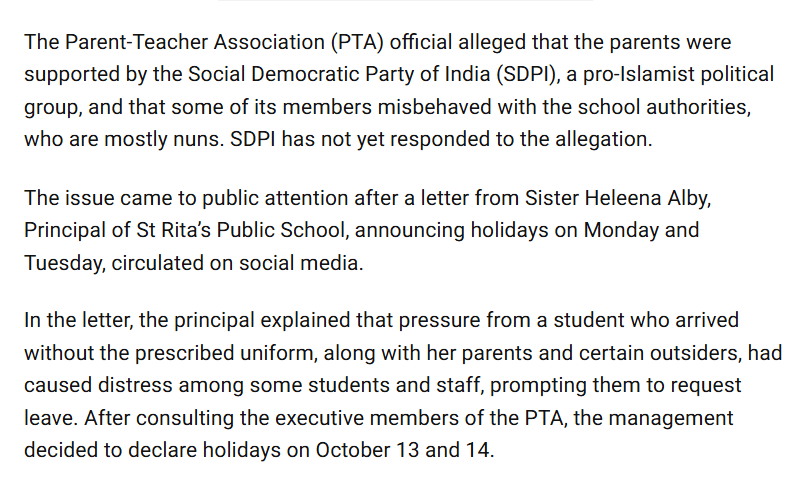
  • Christian vs Muslim: CPM and Congress often stay neutral at first, saying things like “we’ll look into it,” but in the end, they tend to side with Muslims. Examples include the Munambam Waqf issue, Professor Joseph’s case, Sona Eldhose’s conversion, and incidents involving SDPI bullying, such as the hijab case at the Christian-run St Rita’s school in Kochi (details in the image below).
Hijab controversy in Kochi school
News Source: “Hijab controversy forces school in Kochi to close temporarily after parents’ protest” (Mathrubhumi.com)

If you look at any case in Kerala, the pattern more or less stays the same. I’m not sure about regional politics in other states, but I suspect it’s similar elsewhere.

While BJP clearly positions itself as a Hindu party, there’s a growing sense in Kerala that Congress and CPM lean pro-Muslim. Why? It’s not really about religion. It’s about vote-bank politics. Christians are a minority among minorities in Kerala, so pandering to them doesn’t win many votes and can even cost support from other minority groups.

Growth of Chrisanghis in Kerala

Now, in Kerala, there’s a growing group called “Chrisanghis,” a term left-leaning voices like Arundhati Roy have used. These are Christians who support the BJP. Arundhati recently warned Christians in Kerala not to become Chrisanghis, citing conversion attacks in the North as a concern.

So why do some Christians support the BJP? It’s because they view Islamist groups like SDPI and Jamaat-e-Islami as a bigger threat than BJP. Many point to the persecution of Christians in countries like Nigeria by Islamist groups and feel that, compared to such threats, the BJP’s Hindutva agenda poses a lesser danger. At the same time, parties like Congress and CPM often downplay or ignore the activities of these Islamist groups in India, mostly for political gain, leading some Christians to see BJP as a safer option.

Congress support for Jamaat-e-Islami
News Source: “Congress in a fix as Jamaat arm readies to back theocratic state” (NewIndianExpress.com)

Notably, Jamaat-e-Islami has frequently been in the news, even recently, for persecuting minorities in Pakistan and Bangladesh. In India, its branch presents a secular image, likely to gain acceptance and influence within mainstream politics, using it as a pathway to gain power.

It’s also true that Kerala’s two mainstream parties have largely ignored such concerns from the Christian community. Their typical response is often, “Don’t fall for RSS/BJP propaganda,” even when the issues have nothing to do with RSS or BJP.

Thoughts

So what can the Christian population in India do in this situation? On one side, there’s a pro-Hindu or “Hindutva” party that will never fully accept conversions under “freedom of religion,” and on the other, there are parties that haven’t supported Christians when they faced threats from Islamist groups.

From my perspective, Christians should keep all parties guessing about where their votes will go. They shouldn’t strongly back any party, since none fully meets their needs. Take the Munambam Waqf issue, for example: the removal of Section 40 in the Waqf Bill allowed the Kerala High Court to rule the Waqf claim over Munambam land as illegal, protecting Christian landowners. Congress leaders like Hibi Eden tried to persuade residents to drop their case, saying nothing would come of it, while the only BJP MP from Kerala, Suresh Gopi, stood by the people, largely comprising Christian fisherfolk, and supported the amendment that ensured their land rights.

When missionaries face attacks by far-right Hindus in the North, that’s when Opposition parties step in. But in cases like the Chhattisgarh nuns’ arrests over alleged conversions, the local Congress in Chhattisgarh hardly protested, as taking a stand would have cost them votes. On the other hand, in Kerala, protesting the arrest of the nuns would have earned them support, which is why several Opposition leaders from Kerala traveled to Chhattisgarh to show solidarity.

This shows that Christians can’t rely fully on any party and should strategically make their political influence felt.

This is how politics works: there are no fixed principles for political parties. They act based on the local political context. Christians in India should remember this and avoid fully backing or rejecting any party. Instead, they can use this knowledge strategically and wisely, since different parties support them in different situations.

***

Photo by Pratheesh S

From India-Pakistan to Gaza: Exploring the Duality of War

Fire explosion with smoke

Personal observation: In almost every war, there’s always someone who doesn’t want it to end.

In the India–Pakistan war, many in India didn’t want the fighting to stop because they felt Pakistan hadn’t learned its lesson yet. Some even wanted the government to reclaim PoK (Pakistan-occupied Kashmir) during this time (which I strongly oppose).

When Israel attacked Iran’s nuclear sites, many anti-regime Iranians wanted the war to continue because they hoped the regime would fall.

The Israel–Gaza conflict is even more unusual. Many who kept calling for a ceasefire suddenly went quiet or were openly against it when finally announced. Maybe they had expected Israel to be driven out and a new Palestinian state to rise “from the river to the sea.” But that idea is unrealistic and only calls for more violence. Just like India will never give up Kashmir, Israel will never give up its land. Both countries get a lot of criticism for putting their own interests first. But, over the years, Jews and Indians have learned an important lesson: if they want their interests protected, they can’t rely on anyone else. When Indians get murdered in America, there’s next to no backlash. It’s the same case with Jews. History is also proof that when Hindus face persecution or genocide (Kashmiri Pandits, Sandeshkhali, Bangladeshi, and Pakistani Hindus), the world stays silent. In a world shaped by selective activism, these two communities have gradually learned to shed their passivity and docile nature, standing up for themselves without guilt. Indians, in my view, are still learning. Our tendency to stay silent runs deep. But since 2014, that’s starting to change, much to the annoyance of some. Apparently, a “good” Indian is still largely expected to be a silent one in the face of persecution and bigotry.

Anyway, the point is that in any war, there’s always duality. Those who push for the conflict to continue aren’t always on the “far-right.” Sometimes, they are far-left or far-right figures from other communities, disguised as leftist liberals. Take, for example, the India-Pakistan war. Many leftists in India wanted it to end and for peace to prevail. Yet recently, some of those same voices wanted Hamas to reject the peace deal, even at the cost of many lives.

I’ve often felt that the far-left and far-right are just two sides of the same coin. The recent wars and reactions to them over the years only validate this claim.

***

Photo by Pixabay

Why Do Hindus Vote for BJP?

BJP Supporters Waving Flag

I’m a Palakkad native, and I had travelled home just to vote during the Lok Sabha elections. To make it clear, I have no loyalty to any political party and have voted for different parties over the years based on their performance and activism. I believe pledging unwavering support to any single party prevents us from critically examining their flaws. However, this time, voting for the CPI(M) was not an option, as I am well aware of its shortcomings during its second term in power.

I decided I would vote for Congress in the Lok Sabha elections. But then October 7 happened, and I saw Congress’s response to it, especially how they tried to silence Shashi Tharoor in Kerala for criticizing Hamas. It came as a shock and played a key role in changing my decision. That’s when I realized, unfortunately, this party is no different from those it criticizes. The Opposition parties in India excel at criticizing far-right Hindu groups, but avoid condemning far-right Islamist groups in society, fearing backlash from supporters.

People call out the BJP and RSS for sheltering far-right Hindus. But how is Congress different if it shelters far-right Islamists? Both cater to extremes. BJP voters are criticized for supporting a party that allegedly wants to turn India into a Hindu nation. Congress voters should ask themselves the same question: why support a party that mollycoddles groups that have once openly called for turning India into an Islamic nation? How would it make the majority of Hindus feel?

So, when people ask why Hindus vote for the BJP, the answer is simple. If the choice is between far-right Hindus and far-right Islamists, many Hindus will pick what feels safer. Left-leaning Hindus may sympathize with Islamist groups, seeing them as victims. But most in the community, just like any other community, vote on the basis of safety.

Congress and Islamist Ties

In the upcoming Nilambur by-election in Kerala, the Welfare Party has now openly declared its support for the Congress candidate.

To the uninitiated, the Welfare Party is the political arm of Jamaat-e-Islami Hind, a group known for its fundamentalist views. This group shares roots with the Jamaat movements in Pakistan and Bangladesh, which are often accused of anti-Hindu activities.

As per the New Indian Express report, “It’s learned that the Welfare Party, backed by Jamaat-e-Islami, has put forward various demands, including making it an associate party of the UDF. However, no assurance has been received in this regard so far.” This is a common far-right Islamist tactic in democracies across the world: try to join mainstream parties to gain power, resources, and reach. Once these groups gain enough strength, their true agenda emerges, often centered around enforcing religious doctrine. We see this happening in Bangladesh today. A similar pattern unfolded in Iran in 1979, when leftists and Islamists joined forces to establish an Islamic regime. This led to widespread persecution and the exodus of many Persians, some of whom sought refuge in India.

Many leftists, in both India and abroad, often align with Islamist groups unknowingly, driven by a genuine desire to support the persecuted and uphold justice. However, this well-meaning approach is frequently exploited by far-right Islamist groups for their own agenda. It’s fair to say that many on the left still operate with this same mindset, unaware of the long-term consequences.

Such Islamist groups remind me of the Persian movie “The Seed of the Sacred Fig” (playing on Amazon Prime), a 2024 crime drama film directed by Mohammad Rasoulof. The movie starts with an explanation of strangler figs, a type of parasite that grows on a host tree’s branches. As they grow, their roots reach the ground and thicken. Eventually, they wrap around the host tree, in a way “suffocating” it. Over time, the host tree dies from lack of light and nutrients, while the fig survives independently. I hope Congress and other left-leaning parties realize that they are the “hosts” in this equation.

Both the Welfare Party and SDPI have been trying to win Congress’s favour in Kerala. Their open support was clearly visible in places like Palakkad (my hometown). The fact that Congress is not distancing itself from these groups is a matter of concern. The party appears to seek the support and votes of such groups to win, which may explain its consistent silence or hesitation in condemning Islamist acts. But how far are they willing to go? Will there come a time when they finally strike deals with the devil because they can’t win anymore without their support or votes?

Valid Concerns

Can you really blame Hindus for refusing to vote for parties that associate with groups that seem more likely to drag India down a path similar to Pakistan or Afghanistan?

Let’s not forget the current state of Bangladesh. JEI has played a significant role in steering Bangladesh toward radical Islam. If India were ever to become an Islamic nation, it wouldn’t resemble the UAE or Bahrain. It would more likely mirror Pakistan or Bangladesh, where radical Islamist groups wield substantial influence. Unlike the Gulf nations, which strictly ban and suppress such groups, India still hesitates to even name them. The moment any criticism is raised, it’s quickly dismissed as Islamophobia by human rights activists.

No One’s Truly Secular

In the end, no one is truly secular. Most people vote thinking, “Which party is best for my community?” — not for the nation. That’s why, in Kerala, Congress is the preferred party for many Christians, and a large section of Muslims support the Muslim League. So why is the burden of voting on the basis of secularism placed only on Hindus?

***

Feature Representative Image Source: Shutterstock

Book Review: “I Am A Troll” by Swati Chaturvedi

I finished I Am a Troll by Swati Chaturvedi last night. It’s an insightful read if you’re unaware that the BJP, like all major parties, has a dedicated IT cell.

I am a Troll by Swati Chaturvedi

However, if you’re already familiar with the BJP’s IT cell, the book doesn’t offer much new, apart from a few interviews with former BJP insiders who strongly criticize the party. But in Indian politics, this isn’t unusual. Members who leave any party, be it the BJP or Congress, often openly highlight its flaws. This trend isn’t unique to the BJP.

The book also points out that Modi’s official Twitter handle follows some controversial right-wing accounts like OpIndia, which is a valid observation. This is somewhat unusual; I’m not aware of any left-leaning political leader or party officially following social media influencers or accounts considered far-left. In that sense, this could be something unique to the BJP, and worth re-evaluating if it raises credibility concerns.

All that aside, the author’s pro-Congress bias is evident. She claims Rahul Gandhi was becoming as popular as Modi and predicted strong results for the Congress in the 2019 elections (the book was published in 2017). She lays emphasis on Rahul Gandhi’s social media growth, rather than his on-ground political performance. Chaturvedi presents his increasing followers and engagement as indicators of his strength and popularity, which feels selective and somewhat misleading. To appear balanced, she briefly mentions 2–3 false narratives that were pushed by the Congress IT cell, but downplays their impact.

The writing has its issues. Critiquing someone’s views is fine, but body-shaming, stereotyping Indian men, and mocking someone’s English skills feels unprofessional, especially from a journalist aiming to be objective. For example, consider the sample below, where she generalizes right-wing “trolls”.

Chaturvedi also complains that trolls refuse to engage with her reasoning on why the BJP is problematic, yet admits she zones out when they begin to speak. This contradiction weakens her argument and suggests a similar unwillingness to listen.

Interestingly, the book indirectly acknowledges that mainstream media was largely pro-Congress in 2014 (and still is in states like Kerala), which made it difficult for the BJP to be heard without strong social media outreach (reference to this is below).

These are a few minor concerns I had with the book, but overall, it provides a revealing look into political online warfare, though not without its caveats.