Why Do Hindus Vote for BJP?

BJP Supporters Waving Flag

I’m a Palakkad native, and I had travelled home just to vote during the Lok Sabha elections. To make it clear, I have no loyalty to any political party and have voted for different parties over the years based on their performance and activism. I believe pledging unwavering support to any single party prevents us from critically examining their flaws. However, this time, voting for the CPI(M) was not an option, as I am well aware of its shortcomings during its second term in power.

I decided I would vote for Congress in the Lok Sabha elections. But then October 7 happened, and I saw Congress’s response to it, especially how they tried to silence Shashi Tharoor in Kerala for criticizing Hamas. It came as a shock and played a key role in changing my decision. That’s when I realized, unfortunately, this party is no different from those it criticizes. The Opposition parties in India excel at criticizing far-right Hindu groups, but avoid condemning far-right Islamist groups in society, fearing backlash from supporters.

People call out the BJP and RSS for sheltering far-right Hindus. But how is Congress different if it shelters far-right Islamists? Both cater to extremes. BJP voters are criticized for supporting a party that allegedly wants to turn India into a Hindu nation. Congress voters should ask themselves the same question: why support a party that mollycoddles groups that have once openly called for turning India into an Islamic nation? How would it make the majority of Hindus feel?

So, when people ask why Hindus vote for the BJP, the answer is simple. If the choice is between far-right Hindus and far-right Islamists, many Hindus will pick what feels safer. Left-leaning Hindus may sympathize with Islamist groups, seeing them as victims. But most in the community, just like any other community, vote on the basis of safety.

Congress and Islamist Ties

In the upcoming Nilambur by-election in Kerala, the Welfare Party has now openly declared its support for the Congress candidate.

To the uninitiated, the Welfare Party is the political arm of Jamaat-e-Islami Hind, a group known for its fundamentalist views. This group shares roots with the Jamaat movements in Pakistan and Bangladesh, which are often accused of anti-Hindu activities.

As per the New Indian Express report, “It’s learned that the Welfare Party, backed by Jamaat-e-Islami, has put forward various demands, including making it an associate party of the UDF. However, no assurance has been received in this regard so far.” This is a common far-right Islamist tactic in democracies across the world: try to join mainstream parties to gain power, resources, and reach. Once these groups gain enough strength, their true agenda emerges, often centered around enforcing religious doctrine. We see this happening in Bangladesh today. A similar pattern unfolded in Iran in 1979, when leftists and Islamists joined forces to establish an Islamic regime. This led to widespread persecution and the exodus of many Persians, some of whom sought refuge in India.

Many leftists, in both India and abroad, often align with Islamist groups unknowingly, driven by a genuine desire to support the persecuted and uphold justice. However, this well-meaning approach is frequently exploited by far-right Islamist groups for their own agenda. It’s fair to say that many on the left still operate with this same mindset, unaware of the long-term consequences.

Such Islamist groups remind me of the Persian movie “The Seed of the Sacred Fig” (playing on Amazon Prime), a 2024 crime drama film directed by Mohammad Rasoulof. The movie starts with an explanation of strangler figs, a type of parasite that grows on a host tree’s branches. As they grow, their roots reach the ground and thicken. Eventually, they wrap around the host tree, in a way “suffocating” it. Over time, the host tree dies from lack of light and nutrients, while the fig survives independently. I hope Congress and other left-leaning parties realize that they are the “hosts” in this equation.

Both the Welfare Party and SDPI have been trying to win Congress’s favour in Kerala. Their open support was clearly visible in places like Palakkad (my hometown). The fact that Congress is not distancing itself from these groups is a matter of concern. The party appears to seek the support and votes of such groups to win, which may explain its consistent silence or hesitation in condemning Islamist acts. But how far are they willing to go? Will there come a time when they finally strike deals with the devil because they can’t win anymore without their support or votes?

Valid Concerns

Can you really blame Hindus for refusing to vote for parties that associate with groups that seem more likely to drag India down a path similar to Pakistan or Afghanistan?

Let’s not forget the current state of Bangladesh. JEI has played a significant role in steering Bangladesh toward radical Islam. If India were ever to become an Islamic nation, it wouldn’t resemble the UAE or Bahrain. It would more likely mirror Pakistan or Bangladesh, where radical Islamist groups wield substantial influence. Unlike the Gulf nations, which strictly ban and suppress such groups, India still hesitates to even name them. The moment any criticism is raised, it’s quickly dismissed as Islamophobia by human rights activists.

No One’s Truly Secular

In the end, no one is truly secular. Most people vote thinking, “Which party is best for my community?” — not for the nation. That’s why, in Kerala, Congress is the preferred party for many Christians, and a large section of Muslims support the Muslim League. So why is the burden of voting on the basis of secularism placed only on Hindus?

***

Feature Representative Image Source: Shutterstock

Book Review: “I Am A Troll” by Swati Chaturvedi

I finished I Am a Troll by Swati Chaturvedi last night. It’s an insightful read if you’re unaware that the BJP, like all major parties, has a dedicated IT cell.

I am a Troll by Swati Chaturvedi

However, if you’re already familiar with the BJP’s IT cell, the book doesn’t offer much new, apart from a few interviews with former BJP insiders who strongly criticize the party. But in Indian politics, this isn’t unusual. Members who leave any party, be it the BJP or Congress, often openly highlight its flaws. This trend isn’t unique to the BJP.

The book also points out that Modi’s official Twitter handle follows some controversial right-wing accounts like OpIndia, which is a valid observation. This is somewhat unusual; I’m not aware of any left-leaning political leader or party officially following social media influencers or accounts considered far-left. In that sense, this could be something unique to the BJP, and worth re-evaluating if it raises credibility concerns.

All that aside, the author’s pro-Congress bias is evident. She claims Rahul Gandhi was becoming as popular as Modi and predicted strong results for the Congress in the 2019 elections (the book was published in 2017). She lays emphasis on Rahul Gandhi’s social media growth, rather than his on-ground political performance. Chaturvedi presents his increasing followers and engagement as indicators of his strength and popularity, which feels selective and somewhat misleading. To appear balanced, she briefly mentions 2–3 false narratives that were pushed by the Congress IT cell, but downplays their impact.

The writing has its issues. Critiquing someone’s views is fine, but body-shaming, stereotyping Indian men, and mocking someone’s English skills feels unprofessional, especially from a journalist aiming to be objective. For example, consider the sample below, where she generalizes right-wing “trolls”.

Chaturvedi also complains that trolls refuse to engage with her reasoning on why the BJP is problematic, yet admits she zones out when they begin to speak. This contradiction weakens her argument and suggests a similar unwillingness to listen.

Interestingly, the book indirectly acknowledges that mainstream media was largely pro-Congress in 2014 (and still is in states like Kerala), which made it difficult for the BJP to be heard without strong social media outreach (reference to this is below).

These are a few minor concerns I had with the book, but overall, it provides a revealing look into political online warfare, though not without its caveats.

Empuraan and Its Controversial Take on Gujarat Riots

Empuraan is facing criticism from the right wing for allegedly promoting a biased narrative. Many are calling it a political propaganda film with a pro-Congress stance. How true is the allegation?

Spoilers Ahead

I haven’t watched the movie yet, but I’ve heard that the first 30 minutes focus on the Gujarat Riots. It depicts some of the most horrific incidents from that time. Reportedly, the film includes a rape scene that’s highly debatable. This particular rape story has been circulating since the time of the Gujarat Riots but remains unverified, with no solid evidence to support it. Additionally, the Godhra train burning in the movie is reportedly depicted as something that happened by accident. This portrayal gives the impression that the film is based on the findings of the Banerjee Committee Report, a report that was later ruled invalid, unconstitutional, and politically manipulated by the court. The Nanavati-Mehta Commission Report is the report that was officially accepted as the authoritative account of events due to its presentation of evidence. This information was also covered in the recent film The Sabarmati Report.

The Banerjee Committee was set up in 2004 by the UPA government, led by the Congress party. The committee’s report was released just before the Bihar Assembly elections, apparently to influence the election results and weaken the BJP’s position. The report concluded that the Godhra train fire was accidental, contradicting the BJP’s stance that it was a pre-planned attack.

However, the Nanavati-Mehta Commission later confirmed that the train burning was a premeditated communal act, not an accident.

  • The investigation found that large quantities of petrol were purchased a day before the incident from a nearby petrol pump.
  • The forensic report confirmed the presence of petrol residues inside Coach S-6, where the fire broke out.
  • Eyewitnesses and forensic evidence suggested that petrol was thrown into the coach and set on fire, indicating a pre-planned attack rather than an accidental fire.

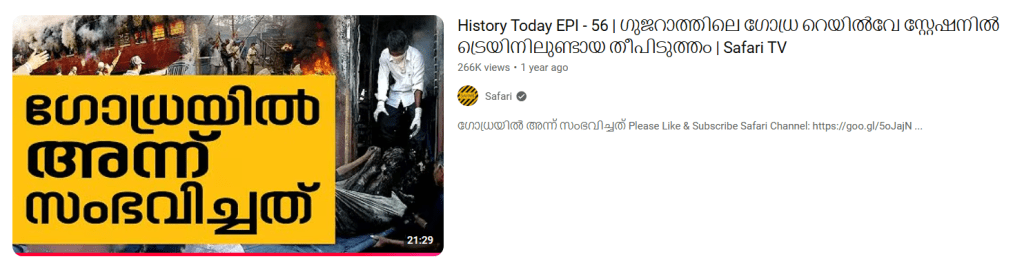
For Malayalees who prefer not to watch The Sabarmati Report, I recommend a documentary on YouTube by the Sanchari channel. It’s in Malayalam and provides a detailed account of the Godhra train burning. I am attaching a screenshot of the video below.

The documentary is likely one of the first of its kind in Malayalam. It offers a detailed look at the various angles of the Godhra train burning, the different reports that emerged, the political maneuvering involved, and the final conclusions drawn. If you are a Malayalee interested in research and fact-checking, I highly recommend watching this video.

Naturally, Congress is supporting Empuraan, just as the BJP backs right-wing films when they are released. Even if Empuraan turns out to be entirely pro-Congress, I support the creator’s right to make and release such a film. Several right-wing movies have been produced in India recently, so a left-leaning perspective is equally valid in a democratic space. However, as viewers, we must avoid taking any movie as absolute truth. Instead, we should conduct independent research, considering both left-leaning and right-leaning sources to develop a balanced understanding of the subject.

From Left to Right: My Journey of Political Awakening

I was once a leftist. However, at that time, I didn’t consider all sides of a story. Even though I am a Hindu, I was often dismissive of conflicts in which Hindus were victims in India, such as the Kashmiri Pandit genocide, the 1992 Ajmer rapes, the Moplah riots, and others. I coldly labeled the narratives as right-wing propaganda. I was radicalized to the extent I wasn’t open to other perspectives.

On October 7th, 2023, I experienced a significant shift in my perspective. I witnessed people justifying acts of violence, including rape and saw secular politicians in my country referring to it as resistance. This left me shocked. It wasn’t the BJP that influenced my change, but rather the people around me. The only individuals expressing outrage about these events were from the right wing, which took me by surprise.

Over the next couple of months, I underwent a monumental shift in my ideology that startled me. It felt like old layers of my beliefs were peeling away, making way for new understandings—a painful process. I came to realize that the principles of fairness and equality I had believed in until then were merely a façade. I also understood that I would likely be alone in this revelation.

The world operates in a contradictory and troubling way. People often expect unwavering support from others, yet when it’s their turn to show empathy, they respond with scoffing, mockery, and belittlement towards heinous crimes. They easily justify acts of violence, murder, and rape with statements like, “So what? They deserved it.”

It took me months to calm my anger and process the betrayal I felt when I discovered that some of my friends had become radicalized to the point of believing that rapes were justified. Until that moment, I had viewed the world through rose-colored glasses, believing it to be a kind place.

I then looked at my country with a fresh perspective and realized that similar patterns were at play here. Hindus seemed to have to compromise more than other communities in the name of secularism. I observed that many conflicts where the victims were predominantly Hindus were dismissed as propaganda, belittled, mocked, or invalidated, much like the rapes of Israelis on October 7.

I now identify as a right-winger. I consider myself center-right and hold no animosity toward anyone. In the past, I hesitated to label myself as a right-winger because almost everyone I know leans left. However, over time, I’ve moved past the fear of labels. People can judge or categorize me as they wish; as we age, labels become less significant. My shift in ideology is not due to any political party or its propaganda, but rather my observations of people’s behavior and their viciousness.

I have become more patriotic and now want everyone in India to adopt a “nation first” mentality. This is something I missed when I was a leftist; I felt that people weren’t sufficiently pro-India. I realize now that the center-right community is where I truly belong.

We, the center-right, believe in the following principles:

  • We are patriotic and uphold a “nation first” mentality.
  • We reject extremism from both the far-right and the far-left.
  • We take pride in the achievements of India.
  • We advocate for equal rights for everyone, regardless of their community.
  • We oppose appeasement politics.
  • We strongly support enhanced security measures.
  • We have zero tolerance for radical groups.

There are several negative aspects of the far-right that frustrate people like me. They should be held accountable by the government. However, I still feel positive about my country under strong leadership that has the courage to confront extremism.

Unfortunately, in India, when you openly call out extremism, you are declared Islamophobic. When radicals get arrested due to active participation in extremist groups, the country is declared Islamophobic. The global media often gets their news about India from the local left-leaning media which is notorious for giving one-sided stories. In this day and age of media bias, it is imperative to refer to both the left and right-wing channels to get a full balanced view.

It’s true that Islamophobia exists in India and the country should do more to protect its minorities. However, even if the BJP takes positive steps, it is unlikely to reduce the extreme victim mentality prevalent in the community that refuses to acknowledge any good done by the party. For example, the BJP introduced the Shadi Shagun Yojana scheme in which a Muslim girl is given Rs 51000/ when she marries after her graduation (BA, BSc, BCom, BE etc.). BJP banned the Triple Talaq. This is for Muslims alone. Most of the recipients of other welfare schemes have been members of the Muslim community. No ruler would have tried to uplift the Muslim community if they were Islamophobic. Riots and young children getting murdered due to terrorist activities in Kashmir have also drastically reduced. But these plus points are often blatantly ignored and many choose to judge Modi by the actions of the far-right.

A question to consider is: If Modi is still judged for the 2002 Gujarat riots, why isn’t Congress held accountable for the 1984 Sikh riots that they enabled, which were equally horrific? Politicians have contributed to deepening societal divisions by fueling narratives. Riots and violence instigated by one party are often deemed forgivable, while those provoked by another are considered unforgivable.

My political ideology is not fixed. I may shift from center-right to center-left in the future if I find that the center-left in India has become bold enough to openly oppose Islamist extremism as well, not just Hindutva. As of now, they do not meet that standard.

To end with a quote on pseudo-secularism in India:

To those who claim we are now living in a totalitarian, fascist, Hindu Rashtra, one must ask:

What kind of Hindu Rashtra is this where Ram Navami, Hanuman Jayanti, Durga pooja processions, and even Garba celebrations, are attacked and stoned with impunity? 

What kind of Hindu Rashtra is this where Hindus are forced to be refugees in their own land, where one can settle 40,000 Rohingya Muslims but not 700,000 Kashmiri Hindus, the land’s original inhabitants; where the judiciary says it is too late to prosecute those who raped, murdered, and ethnically cleansed lacs of Hindus? 

What kind of Hindu Rashtra is this where Hindu temples are exclusively controlled by the State, and where the government usurps hundreds of thousands of acres of temple land and is responsible for more than 100,000 temples losing lakhs of crores in rental income? 

What kind of Hindu Rashtra is this where the Right to Education Act discriminates only against Hindus and their schools, forcing tens of thousands of them to shut down? 

What kind of Hindu Rashtra is this where a communal violence law was about to be enacted through with only the Hindus would have been held guilty in a communal riot even if they were in a minority for example in Kashmir? 

What kind of Hindu Rashtra is this where court judgments like the Sabarimala and legislative enactments like the Hindu Code Bill purport to reform only Hindu religious practices but dare not touch practices of other religions, and if they do, the decisions are promptly reversed like in the Shah Bano case? 

What kind of Hindu Rashtra is this where the Waqf Act gives overarching powers to Muslims to declare a 1500-year-old Hindu temple to be on Islamic land when Islam is only 1300 years old? 

If this is how a Hindu is rewarded in a Hindu Rashtra, he’d much rather be in a Muslim Rashtra because then at least there’d be no pretence of equality.

Anand Ranganathan

Quick Bytes: Why are Indian Leaders Encouraging Women to Have More Children?

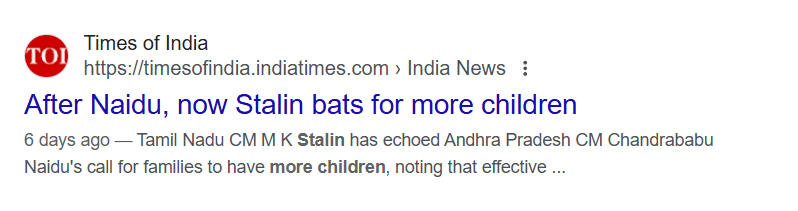
Why are South Indian leaders, like Stalin and Chandrababu Naidu, all of a sudden, pushing women to have more children? It’s not to combat the aging population as they make it seem. It’s all politics!

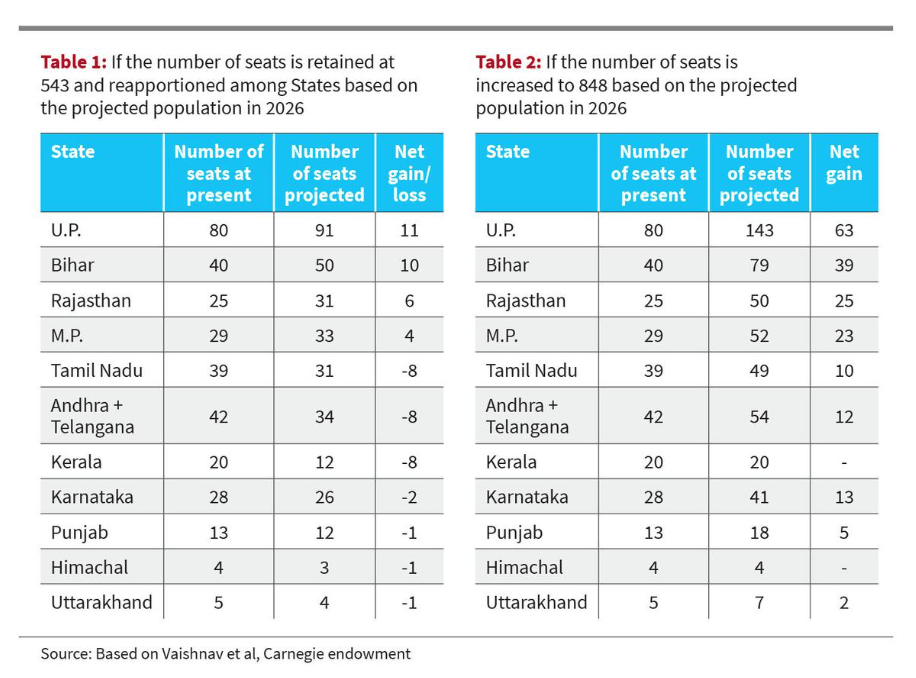
In India, there’s something called Delimitation. It’s a process of redrawing the boundaries of constituencies based on population. States with more population will get more constituencies, whereas those with low populations, like southern states, will get fewer seats. Basically, the exercise is to ensure each constituency has an equal number of people.

Since South India’s population growth is decreasing, plus migration, it won’t need as many constituencies. The total number of constituencies in Lok Sabha has been frozen since the 70s and is in place until 2026. 2026 is almost here! This is why politicians in South India are worried about women not having enough children. They don’t want to lose their seats.

As per The Hindu newspaper, Kerala, Tamil Nadu, Andhra + Telangana, all of which are South Indian states, stand to lose 8 seats each, if the current number of seats in Lok Sabha (543) is maintained.

We can expect Pinarayi Vijayan, the CM of Kerala, to make a similar statement next.

Biggest Surprises in Jammu Kashmir and Haryana Elections 2024

Jammu & Kashmir Election Results
Courtesy: ECI Website

While reading today’s newspapers, an interesting trend caught my eye. Most newspapers in India are left-leaning, so election results are primarily presented in a way that props up the left-leaning parties. For example, “NC got a thumping victory,” in contrast to a more subdued “BJP earned a hat-trick in Haryana.” No fancy adjectives. Another example is “J&K has rejected BJP’s politics” while failing to report that BJP’s vote share has been increasing in J&K with every passing election. In some newspapers, Vinesh Phogat’s win was highlighted more than the overall performances of individual parties.

The election results declared on 8th October have been filled with surprises. However, due to the media’s own biased leanings, not every fact made it to the papers. Here are some of the top surprises from the Haryana and J&K Elections 2024.

BJP getting more seats than Mehbooba Mufti’s PDP in J&K

From a party that used to get single-digit votes in Kashmir, BJP’s vote count has now risen to four digits. The party came second in J&K, beating Mehbooba Mufti’s PDP.

PDP is an indigenous Kashmiri political party. The party has been on the political scene in Kashmir for ages. This time, most of the PDP’s votes went to NC in the Kashmir region. PDP’s association with the BJP in the recent past proved to be its undoing. Interestingly, this camaraderie did not have the same effect on the BJP, as its vote share increased from the 2014 elections.

Jammu & Kashmir Seats and Vote Share
Courtesy: The Hindu

No one, including BJP members, ever countered the fact that BJP would not win a single seat in Kashmir. It was reported that even the people of Jammu, along with Kashmiri Pandits, BJP’s primary vote base, were dissatisfied with the saffron party as their demands were left unaddressed.

Considering that politicians like Omar Abdullah were saying there was intense anger brewing in the valley beneath the surface of peace and tranquility, it was surprising to see the BJP not only increase its number of seats without an alliance but also its overall vote share in J&K albeit marginally, as compared to the 2014 elections.

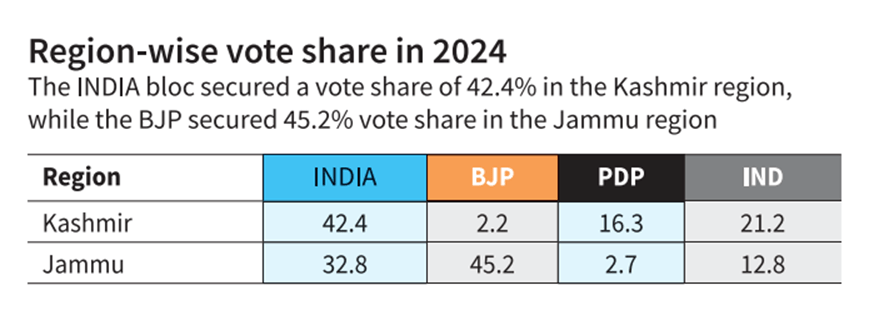
If we were to analyze just Kashmir alone, the BJP neither lost nor gained its vote share (2.2%) in the region. So, in summary, the BJP increased its seats/vote share in Jammu while maintaining its vote share in Kashmir. If the Abrogation of Section 370 was indeed a major point of discontent for J&K locals, we should have seen a drastic decrease in BJP’s seat count/vote share. But that’s not what happened.

Jammu & Kashmir Region-wise Vote Share
Courtesy: The Hindu

The media and politicians might paint the Kashmir election results as a big loss for the BJP and a “befitting reply to BJP by the people for the Abrogation of 370”, but the data seems to indicate otherwise. Yes, they did not win a seat, but the fact that in many seats of Muslim-dominated Kashmir, BJP came second, beating Congress and PDP, implies there’s far more to the story than what meets the eye.  

BJP losing Gurez in Baramulla by a mere 1132 votes

Gurez is a seat that is 98% Muslim and where the BJP did not have any presence till now. Faqeer Mohammad Khan from the BJP lost by a mere 1132 votes to NC’s Nazir Ahmad Khan.

This close contest has been the biggest shocker from the Kashmir region, considering the BJP is always portrayed as an “anti-Muslim” party.

Gurez Kashmir
Courtesy: ECI Website

BJP’s Shagun Parihar winning Muslim-dominated Kishtwar seat

Shagun Parihar BJP
Shagun Parihar

There is a misconception that Jammu is a “Hindu-only” area and Kashmir is a “Muslim-only” area. Jammu has areas with a significant Muslim population. One such area is Kishtwar, a district that has long been a hotbed of militant activities.

Shagun’s father and uncle were murdered by Hizbul Mujahideen terrorists in 2018. She initially had no plan to join politics, but after the murder of her father and uncle, she felt the need to bring about a change. Her victory, albeit by a small margin, proved to be sweet revenge.

Speaking to the media after the verdict, she said: “We have lost a large number of our soldiers. I have lost my father, and some have lost their brothers and sons. My first effort will be to ensure that every child here has the shadow of a father over his head and that there is peace and prosperity in the area. My efforts will be to bring happiness to every home.

Jamaat-e-Islami and former separatists faced a big loss in J&K

When members from banned radical groups like Jamaat-e-Islami and former separatists were allowed to contest this election individually, many were worried.

As Kashmir continues to be a sensitive zone, analysts questioned the motive behind this move and the consequences of having radical elements elected into power. However, the people of J&K answered this pressing question through their votes, resoundingly rejecting the radicals and choosing a party like the National Conference instead, which believes in working democratically within the rules of the Indian constitution. This has come as a relief for many, especially since Engineer Rashid was elected as MP in the Lok Sabha elections.

The loss of Engineer Rashid’s party in the J&K election has provided ample proof that his victory in the Lok Sabha elections was a case of sympathy voting. His sons had extensively campaigned for him before general elections, saying the only way their father could escape jail was if he became an MP. However, in the case of the J&K elections, Kashmiris seemed to have drawn a line, and Rashid was unable to replicate his victorious stint in the general elections.

Congress in a way lost both Haryana and J&K

Even though Congress is an ally of the NC in J&K, their standalone performance proved to be lackluster. Congress managed to earn only 6 seats in J&K, compared to BJP’s 29. This cannot be considered a victory for Congress. In Jammu, too, an area where they were stationed to put up a strong fight against the BJP, they managed to win only one seat.

NC leader Omar Abdullah admitted post-election that, in hindsight, the alliance was unnecessary as they would have won the election anyway without the help of Congress.

Haryana outcome

Haryana’s election results came as a shock to everyone, including right-wingers. The trend was overwhelmingly leaning towards anti-incumbency in the state. BJP has been ruling Haryana for over a decade, and there were a plethora of issues surrounding “farmers, soldiers, and wrestlers” plaguing the state.

However, around a month back, it was reported that the non-Jats were having second thoughts about Jats supporting Congress and gaining power. This led to a consolidation of non-Jat votes against Congress. It is a simple case of caste-based politics gone wrong for the party.

Haryana Election Results
Courtesy: The Hindu

RSS played a huge role in BJP’s victory

Reportedly, RSS went above and beyond in Haryana, campaigning door to door, distributing pamphlets that highlighted the dangers of caste-based divisive politics, ensuring everyone got their voter slips on time, and organizing outreach programs.

In the Lok Sabha Elections, it was reported that there had been a fallout between the BJP and RSS, which led to RSS members not making any effort to help the BJP. BJP seems to have realized its blunder post-election and made a conscious effort to re-establish connection with RSS, which is undeniably its backbone. Several changes were made in Haryana based on RSS’ recommendations. It ended up proving effective.

Conclusion

Yet again, Exit polls in India have turned out to be a disaster. You never know what the janta is thinking. There are silent voters who make their stance known only through their votes. Exit polls have been unable to infiltrate that section.

One thing is clear: this election has been a big win for democracy, especially in the Kashmir valley. The turnout was impressive. The trust they placed in the Indian democratic process is noteworthy. As Modi mentioned, the peaceful conduct of the J&K election has proven to be a victory in itself.