How the DEI Program Fostered Biases

How the DEI Program in USA Contributed to Fostering Biases

A recent set of DEI studies explores a critical question: Do the ideas and narratives central to many DEI trainings truly promote inclusivity and empathy?

Or do they end up deepening divisions and fueling hostility toward groups labeled as oppressors?

DEI Study Source: static.foxnews.com/foxnews.com/content/uploads/2024/11/anti-oppressive-dei-report-8.pdf

Social Experiment #1 – Exposing One Group to DEI Essays

The study found that individuals exposed to DEI material were more likely to perceive problems even where none existed. For example, one group was presented with a DEI essay by Ibram X. Kendi and Robin DiAngelo, while another group was not. Both groups were then asked to analyze the following scenario:

A student applied to an elite East Coast university in Fall 2024. During the application process, he was interviewed by an admissions officer. Ultimately, the student’s application was rejected.  

A simple, straightforward survey. The scenario was deliberately created without mentioning the race or ethnicity of either the student or the admissions officer and contained no indicators of racism. Participants were then asked to evaluate the scenario using questions meant to assess how much racism they perceived in the interaction.

Results: The analysis showed that participants who read the Ibram X. Kendi/Robin DiAngelo essay developed a hostile attribution bias. They viewed the admissions officer as significantly more prejudiced compared to those who read a neutral essay. Despite no evidence of discrimination in the scenario:

  • Perceived discrimination rose by 21%
  • Perceived unfair treatment increased by 12%
  • Perceived harm to the applicant rose by 26%
  • Perceived microaggressions jumped by 35%

These strong results led NCRI to replicate the experiment with a national sample of college students, confirming that the effects were not limited to the original set of students. The follow-up study found similar outcomes.

Social Experiment #2 – Exposure to Anti-Islamophobia Training

Similarly, a nationally representative sample was recruited via Amazon Prime Panels to assess the impact of anti-Islamophobia content. Participants were shown two identical terrorism trial scenarios, one involving Ahmed Akhtar and the other George Green, both convicted of the same crime. In the group that did not receive anti-Islamophobia training, both trials were perceived as equally fair, showing no inherent bias or perception of Islamophobia. However, in the group exposed to anti-Islamophobia content, perceptions shifted: while views on George’s trial remained unchanged, Ahmed’s trial was rated as significantly less fair.

This indicates that exposure to anti-Islamophobia messaging led participants to perceive bias where none existed, introducing a new bias in favor of Ahmed despite both cases being identical.

These results suggest that anti-Islamophobia training may lead people to assume discrimination against Muslims, even in the absence of actual bias.

Concerns: How much is too much?

This reflects a broader concern. The DEI programs that heavily emphasize victimhood and systemic oppression may unintentionally distort perceptions of fairness, as also seen in the case of Hindu Brahmins. While these trainings aim to highlight real injustices, they also foster hostile attribution bias, a tendency to see prejudice where none exists.

Such distortions risk undermining public trust in institutions, even when those institutions are acting fairly. This is especially troubling given that these institutions, such as ISPU, also provide Islamophobia sensitivity training to federal agents.

Food for Thought

It makes us, Indians, reflect on our own perspectives too. How much of what we believe is shaped by personal thought and observation, and how much is simply absorbed from what we’ve read, heard, or been told?

We’re constantly surrounded by voices telling us what’s right, what’s wrong, what to support, and what to reject, so much so that we often stop thinking critically. We rely on others to give us the “truth,” but how can we be sure those sources are unbiased or even complete?

In the pursuit of justice, I see a troubling pattern: one group being demonized, while another’s wrongdoings are overlooked. That’s not justice, it’s imbalance.

True justice can only be achieved when we hold all sides accountable, without bias, without exception. To do that, we need to cultivate a rational, balanced mindset, one that isn’t rigid or exclusionary. Listen to all sides, and stand with the truth, not with narratives that vilify entire communities or sections of society.

***

Photo by cottonbro studio
No One’s Truly Secular in India

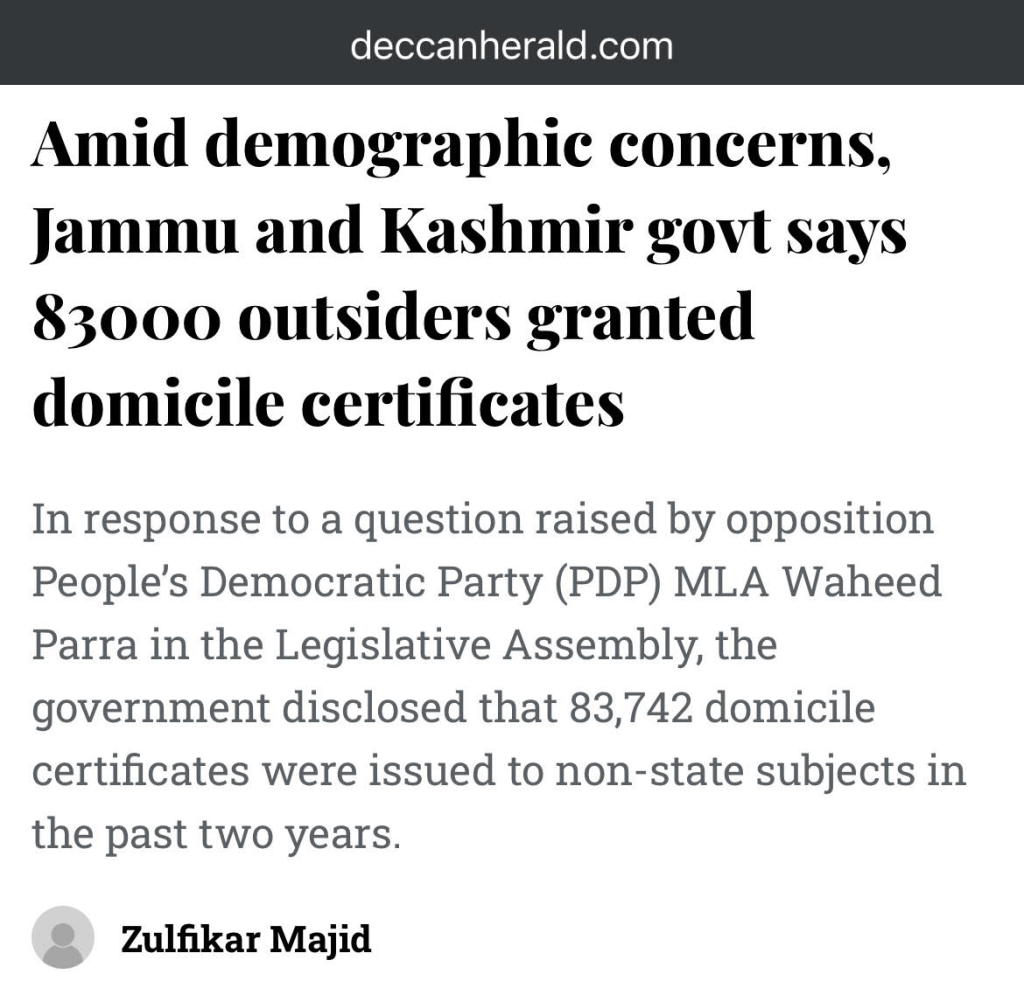
Newspaper clipping on demographic concerns in Kashmir

Say the words “demographic concerns” in any other Indian state, and you’d likely be branded a bigot. But in Kashmir, the “insider vs outsider” narrative is not only common, it’s actively pushed. If the Chief Minister, Omar Abdullah, has sworn allegiance to the Constitution of India, why the reluctance to openly embrace fellow Indians as equals? Kashmiris are free to work and settle anywhere in the country without being called outsiders. So why can’t someone from another Indian state do the same in Kashmir without facing hostility?

What India needs now more than ever is a spirit of unity. Not this constant “us vs them” divide.

These incidents make it clear: no one is truly secular, not even those who constantly criticize Hindu majoritarianism like Omar Abdullah. Let’s be honest. In Muslim-majority Kashmir, a fashion show during Ramadan sparked outrage, with people claiming it was against their “culture.” In parts of Malappuram and Kozhikode in Kerala, there have been cases where people were told not to eat in public during Ramadan. Meanwhile, in some Hindu-majority regions of North India, meat shops are ordered shut during Hindu festivals. Different standards, same mindset.

This isn’t just an Indian phenomenon. In the UK and the US, you’ll often hear people say, “We are a Christian country. This isn’t our culture!” whenever Hindu or Muslim festivals are celebrated in public spaces. The reaction is the same, just the setting changes.

Wherever you go, majority vs minority dynamics are always at play. What feels like a “religious restriction” to one person might feel like cultural protection to another. It all depends on your bias and perspective. Take Iran, for instance. Many of us might see it as deeply restrictive for women. But some Iranian Muslim women might see it as ideal because it strictly upholds their religious values. That’s religious bias in action – shaped by belief, identity, and comfort with the dominant culture.

Most people are secular only on paper. In reality, they tend to place their own religious beliefs a notch above others. They’re usually comfortable with the rules their faith imposes, no matter how restrictive those rules might seem to someone outside that belief system. It’s less about universal values and more about what feels familiar and justified to them.

An Ode to Questioning Biases

I have been increasingly questioning my biases lately.

Social Media Bias

How my opinions are largely formed by what the media is showing me. Sometimes, never bothering to look at the “other side.” A kind of blind faith that the news portals will show me only the truth and nothing but the absolute truth.

This belief was shaken up quite a bit when I understood that a lot of times, the media chooses to pick a side and highlight only that part of the story. We never get to know why “the other side” acted the way they did, said the things they did. It is well hidden. We never get to know the full picture. There are times I have made that extra effort to know more.. and have been amazed at how well the media hides bits and pieces of relevant information. The kind of information that wouldn’t have agitated the people so much if it were to be revealed alongside the flustering headline (or at least at the top of the news article). Add to that the social media’s personal opinions, which again, most often than not, do not give the complete picture.

With all this excessive one-sided information, a person who used to feel concerned about the issue in a healthy way before is left extremely agitated, angry and restless in a matter of minutes. The issue won’t leave your head. It stays with you when you sleep, it is the first thing you think of when you wake up. You snap at the drop of a hat, refusing to see any other angles. This keeps happening each time a new issue pops up. Imagine the stress your body has to go through, taking the world’s collective burden on your shoulders. In short, it just messes up your mental health.

I have had to log out of my social media accounts multiple times in the last one year just to calm myself down and to dissociate from all the noise. During such moments I often think, is social media a boon or a bane?

Information Bias

A large number of social media influencers (the ones who review movies) are largely influenced by critics and the media. If the critics say it is a good movie, they will say it is a good movie. If the critics thrash a movie, they will say it is the worst movie of the decade. I was so caught up in this information bias, that I was afraid of saying that I liked a movie that the majority hated. I was also afraid of saying I did not enjoy a movie that the majority liked. Because then, the movie shaming begins. Your taste in movies is questioned.

It is the case with almost anything, not just movies. If the general review of a product is positive or negative, you are expected to have the exact same view. Herd mentality in such cases is encouraged. If you step out of the box, you are questioned.

That was until I got out of that zone and said to myself “You know, I laughed watching this movie. It is funny. It worked for me. Why should I ashamed of something that kept me entertained throughout?” I started being open about liking the movies I really liked (even if they weren’t critically acclaimed) and not liking the movies that I truly did not (even if they were liked by the majority). I was being true to myself and that felt good.

I realized there were more people like me out there, shying away from voicing their true likes/dislikes, when I started getting messages (in private) that they liked/hated the same thing too.

Halo Effect

When you admire a person (it could also be a celebrity, politician or government), you tend to believe that everything the person does is justified – whether good or evil. We refuse to believe they are human after all – prone to mistakes. We forgive and forget. This is a bias I am trying to overcome as well. Trying consciously to notice and acknowledge those errors even if I like the entity very much. To hold them accountable if feelings were hurt, and not to give them the status of a superior being who is incapable of mistakes.

I have been reading up on biases and media bias is something that struck me the most. When you seek more information about something, weirdly enough, you start noticing these little things that you used to ignore before. You become aware of the biases that are now part and parcel of your daily life.

It is a scary thought to reflect on, that you can be manipulated into believing something that is constantly thrown in your face, as if there is no other truth.