I watched Dhurandhar a few days back, and it has stayed with me ever since. It keeps running in my head – the songs, the action sequences, the passion for the country. The nationalist in me is satisfied.
For the first time in a long while, an Indian spy movie moved away from humanizing terrorism. That shift feels bold and necessary. The film forces you to sit with harsh truths instead of offering easy heroes and neat endings. It does not try to make violence look noble or harmless. That honesty is what makes Dhurandhar powerful, and also hard to shake off.
Personally, I felt a quiet mix of angst and sorrow when I saw some people brush the film off as propaganda or political. This view is subjective, but it still made me uneasy. The events shown are not opinions or theories. They happened. Calling a film like Dhurandhar propaganda does a disservice to the people who lost their lives in terrorist attacks. It dismisses real events that happened and real pain that was lived. These truths were not addressed openly for years, often out of fear or sheer convenience. When cinema finally creates space to tell these stories, the instinct should be to listen, not reject. The strong box office response shows that many people are ready to face uncomfortable realities. That response matters. Aditya Dhar deserves credit for choosing honesty over comfort. I have admired his films for consistently daring to tell stories most would rather avoid.
When the screen turned red, I could not hold back my tears. It made me emotional. But I also wondered if anyone watched that moment and felt nothing at all. That thought itself felt disturbing. Not feeling the pain of fellow Indians, or even a flicker of anger, says something deeper. In a country where apathy is already common, it is easy to believe some viewers saw it with blank eyes. For them, everything uncomfortable becomes propaganda, dismissed as an attempt to show Pakistan in a bad light.
Sometimes it feels like a lost cause to expect people to stand firmly with the country, without hesitation or filters. Many of us avoid the truth because it feels uncomfortable. We prefer to hide behind safe words like peace and love. But years of doing that came at a cost. We were taken for granted. Our suffering was questioned. Our stories were dismissed as lies or branded as conspiracy theories.
I think it is time for India to stand up for itself. We need to acknowledge our truth and stop looking away. Facing reality head-on is not hatred or extremism. It is honesty. Only when we accept what went wrong can we learn from it. Growth does not come from denial. It comes from clarity, courage, and accountability.
Now there are people who argue that this much truth does not belong on screen. If that were true, then why do we make social films like Homebound at all? Those films are also hard-hitting and deeply uncomfortable. Cinema has always helped bring difficult issues to the public in a more digestible way. Stopping that only pushes reality back into silence.
The violence in the movie is also being criticised, but real-world events prove how close such scenes are to the truth. The recent lynching of a Hindu man in Bangladesh is a grim reminder that brutality is not exaggerated fiction. Dhurandhar does not sugarcoat this reality, and that honesty is exactly why it matters.
Coming to the performances, while many are praising Akshaye Khanna, for me it was Ranveer Singh who truly stood out. His eyes did most of the talking, and it was brilliant to watch. There was a quiet intensity in his acting that stayed with me. Sara Arjun also impressed me with her performance and screen presence. She brought both grace and emotional weight to her role. The music deserves special mention too. It lingers in your mind and pulls you back into the world of Dhurandhar long after the film ends.
Overall, I would say Dhurandhar is a must-watch. It is not an easy film, but it is an important one. It stays with you long after the credits roll. I most probably would end up watching it again.
Personal observation: In almost every war, there’s always someone who doesn’t want it to end.
In the India–Pakistan war, many in India didn’t want the fighting to stop because they felt Pakistan hadn’t learned its lesson yet. Some even wanted the government to reclaim PoK (Pakistan-occupied Kashmir) during this time (which I strongly oppose).
When Israel attacked Iran’s nuclear sites, many anti-regime Iranians wanted the war to continue because they hoped the regime would fall.
The Israel–Gaza conflict is even more unusual. Many who kept calling for a ceasefire suddenly went quiet or were openly against it when finally announced. Maybe they had expected Israel to be driven out and a new Palestinian state to rise “from the river to the sea.” But that idea is unrealistic and only calls for more violence. Just like India will never give up Kashmir, Israel will never give up its land. Both countries get a lot of criticism for putting their own interests first. But, over the years, Jews and Indians have learned an important lesson: if they want their interests protected, they can’t rely on anyone else. When Indians get murdered in America, there’s next to no backlash. It’s the same case with Jews. History is also proof that when Hindus face persecution or genocide (Kashmiri Pandits, Sandeshkhali, Bangladeshi, and Pakistani Hindus), the world stays silent. In a world shaped by selective activism, these two communities have gradually learned to shed their passivity and docile nature, standing up for themselves without guilt. Indians, in my view, are still learning. Our tendency to stay silent runs deep. But since 2014, that’s starting to change, much to the annoyance of some. Apparently, a “good” Indian is still largely expected to be a silent one in the face of persecution and bigotry.
Anyway, the point is that in any war, there’s always duality. Those who push for the conflict to continue aren’t always on the “far-right.” Sometimes, they are far-left or far-right figures from other communities, disguised as leftist liberals. Take, for example, the India-Pakistan war. Many leftists in India wanted it to end and for peace to prevail. Yet recently, some of those same voices wanted Hamas to reject the peace deal, even at the cost of many lives.
I’ve often felt that the far-left and far-right are just two sides of the same coin. The recent wars and reactions to them over the years only validate this claim.
There’s so much I want to say about Being Hindu in Bangladesh, a book written by Avishek Biswas and Deep Halder, but I don’t think my words would do justice to my emotions. Whatever I write would be a watered-down version of what I felt while reading.
The authors are sons of refugees who once fled Bangladesh. They wrote this book during Sheikh Hasina’s rule, a time when they could safely visit Hindu areas and speak openly with locals, scholars, and researchers about the past.
It was a deeply uncomfortable read. Especially as I kept coming across recent posts from people in Bangladesh on Reddit, worried about the country slipping back into radicalism. It felt like history was repeating itself. On top of that, there were people, including the global and Indian left-leaning media, trying to downplay the communal angle in Bangladesh so as not to flare up Islamophobia. As an ex-leftist, this behaviour is all too familiar. I was once part of that ecosystem.
Despite being a Hindu, I could not acknowledge the persecution that Hindus faced in neighbouring regions. The data was there for everyone to witness, yet I was blind. I believe this is true for many Hindus. We are raised with strong secular values, which often makes it uncomfortable to openly acknowledge or speak about atrocities against our own community. Personally, it was difficult to break out of that mindset and accept the reality that Hindus did face genocide in Pakistan, Bangladesh, and Kashmir. Adding to that is the consistent bias of left-leaning media, which often avoided reporting anti-Hindu communal incidents both in India and abroad. This selective activism played a key role in my decision to step away from the leftist ecosystem.
Sahidul’s narrative states: ‘The genocide orchestrated and masterminded by Pakistan, began on the night of March 25, 1971 … Three million were killed (in East Pakistan), 200,000 to 300,000 women were violated in the most diabolic ethnic cleansing since the days of the Holocaust. And these are just rough estimates. How much does the world or even the subcontinent talk about it?
Most Painful Part of the Book
The most aching part for me was the quiet optimism in the book. Written during Sheikh Hasina’s rule, the authors were hopeful about the secular path Bangladesh was taking. They welcomed the ban on JeI and the arrests of those involved in the Hindu genocide of 1971. I read those pages, and then Al Jazeera’s headline from a few days back: “Bangladesh Supreme Court lifts ban on Jamaat-e-Islami.” I feel a mixture of emotions.
The authors also appreciated the death sentence awarded to a Jamaat leader involved in the 1971 genocide of Hindus. That sentence, too, has now been overturned in current-day Bangladesh under Yunus’s rule. Makes you wonder – is justice so fickle?
Opposition to Bengali Because It Was Too “Hindu”
From the book, I learned that Pakistan was opposed to Bengali in East Pakistan (now Bangladesh) because they considered the language “too Hindu” as opposed to Urdu. When East Pakistan demanded a new nation on the basis of Bengali culture, Pakistan thought Hindus were responsible for this “brainwashing”, which is what led to the genocide.
The Pakistani Army launched Operation Searchlight for complete cleansing of the Bengali and Hindu identity. Even the press secretary of the third president of Pakistan, Yahya Khan, said that this operation was to ‘brainwash the people, wean them off their Bengali mores and make them true Pakistanis … The Hindu influence must be eradicated root and branch and the people who were misguiding the innocent and illiterate masses must be liquidated.’
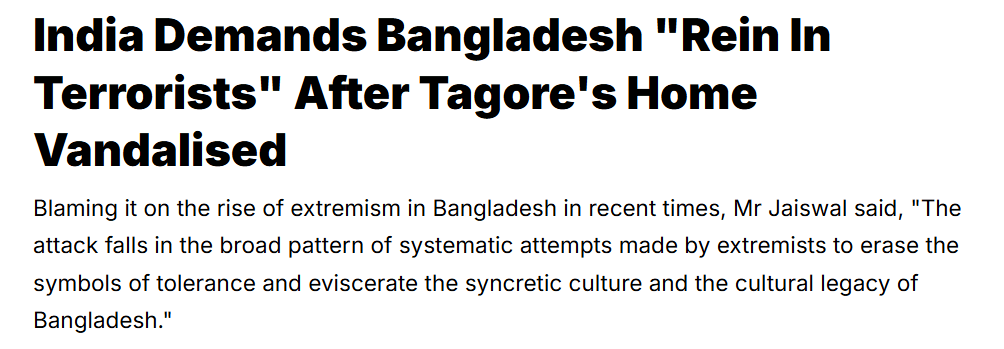
Tagore’s Home Vandalized in Bangladesh. News Source: NDTV
Truth be told, I was thinking while reading the book, how long would it take for the pro-Pakistan radicals in Bangladesh to go after anything related to Tagore, the Hindu writer of Bangladesh’s anthem “Amar Sonar Bangla” (My Golden Bengal), and then the vandalism of Tagore’s home happened. I wouldn’t be surprised if they replace the anthem, too, at some point in the future.
Jogendra Nath Mandal – The Dalit Leader Who Chose Pakistan
It’s from the book that I came across the name Jogendra Nath Mandal for the first time. He was a Dalit leader and a close associate of Dr. Ambedkar. At the time of Partition, Mandal chose to side with Pakistan, believing it would offer Dalits greater freedom and rights than a Hindu-majority India. He motivated many Dalits to migrate with him, promising an escape from caste oppression.
Mandal, the man who wanted Pakistan to become a land of Dalits and Muslims.
But what they found was a harsher reality. Regret followed soon after. Mandal eventually fled Pakistan and returned to India. Sadly, many Dalits who followed him to Pakistan lacked his privilege and means and were left behind. His popularity waned after that, and he died a lonely death in West Bengal. To quote the book:
Mandal had come to India from East Pakistan as a broken man. Arguably, the tallest Dalit politician in pre-partition East Bengal, Mandal had lost most of his followers after he chose Pakistan over India, stood with Muhammad Ali Jinnah and became the law and labour minister. Mandal had thought Dalits and Muslims would behave like brothers in the newly-created Pakistan. They didn’t, and as communal tension rose and Hindus left East Pakistan for India in large numbers, Jogendranath Mandal came to be looked at as a short-sighted leader at best and a self-serving politician at worst.
Dr. Ambedkar, upon learning about the persecution of Dalits in Pakistan, urged them to return to India. However, most were unable to leave, trapped by circumstances beyond their control.
I encourage everyone to read the following Reddit post that offers a more complete account of Jogendra Nath Mandal’s life. It includes his resignation letter to the Prime Minister of Pakistan and Dr. Ambedkar’s heartfelt appeal to Dalits living there.
Mandal’s story reminds us never to forget history or its lessons. These accounts were documented by key figures of that era for a reason. Not to be ignored, but to help us reflect, understand, learn, and avoid repeating the same mistakes in the future.
Quotable Quotes from Being Hindu in Bangladesh
‘Yes, only two people might have died in Noakhali in last year’s violence. But look around and you will find boys and men without an arm or a leg walking around. They will remind you of what was.’
What was it like in 1946? When freedom from 200 years of British rule was becoming a reality, Bengali-Hindu women and men, in village after village in Noakhali district of undivided Bengal, the same place where we now are, were r*ped and killed, or forcibly converted. Then too, it had started with fake news.
‘I have never been able to forget those days,’ she says, ‘when neighbours became rioters and friends became murderers. The stench of blood haunts me to this day.’
‘I remember he would come and tell us to make sure no one made any sound, and make sure that the children remained silent. It should appear from outside that the college building was deserted. Or else, a mob could come and kill us all. But my seven-month-old sister cried out in hunger. We gave her some treacle to make her stop crying, but she would start wailing soon after. My father told us that we had to kill her as she simply wouldn’t stop crying. And her wails would bring the mob to us. She cried and cried, till she cried no more.’
In other riots, religion was the point of disagreement. In Noakhali, religion was also the instrument that ended the disagreement. The attacks in Noakhali on Hindus by Muslims ended when the Hindus became Muslims.
‘But it’s a mistake that all democratic governments make in trying to control one set of extremists. They often play with the other set that looks less worse than the other (but) in the course of time, they all become Frankensteins’ he said.
There’s something about discovering forgotten buildings where powerful men once lived, touring villages where they spent their boyhood. It is like sifting through dog-eared, yellowed pages of history. So much of what once was still hangs in the air. So many stories are kept alive by village elders who saw history take shape.
Conclusion
The book details several atrocities that are too graphic to include in this blog post. I strongly encourage everyone to read Being Hindu in Bangladesh for a clearer and unbiased understanding of the condition of Hindus in the country.
It is with utter dismay I am reading the news about the attack on Hindus in Bangladesh. Secular Muslims in the country are trying to protect the Hindus. This is positive news, and you can’t help but feel grateful for such people in the community. However, radicals are still deliberately targeting the houses and religious places of Hindus. How can they be stopped?
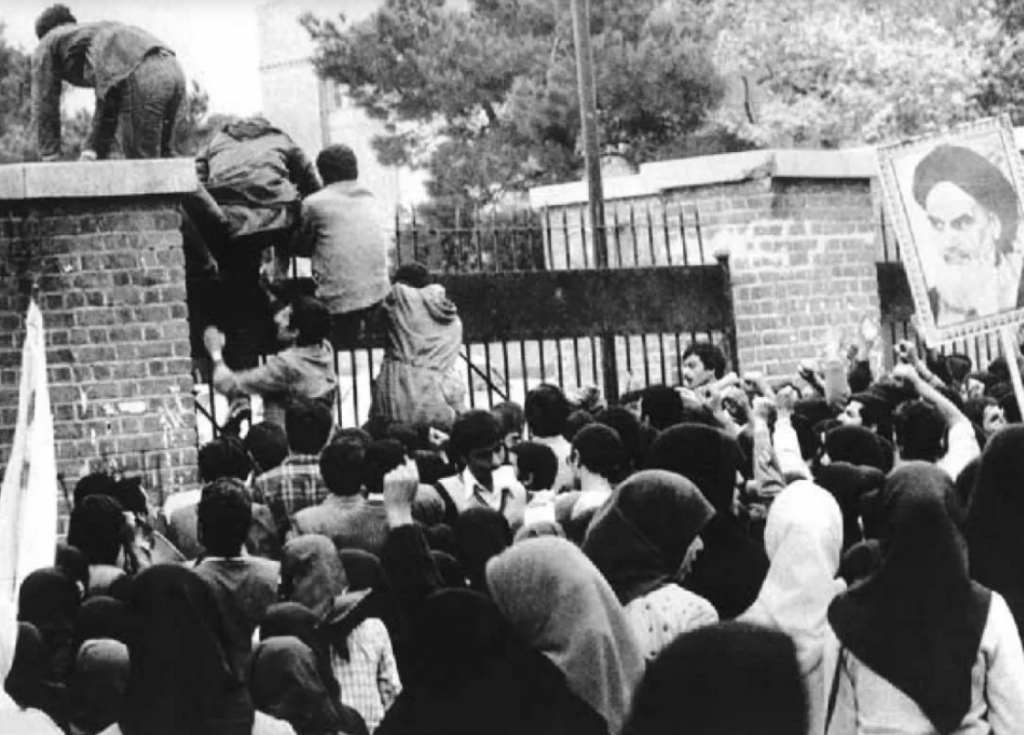
Often, we have seen that in the struggle between radicals and seculars, the radicals emerge victorious. This has happened previously in Iran. A student uprising in Iran in 1979 played a significant role in the downfall of secularism and the emergence of the Islamic regime.
Student protestors climbing the gate of the U.S. Embassy in Tehran on November 4, 1979 / Wikimedia Commons
The reasons for the uprising back then were quite similar:
Widespread discontent with the Shah’s authoritarian rule, political repression, and economic issues.
Iranian students, both domestically and abroad, were active in organizing protests, disseminating anti-Shah literature, and galvanizing public opinion against the regime. They played a crucial role in spreading revolutionary ideas and mobilizing the masses.
A simple act of protesting an “authoritarian” rule in Iran brought in a more religious regime that was dictatorial in its tendencies. So how successful would one consider this student uprising, unless the original intention of the riots was not social justice, but a religious takeover? Shah, considered secular in nature, fled the country never to return, which in all probability will be Sheikh Hasina’s trajectory too. Comparisons are inevitable. Iran is still struggling to bring back its golden days of secularism. Will Bangladesh end up being the same? Only time will tell.
I saw Bangladeshi residents expressing their joy over Sheikh Hasina’s ouster, which is valid, as she was unnecessarily brutal in her approach. But I also saw them in private groups worrying about the future of the country and whether they will fall into the hands of radical Islamists. Some even said they would leave the country if it came to that.
What does this mean for India? Sheikh Hasina was considered pro-India in her approach. She kept the fundamentalists like the Jamaat-e-Islami and anti-India elements under check. This is of significance as India shares a long border with Bangladesh and any sort of instability has the potential to spill over to neighboring regions.
The new leader, Muhammad Yunus, is a Nobel Laureate. He has proven himself an intellectual, but how effective would he be as a politician and a peace-keeper? Will he be pro-India and continue to maintain peaceful relations with our country, promising to secure the borders and protect the minority community in Bangladesh? Or will he be a puppet for the radicals? Questions only time can answer.
As usual, the leftist ecosystem in India is working overtime to convince us that the Hindus in Bangladesh are not in trouble. This is not surprising. It is a standard approach when minorities in Pakistan, Bangladesh, and even within India (Kashmiri Pandits) are attacked. The events are quickly negated or justified and brushed under the carpet. A close observation of their responses provides enough proof of their bias. In my 40+ years, I have never seen them acknowledge attacks against Hindus. There is always a “reason” for it.
If by chance you point out the attacks, you are labeled a right-wing communal Sanghi (a BJP supporter). However, if you support any other community, you are a social justice warrior, an activist, and a secular. This double standard is difficult to fathom, and I have seen many becoming BJP supporters because of this hypocrisy.
In India, I am witnessing more secular Muslims openly supporting Bangladeshi Hindus than the so-called secular Hindus. Due to the indifference of left-leaning Indian Hindus, the community will continue to suffer persecution at the hands of radicals. There is not enough support. For the support to pour in, people need to first acknowledge the fact that there is an issue.
It is with some relief I read that all political parties in India are on the same page regarding the Bangladesh issue. The opposition hasn’t yet negated the Bangladeshi Hindu’s plight. They voiced concern for the minorities in Bangladesh and said they would work in unity with the central government. A nuanced approach their supporters need to learn.
Hopefully, peace will soon be restored in Bangladesh, rendering my concerns unnecessary. Until that day arrives, my worries persist.



 The Monkey Dilemma
You must be logged in to post a comment.