Quick Bytes: Why are Indian Leaders Encouraging Women to Have More Children?

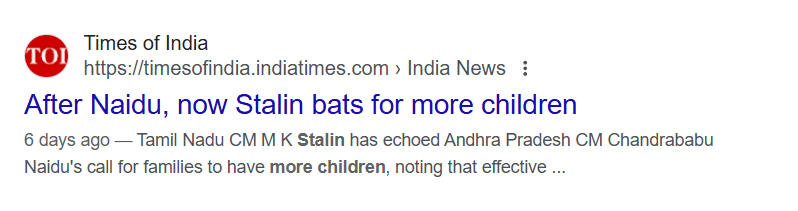
Why are South Indian leaders, like Stalin and Chandrababu Naidu, all of a sudden, pushing women to have more children? It’s not to combat the aging population as they make it seem. It’s all politics!

In India, there’s something called Delimitation. It’s a process of redrawing the boundaries of constituencies based on population. States with more population will get more constituencies, whereas those with low populations, like southern states, will get fewer seats. Basically, the exercise is to ensure each constituency has an equal number of people.

Since South India’s population growth is decreasing, plus migration, it won’t need as many constituencies. The total number of constituencies in Lok Sabha has been frozen since the 70s and is in place until 2026. 2026 is almost here! This is why politicians in South India are worried about women not having enough children. They don’t want to lose their seats.

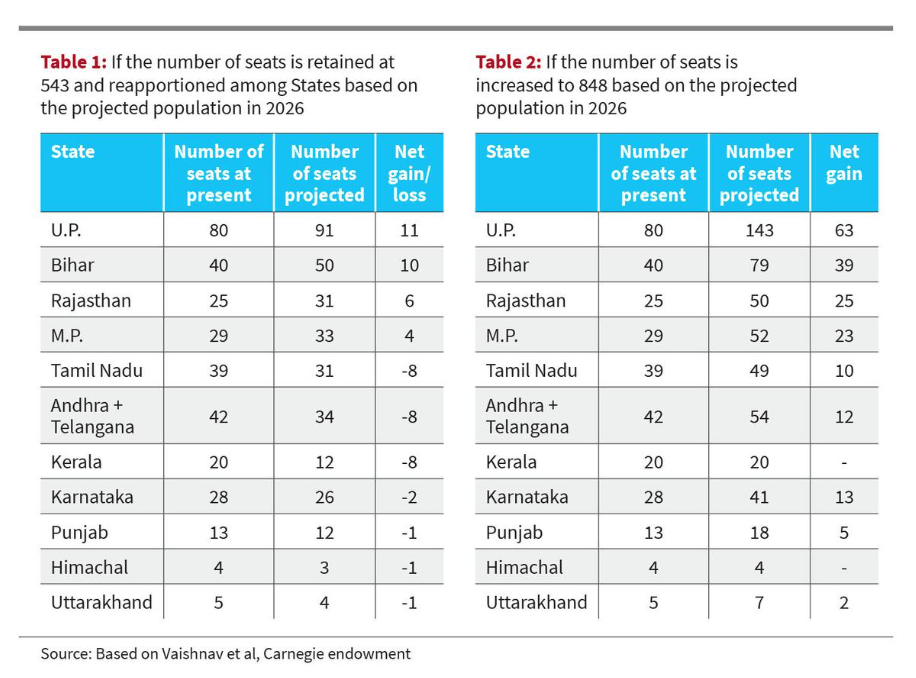
As per The Hindu newspaper, Kerala, Tamil Nadu, Andhra + Telangana, all of which are South Indian states, stand to lose 8 seats each, if the current number of seats in Lok Sabha (543) is maintained.
We can expect Pinarayi Vijayan, the CM of Kerala, to make a similar statement next.

Quick Bytes: Different Perspectives on the Abrogation of Section 370

Different Perspectives on the Abrogation of Section 370

It’s the fifth anniversary of the Abrogation of Section 370. I couldn’t help but reflect on differing opinions about this watershed moment in the nation’s history. There are politicians like Omar Abdullah and Mehbooba Mufti who consider it a disaster. Then, there are BJP supporters who think it’s the best thing that happened to Kashmir.

How do you know who is right?

It’s a given that our biases influence the sides we choose. When we believe something is unjust, we tend to seek out information that aligns with that perspective. Conversely, when we aim to be more optimistic, we focus on positive news.

In the context of Kashmir, you see different types of YouTube videos. If a vlogger or YouTuber seeks to demonstrate that the Abrogation of Article 370 was misguided, they will seek out discontented Kashmiri locals who share that viewpoint. On the other hand, those looking to justify the decision would seek out locals who support it. No matter one’s perspective, there will always be individuals who support each side of the story. Both sides are also convinced that only their version is the correct one.

However, it’s important to consider the facts.

As per Firstpost’s new article, “The incidents of organized stone pelting, connected with terrorist-separatist agendas, went from a staggering 1,767 in 2018 to zero in 2023“. More facts are provided in the article, which is worth a read.

The writer poses a valid question to Omar Abdullah, who keeps talking about how nothing has changed in Kashmir:

The question arises now that, for the first time in two decades, since four years, which is 1460 days and counting, not one youth has died, but you are saying that the situation overall is terrible. Are we then to assume that normalcy is stone-pelting and youngsters dying every week? The end of stone-pelting and no civilians dying is actually a terrible development for your politics.

Ultimately, your perception of a situation is influenced by your bias. But I can’t help but wonder with all the discontent over the Abrogation of 370: Is the prevention of youth fatalities from stone-pelting incidents of less importance than advocating a political agenda?

***

Photo by Imad Clicks

Quick Bytes: As a Centrist Hindu, I Did Not Find Netflix’s Maharaj Problematic

Netflix Maharaj Review

Indian politics cannot be easily categorized as “right” or “left” in the truest sense. However, it is easier for an apolitical person to understand whom you are referring to when you mention “left” (parties like CPI(M), but we generally include any non-BJP party in India) and “right” (NDA). I would call myself a centrist as I find a lot of things from both sides problematic. I can never swear allegiance to any one party, as I often look at the party’s performance and form my judgments based on that.

Now, the left-leaning crowd is naturally praising Maharaj, Netflix’s new movie starring Aamir Khan’s son, Junaid Khan. In contrast, the right-wing supporters are asking Hindus to boycott the movie. Truth be told, I haven’t read much about the Maharaj libel case, so I cannot pinpoint with utmost certainty which part of it is anti-Hindu. My opinion here is based on what I saw in the movie. Here’s why I, a centrist Hindu, did not find the movie problematic.

In Maharaj, Karsandas is portrayed as a reformist who is a practicing Hindu, but he asks questions and is not swayed easily by godmen. There is a monologue at the end where he says he fell more in love with his religion when he studied it in detail. He accuses the religious leader, Maharaj, of misusing it, misinterpreting the Sanskrit Vedas to further his vulgar agendas. This is not anti-Hindu in any manner. The court must have thought the same as well, which is why it got a clean chit.

The only material I referred to after watching the movie was a Wikipedia article on Karsandas. Interestingly, I found the following information, which was not covered in the movie.

He was deeply influenced by the English culture to an extent that he had dislike for institutional religious authority and had penchant for reading Christian sermons and later started translating English sermons & conduct manuals into Gujarati, thereby also bringing a distinctively Protestant ethic into Gujarati’s cultural world.

I am of the belief that community members and religious leaders should openly criticize the bad elements of their religion. If there is an extremist misusing and spoiling the name of your religion, why not openly oppose them? This applies to all communities. It’s only when you distance yourself from the fringe elements of religion that society truly reforms. As long as haters get support in the form of words or silence, radicals will continue to flourish.

Quick Bytes: The New India

The recent controversy surrounding TM Krishna made me ponder: Is there a rise in intolerance in India, or are Hindus simply becoming more vocal about disrespect toward their culture and religion?

Nirmalyam, a Malayalam movie released in 1973, showed a man spitting on the idol of a goddess. There was no controversy back then. Maybe Hindus took offence but they endured the insult. No one can dare imagine releasing a movie with such a scene now. Some might call it the death of art, but is the survival of art dependent on humiliating Hindu religious beliefs? How often do you see an Indian artist scrutinizing other religions? If we’re going to engage in this game, let’s do so fairly. Selective activism is no longer accepted or praised.

Times have changed. Hindus are no longer silent. They are defending their religion. So does this mean Hindus have become intolerant? Or does this mean they have finally found their voice under the leadership of Modi after decades of suppression? It’s a matter of perspective, but one thing is certain: Criticizing Hinduism in India now comes with greater scrutiny and potential consequences. It’s no longer forgiven as easily as before.

***

Tweet courtesy: @dushyanthsridar / X

Quick Bytes: Check Your MP’s Contribution to Your Constituency’s Development

Lok Sabha Elections 2024 - Check MP Contribution

There are two ways to check your MP’s contribution to your constituency in India.

MPLADs

In India, we have something called the Member of Parliament Local Area Development Scheme (MPLADS) funds. These funds are allocated to MPs for development projects in their respective constituencies. By tracking this data, you can check whether your MP’s words match his actions.

To track MPLADs fund utilization, you can go to the MPLADS website and generate MP-wise statements.

Please note there might be a lag in the data presented on the website. This means the data might not be the latest. However, you can get an inkling of how much funds were utilized by the MP for the development of your constituency.

I wish the website also displayed the exact work the MP did. Unfortunately, there is no way to know.

MP’s Performance in Parliament

Another highly useful website to check your MP’s performance in parliament is the PRS Website. You can search for your Lok Sabha or Rajya Sabha MP and analyze his parliamentary activity, attendance, questions raised, etc.

Tip

If you have difficulty understanding any of the terms used in the websites, use an AI bot like ChatGPT or Gemini to explain the terms to you.

Here’s to more informed voting!

If you use any other website to analyze an MP’s performance, let us know in the comments section below.

***

Photo by Markus Spiske

Quick Bytes: Indian Journalists Should Stop Being Lazy

Indian Journalists Should Do More Research To Help Voters

Why are our Indian journalists so lazy? They refurbish stuff from news agencies like Reuters, hold some debates, and consider their job done. After a year or two, they forget what they reported in the past and make contradictory claims. Most are not well informed. They stick to one viewpoint. In the process, their viewers, i.e., us, suffer as we do not get a well-rounded perspective of current events, only a biased one.

When will we get a journalist who actually wants to help us understand the complete picture? At the moment, we have to resort to using multiple news sources for left, right, and centrist views. We are in dire need of a journalist who is pro-India in the sense they do not conduct any irresponsible journalism through hatemongering that can affect the social fabric of the country. Someone who gives us a side-by-side comparison of the rightist and leftist viewpoints and lets us, the viewer, decide what is right and wrong instead of feeding it to us in the form of polarizing “opinions”?

It’s almost election time, and no journalist or news media outlet has yet come out with a detailed study on what the parties have done for each state and its districts over the past five years. Where are the pros and cons? How many items in manifestos have been fulfilled so far?

We have so many journalists in this country. Yet, no one has made a detailed, well-researched, balanced list of achievements and criticisms of the various parties in the country. We get to see only the plain ol’ (but easy) hatemongering. They leave it upon us to do the hurdlesome, yet important, research.

I wish Indian journalists spent less time on debates and more time studying and providing citizens with material to help us, the voters, understand the actual work done by our politicians. By that, I mean a balanced take. Not a biased communal one. A tabled list of all the infra projects, health care, education facilities, and other tangible developments in the country, along with promises that weren’t fulfilled.

Do better, Indian media!

***

Photo by Pixabay