The UN analytical support and sanctions monitoring team has released its 35th report that analyzes ISIL’s threat to the world. Here are some interesting points related to India:
The report states that handlers attempted to incite lone-wolf attacks through their India-based supporters. Analysts have often argued that India faces greater threats from internal radicalization than external forces, particularly from terror sympathizers.
Anti-India propaganda from terror-linked publications, such as the pro-ISIL magazine Serat ul-Haq, is now spreading on social media. These platforms frequently highlight Babri Masjid and selectively amplify one-sided, inflammatory narratives about attacks on Muslims. The goal is to fuel a victim mentality, making many believe these narratives are the absolute truth.
Those unaware of online radicalization tactics easily fall for such content, and an extreme victim mindset often leads to anger, pushing individuals toward extremist groups. Recently, the Israel-Hamas war has been exploited for recruitment by terror organizations like ISIL.
I feel it’s important for India to be wary of such anti-India propaganda online. Not every piece of news is covered to bring awareness. Selective activism and outrage are often used to misguide youth into taking up arms. There should be awareness regarding this, so people know what to expect.
Since India has established some level of cordial relations with the Taliban-led government in Afghanistan, it must remain cautious of this engagement. The Taliban has expressed interest in having its representatives work in India’s embassy, but given the group’s radical nature, India should approach this with hesitation.
At the end of the day, for groups like the Taliban, religious extremism often takes precedence over diplomacy.
To read the full report, go here: docs.un.org/en/S/2025/71
In 1921, Kerala witnessed the Moplah Riots, where numerous Hindus were killed in communal violence. However, to this day, Congress and CPI(M) refuse to acknowledge it as a communal riot and instead label it a “class struggle between Hindu landlords and Muslim peasants.”
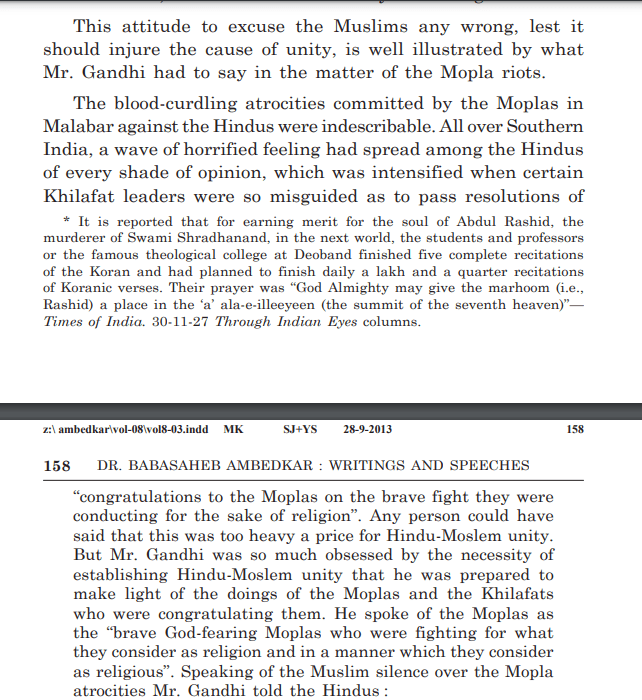
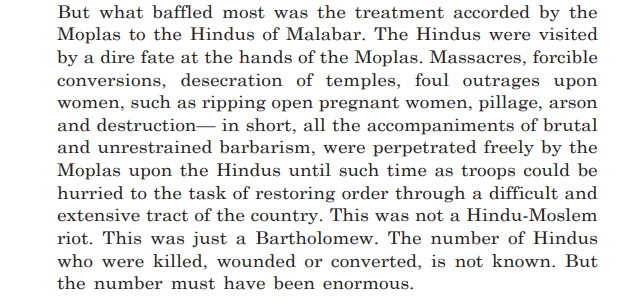
I also believed the class struggle narrative until I read B.R. Ambedkar’s book, The Partition of India. He clearly highlights the communal nature of the Moplah Riots, mentioning temple destruction, mass killings, and forced conversions of Hindus.
Some clippings from the book:
Source: Dr. Babasaheb Ambedkar : Writings and Speeches (Vol. 8)
If Hindus were specifically targeted, their temples destroyed, and they were forcibly converted, how can this not be considered a communal riot? Ambedkar’s account challenges the attempt to whitewash history by reducing it to just a landlord-peasant conflict.
Here is the question I asked AI and the response it generated:
Question: Were temples destroyed during the Moplah riots?
Answer: Yes, several temples were destroyed, looted, or desecrated during the Moplah Riots of 1921 in the Malabar region of Kerala.
Historical Accounts of Temple Destruction:
Looting and Desecration:
Many Hindu temples were attacked, idols were broken, and valuables were looted.
Records mention temples like the Thirumandhamkunnu Bhagavathy Temple being desecrated.
Forced Conversions and Killings:
The riots targeted Hindus, with reports of forced conversions, massacres, and mass displacement.
Many Hindus fled their villages, leaving temples unprotected.
British Reports and Historical Records:
British colonial reports and contemporary eyewitness accounts mention temple destruction.
Annie Besant and Veer Savarkar documented attacks on Hindu religious sites.
Conclusion:
Yes, temples were destroyed and desecrated during the Moplah Riots, which started as an anti-British uprising but later turned into violent communal attacks against Hindus in Malabar.
So how can it be concluded as merely a class struggle? Next time, someone dismisses the communal angle of the Moplah Riots as propaganda, one should ask, “Why were temples destroyed if the riots weren’t communal? Why did conversions happen? Was Ambedkar lying in his book?“
This is just one of the many lies spread by Congress and CPI(M). Why do they do it? Only they know. Perhaps to ensure Hindus keep supporting them, or maybe to prevent the majority community from developing resentment.
The second reason might have been understandable if only they didn’t paint Hindus as villains in other communal conflicts. The lack of consistency exposes their bias.
Surprisingly, many Indians are unaware that Hamas is anti-India. I’ve seen people glorify the group as “freedom fighters who are only interested in the Palestinian cause,” but a little research makes it clear that Hamas is also pro-Pakistan and anti-India.
I found Hamas problematic from the moment the October 7 attacks happened. Left-leaning friends tried to convince me they were simply fighting oppression, but I couldn’t support a group that used rape as a weapon of resistance. As a feminist, I believe in defending women’s rights universally, not selectively. I refuse to justify rape and violence when it suits one cause while condemning it elsewhere.
October 7 changed my perspective. It exposed the hypocrisy of some so-called “feminists” who speak up only when it aligns with their politics. They remain silent on Iran oppressing women, Yazidis being taken as sex slaves by ISIS, Afghanistan restricting women’s rights, or Hamas using sexual violence as a weapon. Their activism is not about justice—it’s just political.
Why Indians Should Stop Glorifying Hamas
Hamas has expressed support for Pakistan’s claim over Kashmir, viewing it as a cause similar to the Palestinian struggle. They have engaged in discussions with Pakistani leaders about Kashmir. For instance, in 2023, reports indicated that Hamas leaders met with Pakistani officials to discuss mutual concerns, including the situation in Kashmir. This alignment underscores Hamas’s willingness to support actions that could harm innocents in India.
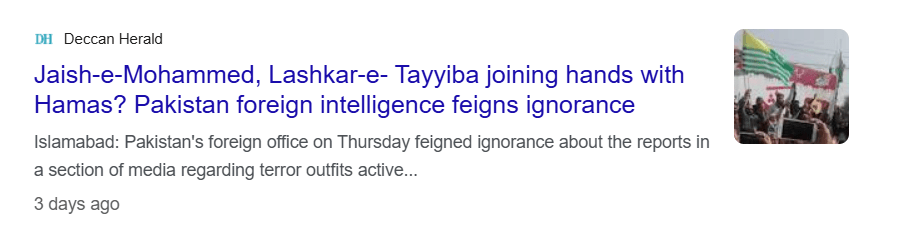
In February 2025, Hamas leaders landed in Pakistan for the first time to talk about Kashmir with Jaish-e-Mohammed and Lashkar-e-Tayyiba, groups notorious for carrying out several terrorist attacks in India. Pakistan’s foreign intelligence feigned ignorance, making it clear they support harboring anti-India terrorists on their soil.
Radical groups often shift focus when their primary battleground becomes difficult to operate in. Radicals thrive on violence—it’s a cycle they cannot break. As Son of Hamas mentions in his book, the moment peace prevails in Palestine, terror groups seek new ways to stir conflict. This keeps their funding networks active, especially from supporters abroad.
With Hamas now struggling to regroup in Gaza, could India become the next target in this Israel-Hamas lull period?
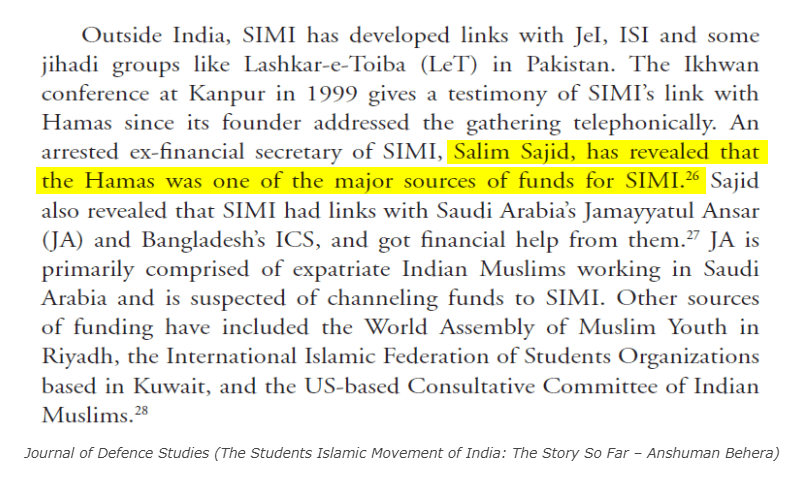
Hamas Funded Radical Group SIMI in India
An old research paper published by SSPC in 2006 mentioned the following about Hamas’ link with SIMI, the Jamaat-e-Islami’s banned student radical group whose aim was to establish Islamic rule in India:
Page 2 of The Society for the Study of Peace and Conflict (SSPC)’s Terrorism Monitor published in 2006. SSPC is considered credible within academic and research circles. It publishes well-researched papers and articles on global security, conflict resolution, and peace studies to inform scholars, policymakers, and the public.
SIMI morphed into the current PFI after it was banned.
So when I say Hamas is anti-India and pro-Pakistan, this is what I mean. Mainstream media rarely highlights this, and older reports on the subject have either been removed or are difficult to find. Articles from 2006 that covered Hamas’s stance on Kashmir have disappeared, and reference links in publications are now inactive.
This suggests a deliberate effort to portray Hamas as an organization with only good intentions. Right now, Hamas is heavily focused on the Palestinian cause, but if circumstances allowed, it would likely attempt to destabilize India as well.
Palestinians Openly Endorsing Hate and Attacks Against Hindus
In a video shared extensively online, a group of Palestinians are seen openly endorsing hate and attacks against Hindus. The speaker calls on Pakistan to attack the “filthy Hindus” to teach them a lesson for “oppressing Muslims”.
He says: “The only way to deal with the cow-worshipping Hindus is by eradicating them.”
However, it’s a credit to Indians that despite this extreme hate, most are moderate in their stance, and do not endorse violence.
How India Should Deal with Hamas
Now that Hamas has openly aligned with Pakistani terrorists, the Indian government must take steps to curb its influence in India.
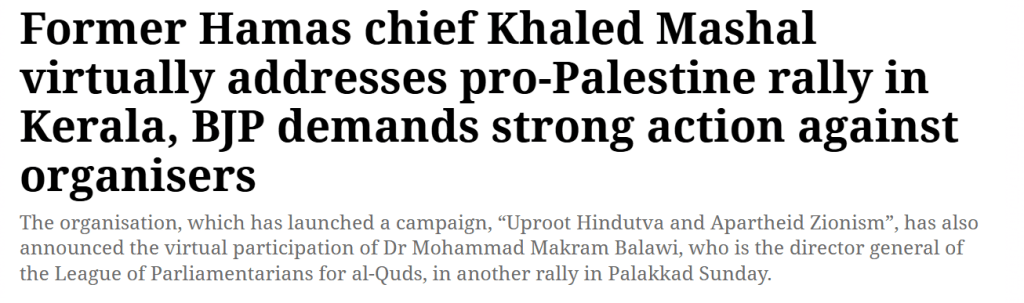
In December 2023, a Hamas leader virtually addressed a pro-Palestinian event in a Muslim-majority area of Kerala, raising serious concerns. Such events should never be allowed on Indian soil, as they carry the risk of radicalizing impressionable youth and promoting violence. The government must act decisively to prevent extremist narratives from gaining ground in India.
Hamas should be immediately designated as a terrorist organization as a precautionary measure, rather than waiting for a threat to materialize. Banning it would also prevent Indians from glorifying a group that has openly aligned with Pakistani terrorists and poses a potential threat to India.
While people are free to sympathize with any cause, it should never come at the cost of national security.
Khalistanis demand a separate Sikh country called Khalistan which includes the Punjab region of India. However, they do not talk about including Pakistan’s Punjab as part of this homeland. Why?
Pakistan’s Punjab is four times larger than Indian Punjab in terms of land area.
Pakistan is also home to several important Sikh sites, such as Nankana Sahib, the birthplace of Guru Nanak (founder of Sikhism), and Kartarpur, where Guru Nanak spent his later years.
So why don’t Khalistanis demand a separate state that includes Pakistan’s Punjab if having a separate homeland for Sikhs is important?
The same reason why separatists in Kashmir and global leftists think only Indian Kashmir should be “freed,” not Pakistan-occupied Kashmir.
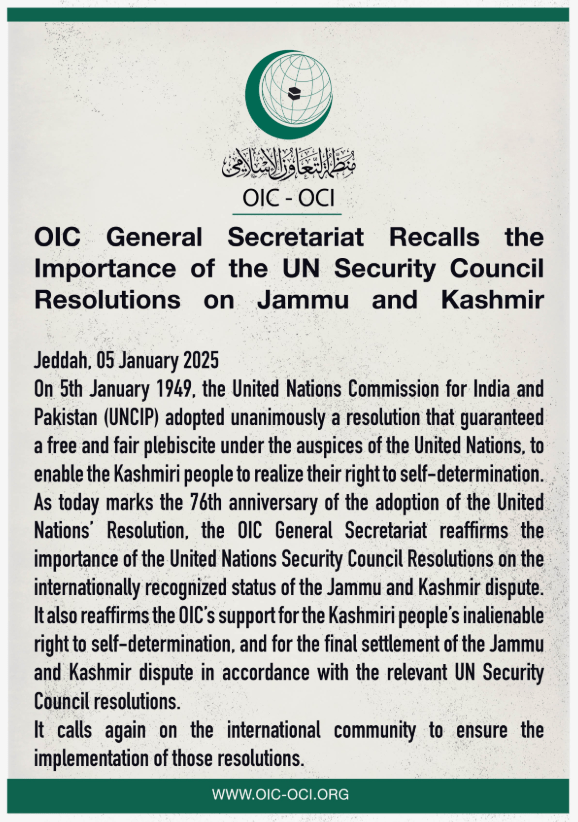
Also, as mentioned in a previous post, The Most Intriguing Fact in “Kashmir Narratives” by Colonel Ajay Raina, the first step toward a plebiscite in Kashmir requires Pakistani militants to fully disengage from the region. According to the UN resolution, once they leave, the Indian military must also withdraw, ensuring a fair plebiscite. Yet, no one is calling on Pakistani militants to step back.
This glaring omission of Pakistani elements raises questions about whether Pakistani influences are shaping the narrative.
Some Indian Muslims like Arfa, Rana, Zubair, and Naseeruddin Shah feel India is intolerant and unsafe for Muslims.
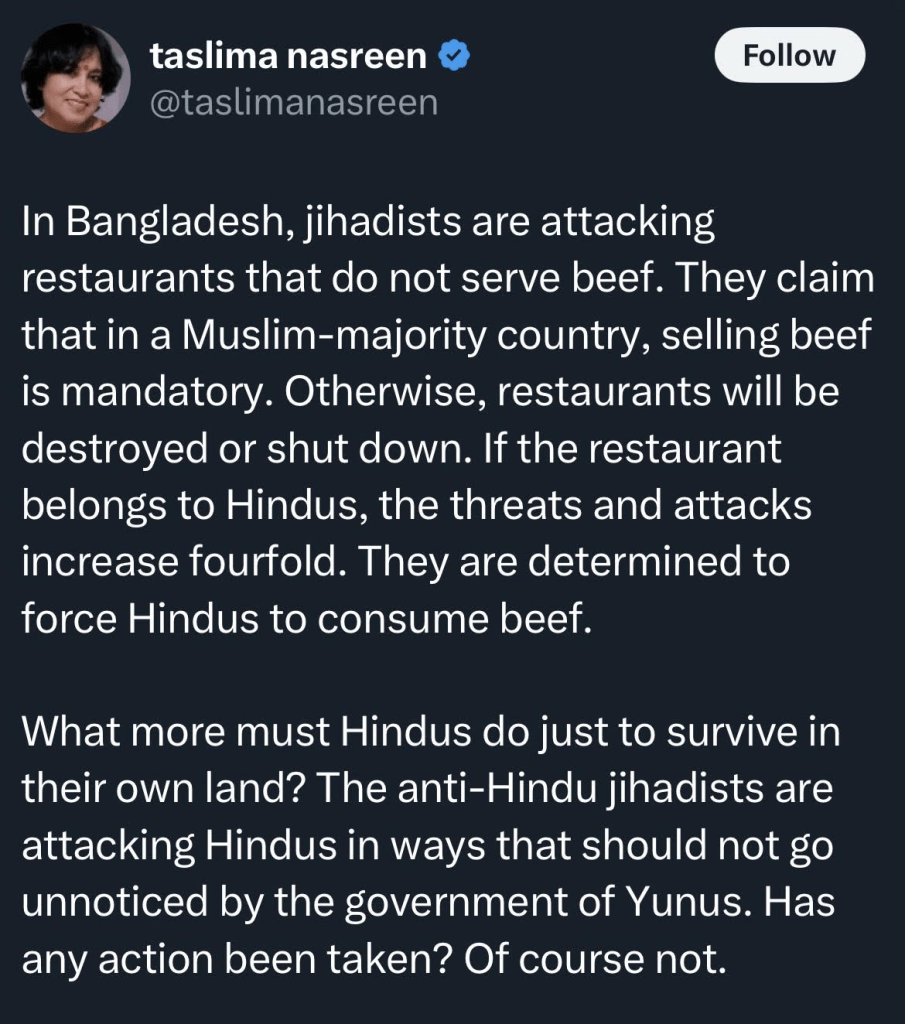
Yet, Muslims like Taslima Nasreen and Sheikh Hasina feel safer in India than in their own Muslim-majority countries. They have escaped their countries to avoid getting persecuted and can openly criticize extremists in India.
Souce: x.com/taslimanasreen
In India, you can criticize any religion freely, like PC George in Kerala targeting Islam, or Stalin in Tamil Nadu attacking Sanatana Dharma.
Source: livelaw.in
But at the same time, mocking/disrespecting Hinduism or Islam can also lead to lynching or beheading.
This shows the complicated nature of India’s religious tolerance. It’s not fully black or white; there are many layers of grey.
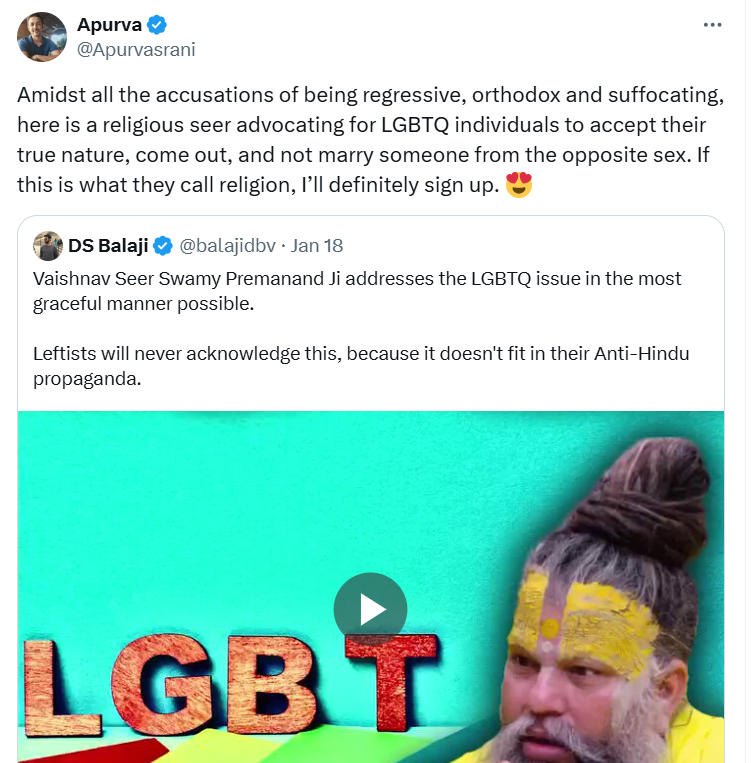
A country, accused of religious intolerance, is also a country where seers like Swamy Premanand Ji openly advocate for LGBTQ issues. He advises young members of the LGBTQ community not to succumb to parental pressure to marry according to societal norms, as it could harm both their own life and that of their partner.
From these examples, it is quite clear that India is a nation with diverse perspectives. Yet international media often portrays it as a regressive and intolerant society, probably because they rely heavily on left-leaning biased sources for their information. This depiction is unfair to the country’s social fabric, which embraces various ideologies.
It is important to note that much of the left-leaning media in India tends to present only one side of the story, resulting in incomplete or biased information. In an era where media bias is prevalent, it is strongly recommended to read news from both left- and right-leaning sources to gain a comprehensive understanding of the issue. Without this balanced approach, people may remain unaware of where genuine reforms are needed and could be misled by those with specific agendas.
The downside of one-sided stories is that they can foster an extreme victim mentality, making people believe that any violence or attack is justified due to past suffering. For instance, some celebrated the LA fires, posting that the USA deserved it for funding weapons for Israel, without considering that pro-Palestinians could have lost their homes too. If a tragedy strikes India, similar comments might surface. This is partly due to media narratives that fuel such sentiments and intensify hatred.
In an increasingly polarized world, it is crucial to report news with accountability. Both extremes are harmful—religious extremism that forces others to conform through coercion and an extreme victim mentality that blinds individuals to any positive aspects, making them focus solely on negative narratives. Currently, in India, I am seeing more of the latter than the former. Media is partly responsible for this.
A ceasefire and hostage deal is close to being reached, with plans to start on Monday. However, some people on both sides want the situation to stay the same.
The ceasefire has not yet started and a journalist from Gaza is already talking about destroying Israel.
Source: x.com/bayanpalestine
Meanwhile, a far-right Israeli politician wants the Gaza war to continue.
Source: The Times of Israel
How long can this hate continue?
One thing is clear: things cannot go on as they are. Israel must implement the two-state solution right away and remove illegal settlements. This doesn’t mean Israel should give up its land, but rather stick to the established boundaries.
If Gaza wants peace, they must abandon the idea of revenge. Israelis are unlikely to give up their land without a fight. They would rather use extreme measures, including nuclear weapons, to destroy their land themselves than give it up. They are driven by strong nationalist sentiments.
Many countries have lost land due to disputes. India lost territory to Pakistan, and Pakistan lost land to Bangladesh. The Kashmiri Pandits were displaced from their homes. Now, imagine if these countries and communities harbored the same revenge mentality and resorted to violence to reclaim their lost land. It would lead to chaos worldwide, including in Muslim countries, with countless lives lost. At some point, peace with reality must be made and the past let go. Constantly planning the next bombing or uprising only results in more innocent lives being lost.
The only way forward is peace. A two-state solution should be established, and both countries must learn to coexist. The benefits are clear: Gaza could leverage Israel’s expertise to develop infrastructure and technology that could improve life for its people. Israel, in turn, could benefit from employing Gazan workers, as it did before October 7. Left to its own devices, Gaza would likely be under Hamas, whose focus is primarily on warfare rather than development.
Supporters worldwide, rather than calling for constant war, should recognize the importance of peace and coexistence.
Yet, all this seems like a distant dream.
If serious measures are not implemented to change the status quo, both Israel and Gaza will continue to live without peace. It’s easy for us to sit in our comfortable armchairs in distant countries, encouraging war and violence on social media, while those living in the conflict zones become the true casualties.
We support violence, only to condemn it later. It’s a vicious cycle that repeats, leading to the loss of many lives, yet we fail to learn from our mistakes.










 The Monkey Dilemma
You must be logged in to post a comment.