Yesterday, a Muslim friend visited, and we ended up discussing religion. She’s a practicing Muslim but not overly devout; for instance, she only wears a hijab when her mother-in-law visits.
During our conversation, she shared something beautiful:
People do things in the hope of reaching paradise. There’s so much fear surrounding it. But no one has ever returned from death to confirm if paradise truly exists. What we have now is paradise, isn’t it? You and I, of different faiths, sitting here together, conversing, laughing, and enjoying each other’s company—what better paradise could there be?
I asked her how she developed this perspective when everyone around her follows religious rules so strictly. She said it might be because she attended a non-religious school instead of an Islamic one. She emphasized how important it is to interact with other communities rather than only associating with people from our own. Her husband shares the same outlook. While he offers Namaz five times a day, he hasn’t imposed any religious restrictions on his wife or children. They are the only ones in their family who approach religion this way.
This principle is applicable to all communities. The more we engage with people from different backgrounds, the more open-minded and accepting we become of diverse ideas and perspectives. Conversely, isolating ourselves can lead to more rigid and extreme viewpoints.
I believe this may be why Indians tend to integrate more easily in foreign countries. Growing up in a society where different faiths coexist has shaped our ability to adapt. This is why I feel we should be sharing our culture with the world rather than adopting foreign ones. India’s inclusive culture, which embraces all faiths, is truly beautiful. I hope we continue to honor and preserve it.
It’s the fifth anniversary of the Abrogation of Section 370. I couldn’t help but reflect on differing opinions about this watershed moment in the nation’s history. There are politicians like Omar Abdullah and Mehbooba Mufti who consider it a disaster. Then, there are BJP supporters who think it’s the best thing that happened to Kashmir.
How do you know who is right?
It’s a given that our biases influence the sides we choose. When we believe something is unjust, we tend to seek out information that aligns with that perspective. Conversely, when we aim to be more optimistic, we focus on positive news.
In the context of Kashmir, you see different types of YouTube videos. If a vlogger or YouTuber seeks to demonstrate that the Abrogation of Article 370 was misguided, they will seek out discontented Kashmiri locals who share that viewpoint. On the other hand, those looking to justify the decision would seek out locals who support it. No matter one’s perspective, there will always be individuals who support each side of the story. Both sides are also convinced that only their version is the correct one.
However, it’s important to consider the facts.
As per Firstpost’s new article, “The incidents of organized stone pelting, connected with terrorist-separatist agendas, went from a staggering 1,767 in 2018 to zero in 2023“. More facts are provided in the article, which is worth a read.
The writer poses a valid question to Omar Abdullah, who keeps talking about how nothing has changed in Kashmir:
The question arises now that, for the first time in two decades, since four years, which is 1460 days and counting, not one youth has died, but you are saying that the situation overall is terrible. Are we then to assume that normalcy is stone-pelting and youngsters dying every week? The end of stone-pelting and no civilians dying is actually a terrible development for your politics.
Ultimately, your perception of a situation is influenced by your bias. But I can’t help but wonder with all the discontent over the Abrogation of 370: Is the prevention of youth fatalities from stone-pelting incidents of less importance than advocating a political agenda?
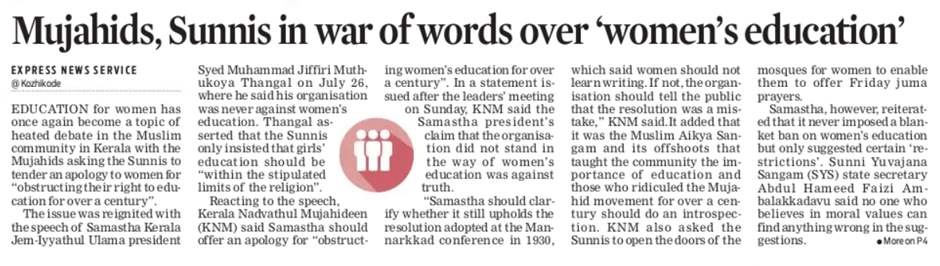
I came across this news today. It is comforting to know that there are members of the Muslim community in India who are fighting for unrestricted women’s education.
Samastha earlier had conveyed that a Muslim woman’s education should be encouraged but within religious restrictions. This became a point of debate across the state of Kerala, with many progressives calling it problematic. However, the most striking response came from a group within the community – the KNM. The organization is demanding that Samastha apologize for its take. KNM is not without its faults, but the stand they took on this particular issue is noteworthy.
Samastha and KNM
To the uninitiated, the “Samastha” group in Kerala refers to “Samastha Kerala Jamiyyathul Ulama,” an influential Sunni Muslim scholarly body in the state. Samastha plays a significant role in managing religious and educational institutions, including madrasas and mosques, and often issues guidelines on religious matters.
The term “Mujahids” in the context of Kerala typically refers to the Kerala Nadvathul Mujahideen (KNM), a prominent Islamic reformist organization in the state. The KNM often contrasts with traditionalist groups like Samastha, promoting a more modern interpretation of Islam, such as advocating the opening of the doors of mosques for Muslim women to enable them to offer Friday juma prayers.
Restricting Women’s Education on Religious Lines
If we connect religion with education, the progress of women in our country will be hindered. Afghanistan is a live example of this. Currently, girls in Afghanistan are generally allowed to attend school only up to the sixth grade. The Taliban, who regained control of the country in August 2021, have imposed severe restrictions on girls’ education beyond this level. Secondary education for girls (grades 7-12) has been largely suspended, and there have also been significant restrictions on female university students, including the closure of universities to women in late 2022. These measures have been widely condemned by international organizations and human rights groups. The global campaign #LetHerLearn, which advocates for Afghan women’s right to education, is gaining traction.
India is no Afghanistan. Here, women are allowed to study without restrictions regardless of religion. Women who are limited to religious studies may face challenges in the corporate world. It would severely restrict their job opportunities in a secular country like India, where well-paid corporate jobs often require you to engage with a global audience and follow strict academic and professional protocols that might not always adhere to religious lines.
Jobs cannot be built around religion in a democracy. Corporate jobs often require specific skills such as critical thinking, teamwork, leadership, and digital literacy. Religious studies may not always focus on developing these skills, which can impact the ability to perform effectively in a corporate setting.
Unfortunate Consequences
What happens when there are limited job opportunities for women due to religious restrictions? They will end up staying at home. Marriage becomes the only option. Financial independence becomes a distant dream.
It is ultimately up to the Indian Muslim woman to decide. If she wishes to pursue further studies, she should not be shamed.
Indian Muslim women deserve quality education, just like anyone else in India. We should have more Indian Muslim women in top positions in the corporate world. Currently, they are practically non-existent outside of Muslim countries. However, to make this happen, there need to be some reforms within the community that will help the women integrate more seamlessly into the existing corporate structure.
***
Picture Courtesy: The New Indian Express (July 2nd 2024, Kerala Edition)
The recent election in India was proof that the BJP is not invincible. Despite the party’s considerable efforts in improving the economy, it failed to connect with the people at the grassroots level. Voters ultimately prioritized free benefits and voted based on caste and religion in rural areas, where the BJP performed poorly. These are the exact issues the government had been working to avoid because they do not contribute to India’s growth in any way.
The election outcome cannot be blamed on the voters, as it is understandable why promises of freebies and jobs with guaranteed 1 lakh salaries were more alluring than infrastructure or development, no matter how burdensome such things might prove for the exchequer. Saying no to such promises is a luxury reserved for the privileged.
It needs to be acknowledged that all political parties, not just the BJP, have played a role in fueling discontent, animosity, and disharmony among communities. It is a collective failure that we, as a society, allowed ourselves to be divided along religious lines. The INDI alliance, too, resorted to fear tactics and misinformation in the name of secularism to further their agendas. As the opposition parties relentlessly worked on propagating their “savior” image, people were quick to believe that the answer to all their solutions, like poverty and joblessness, was the INDI alliance.
I have always been of the belief that one should judge a party/politician by the work they do, not the words they utter. But unfortunately, we are quick to believe hate narratives and forget that in this big bad world of politics, there is no savior, only megalomaniacs greedy for power.
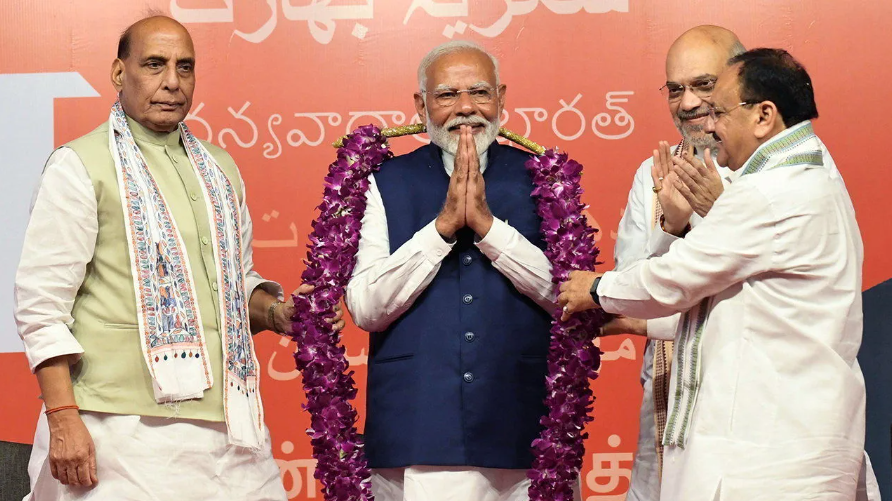
To gain back confidence, the coalition NDA government needs to pull up its socks. Things are far from gloomy for the BJP, as they still are the party with the most seats (240) in India. Congress comes a distant second with their 99 seats. However, BJP’s performance was still a big disappointment to its supporters who expected their party to get more support, especially in Uttar Pradesh, where the sacred Ayodhya temple was built after a long period of wait.
Some changes are in need of the hour. What can the Indian coalition government do to improve its performance? Here are my takes.
Don’t take success for granted
Undoubtedly, this has been the biggest lesson for the ruling party that you should never take your success for granted. The BJP became overconfident with their “400 paar” declarations, which resulted in them not doing enough groundwork.
Many reasons are mentioned for voter dissatisfaction in places like Uttar Pradesh, but the parties would have more accurate insights than us, the speculators. RSS workers allegedly did not campaign extensively or help voters reach the booth, there is also an allegation of missing votes, not enough compensation for people who lost their homes to make way for the temple, etc. Regardless of the issue, the fact remains that the BJP and RSS did not make an effort to connect with voters in rural areas and understand their issues. Instead of providing justifications, the BJP should regroup and focus on the areas where it faltered.
Outreach programs for minorities
Most Christians and Muslims I know are frightened of the BJP. This is where the opposition party made a resounding impact, albeit in a negative/divisive manner. The local politicians went around, scaring people into thinking they would be evicted if the BJP came into power. Elderly, economically disadvantaged Muslims who were approached by news channels were seen pleading to the general public with teary eyes, “Please don’t vote for the BJP. If they come into power, they will kill us.”
Who is responsible for this fearmongering? The “Hindu vs other religions” narrative has gained such solid ground that it seems next to impossible to convince minorities that Hindus mean no harm to anyone. Media, too, has a huge role to play in spreading this fear. Due to their irresponsible journalism, done solely to put Modi in a poor light, they ended up creating irreparable damage.
It became easier for the opposition to spread hatred after the emergence of the Ayodhya Temple. No one from the ruling party made an effort to explain to the minorities that these sites are as important to religious Hindus as Mecca or Medina for Muslims or the Vatican for Christians. Justice was denied to the Hindu community since the Mughal era when temples were brutally demolished to make way for mosques. A few Muslims realized this, such as the archaeologist KK Muhammed (the one who studied the site and came to the conclusion that the mosque was brazenly built over a temple) and the BJP Malappuram candidate Dr. Abdul Salam. Both of them have openly said on news channels how other communities should show empathy to “our Hindu brothers and sisters” as the community was subjected to extreme unfairness in the past, so much so that even their most sacred sites were denied to them. It takes a great deal of empathy to acknowledge someone else’s turbulent past, and you can’t help but feel gratitude for such people.
As no effort was made by the ruling party to bridge misunderstandings, political parties milked the opportunity for what its worth. Rest assured, they will continue to use the sacred temple as a tool for playing politics, further increasing the divide between Hindus and other communities. BJP should realize communication is key and work towards improving the skill to effectively clear misunderstandings.
The BJP team in Thrissur (Kerala) appeared to have been effective in their communication, which may explain why the party received Christian votes despite the opposition’s efforts to portray the Manipur issue as a communal clash. Interestingly, it was only after the elections did priests and bishops in Kerala clarified that the Manipur issue is not communal but rather ethnic. However, by that time some individuals on the ground had already done enough research to discover this on their own.
BJP often lags in countering allegations or taking strict action against the hatemongers. They never communicate their side of the story or a simple “you are safe with us,” the absence of which leads to speculations and uncertainty. They need to interact more with minorities at the ground level and induce confidence in them by clearing their misconceptions. This can come only with proper effort.
Offer financial relief to citizens
In rural areas or for those with low income, freebies are highly valued. However, it’s important to note that these freebies are often funded by taxing the middle class. The government should find a way to carefully balance the two – providing assistance to the poor without burdening the middle class. While investing in infrastructure and development projects is beneficial for the economy, it’s crucial to also provide some relief to ordinary citizens.
Avoid polarizing language
In order to gain the trust of more people, the BJP needs to use more restrained language. While Modi’s “ghuspetiyas” comment was aimed at illegal immigrants, it was twisted by the opposition for their own benefit, leading to fear-mongering.
Many people now understand that words uttered by politicians often mean nothing and are solely used as a tool to sway voters. They understand it’s a game. However, others may take it more seriously. To prevent this, simple language should be used, and the intention should be clearly specified.
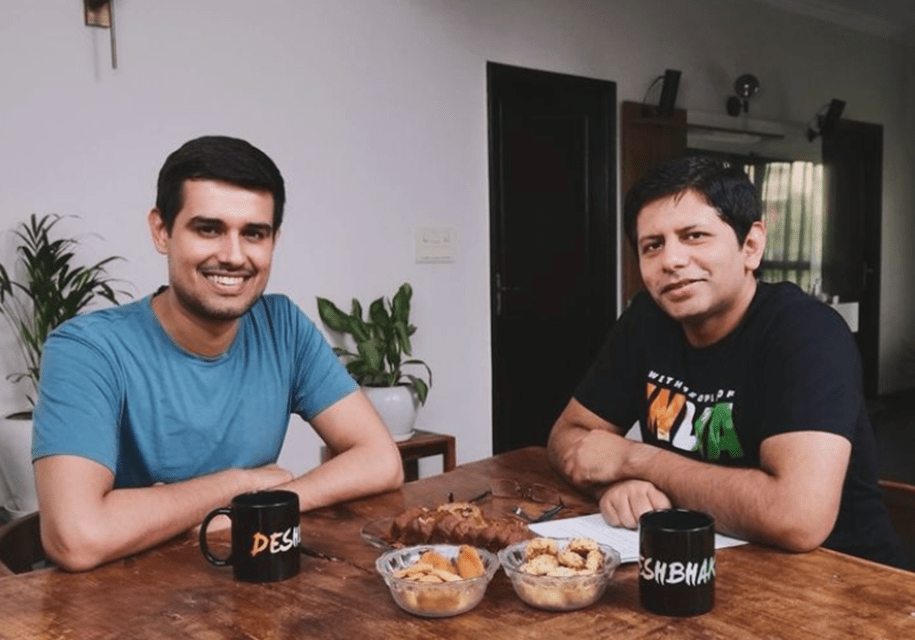
We have observed the significant rise of left-leaning political commentators on social media, particularly YouTubers, during this election. Dhruv Rathee and Ravish have amassed massive views, surpassing even mainstream news channels. It was believed that they would have a significant impact on the Lok Sabha Elections.
Dhruv, who typically maintains a neutral tone, noticeably shifted his approach in the months leading up to the election, embracing a more polarized political viewpoint. I use the term “polarized” because he blatantly overlooked several important issues during this time, such as the Sandeshkhali rapes in West Bengal and the Sidharthan case in Kerala, primarily because these cases put the opposition in a poor light. Personally, I felt his demeanor change from that of a regular YouTuber to that of a politician.
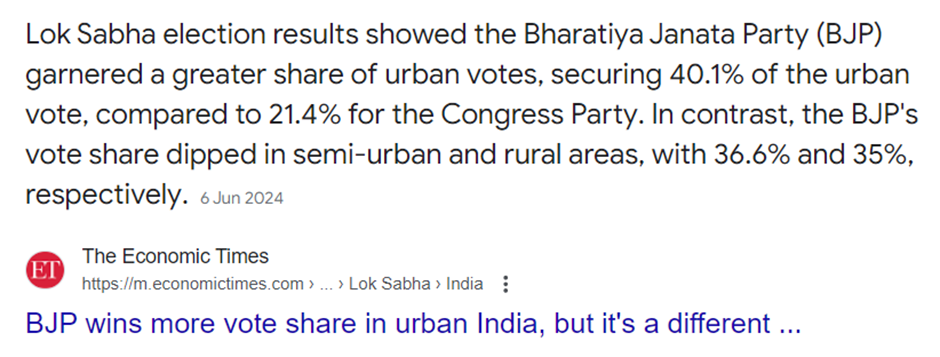
After months of running intense social media campaigns, were these left-leaning YouTubers successful? In a previous post, I mentioned how Dhruv Rathee is unlikely to have a significant impact on the Lok Sabha elections. The echo chamber angle aside, the answer lies in the data collected from the CSDS-Lokniti Post Poll Survey. It shows how the BJP performed well in urban areas while lagging in rural areas.
How much influence do YouTubers have in rural areas? Unless a proper survey is conducted that asks people living in villages, “Did Dhruv Rathee or any other YouTuber influence you to change your voting pattern this time?” we will never know for sure. Another way to analyze the impact is by examining video statistics. Content creators can share their video statistics, including the regions where their videos were most viewed. Did they receive significant viewership from rural areas?
Huge rallies were conducted in villages where Dhruv’s videos were played. However, it’s safe to say that people in rural areas do not vote based on social media activism. Instead, they vote based on their personal experiences, caste-based politics, and the help they receive. They are unlikely to resort to the Internet to research the pros and cons of political parties.
To summarize, any success resulting from YouTube videos should have primarily been reflected in urban areas, but that was not the case. BJP performed considerably well in cities.
The Congress party’s performance in the Lok Sabha Elections 2024, with a win of 99 seats, is a notable improvement from 2019. However, it still pales in comparison to the BJP’s reduced 240 seats. The alliance, as a whole, played a pivotal role in forming a strong opposition. Yet, it is evident that no single party can claim sole credit for the alliance’s success.
Samajwadi Party (SP) – The Unsung Hero
In Uttar Pradesh, it was the Samajwadi Party (SP) that was the game-changer with its 37 seats. BJP came a close second with 33 seats. Congress managed 6. In the end, it is not how many seats you gained or lost that matters, but whether you won. I have my grievances with the SP, but if credit is to be given to any party, it should go to the SP. It was Akhilesh Yadav who turned things around.
Despite Congress’ lackluster performance (this was its third-worst performance overall), you often hear the party nowadays boasting about its “achievements” and how Rahul Gandhi single-handedly saved democracy. Ironically, this narrative has also been picked up by the West.
It seems that the party is trying to present this as a Congress victory as a way to save Rahul Gandhi. This may have been his final opportunity to get things right, and by insinuating that Rahul was the driving force behind the alliance’s success, Congress managed to secure his leadership position.
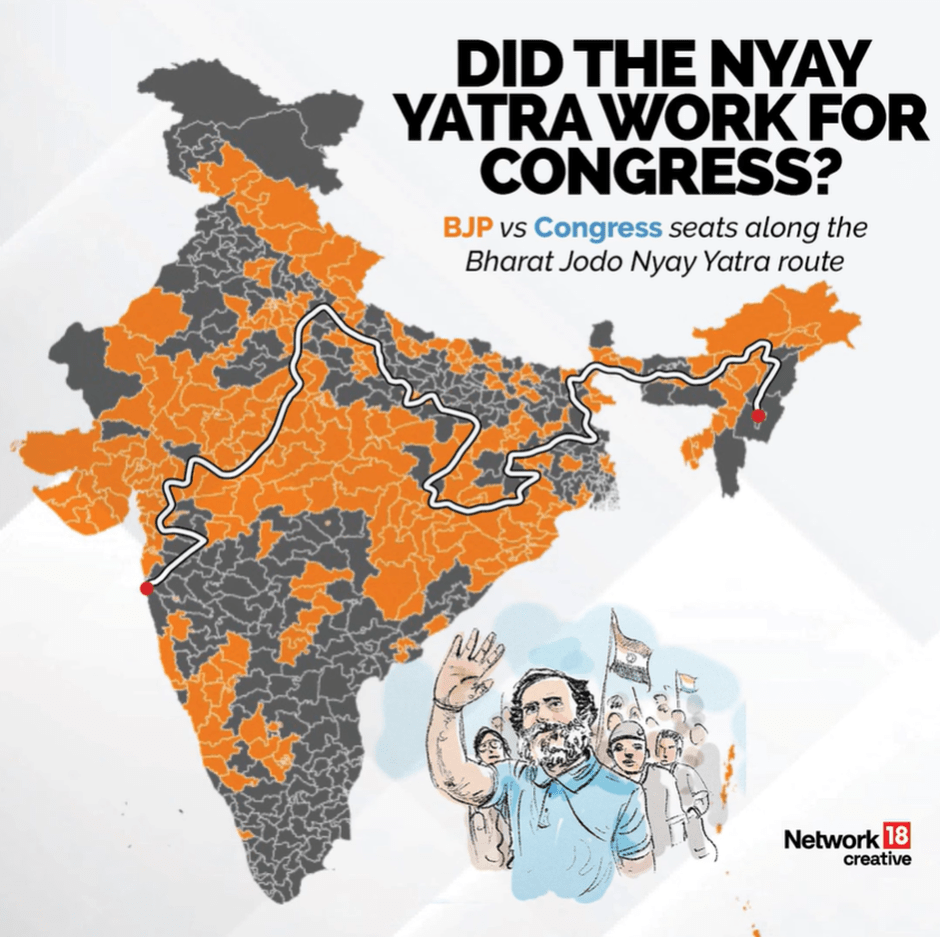
Nyay Yatra Results
If you look at the route of Rahul’s Nyay Yatra, you will see that BJP won most of the areas where Rahul Gandhi campaigned. This map was shared by Moneycontrol.
The white line was the route taken by Rahul Gandhi. It went well in Manipur, but as his journey progressed, his yatra seemed to have had less impact on the common man.
This is BJP’s performance in the same areas for comparison purposes:
As you can see, most of the areas were dominated by the BJP.
Questioning Congress’ Performance
The irony is that no journalist has questioned his performance and is projecting him as a hero. I am pointing this out because Congress prefers to believe that Rahul Gandhi is the best Prime Ministerial candidate. However, if you replace him with someone much more competent, votes will flow from the BJP to Congress naturally without much work or unending yatras. Many I know only opt for the BJP because they dislike the Gandhis, a sentiment that could be leveraged by a stronger Congress leader.
In India, there is a lack of a strong opposition party (not an alliance) with consistent and solid ideologies that do not vary among party members. Consistency brings confidence. Personally, I was not sure if I was voting for the left’s or Congress’ ideologies in the INDI alliance. The manifesto of CPI(M), one of the members of the INDI alliance, is one of the most dangerous I have ever seen. It does not inspire confidence. If I support the Congress but not the CPI(M), should I still vote for the INDI alliance? This is the skepticism I feel.
The question remains whether Congress is planning to continue working with an alliance and take credit for the alliance’s victories. We should question the party and demand improvements. Celebrating the current situation as a victory could prevent the emergence of a much more competent opposition party. The citizens of India deserve more.





 The Monkey Dilemma
You must be logged in to post a comment.