As I write this, an Indian news channel is broadcasting peaceful protests by Kashmiris condemning the recent Pakistani terrorist attack on tourists in Pahalgam. One protester says, “Pakistan doesn’t want us to live in peace. They’re destroying our livelihood by constantly sending terror into our land.”
After years, Kashmir was finally seeing progress. Businesses were recovering, and for the first time in ages, children completed a full academic year, attending school instead of being pulled into stone pelting and street violence funded by Pakistan’s terrorist groups.
So, who exactly are these Pakistani terrorists fighting for? Themselves? Their religion? What does Pakistan gain by funding terrorism or sheltering terrorists on its soil, other than being rebranded year after year globally as a “terrorist state”?
Where are the voices of Pakistani celebrities, many of whom have large Indian fan bases, when it comes to condemning this violence?
A quick scroll through Pakistani Reddit forums shows users justifying the attack as “resistance.” When will ordinary Pakistanis tell their government and military to stop sponsoring terrorism in Indian Kashmir?
When will they let Kashmir breathe in peace?
So many grievances. And yet, silence ensues.
When Indians express anger toward Pakistan, many Pakistanis act surprised. They are unable to understand why Indians harbour so much hatred for Pakistan (or they may be feigning ignorance). The answer lies in the reactions, the deafening silence that follows whenever India gets attacked. It’s easy to speak of peace and brotherhood when you’re not the one burying your loved ones. How many Indians, soldiers and civilians, Hindus and Muslims alike, have lost their lives to Pakistan-sponsored terrorism? And yet, we’re expected to keep our borders open, welcome Pakistani artists, and pretend everything is normal. Most of these artists haven’t even spoken a word against the radicals who spill Indian blood. They want our money and admiration, while their country fuels terror against us.
Every time Kashmiris speak out against Pakistan or wave the Indian flag, Islamabad spins the same tired excuse: “They’re being forced by the Hindutva government.” Really? Was the Kashmiri Muslim man who died trying to save Hindu tourists in Pahalgam doing it under pressure from the Indian government? Make it make sense.
Pakistan is to India what Hamas is to Israel. Friendship is a fantasy. We may share history, but there’s no future unless Pakistan first cleans up the terrorism it breeds. Until then, no dialogue, no gesture, no cultural exchange can bridge this gap. The course correction has to begin on Pakistan’s side. Let Kashmir live in peace.
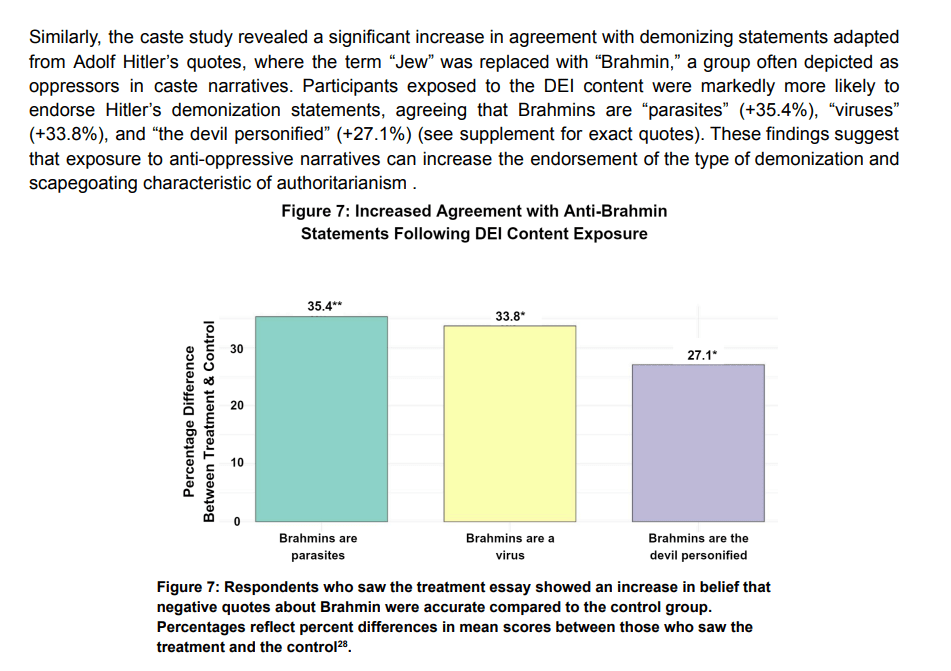
The following snippet is from a DEI study by the Network Contagion Research Institute (NCRI) in the U.S. The diversity, equity, and inclusion (DEI) program, originally meant to raise awareness, appears to have backfired in some areas. By framing everything through an “oppressor vs. oppressed” lens, it has ended up vilifying the Hindu Brahmin community, similar to the Jewish community.
While DEI narratives often focus on Islamophobia and racial discrimination, caste-based bias among American Hindus has largely remained outside the spotlight. Though widely recognized in India, caste discrimination has only recently started gaining attention in the U.S., leading to the introduction of caste-sensitivity training in schools, workplaces, and policy discussions. But did they have the desired effect? Studies show otherwise.
The vilification of Brahmins began in India, where they are often targeted for everything, from their dietary habits to their lifestyle choices. What should have remained a focused activism against caste discrimination has unfortunately expanded into a broader mockery of the community as a whole. Even Brahmins who reject caste-based thinking are not spared.
Like anyone else, a Brahmin does not choose the caste they are born into. So, isn’t attacking them solely for their birth also a form of casteism? Every community should be open to critique for its flaws, but no one should be dehumanized for simply existing.
Awareness is important, but this study shows that excessive activism can cross a line and end up vilifying an entire community. In the findings, respondents described Brahmins as “parasites,” “viruses,” and “the devil personified.” How is that fair, or even acceptable, in the name of social justice?
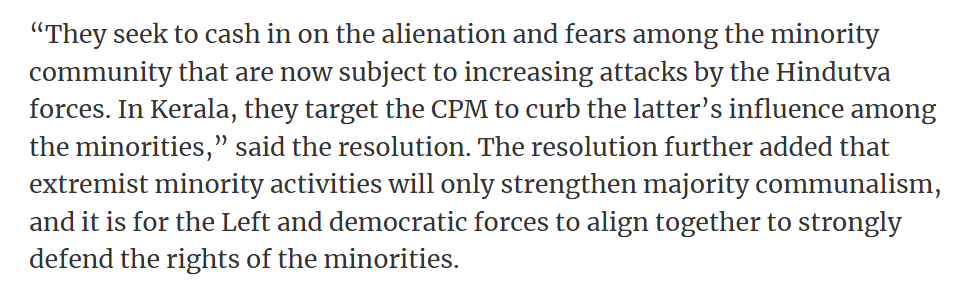
CPM mentions this about Islamist groups in the draft resolution:
Hindu extremists are using radical Muslim groups as fodder to fuel hatred between communities. But the reverse is also true—radical Muslim groups exploit the political climate to spread their own agenda. They feed off each other.
One side claims, “If Islamists stop, Hindu extremism will die down.” The other side counters, “If Hindu extremists stop, Islamists will weaken.”
There’s no middle ground. How do we break this cycle? Who should compromise? The answer is—both.
The only way forward is to call out radical elements within your own community—those who discourage interfaith interactions, prevent you from celebrating others’ festivals, and push you away from the secular fabric of the country. Peaceful coexistence is the only solution.
However, I mostly see this self-criticism coming from the Hindu community. Not everyone supports right-wing politics, a Hindu Rashtra, or extremist activities, and many Hindus actively speak out against radicalism within their own circles. But the same level of criticism isn’t visible in other communities. At least 95% of the Muslims I know have never condemned extremism within their own community, but they are very vocal about Hindu extremism. If only one side is willing to challenge its radicals, how can we truly achieve peaceful coexistence in a secular, democratic nation like India?
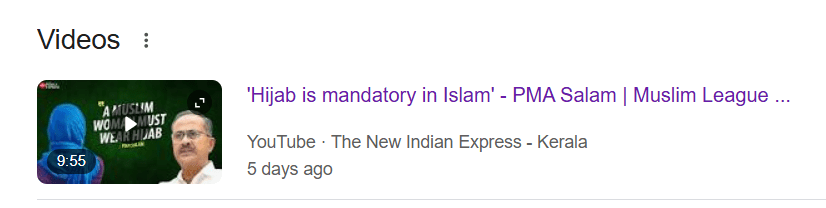
I feel this silence comes from fear—fear of being ostracized by their own community. In Kerala, the Muslim League openly stated that the hijab is not a choice for Muslim women; it is mandatory. When a journalist asked, “What if someone doesn’t want to wear it?” the leader reaffirmed, “If she’s a Muslim, we advise her to wear it.” There was no room for choice. Yet, despite often advocating for personal freedom, there was no backlash from within the Muslim community against this statement. This silence is unsettling. It makes people wonder—“If they won’t even speak up for their own freedom of choice, how can we expect them to stand up for ours?”
India is a secular nation, and preserving this secularism requires protecting religious freedom. When prominent leaders impose strict regulations on women, silence is not an option—it is a time to question them and hold them accountable. If not now, then when? Waiting until things spiral out of control will only make it harder to reclaim lost freedoms.
Western countries often criticize India, accusing it of restricting the religious freedom of minorities. For a long time, I was puzzled by this, as I saw minorities freely attending their religious places without any problems. On the other hand, Hindus in Jammu require police protection to visit their religious sites due to the ongoing threat of terrorism. So, where is this accusation truly coming from?
One of the main reasons many Christians oppose the BJP is that the party has significantly restricted international funds meant for proselytization. These funds were often misused in India to attract economically disadvantaged citizens into converting, with promises of financial assistance tied to conversion. As a result, conversions were driven more by economic pressures and manipulation than genuine faith.
Countries like the USA actively fund missionary programs, with groups such as the evangelical World Vision and the U.S. Commission on International Religious Freedom (USCIRF) advocating for unrestricted proselytization as a form of religious freedom. They often cite Article 18 of the United Nations’ Universal Declaration of Human Rights (UNDHR), which asserts that every individual “has the right to freedom of thought, conscience and religion; this right includes freedom to change his religion or belief…” This interpretation forms the basis for their criticism of India, accusing the country of limiting religious freedom and ranking it low in the religious freedom index. A 2012 article written by Dr Aseem Shukla explains this point brilliantly (hinduamerican.org/blog/proselytism-conversion-to-intolerance/).
This raises an important question: why offer monetary assistance only after conversion? Why not provide help based on humanitarian principles, without attaching religious conditions? When people are lured into faith through financial incentives, it undermines the integrity of the belief system itself. Shouldn’t conversions be driven by genuine faith and conviction, rather than economic manipulation or coercion?
Unfortunately, that’s not the reality for many. People are being lured into changing their religion through manipulation, whether through money or other means. I personally know several individuals who converted simply because they were promised financial support. What’s even more surprising is that younger generations are now making conversion a prerequisite for marriage. It’s hard to comprehend how, in today’s world, people still can’t accept different faiths and feel the need to demand conversion from their partner for the sake of marriage. Is this really secularism? Or love? I discussed this topic on this blog after watching a show, Nobody Wants This, on Netflix some time ago.
I’m currently reading a book about Kamala Das, The Love Queen of Malabar, written by a Canadian author, where it’s mentioned that Kamala was pressured to claim her conversion was out of faith, not love. The reasoning behind this was that saying she converted for love would diminish the strength of her faith. However, after her partner left her, she felt deeply depressed. The book suggests that the man she loved had been financially incentivized by foreign entities to convert Kamala. Later, Kamala wished to return to Hinduism but feared for her life and her family’s safety, including her grandchildren. Her sons even used to correct her whenever she, by habit, uttered the name of her former god, as they were afraid it might anger radicals and put their family at risk.
Why manipulate people into conversion? Let them choose to convert out of genuine faith – that is true religious freedom, not a process driven by external incentives.
The new government has largely restricted predatory conversion tactics by limiting international funds and addressing radical elements within society. This is one of the primary reasons the Indian government is widely criticized globally.
The propaganda against India has a broader base compared to the narratives propagated by BJP supporters. It’s easier for these narratives to spread, as the Christian and Muslim communities form larger global groups compared to the Hindu community. With such a widespread network, sensational news spreads quickly and easily. Adding to this challenge is the Hindu community’s general reluctance to actively counter exaggerated news, making it even harder to protect India’s image.
Many who believe in proselytization through unfair means seek the removal of the current government to restore previous practices. This is probably why they complain about every small issue and often manipulate facts to present one-sided stories. By focusing on selective narratives, they aim to undermine the current administration and bring back the old ways.
The narratives about India are often more complex than they appear in the media or through agenda-driven sources. They tend to present only one side of the story, exaggerating it to evoke emotional reactions. This is why it’s crucial to consult both left and right-wing media to gain a more balanced perspective. Otherwise, you risk forming judgments based on incomplete or biased information.
I purchased A Thousand Cuts because I wanted to know Professor T.J. Joseph’s side of the story. Those who don’t closely follow news from South India might not have heard of him. I will offer an introduction before moving on to the quotes from his book.
Who is Professor TJ Joseph?
Professor T.J. Joseph is a retired college professor from Kerala, India. He gained significant attention after he became a victim of religious extremism. The tragedy that occurred in 2010 shook Kerala to the core and impacted the communal harmony of the state. Never had Kerala witnessed such a radical act in modern history. How and why did this happen?
The Tragic 2010 Incident
In 2010, while working as a Malayalam professor at Newman College in Kerala, Professor Joseph set up a question paper for an exam. One of the questions unexpectedly became viral due to its controversial nature. Professor T.J. Joseph did not mean any harm when he drafted the question. He had simply taken influence from a book that he had read. But alas, many misunderstood the actual intention behind the question and accused the Professor of blasphemy.
Despite offering an apology, communal tensions refused to die down. The religious were angry. Fearing for his life, and feeling utterly unsafe in his surroundings, he ran away from home. After moving from one district to another, he finally decided there was no point in hiding, especially when he had done no wrong. He returned home, only to be eventually attacked by PFI members. He was mercilessly beaten up, and his right hand, which the extremists accused of writing the “dreaded” question, was severed in front of his family, neighbors, and other village folk who stood shellshocked, too scared to intervene. It took multiple complex surgical procedures to re-attach his hand.
Kerala is a state that is renowned for its communal harmony. But it is also known for its appeasement politics. The state government, politicians, and media did little to help Professor TJ Joseph. His Church abandoned him out of fear and ego. The Professor ended up losing his job in the college on the grounds of misconduct, although he was later reinstated after public outcry and intervention by authorities. He was the sole breadwinner in his family, and his wife and children had to endure many hardships due to his job loss. His wife, Salomi, slowly went into depression and died by suicide. The chapter on his wife is the only chapter without a title. It’s as if words aren’t enough to encapsulate the depth of his grief.
I bought his book because I had only heard the media’s version of his story till now. We all know by now how the media often tries to cover up facts based on their own biases. The present state of mainstream media made me purchase the book. I am glad I did it. The details are chilling. The points I am giving are only a summary of the things that happened. When you read the book, you are transported into Professor Joseph’s world of art, cinema, poetry, desperation, fear, courage, and resolve. He explains every little incident in vibrant detail. You can’t help but shed a few tears. I feel Kerala collectively failed him. Yet, his optimism and his dry sense of humor prevail and serve as a source of inspiration. Here’s a teacher who is teaching everyone in his own unique way how to combat the extremes that life throws at you.
Professor T.J. Joseph’s case remains one of the most shocking cases of religiously motivated violence in Kerala. The incident sparked widespread anger and discussions about freedom of expression and religious intolerance. The PFI members involved were later arrested and convicted. But, sadly, as a society, we still remain religiously intolerant. If you take a peek at the comments under any of his videos or news articles, you will know what I mean.
Quotes from Professor TJ Joseph’s Book
In an apology of a democracy, the interests of the mob got weightage over anything else, even if those interests were born out of ignorance, against truth and flagrantly unethical. Vote banks comprise such mobs. They shoulder the chair of power.
Marital life is a kind of war. An extraordinary war that lasts a lifetime. In a normal war, the one who defeats the opponent wins the war. In a marriage, the one who defeats the other will also lose. Therefore, marriage is a war where one must win without defeating the significant other.
My rationale was that as I had taught thousands of students, a large number of whom were Muslims, even if some misguided elements wanted to harm me, wouldn’t they first ask my students, and wouldn’t my students stand up for me and disabuse them of their wrong notions about me?
The mind of a student of literature must be dispassionate. Only in a place where there is no entrenched emotion can all emotion enter. Only in spaces where no one belief has nested itself can enlightenment enter and soar.
As I lay there accepting gifts and graces, I thought I must not merely forgive my attackers but thank them as well. For until then, I had never received so much love and care.
The attack on me was condemned even by Muslim organizations. The Church authorities alone remained silent.
I have been told that the gang that attacked me was made up of active members of an organization called Popular Front of India (PFI) and its political wing known as the Social Democratic Party of India (SDPI). All the members of the attack gang were then sent to various safe houses and shifted from one to another frequently with the help of many sympathizers.
The fish seller in our area in Muvattupuzha was a Muslim. Earlier, if we asked for half a kilo, we would receive exactly half a kilo. That has changed since: when we ask for half a kilo, we get at least three-fourths of a kilo. Only when I threatened to stop buying his fish if he didn’t accept payment did he, very reluctantly, start to accept money from me again.
Pinarayi Vijayan said that the whole of Kerala was on my side and that there was no difference between the extremists from PFI who had chopped off my hand and the church diocese that owned and managed the college.
At one time, having run out of funds, when I was at the end of my tether, Yukthivadi Sanghatana (Rationalists Organization) turned up with the money they had collected for me. I asked myself, why would they need other gods when they are themselves playing the role of God?
After I was attacked and maimed, I appealed to the state chief minister and home minister to withdraw the blasphemy case filed by the police against me of their own accord. The government had no will or courage to withdraw a case they had got instituted for communal appeasement.
The view that the suicide was caused by the unjust and immoral ways of the Newman College authorities predominated. One thing is certain, a dead Salomi is more powerful than a live Salomi. Because what she couldn’t achieve while alive, she could, by dying—bring the management to change their mind.
600 families in a small coastal area in Kerala risk losing the properties they paid for. Reason: The Waqf claims the land is theirs.
What is Waqf?
A waqf is an Islamic endowment of property or assets designated for religious, charitable, or social purposes.
In India, waqf properties are managed by the Waqf Board, a government body responsible for overseeing and regulating these endowments.
What is the Munambam Waqf Issue?
The Munambam Waqf issue is a complicated land dispute. This land, which covers approximately 404 acres, is located in a place called Munambam in the Ernakulam district of Kerala.
Historically, the land belonged to the Kutchi Memon community. They migrated to Kerala for trade and were granted this land by the Travancore kingdom. In 1950, part of the land was donated to Farook College as Waqf property, intended for educational purposes. Farook College went on to sell this land to the current property owners of Munambam.
In recent years, the Kerala Waqf Board has claimed ownership of the land. This has led to significant tensions among local residents, most of whom are Christian families and fishermen who have lived there for decades with legal ownership. This is not a communal issue, as even Muslim families have been affected by Waqf.
The claims by the Waqf Board have prevented the residents from managing their properties. They cannot pay taxes or sell their land to meet personal needs, such as funding their child’s education or obtaining health treatments. The residents assert that the claims by the Waqf Board are invalid, as they fairly paid for the property.
Politicians from Congress and CPI(M) insist the property is not Waqf to console the residents. However, the Waqf Board says the land is indeed Waqf and the 600 Munambam families are encroachers who need to eventually vacate the area.
The Munambam residents were initially told to approach the Waqf tribunal to fight their case, as the court is unauthorized to handle Waqf land matters. This requirement is enabled by the current Waqf Act introduced by Congress, forcing victims to seek justice from the perpetrators themselves. Across India, there are 70,000 such cases pending, which the court cannot address until the Act is reformed.
How to Resolve this Issue?
To prevent this issue from escalating, political parties must ensure that the vulnerable families in Munambam are provided justice. If they paid for the property, it is theirs to keep. Another community’s beliefs should not be imposed on them. It will lead to matters turning communal.
Concerns
This is not the only Waqf dispute in the country. The Waqf Board is claiming acres of land in other states of India, one of which houses a temple that is older than Islam itself.
The opposition parties, especially Congress, need to ensure the poor do not suffer because of discriminatory laws. For that to happen, all political parties need to work together to reform the existing Waqf law in India that allows such unfair claims.
I’m observing that the Waqf issue in Munambam is causing more Christians in Kerala to support the BJP. The matter has also drawn the attention of churches, which are advocating for reforms to protect property rights in cases like this.
If the reforms do not get passed in the winter session of parliament due to the appeasement politics of the opposition parties, the political landscape might shift significantly in favor of the BJP. It might change the political beliefs of many, who until now used to treat the BJP as untouchables.
The opposition parties’ best course of action is to back the Waqf reforms and avoid misleading the underprivileged with false promises. Words are not enough at this moment. The parties need to proactively initiate a discussion with the Waqf Board and ensure the poor get justice.





 The Monkey Dilemma
You must be logged in to post a comment.