I’ll start by saying I’m in my 40s, so I’m not exactly the target audience for this film. Still, I enjoyed seeing fresh faces on screen. Actors who look natural, expressive, and free from the usual heavy Botox work.
What’s It About?
Saiyaara opens with the female lead at the registrar’s office, ready to formalize her marriage. She’s a dreamer and a poet, someone who finds inspiration in life’s fleeting moments. Even in the office, she pulls out her diary to capture the beauty of what she believes is the start of a new chapter. But life takes an unexpected turn.
She soon crosses paths with the male lead, an angst-ridden singer determined to make it big. The film traces their love story and the way they navigate the highs and lows of their relationship.
Thoughts
The story felt like a mix of Aashiqui2 and Rockstar. As I’m not drawn to melancholy, tragic romances, it didn’t resonate with me as much as I’d hoped. That said, it was refreshing to see young, expressive talent on screen.
Director Mohit Suri specifically sought an actress without cosmetic enhancements (a “botox-free beauty”), and I think that was a brilliant choice. As an audience member, I’ve found lip jobs and other obvious procedures very distracting, so the natural look was a welcome change.
The lead actress (Aneet Padda) is adorable, and the actor (Ahaan Panday) is quite charming, too. Their chemistry was lovely. Personally, I would have loved to watch this pair in a light-hearted romcom instead. Hopefully soon. We need more youthful, happy, meet-cute romantic stories in Bollywood.
The debate around Umar Khalid, Sharjeel Imam, and other Delhi riots accused who have not yet been granted bail has once again come into focus. From the right-wing perspective, the issue is not as simple as “judicial delay” or “denial of justice.” I thought of writing this post because many in India only trust left-wing channels, which causes them to miss important fact-based points shared by the right-wing.
Adjournments and CJI’s Remarks
First of all, let us understand what an adjournment is. Simply put, it is when a court hearing or trial is postponed to a later date instead of being completed on the scheduled day.
Out of the 14 adjournments in Umar Khalid’s case, 7 were initiated by his own legal team. This was mentioned by CJI D.Y. Chandrachud himself in his interview with Barkha Dutt.
Source: Lawbeat
“I do not want to comment on the merits of the case but I must tell you one thing which is lost sight by a lot of people when it comes to Umar Khalid‘s case, can you imagine that the case was adjourned, they were at least seven if not more adjournments which were sought by the council appearing for Umar Khalid and eventually the application for bail was withdrawn.” – CJI Chandrachud
Justice Chandrachud noted that, on social media, a one-sided narrative often takes hold, leaving judges with no space to defend themselves. He added that if one looks closely at the actual proceedings in court, the reality is far more nuanced than what is portrayed online.
While some “fact checkers” online have attempted to dismiss this claim by relying on surface-level sources, it is reasonable to trust the CJI more on this matter. As head of the judiciary, he had direct access to both official and indirect records of adjournments.
The Delay Tactic
According to many on the right, Khalid and Imam’s legal strategy is clear. If the trial begins, conviction is almost certain. Thus, their team is accused of deliberately delaying proceedings by filing fresh petitions, often citing a “change in circumstances.” The idea is to drag the trial as long as possible and eventually claim bail on the grounds of delay.
Notably, some petitions that caused delays were also filed by other accused who are already out on bail.
The Judicial Tactic Explained
The strategy seen here is not unique. It is a common tactic in the Indian judiciary:
Lawyers repeatedly file petitions (often citing new circumstances).
Each petition leads to adjournments, dragging the trial.
Eventually, the accused can argue that their right to a speedy trial (protected under Article 21 of the Constitution) has been violated.
On that ground, they can seek bail due to judicial delay.
This slow erosion of the process not only stalls justice but also erodes public trust in the judiciary. Something that many argue is part of the plan.
CJI on Unseen Angles
In an interview with Barkha Dutt, CJI Chandrachud hinted that there are angles in the case that cannot be revealed to the public. Right-wing commentators believe this may refer to multiple coordinated fronts behind the Delhi riots.
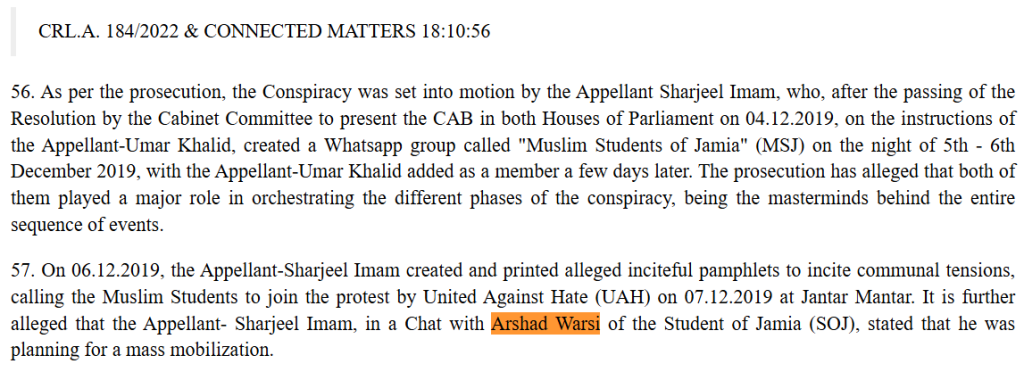
One example often cited is ISIS member Arshad Warsi (not the actor), who was in contact with Sharjeel Imam. Warsi allegedly helped decide the content of pamphlets that were distributed to mosques and Muslim neighbourhoods prior to the riots to incite violence. He was later arrested in the Pune ISIS module case.
Sharjeel Imam’s connection with Arshad Warsi. Source: indiankanoon.org/doc/156202283/Arshad Warsi arrested
There are also allegations of foreign funding and terror groups like PFI supporting the protests and unrest.
Umar Khalid met with other accused people in the PFI office to discuss funds for riots. Source: indiankanoon.org/doc/156202283/
The Seriousness of the Delhi Riots
The 2020 Delhi riots were not minor incidents of unrest. They claimed the lives of 53 people, including Intelligence Bureau officer Ankit Sharma. For many, this underscores the gravity of the case and why justice cannot be indefinitely postponed.
Right-Wing Response
Right-wing commentators like Abhijit Iyer-Mitra and Kushal Mehra have now openly criticized the delay of trials. They argue that instead of dragging the matter endlessly, the trial should begin as soon as possible, and justice should be delivered. In their view, it is time to see through legal manoeuvres and bring the culprits to justice. The longer the delay, the more the perception of judicial inefficiency grows, and that benefits only those seeking to evade accountability.
It is also important to understand that, though we can call for quick trials, courts in India are bound to follow established legal procedures. Every step, adjournments, evidence submission, witness examination, bail hearings, has to comply with the Code of Criminal Procedure (CrPC), the Evidence Act, and constitutional safeguards like Article 21 (right to life and liberty, including speedy trial).
Judges cannot simply “override” these protocols, even if they suspect delaying tactics. If the defense files a petition citing “change in circumstances” or another procedural ground, the court is obliged to hear it and decide. Ignoring or fast-tracking outside the rules would open the door to appeals, accusations of bias, or even the case collapsing later.
Delays often frustrate people. However, they’re also part of the judiciary, ensuring the trial stands on solid legal ground.
Left-Wing Response
The left-wing argues that delays aren’t only due to Khalid’s side and that long undertrial detention is unfair. While these points deserve acknowledgment, they don’t erase the fact that half the adjournments were filed by Khalid’s own team and that Sibal’s strategy clearly aims at running down the clock.
They also say Hindu mobs who killed during the riots haven’t faced equal scrutiny. But the distinction is clear: Hindu rioters were violent on the ground, yes, but they did not make the kind of provocative, mass-scale mobilizing speeches Khalid and Sharjeel Imam did that led to loss of lives. Khalid mobilized crowds by invoking the Kashmir issue, while Sharjeel Imam spoke about separating Assam from India and attempted to provoke people through pamphlets referencing the Babri Masjid dispute. Videos of their speeches can be accessed easily on social media platforms. That’s why the charges against them are different and why delaying the trial feels like a deliberate tactic.
My Take
It is important to examine cases from every angle instead of blindly accepting one-sided propaganda. Dhruv Rathee does not question the opposition, while journalists like Shiv Aroor do not question the ruling party. So it’s up to us, the citizens, to collect points from both sides and analyze it.
I have tried to provide proof for all the points in this post, but they can also be independently validated online. I would highly recommend going through the Indian Kanoon link (indiankanoon.org/doc/156202283/) to read more about the case.
Rather than dismissing everything right-wing as lies, citizens should review the available evidence and ask: Is a separatist attitude acceptable for the country? Does this kind of behaviour warrant bail? This cannot simply be brushed off as freedom of speech, because in this case, speech directly incited violence and led to the loss of 53 lives and the injury of thousands.
In India, there are rarely open-and-shut cases. Even Ajmal Kasab, a convicted terrorist, was given a fair trial. By that standard, it is certain that Sharjeel Imam and Umar Khalid will also receive a fair hearing once their trial begins, especially since their offences, while serious, are not on the same level as Kasab’s. That is why the trial should begin without further delay. So their actions can be properly examined, and justice delivered swiftly.
After celebrating Onam and engaging in numerous social activities, my introvert battery hit rock bottom. I needed a desperate recharge. So what do I do? Naturally, I retreated to every introvert’s most favourite new-gen comfort zone: scrolling endless Instagram reels. Nothing says “I’ve had enough of people” quite like being a couch potato, locked up in your house, while going through everyone else’s social lives.
As I scrolled through the multiple Onam-related posts, I couldn’t help but appreciate the inclusivity in Kerala. Malayalees across religions, whether they are Hindus, Christians, or Muslims, celebrated Onam with equal enthusiasm. Everyone welcomed Mahabali with open arms. A few voices did try to stop their communities, saying Onam is a “Hindu festival,” but not many paid attention. That’s a good sign. People are choosing to step out of religious bubbles to celebrate together.
Still, Kerala, often praised as a secular state, has been showing sporadic worrying signs of exclusion. Just before Onam, a teacher told students not to participate in the festival because “our religion doesn’t allow it.” The outrage led to her suspension, but this mindset isn’t limited to one person. How widespread is the thought? No one can quantify. It’s impossible to analyze each and every Indian’s thought. However, there is an increasing number of cases that advocate for exclusionary behaviour. You are penalized for celebrating other festivals, or for respecting someone else’s god, or for chanting something as simple as “Bharat Mata ki Jai.”
India guarantees freedom of religion for all communities. But if we use that freedom only to exclude ourselves from others, we risk creating deeper divides. True communal harmony comes from participation: joining in festivals, enjoying each other’s food, and refusing to see other faiths as “untouchable.”
For India to stay secular, this effort has to come from all of us. We’ve come far since independence, but there’s still a long way to go. It’s up to us to ensure religion doesn’t become a wall, but a bridge.
I think a lot about how we as a culture have turned “forever” into the only acceptable definition of success. Like… if you open a coffee shop and run it for a while and it makes you happy but then stuff gets too expensive and stressful and you want to do something else so you close it, it’s a “failed” business. If you write a book or two, then decide that you don’t actually want to keep doing that, you’re a “failed” writer. If you marry someone, and that marriage is good for a while, and then stops working and you get divorced, it’s a “failed” marriage.
The only acceptable “win condition” is “you keep doing that thing forever”. A friendship that lasts for a few years but then its time is done and you move on is considered less valuable or not a “real” friendship. A hobby that you do for a while and then are done with is a “phase” – or, alternatively, a “pity” that you don’t do that thing any more. A fandom is “dying” because people have had a lot of fun with it but are now moving on to other things.
I just think that something can be good, and also end, and that thing was still good. And it’s okay to be sad that it ended, too. But the idea that anything that ends is automatically less than this hypothetical eternal state of success… I don’t think that’s doing us any good at all.
It’s never “the person successfully got out of a bad marriage or bad friendship,” which, in my opinion, is one of the toughest things to do, at least in India. There are always a hundred people telling you to save the marriage or friendship, even if it sucks your soul. They go all out to make you feel guilty. When you do manage to get out of it eventually, it’s labelled a “failed” relationship.
Have we got our definition of success all wrong? The way it stands today, it often makes us cling to things that are no longer healthy, just for the sake of appearances. We try to make them work, even when we know they’re a lost cause, because society’s approval depends on it. We want people to look at us from afar and say, “Yes, they’re doing well in life.” This happened to me when I was trying to get out of my bad marriage. Society did not see my anguish; they simply wanted me to save the marriage.
Over time, I’ve grown less dependent on that kind of validation. Experience teaches you that to find true happiness, you need to first understand what happiness is to you, not others. I no longer feel the need to prove anything to anyone. There’s a calmness that comes with stepping out of the race. But it does not come without effort. In a world that constantly pushes you to do more, choosing to stay still and steady is often misunderstood. Living a life that balances financial independence (not luxury) with peace of mind rarely gets branded as “success.” However, luxury and fame without peace of mind are often labelled as the ultimate life.
Success takes on different meanings, even outside personal or professional life. Take politics, for instance. Many Indians see Modi’s stance against Trump’s tariffs and his refusal to bow down to demands (such as where India should purchase their oil from) as a mark of success. Others, however, view it as a diplomatic setback for India. And then there are those who believe it was actually a diplomatic failure for the U.S., considering India is among the fastest-growing economies in the world.
Of course, success looks different for everyone. We judge others by our own yardsticks. But clarity comes when you start asking yourself:
What do I actually want? Do I want wealth in heaps, or do I want balance?
What are the trade-offs, and am I okay with them?
How long am I willing to sacrifice? Am I truly passionate enough to give up other things I hold dear for this one pursuit?
When you have that honest conversation with yourself, defining success on your own terms rather than society’s, life feels lighter. And you stop depending on others for validation and how you should live your life. This does not apply to kids and young adults, though, who still need guidance on how to navigate life. A child cannot simply say, “Screw studies, it makes me upset,” and get away with it in the name of freedom of choice.
Effort is important, but so is knowing when to hold on and when to let go. True freedom comes only after achieving some level of financial independence. So that should be the first pursuit, regardless of gender.
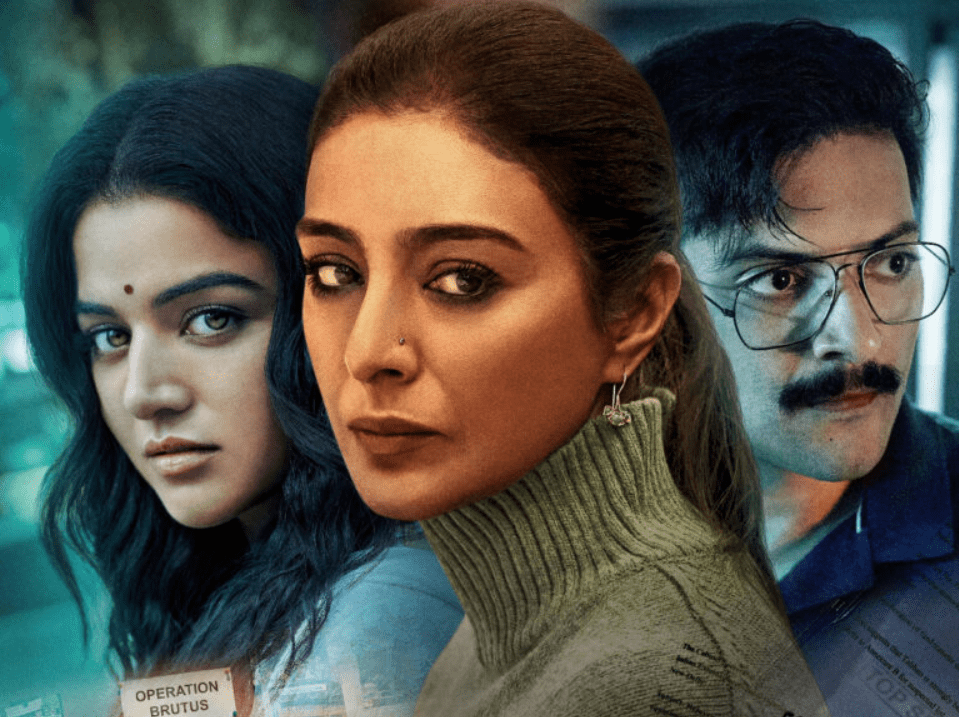
You won’t always find the newest movie or series reviews here. My watchlist is long, and what I finally pick to watch could have been released years ago. That’s how I ended up with Khufiya. In fact, I didn’t even choose it myself, AI did. I simply shared my watchlist because I couldn’t decide what to watch next, and all the options looked interesting. The AI randomly picked Khufiya for me, and I’d say it did a pretty good job.
What’s It About?
An Indian R&AW agent loses a teammate during a failed mission. When the agency discovers there’s a mole in their ranks, they set a trap to catch him, but the plan takes an unexpected turn.
Thoughts
I really enjoyed this movie. It keeps you engaged throughout. Wamiqa Gabbi is the real standout here. Tabu delivers a solid performance, though I wouldn’t call it one of her finest. Wamiqa’s role is the most layered, and she plays it convincingly. There’s also a guruji-like character, seemingly inspired by Sadhguru, who is amusing to watch, though some viewers may find him offensive.
What struck me most was how the film portrays the mindset of traitors. Moles often justify their betrayal by claiming they are “saving the country from conflicts” or “working for peace,” even as they leak sensitive information. In real life, too, Indian spies caught selling secrets often give similar excuses, trying to project themselves as heroes rather than wrongdoers. Khufiya captures this psyche well, showing how enemies exploit such individuals by convincing them they are doing the right thing.
Overall, Khufiya is definitely worth a watch. It is streaming on Netflix.
I came across a review of Dept. Q on Instagram Reels, which is how it ended up on my watchlist. Honestly, before watching, I was doubtful whether I would finish it. Lately, many “thriller” series have failed to truly thrill me. But I’m glad I gave this one a chance and stuck with it.
What’s It About?
An arrogant detective, Carl Morck, returns to work after being injured in a shooting and is assigned to a new department in a dingy basement to investigate unsolved cases. He is soon joined by Akram, a former Syrian policeman now working as a civilian employee, and Rose, a young and spirited constable. Akram ends up selecting a case for Carl to pursue, one involving the sudden disappearance of a lawyer after she is assaulted by her non-verbal brother on a ferry.
Thoughts
Even though the series drags at times, I found myself wanting to know what happens next. This curiosity kept me watching. My rule of thumb for thrillers is simple: Am I interested in finding out the truth? If yes, I continue. If no, I skip. This series made me stay. I genuinely wanted to know what happened. The final episode was the standout of the season, stirring a range of emotions in me: anger, fear, thrill, affection, and warmth.
The performances were strong across the board, but my favourite character was Akram, played by Alexej Manvelov, a mature presence, always in control, in contrast to the more unruly Carl Morck.
I would recommend Dept. Q. It’s streaming on Netflix, with a total of 9 episodes, each roughly an hour long.










You must be logged in to post a comment.