I’ve always viewed Hinduism as a mainstream religion. However, I recently learned that there are people, especially outside India, who consider Hinduism as “pagan.” Surprisingly, even within India, some Hindus refer to themselves as “the last polytheistic pagans remaining on earth.”
However, an article on Scroll by Arvind Sharma presented an interesting explanation of why Hinduism cannot be considered Pagan.

This pluralistic nature of Hinduism could explain why India, a Hindu-majority country, is able to embrace the beliefs of diverse communities. Communal clashes happen, but everyone is free to complain. There is no existential threat. The freedom to complain is in itself an underrated freedom. People in several countries cannot question their government or the majority religion. Sadly, we often take this freedom for granted.
Currently, there is no self-declared Hindu nation; all nations with a Hindu majority identify as secular. Even if a country were to declare itself a “Hindu nation” in the future, the principle of secularism would likely endure, as the idea of secularism is deeply embedded within Hinduism itself. So, a Hindu nation will not be one that would force people into converting to Hinduism, but one that is already in effect and on full display in Hindu-majority nations. Take the case of India. LGBT couples can have a joint bank account in India, abortion is legal, and atheism is tolerated. You are free to worship your god, not worship a god, or go to any religious place of your choice. No one is going to force you to wear a religious symbol or yank it off you.
Is India perfect? Definitely not. It’s like any other pluralistic nation. There is discrimination, but not to the extent the media, especially Western media, reports. Some even peddle fake news as the reality, without hearing both sides of the story.
The problem with religious propaganda is that it attracts the wrong kind of people. Recently, Rahul Gandhi said that Sikhs are unable to practice their religion freely in India. This came as a shock to many, including Sikhs in the country, as there have been no such allegations in the last decade from the community. However, the leader of a separatist group was happy and quoted Rahul’s words to reinforce the group’s agenda to form an independent nation for Sikhs that spans parts of India. Similarly, allegations against India of being Islamophobic have triggered radical Islamist groups like ISIS. The group frequently references India (particularly Hindus) in their newsletters, using the country’s internal clashes to advance its agenda and emphasize to its followers the need for “disciplining” us.
Seeking justice is acceptable. However, I hope people, especially Indians, are mindful of exaggerating communal events in the country, as they often end up catching the attention of extremists, who then use the news to create propaganda videos and material for fueling hatred and recruiting new members to their groups. When the time comes, extremists do not look at political party affiliations, religion, race, color, caste, region, or language before they cause havoc. Everyone is the same for them. Being wary of social media activism is essential for our country’s well-being. We should double-check details from both left-wing and right-wing sources to get a full idea of the story. Most journalists in India today are biased, which is why due diligence is required before endorsing/believing stories.
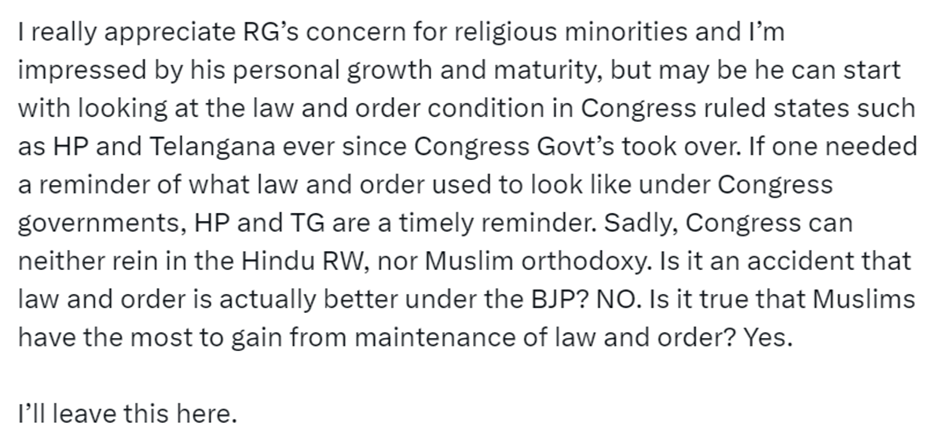
Before signing off, I wish to share this tweet by Shehla Rashid, which beautifully debunks the communal allegations against India.



 The Monkey Dilemma
You must be logged in to post a comment.