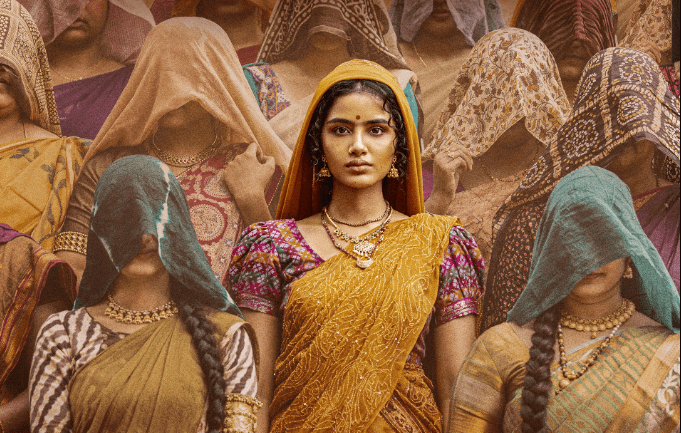
Movie Spotlight: Paradha

Paradha Movie Poster

I actually wanted to watch Paradha in the theatre, because I thought the cast was interesting. It had my lovely curly-haired favourites: Anupama Parameshwaran and Darshana Rajendran, who are known faces in the South. But then I got caught up with other priorities and missed booking a ticket that weekend. Later, I came across some reviews that made me second-guess whether it was worth watching on the big screen and decided to skip going to the theatre. Recently, when it was released on Amazon Prime, I finally decided to watch it.

The movie made me realize that not every review online is meant for you. Reviews often reflect the reviewer’s personal taste, but we tend to assume we’ll feel the same way. I’ve had similar experiences with other films, too, where the reviews were harsh, yet I ended up enjoying them. I still don’t get the importance of movie reviews, because whether we like a movie or not is subjective. But here I am, giving my own movie reviews from a highly subjective viewpoint. I think we should treat reviews as such: personal opinions of someone who loves watching movies, and not the absolute truth.

What’s It About?

Paradha, true to its name, centers on Subbu (Anupama Parameshwaran), a young Hindu woman from a remote Indian village where the tradition of paradha (dupatta veiling) is strictly practiced. While this custom is largely cultural in many parts of India, the film presents it as a religious mandate. The villagers worship Goddess Jwalamma, who they believe commanded that women remain hidden behind a veil. From puberty onward, every girl is forced to follow this rule, with severe consequences for defiance. Subbu, however, finds herself caught in a controversy that threatens her marriage to the man she loves.

Thoughts

Though the story begins with a devout woman who strictly follows religious practices, Paradha is not just about her. It portrays women from different walks of life, each facing gender discrimination in unique ways.

The first woman is deeply religious, bound by the strict purdah or dupatta system. The second, married outside the village, has left purdah behind but remains traditional in other aspects. The third rejects religious traditions altogether, embraces modern values, and focuses on her career. The fourth is a policewoman who’s happily married, enjoying full freedom, and choosing to follow certain traditions out of personal preference rather than compulsion. The movie keeps the narrative balanced this way.

Paradha is a feminist film centered on women’s empowerment, and it may not appeal to everyone. It highlights how women, even the most progressive, continue to face discrimination, no matter how far they try to escape from it.

I really enjoyed the movie. The climax was chilling, and the performances, especially by Anupama Parameshwaran, Darshana Rajendran, and Sangeetha, were superb. It’s a brave film, because criticizing patriarchy is never easy. Often, women themselves defend restrictive practices by saying, “It’s our choice.” But true choice exists only when opting out doesn’t bring harsh criticism or punishment. Many women follow norms not out of freedom, but because they have no other option. The movie captures this truth powerfully.

Paradha is now streaming on Amazon Prime. I watched it in the original Telugu with English subtitles.

Book Review: “A House Without Windows” by Nadia Hashimi

Afghan women walking in front of a blue building image

I just finished A House Without Windows by Afghan-American writer Nadia Hashimi. These days, I gravitate more toward non-fiction and find it more engaging. Still, I’m not ready to give up fiction entirely. A House Without Windows was my fiction pick of the month.

What’s It About?

The story begins with a murder in an Afghan home. A woman, Zeba, is accused of killing her husband and is detained, with almost no chance of survival under Afghanistan’s strict laws for women in such cases. An Afghan-American lawyer, Yusuf, arrives in the country to connect with his roots, stumbles upon her case, and decides to defend her.

Thoughts

I really enjoyed the storyline, though I found the narration slow and somewhat predictable. What stood out most was how Nadia Hashimi portrayed the Afghan-American lawyer’s struggle to balance two cultures in America. This is a story familiar to many migrants. They want to embrace the new, yet can’t fully let go of their roots.

When Yusuf starts dating, everything boils down to one question: Will she bond well with my mother? That’s such a desi trait: wanting your partner to get along with your parents, and if there’s friction, it’s often the partner who pays the price. I also liked the part where he decides to travel to Afghanistan to reconnect with his roots, eventually making peace with the country’s imperfections, because where there’s love, hate doesn’t stand a chance.

The storyline is unique, with a blend of mystique, magic, and sacrifice. I wouldn’t say I strongly recommend the book, as I personally found it slow. However, what’s slow for me might be perfectly paced for someone else.

Ending this post with some quotable quotes from the book:

Alone and free of angst and sorrow
I’ve bled enough for today and tomorrow
Now it is time for my bud to bloom
I’m a sparrow in love with solitude
All my secrets contained within me
I sing aloud—I’m alone, finally!

SHE DID NOT REGRET THE CHILDREN, BUT AT TIMES SHE DID resent them. All mothers did, didn’t they? How could they not bear a little resentment toward people who took took took all the time? How could she be expected to feed them all? Where was Kamal when they were sick or tired or unreasonable?

Medicine is what this man calls his liquor
Strange is the remedy that only makes him sicker.

“And women?” she asked thoughtfully. “What is the world to us?”
Gulnaz offered a meek smile. “Do you not know, my daughter? Our world is the spaces between the rocks and meat. We see the face that should but doesn’t smile, the sliver of sun between dead tree branches. Time passes differently through a woman’s body. We are haunted by all the hours of yesterday and teased by a few moments of tomorrow. That is how we live—torn between what has already happened and what is yet to come.”

People only say nice things about the dead, so you never know what the truth is. You can be a brute in life, but the moment you die, all is forgiven. It used to make me mad, but now that I’m old and know what people say about me, I’m glad for it.

Men were always so frightened by their mortality that they obsessed over ways to live forever: sons to carry on their work, grandsons to carry on their name, their legacies in books, on streets, or in newspapers. Some became more desperate as their black hairs turned silver.

***

Photo by Wasim Mirzaie

Netflix Drama Spotlight: Sirens

Netflix Drama Sirens

Although Sirens is presented as an American dark comedy, I didn’t find anything particularly funny in it. I’m a new fan of Meghann Fahy, so she was the main reason I chose to watch this series. I wasn’t disappointed.

What’s It About?

Sirens centers on three women, each unique in their own way, yet a common factor connects them all. This factor becomes more apparent as the story progresses. You may love or hate the characters, but our inherent nature compels us to judge them for who they are. It forms a subtle yet significant crux of the story.

Thoughts

Sirens was as gripping as I want a drama to be. I thoroughly enjoyed it. I am drawn to series with well-defined female characters, and this was no exception. Though Meghann Fahy is now being typecast in a specific type of role, she does full justice to it. Julianne Moore is breathtaking; no one else could have played the part of the beautiful yet intimidating persona. Milly Alcock as Simone is brilliant and likely has the most substantial role of the three, as she gets to reveal many layers of her character.

What struck me the most about the series is that no female character is entirely black or white. They are layers of gray, doing their best to survive in a world that has not been kind to them. The final scene might make you uncomfortable, but it represents the very essence of life, where nothing is predictable. You do what you have to do to confront your demons. This may seem selfish, but it is also essential for survival.

Sirens is a feminist movie at its core, and its profound messaging about how women are often blamed is woven in subtly without overt activism. You notice it and feel uncomfortable, but you never get the impression that the message is being forced upon you. This is the kind of messaging that is most effective – one that isn’t obvious but still makes a lasting impact. Human nature is such that we don’t listen when we are shouted or screamed at; we listen when we are subtly guided to notice discriminatory issues on our own.

Sirens is streaming on Netflix. The series has 5 episodes, with each episode lasting roughly an hour.