Munambam Waqf Fight: Will BJP Finally Crack Christian Vote? (Legal Delays Inside)

Munambam Beach

I recently came across a video featuring an interview with Stalin Devan, the activist managing the legal research and paperwork for Munambam. In this interview with Shajan Skariah, Stalin shares that Father Joshy added him to a WhatsApp group with the Munambam residents and said, “Explain one point from the Act every day in simple words.” Over time, Stalin became their legal guide, and his efforts are one of the main reasons the community now understands the law so well.

The interview was informative in many ways. At a time when there is still no clear update from politicians or the media on what is actually delaying the resolution for Munambam, even after the Waqf Amendment Bill was passed, Stalin explains the situation with complete clarity.

Stalin Devan Exclusive on Marunadan
A screenshot of the video

The Three Possible Legal Outcomes for Munambam

According to Stalin, there are three possible solutions for Munambam:

  • The government restores revenue rights immediately.
    This can be done at any time if the Chief Minister approves an administrative order restoring those rights.
  • If the Supreme Court upholds the High Court order declaring the land not Waqf, all cases, tribunal, revenue, and others will automatically end.
  • If the Supreme Court rules otherwise, the next legal step will rely on the amended law using Section 2A.

Why Section 2A Cannot Be Used Yet

Earlier, I assumed that recent positive court developments were on the basis of Section 2A. I later realised that was incorrect. Stalin’s interview clarified it. He said:

“We must wait for the rules to be notified. Only after the rules come into force can we use the amendment. As soon as the rules are published, we will file a new petition before the Waqf Tribunal. Once the new rules take effect, the Waqf Board’s order cannot survive.”

It was only through him that I learned the rules tied to the amendment have not yet been fully implemented (central rules were notified in July 2025, but further steps, such as central and state compliance and the ongoing Supreme Court matter, are still pending). Once implementation of the rules is complete, Munambam will be able to use the amendment (Section 2A) fully to establish its rights.

This is where politics begins to overlap with law.

Where Politics Meets Law

Stalin said:

“When everything is resolved, people should celebrate and then withdraw the protest with dignity. But politics entered the issue, and some withdrew support — not because the problem is unresolved, but because they feared the BJP might gain political mileage.”

This is why I feel that even though BJP is the party that helped Munambam with the establishment of new Waqf amendments that can prove favourable to Munambam residents, the Congress-led alliance (UDF) may still win the election there.

Strategically, it makes sense. Now that they’ve pushed the BJP to change the Waqf rules, Christian voters can continue supporting the party they feel protects their religious interests, especially one that does not interfere with missionary activity.

UDF has traditionally been the preferred choice of many Christian voters in Kerala. However, their position on the Waqf Amendment has not aligned with what Munambam residents expected or hoped for. Even so, Christian voters may still continue supporting UDF, largely because they align with the coalition’s lack of anti-conversion sentiment.

Why Timing Matters to BJP and CPM

Here’s where it gets interesting. What follows is only my analysis, not a confirmed claim:

As mentioned earlier, the amendment becomes fully usable only after the remaining implementation steps (central and state action, portal uploads, surveys, and Supreme Court clarity). That process can take months, sometimes more than a year.

Because of that, the timing is now in the hands of both the Central Government (BJP) and the Kerala Government (CPM). Residents say Rijiju has not been active recently. It is possible that the central leadership is waiting to see how the political situation evolves before re-engaging. The BJP may already understand that, even with the support they are offering, they might still not gain full trust or support from the Munambam Christian community. Religious identity often influences decisions more than political assistance. BJP may choose to wait and see whether their support translates into goodwill before offering more help or speeding up the process. In short, they might be waiting for election results to analyze public sentiment.

Meanwhile, CPM has not yet updated or published Waqf lists in the state gazette or uploaded them to the central portal. This is of utmost importance to implement the waqf amendment. CPM has not given explicit technical reasons for the delay.

Current Status of the Waqf Amendment Process (December 5, 2025)

Central Government (BJP)

The Act itself was published and came into force in April 2025. Rules were notified in July 2025. But implementation is still pending: WAMSI portal digitization is incomplete, nationwide surveys and audits have not been done, and the Supreme Court stay since September blocks key provisions.

The central government’s delay primarily reflects implementation challenges. However, political considerations may also play a role, as governments often pace sensitive rollouts based on election outcomes and political advantage.

Kerala Government (CPM)

CPM has not published Waqf lists in the Kerala state gazette. Nor have they uploaded lists to the central portal (90-day deadline under Section 2A). Waqf Tribunal and Board procedures are not aligned yet.

The Kerala government’s delay appears more political in nature. They seem to be officially resisting the amendment.

My view is that the full rollout (central setup, state compliance, and Supreme Court resolution) will now unfold at a pace influenced by political timing. Legally, the delay should not be indefinite, but in practice, regulations and execution can remain pending for a long time if the government chooses.

Why Munambam’s Leadership Is Remaining Neutral

Politics has made the situation complicated.

Many in the Munambam Land Protection Council do not want the BJP to gain politically, but they appear to be trying to remain neutral as the process is still unfinished. The ball is still in the court of both CPM and BJP. This may also explain why Church leaders reportedly asked Joseph Benny, the head of the Munambam Land Protection Council, to withdraw from the election as a UDF candidate. Any outright political affiliation may prove disadvantageous to Munambam residents at this stage.

***

Photo By നിരക്ഷരൻ at ml.wikipedia, CC BY-SA 3.0

Kerala Christians and Politics: Which Parties Really Stand With Them?

A picture of a church in India for an article on Kerala Christians and politics

As someone who’s chronically online and keeps up with news from all kinds of sources, mainstream, regional, left, and right, I’ve noticed something important: Christians in Kerala don’t really have a go-to political party anymore.

For a long time, people assumed the Indian National Congress (INC) was the party in Kerala that understood what every community wanted. But that idea seems to be changing fast on the ground.

Communal Conflicts in Kerala: Who Supports Whom?

If you’re new to Kerala politics, here’s a simple way to understand how parties respond to communal issues here:

  • Hindu vs Minority: CPM and Congress usually back the minority community.
  • Upper Caste Hindu vs Lower Caste Hindu: CPM and Congress generally side with the lower caste.
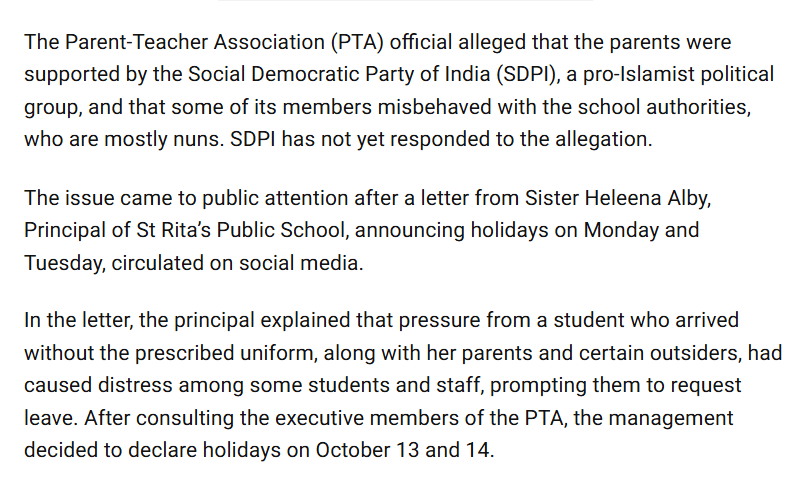
  • Christian vs Muslim: CPM and Congress often stay neutral at first, saying things like “we’ll look into it,” but in the end, they tend to side with Muslims. Examples include the Munambam Waqf issue, Professor Joseph’s case, Sona Eldhose’s conversion, and incidents involving SDPI bullying, such as the hijab case at the Christian-run St Rita’s school in Kochi (details in the image below).
Hijab controversy in Kochi school
News Source: “Hijab controversy forces school in Kochi to close temporarily after parents’ protest” (Mathrubhumi.com)

If you look at any case in Kerala, the pattern more or less stays the same. I’m not sure about regional politics in other states, but I suspect it’s similar elsewhere.

While BJP clearly positions itself as a Hindu party, there’s a growing sense in Kerala that Congress and CPM lean pro-Muslim. Why? It’s not really about religion. It’s about vote-bank politics. Christians are a minority among minorities in Kerala, so pandering to them doesn’t win many votes and can even cost support from other minority groups.

Growth of Chrisanghis in Kerala

Now, in Kerala, there’s a growing group called “Chrisanghis,” a term left-leaning voices like Arundhati Roy have used. These are Christians who support the BJP. Arundhati recently warned Christians in Kerala not to become Chrisanghis, citing conversion attacks in the North as a concern.

So why do some Christians support the BJP? It’s because they view Islamist groups like SDPI and Jamaat-e-Islami as a bigger threat than BJP. Many point to the persecution of Christians in countries like Nigeria by Islamist groups and feel that, compared to such threats, the BJP’s Hindutva agenda poses a lesser danger. At the same time, parties like Congress and CPM often downplay or ignore the activities of these Islamist groups in India, mostly for political gain, leading some Christians to see BJP as a safer option.

Congress support for Jamaat-e-Islami
News Source: “Congress in a fix as Jamaat arm readies to back theocratic state” (NewIndianExpress.com)

Notably, Jamaat-e-Islami has frequently been in the news, even recently, for persecuting minorities in Pakistan and Bangladesh. In India, its branch presents a secular image, likely to gain acceptance and influence within mainstream politics, using it as a pathway to gain power.

It’s also true that Kerala’s two mainstream parties have largely ignored such concerns from the Christian community. Their typical response is often, “Don’t fall for RSS/BJP propaganda,” even when the issues have nothing to do with RSS or BJP.

Thoughts

So what can the Christian population in India do in this situation? On one side, there’s a pro-Hindu or “Hindutva” party that will never fully accept conversions under “freedom of religion,” and on the other, there are parties that haven’t supported Christians when they faced threats from Islamist groups.

From my perspective, Christians should keep all parties guessing about where their votes will go. They shouldn’t strongly back any party, since none fully meets their needs. Take the Munambam Waqf issue, for example: the removal of Section 40 in the Waqf Bill allowed the Kerala High Court to rule the Waqf claim over Munambam land as illegal, protecting Christian landowners. Congress leaders like Hibi Eden tried to persuade residents to drop their case, saying nothing would come of it, while the only BJP MP from Kerala, Suresh Gopi, stood by the people, largely comprising Christian fisherfolk, and supported the amendment that ensured their land rights.

When missionaries face attacks by far-right Hindus in the North, that’s when Opposition parties step in. But in cases like the Chhattisgarh nuns’ arrests over alleged conversions, the local Congress in Chhattisgarh hardly protested, as taking a stand would have cost them votes. On the other hand, in Kerala, protesting the arrest of the nuns would have earned them support, which is why several Opposition leaders from Kerala traveled to Chhattisgarh to show solidarity.

This shows that Christians can’t rely fully on any party and should strategically make their political influence felt.

This is how politics works: there are no fixed principles for political parties. They act based on the local political context. Christians in India should remember this and avoid fully backing or rejecting any party. Instead, they can use this knowledge strategically and wisely, since different parties support them in different situations.

***

Photo by Pratheesh S

Munambam Waqf Dispute: Why India’s Opposition Parties Need to Reflect

Munambam Waqf Issue

600 families in a small coastal area in Kerala risk losing the properties they paid for. Reason: The Waqf claims the land is theirs.

What is Waqf?

A waqf is an Islamic endowment of property or assets designated for religious, charitable, or social purposes.

In India, waqf properties are managed by the Waqf Board, a government body responsible for overseeing and regulating these endowments.

What is the Munambam Waqf Issue?

The Munambam Waqf issue is a complicated land dispute. This land, which covers approximately 404 acres, is located in a place called Munambam in the Ernakulam district of Kerala.

Historically, the land belonged to the Kutchi Memon community. They migrated to Kerala for trade and were granted this land by the Travancore kingdom. In 1950, part of the land was donated to Farook College as Waqf property, intended for educational purposes. Farook College went on to sell this land to the current property owners of Munambam.

In recent years, the Kerala Waqf Board has claimed ownership of the land. This has led to significant tensions among local residents, most of whom are Christian families and fishermen who have lived there for decades with legal ownership. This is not a communal issue, as even Muslim families have been affected by Waqf.

The claims by the Waqf Board have prevented the residents from managing their properties. They cannot pay taxes or sell their land to meet personal needs, such as funding their child’s education or obtaining health treatments. The residents assert that the claims by the Waqf Board are invalid, as they fairly paid for the property.

Politicians from Congress and CPI(M) insist the property is not Waqf to console the residents. However, the Waqf Board says the land is indeed Waqf and the 600 Munambam families are encroachers who need to eventually vacate the area.

The Munambam residents were initially told to approach the Waqf tribunal to fight their case, as the court is unauthorized to handle Waqf land matters. This requirement is enabled by the current Waqf Act introduced by Congress, forcing victims to seek justice from the perpetrators themselves. Across India, there are 70,000 such cases pending, which the court cannot address until the Act is reformed.

How to Resolve this Issue?

To prevent this issue from escalating, political parties must ensure that the vulnerable families in Munambam are provided justice. If they paid for the property, it is theirs to keep. Another community’s beliefs should not be imposed on them. It will lead to matters turning communal.

Concerns

This is not the only Waqf dispute in the country. The Waqf Board is claiming acres of land in other states of India, one of which houses a temple that is older than Islam itself.

The opposition parties, especially Congress, need to ensure the poor do not suffer because of discriminatory laws. For that to happen, all political parties need to work together to reform the existing Waqf law in India that allows such unfair claims.

I’m observing that the Waqf issue in Munambam is causing more Christians in Kerala to support the BJP. The matter has also drawn the attention of churches, which are advocating for reforms to protect property rights in cases like this.

If the reforms do not get passed in the winter session of parliament due to the appeasement politics of the opposition parties, the political landscape might shift significantly in favor of the BJP. It might change the political beliefs of many, who until now used to treat the BJP as untouchables.

The opposition parties’ best course of action is to back the Waqf reforms and avoid misleading the underprivileged with false promises. Words are not enough at this moment. The parties need to proactively initiate a discussion with the Waqf Board and ensure the poor get justice.