
The debate around Umar Khalid, Sharjeel Imam, and other Delhi riots accused who have not yet been granted bail has once again come into focus. From the right-wing perspective, the issue is not as simple as “judicial delay” or “denial of justice.” I thought of writing this post because many in India only trust left-wing channels, which causes them to miss important fact-based points shared by the right-wing.
Adjournments and CJI’s Remarks
First of all, let us understand what an adjournment is. Simply put, it is when a court hearing or trial is postponed to a later date instead of being completed on the scheduled day.
Out of the 14 adjournments in Umar Khalid’s case, 7 were initiated by his own legal team. This was mentioned by CJI D.Y. Chandrachud himself in his interview with Barkha Dutt.

“I do not want to comment on the merits of the case but I must tell you one thing which is lost sight by a lot of people when it comes to Umar Khalid‘s case, can you imagine that the case was adjourned, they were at least seven if not more adjournments which were sought by the council appearing for Umar Khalid and eventually the application for bail was withdrawn.” – CJI Chandrachud
Justice Chandrachud noted that, on social media, a one-sided narrative often takes hold, leaving judges with no space to defend themselves. He added that if one looks closely at the actual proceedings in court, the reality is far more nuanced than what is portrayed online.
While some “fact checkers” online have attempted to dismiss this claim by relying on surface-level sources, it is reasonable to trust the CJI more on this matter. As head of the judiciary, he had direct access to both official and indirect records of adjournments.
The Delay Tactic
According to many on the right, Khalid and Imam’s legal strategy is clear. If the trial begins, conviction is almost certain. Thus, their team is accused of deliberately delaying proceedings by filing fresh petitions, often citing a “change in circumstances.” The idea is to drag the trial as long as possible and eventually claim bail on the grounds of delay.
Notably, some petitions that caused delays were also filed by other accused who are already out on bail.
The Judicial Tactic Explained
The strategy seen here is not unique. It is a common tactic in the Indian judiciary:
- Lawyers repeatedly file petitions (often citing new circumstances).
- Each petition leads to adjournments, dragging the trial.
- Eventually, the accused can argue that their right to a speedy trial (protected under Article 21 of the Constitution) has been violated.
- On that ground, they can seek bail due to judicial delay.
This slow erosion of the process not only stalls justice but also erodes public trust in the judiciary. Something that many argue is part of the plan.
CJI on Unseen Angles
In an interview with Barkha Dutt, CJI Chandrachud hinted that there are angles in the case that cannot be revealed to the public. Right-wing commentators believe this may refer to multiple coordinated fronts behind the Delhi riots.
One example often cited is ISIS member Arshad Warsi (not the actor), who was in contact with Sharjeel Imam. Warsi allegedly helped decide the content of pamphlets that were distributed to mosques and Muslim neighbourhoods prior to the riots to incite violence. He was later arrested in the Pune ISIS module case.
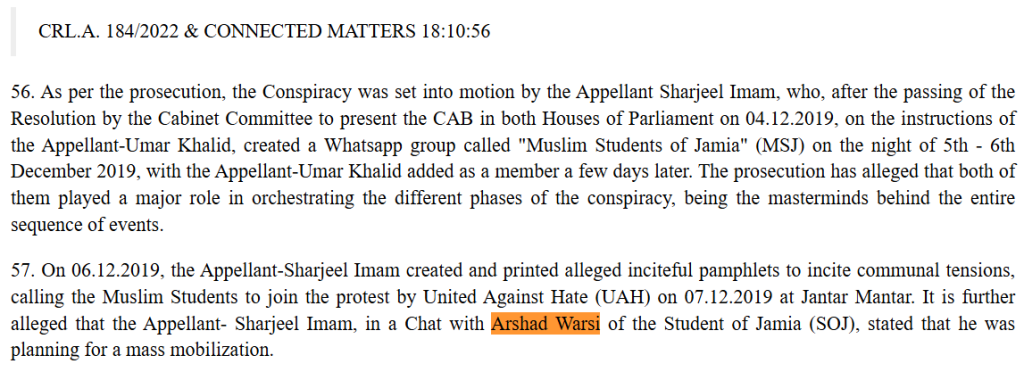

There are also allegations of foreign funding and terror groups like PFI supporting the protests and unrest.

The Seriousness of the Delhi Riots
The 2020 Delhi riots were not minor incidents of unrest. They claimed the lives of 53 people, including Intelligence Bureau officer Ankit Sharma. For many, this underscores the gravity of the case and why justice cannot be indefinitely postponed.
Right-Wing Response
Right-wing commentators like Abhijit Iyer-Mitra and Kushal Mehra have now openly criticized the delay of trials. They argue that instead of dragging the matter endlessly, the trial should begin as soon as possible, and justice should be delivered. In their view, it is time to see through legal manoeuvres and bring the culprits to justice. The longer the delay, the more the perception of judicial inefficiency grows, and that benefits only those seeking to evade accountability.
It is also important to understand that, though we can call for quick trials, courts in India are bound to follow established legal procedures. Every step, adjournments, evidence submission, witness examination, bail hearings, has to comply with the Code of Criminal Procedure (CrPC), the Evidence Act, and constitutional safeguards like Article 21 (right to life and liberty, including speedy trial).
Judges cannot simply “override” these protocols, even if they suspect delaying tactics. If the defense files a petition citing “change in circumstances” or another procedural ground, the court is obliged to hear it and decide. Ignoring or fast-tracking outside the rules would open the door to appeals, accusations of bias, or even the case collapsing later.
Delays often frustrate people. However, they’re also part of the judiciary, ensuring the trial stands on solid legal ground.
Left-Wing Response
The left-wing argues that delays aren’t only due to Khalid’s side and that long undertrial detention is unfair. While these points deserve acknowledgment, they don’t erase the fact that half the adjournments were filed by Khalid’s own team and that Sibal’s strategy clearly aims at running down the clock.
They also say Hindu mobs who killed during the riots haven’t faced equal scrutiny. But the distinction is clear: Hindu rioters were violent on the ground, yes, but they did not make the kind of provocative, mass-scale mobilizing speeches Khalid and Sharjeel Imam did that led to loss of lives. Khalid mobilized crowds by invoking the Kashmir issue, while Sharjeel Imam spoke about separating Assam from India and attempted to provoke people through pamphlets referencing the Babri Masjid dispute. Videos of their speeches can be accessed easily on social media platforms. That’s why the charges against them are different and why delaying the trial feels like a deliberate tactic.
My Take
It is important to examine cases from every angle instead of blindly accepting one-sided propaganda. Dhruv Rathee does not question the opposition, while journalists like Shiv Aroor do not question the ruling party. So it’s up to us, the citizens, to collect points from both sides and analyze it.
I have tried to provide proof for all the points in this post, but they can also be independently validated online. I would highly recommend going through the Indian Kanoon link (indiankanoon.org/doc/156202283/) to read more about the case.
Rather than dismissing everything right-wing as lies, citizens should review the available evidence and ask: Is a separatist attitude acceptable for the country? Does this kind of behaviour warrant bail? This cannot simply be brushed off as freedom of speech, because in this case, speech directly incited violence and led to the loss of 53 lives and the injury of thousands.
In India, there are rarely open-and-shut cases. Even Ajmal Kasab, a convicted terrorist, was given a fair trial. By that standard, it is certain that Sharjeel Imam and Umar Khalid will also receive a fair hearing once their trial begins, especially since their offences, while serious, are not on the same level as Kasab’s. That is why the trial should begin without further delay. So their actions can be properly examined, and justice delivered swiftly.


 The Monkey Dilemma
You must be logged in to post a comment.