The Truth Behind Why Bail Was Denied to Umar Khalid and Sharjeel Imam

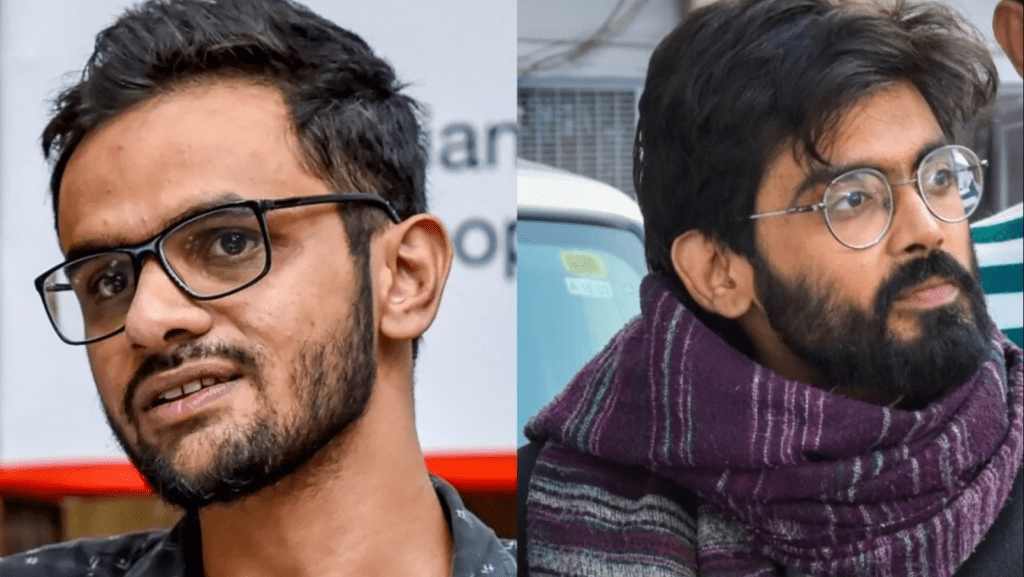
Umar Khalid and Sharjeel Imam Photo

With the Umar Khalid and Sharjeel Imam cases once again drawing global attention, especially after Umar Khalid’s father met US politician Zohran Mamdani, it’s the right time to scrutinize why the Supreme Court rejected bail pleas for both activists. The issue has sparked renewed discussion around India’s anti-terror law, the UAPA, and how it is applied in high-profile cases.

In the age of social media, misinformation often travels across the world long before the truth gets its moment. That makes it all the more important to examine each argument carefully and understand the reasoning behind the court’s responses. We are living in a time where selective fact-checking is common, misinformation is circulated to serve political agendas, and inconvenient truths are pushed out of sight. From what I have seen, some of the material relevant to this case has still not reached the wider public because it is rarely covered by mainstream media. As a result, distrust continues to linger.

Of course, for some people, no amount of truth really matters. What they seek is validation for their existing biases or political leanings. This post is not meant for that audience. No amount of proof can change such a mindset. It is written for readers willing to acknowledge facts when presented.

Getting back to the case, according to the prosecution, Umar Khalid and Sharjeel Imam were not just participants but masterminds who mobilised or influenced others during the events in question. The defence, however, put forward two key arguments while seeking their release on bail. Let’s take a closer look at what those arguments were and why the court chose not to accept them.

Defense Argument #1:
Not Directly Involved in Violence
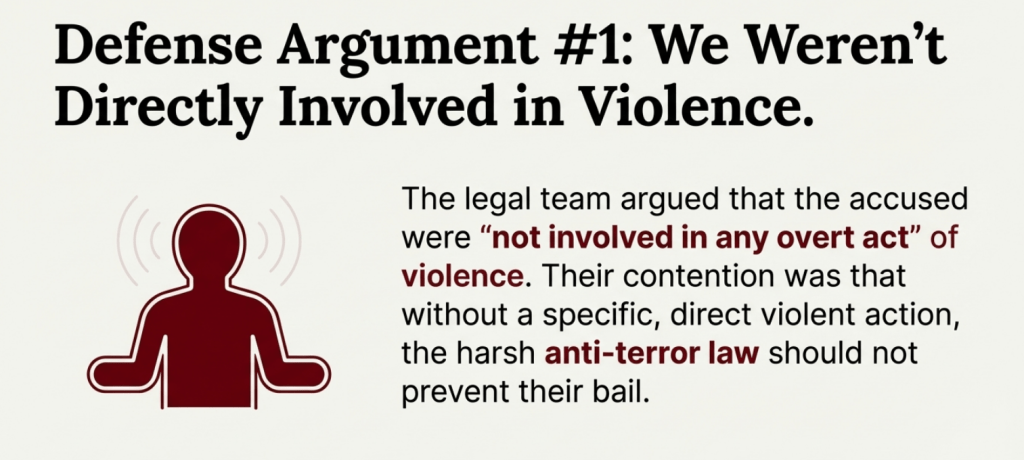
Sharjeel Imam Umar Khalid Bail Defense Argument #1 Photo

One of the most repeated arguments, especially in Umar Khalid’s case, is that he was not present at the riot spots when the violence took place.

Court Response

The court indicated that the act of masterminding the riots, even without direct presence, was in itself sufficient. The court’s position was clear and firm: nothing comes above the interests of national security. On a prima facie assessment of the material placed before it, which includes videos, audios, posts, and messages, the court held that both Umar Khalid and Sharjeel Imam faced similar allegations of being the masterminds, which weighed heavily against granting bail. Due to their involvement in the larger plan, several people were killed and injured, including an intelligence officer.
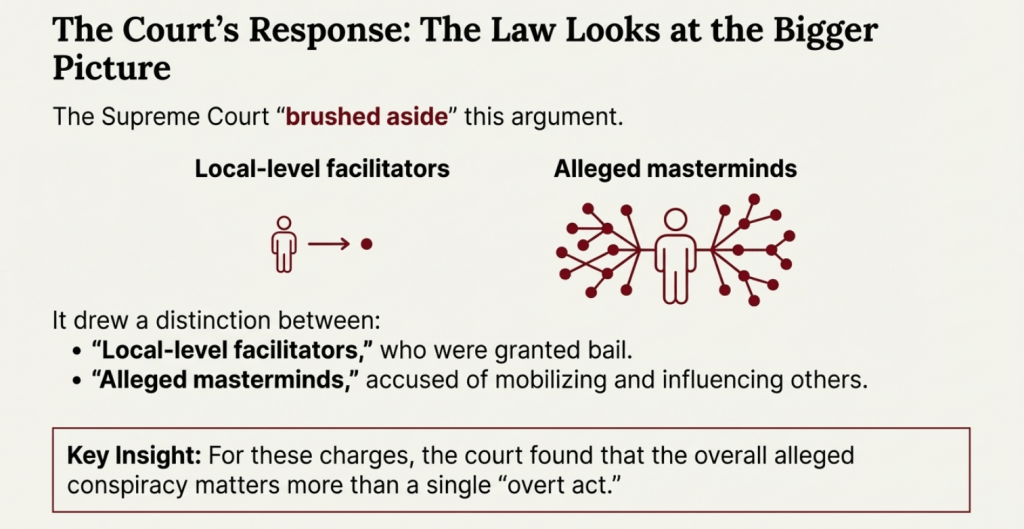
Sharjeel Imam Umar Khalid Bail Defense Argument #1 Court Response Photo

It should be noted that provocative words alone can be enough to incite violence. This is not something new. Something similar was seen even before the Gujarat riots, where RSS members were found to have mobilised people through provocative speeches. Many who provoked never participated in the violence, but their words were enough. They were taken into custody and remained there for years.

This raises an important question: what makes those cases different from the cases of Sharjeel Imam and Umar Khalid, so that the latter deserves bail? Both instances were the same: provocative speeches leading to mass mobilization. The 2020 Delhi riots too had a communal angle, with tensions between different communities being stirred during the violence. Videos of the provocative communal speeches are available widely on X. WhatsApp groups were formed along religious lines, which added to the sense of division at the time.

Rather than relying on political influencers or commentators, I recommend reading the official case files to understand the facts as presented in court. You can find these by searching Google with terms like “Delhi NCT Sharjeel Imam pdf” and then looking within the document for specific details.

Often, religion is used as a tool to strengthen or manipulate one’s case, and that appears to have happened here as well. As someone who has gone through the provocative videos and social media posts of the two, it is difficult to see them as innocent. I cannot quote or reproduce those statements here because of their sensitive nature, but they are publicly available and can be found on social media platforms like X by searching their names.

Sharjeel Imam’s Facebook account is still active, while Umar Khalid has deleted his. I would recommend going through Sharjeel’s Facebook posts to see for yourself how passionately he tried to convince people to hit the streets. Some posts had a communal dimension as well. The content includes rhetoric that can be interpreted as calls for violence and even secession, which adds serious weight to the charges against them.

Defense Argument #2:
The Trial Delay

One more argument that often comes up is the long delay in the trials of Sharjeel Imam and Umar Khalid.
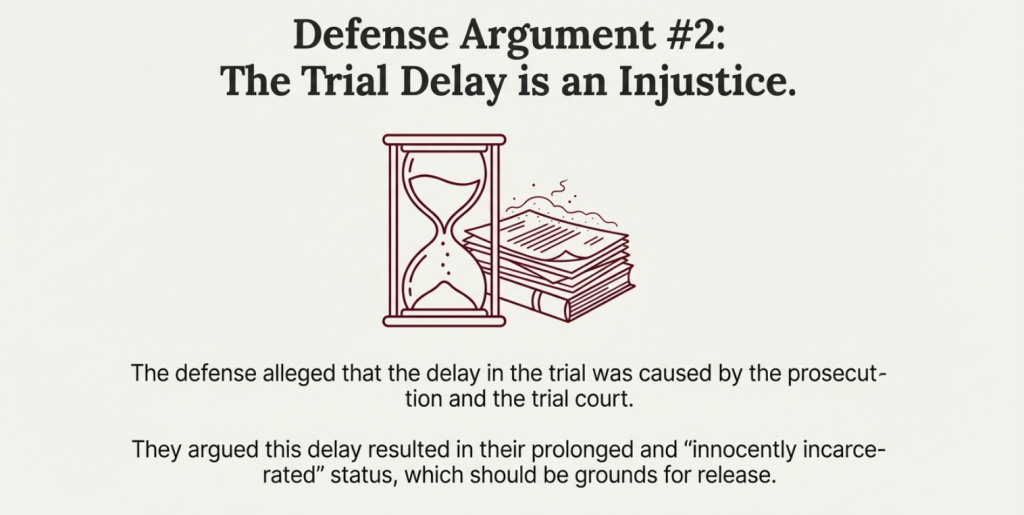
Sharjeel Imam Umar Khalid Bail Defense Argument #2 Photo

Court Response

The court maintained that a delay in the trial does not dilute the gravity of the case.

Also Read: CJI’s Remarks on Umar Khalid’s Trial Delays
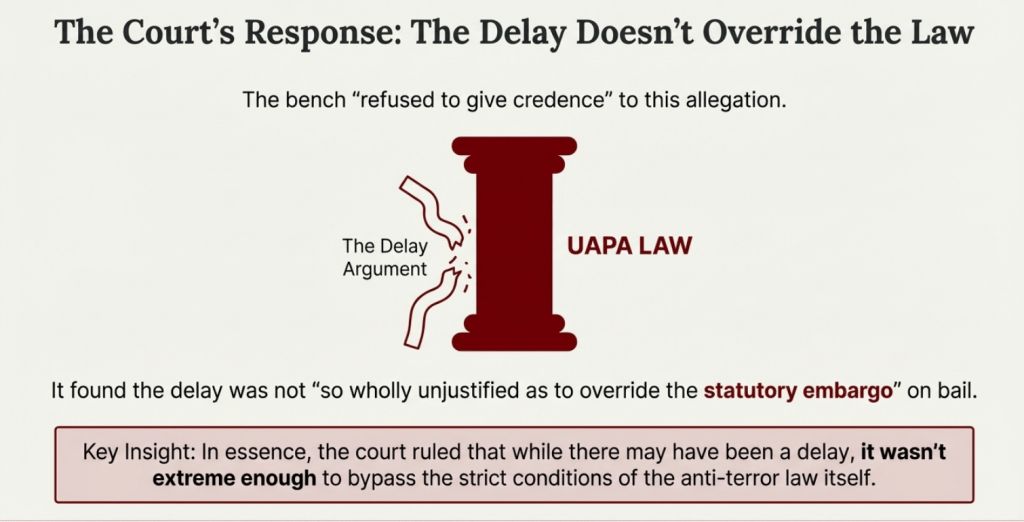
Sharjeel Imam Umar Khalid Bail Defense Argument #1 Court Response Photo

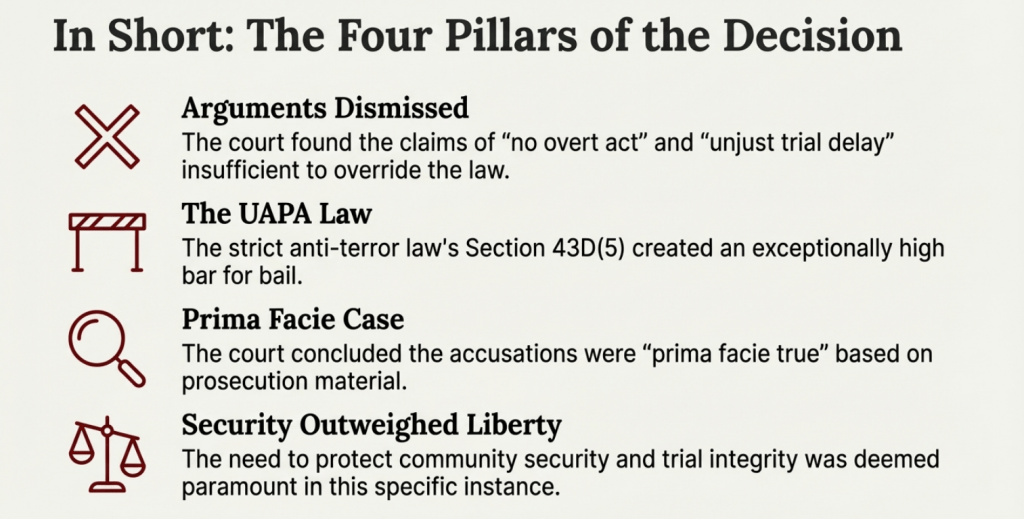
The Final Verdict

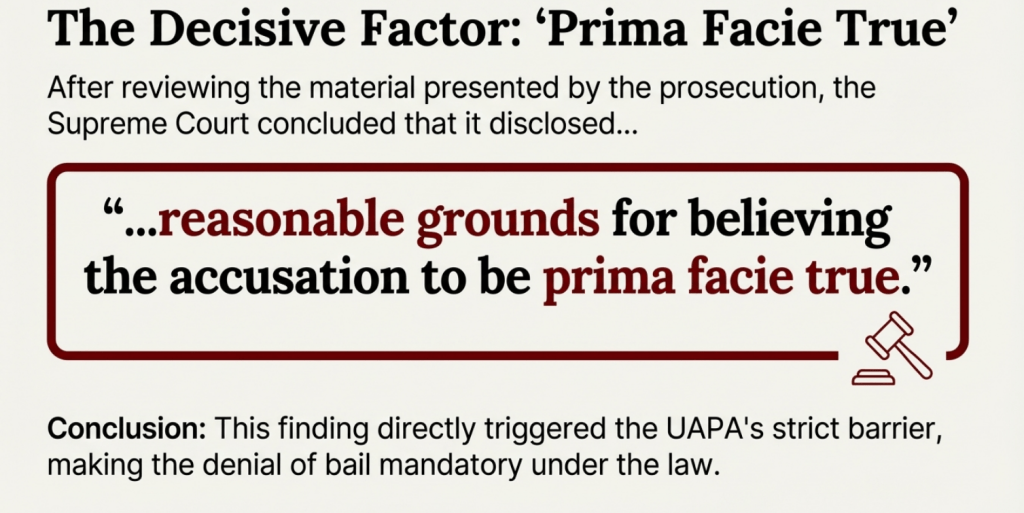
The court observed that the polarising material appeared prima facie true, and this played a key role in denying bail to them as alleged masterminds.
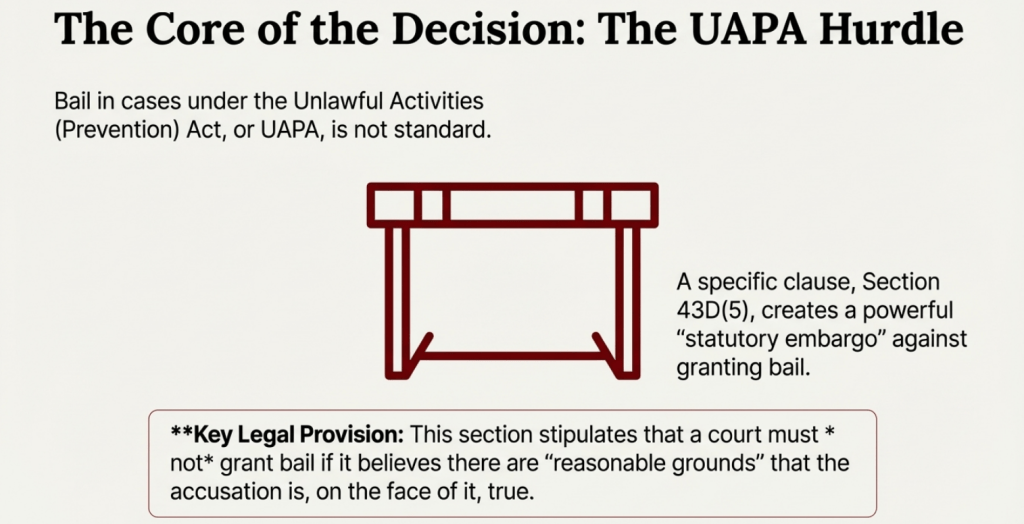
Sharjeel Imam Umar Khalid Bail Rejection Decision Image
Sharjeel Imam Umar Khalid Proof Prima Facie True Image

The court admitted that balancing individual rights with the nation’s security is never an easy task.
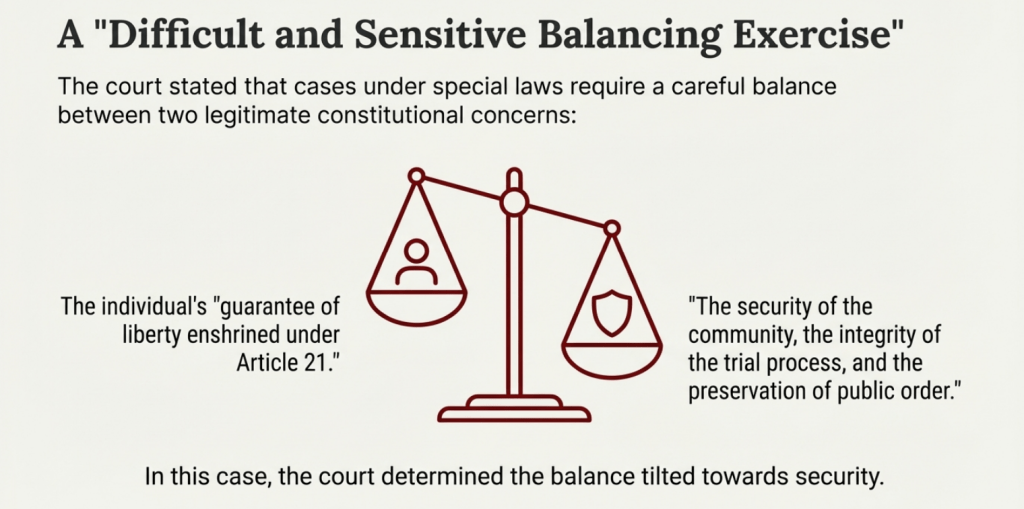
Sharjeel Imam Umar Khalid Bail Is a Difficult and Sensitive Balancing Exercise Image
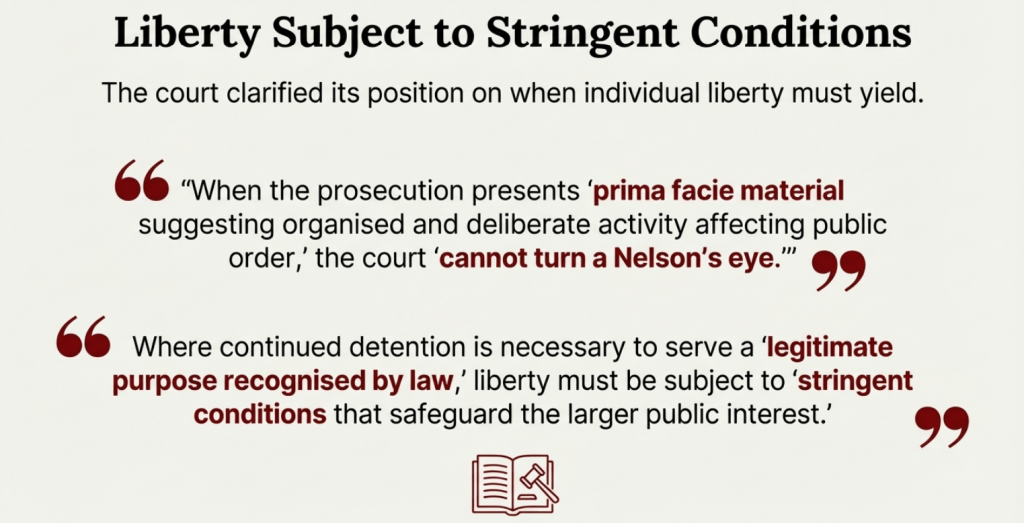
Sharjeel Imam Umar Khalid Liberty Subject to Stringent Conditions Image
Sharjeel Imam Umar Khalid Bail Rejection Summary Image

Umar Khalid and Sharjeel Imam were not denied bail because of unfairness or a failure of the legal system. Their bail was rejected because the court found the material presented before it to be valid and credible.

However, unless this material, such as videos or posts, is made available for public viewing in a structured and responsible manner, many people will continue to believe that the legal system itself is fractured. Since I have seen the provocative videos and social media posts and gone through the case details, I do not doubt the court’s reasoning.

But the lack of transparency leaves room for misunderstanding. It also creates space for political parties and interest groups to selectively present facts and shape narratives for their own benefit. Should there not be a mechanism to clearly explain why and how such decisions are taken, along with supporting material, so that the ordinary citizen does not have to rely on fragments found on their own?
From 26/11 to Delhi Blasts: Why the “False Flag” Narrative Must End in India

What surprises me more than the terror attacks in India is the speed with which some Indians dismiss them as “false flag operations.” For instance, a look at the comments under Faye D’Souza’s Instagram post about the Delhi terror blasts shows several users mocking the incident and blaming the Indian government instead of the perpetrators. Many genuinely seem to believe it’s a political ploy to influence votes rather than an act of terror.

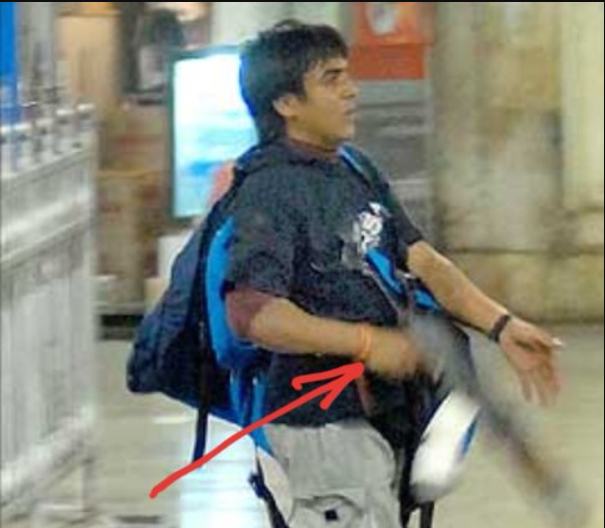
The “false flag” narrative isn’t new. It has surfaced after nearly every major terror attack in India. Even the 26/11 Mumbai attacks were, at first, misrepresented by some as an internal operation. The claim gained attention mainly because Ajmal Kasab, one of the attackers, wore a saffron thread on his wrist. Those spreading the theory strangely assumed such a thread could only belong to members of BJP or RSS. They overlooked the possibility that it might have been deliberately used to mislead investigators.

Ajmal Kasab with Saffron Thread on His Wrist

Kasab’s real plan, as later revealed, was to die appearing as a “Hindu” and thus shift suspicion away from Pakistan-based handlers, reinforcing the myth of “saffron terror.” Thankfully, due to the extraordinary courage and sacrifice of Assistant Sub-Inspector Tukaram Omble, Kasab was captured alive and later confessed to being a Pakistani national trained by terrorists.

Tukaram Omble and Mumbai 26/11 Attacks
Tukaram Omble

By then, however, the false-flag theory had already gained widespread circulation. Well-known public figures even released a book titled 26/11: RSS ki Saazish? that promoted the “false flag” theory surrounding the attacks.

Influential Figures Promoting RSS ki Saazish Book
Influential Indian Figures Promoting “26/11: RSS ki Saazish?” Book

The “false flag” narrative resurfaced after the Pulwama terror attack, when a suicide bomber from Jaish-e-Mohammed (JeM) drove an explosive-laden vehicle into a CRPF convoy in Pulwama, Jammu & Kashmir, killing 40 soldiers. Following the attack, some voices in Pakistan, including senior officials, suggested that India might have staged the incident to influence the upcoming 2019 elections. Commentators in India echoed similar theories online, framing the tragedy as politically motivated rather than acknowledging it as an act of cross-border terrorism.

Then came the recent Pahalgam attacks, where Pakistani media outlets and online commentators claimed that India had staged the incident to divert attention from domestic issues and influence elections. They described it as part of an alleged “Indian playbook” of false-flag operations. Soon after, similar talking points appeared in sections of Indian social media and commentary spaces.

In each case, claims of “false flag operations” lacked credible evidence and were primarily rooted in conspiracy theories first circulated in Pakistan and later amplified by certain opinion groups in India.

The Global “False Flag” Obsession

It’s worrying that many people in India tend to believe external narratives about terror attacks rather than trusting verified investigations at home.

This pattern might have been up for serious debate if it only happened locally, but the deflection from religious extremism appears to be a global trend. To cite a few examples:

  • The 9/11 attacks are still viewed by some as a “false flag” orchestrated by the U.S. or Israel to malign Muslims. This is a theory long disproved but still used by extremist groups to recruit followers. They thrive on anger, convincing vulnerable minds that violence is the only response to perceived oppression. In India, extremist recruiters have similarly exploited stories like the Babri Masjid while dismissing events like the Godhra train burning as conspiracies, weaving grievance into a tool for radicalization.
  • The October 7 attacks in Israel were also met with widespread conspiracy claims, framed as a false flag operation meant to discredit certain groups.
  • Likewise, criticism of regimes such as Iran’s leadership, the Taliban, or Hamas is often dismissed as Western propaganda. This is another form of deflection that prevents honest introspection.

Conspiracies Shield Extremists

It’s time to move past the overused “false flag” narrative.

Each time a terror attack is dismissed as a conspiracy, it insults the victims, weakens trust, and blurs the line between truth and propaganda. These baseless claims don’t protect anyone. They only embolden extremists and deepen divisions.

Real courage and national unity will come from confronting facts, condemning violence without bias, and demanding accountability from those who spread hate, no matter where it comes from.

Ending the false flag obsession is the first step toward restoring integrity in how we respond to terrorism.

Kerala Christians and Politics: Which Parties Really Stand With Them?

A picture of a church in India for an article on Kerala Christians and politics

As someone who’s chronically online and keeps up with news from all kinds of sources, mainstream, regional, left, and right, I’ve noticed something important: Christians in Kerala don’t really have a go-to political party anymore.

For a long time, people assumed the Indian National Congress (INC) was the party in Kerala that understood what every community wanted. But that idea seems to be changing fast on the ground.

Communal Conflicts in Kerala: Who Supports Whom?

If you’re new to Kerala politics, here’s a simple way to understand how parties respond to communal issues here:

  • Hindu vs Minority: CPM and Congress usually back the minority community.
  • Upper Caste Hindu vs Lower Caste Hindu: CPM and Congress generally side with the lower caste.
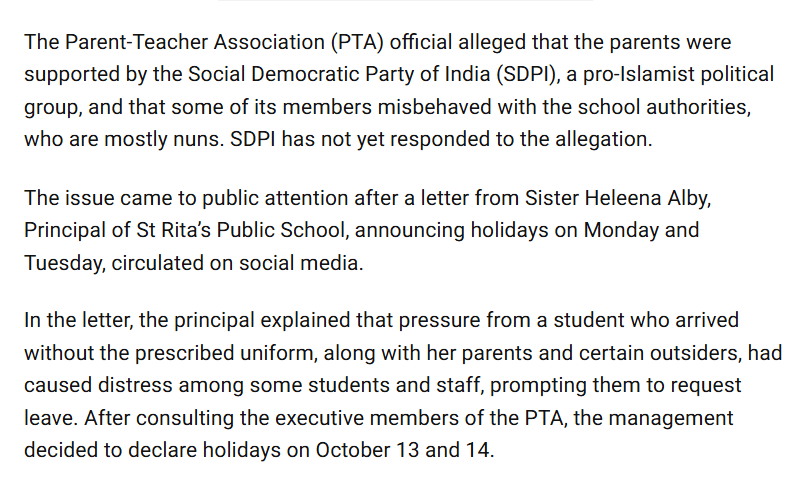
  • Christian vs Muslim: CPM and Congress often stay neutral at first, saying things like “we’ll look into it,” but in the end, they tend to side with Muslims. Examples include the Munambam Waqf issue, Professor Joseph’s case, Sona Eldhose’s conversion, and incidents involving SDPI bullying, such as the hijab case at the Christian-run St Rita’s school in Kochi (details in the image below).
Hijab controversy in Kochi school
News Source: “Hijab controversy forces school in Kochi to close temporarily after parents’ protest” (Mathrubhumi.com)

If you look at any case in Kerala, the pattern more or less stays the same. I’m not sure about regional politics in other states, but I suspect it’s similar elsewhere.

While BJP clearly positions itself as a Hindu party, there’s a growing sense in Kerala that Congress and CPM lean pro-Muslim. Why? It’s not really about religion. It’s about vote-bank politics. Christians are a minority among minorities in Kerala, so pandering to them doesn’t win many votes and can even cost support from other minority groups.

Growth of Chrisanghis in Kerala

Now, in Kerala, there’s a growing group called “Chrisanghis,” a term left-leaning voices like Arundhati Roy have used. These are Christians who support the BJP. Arundhati recently warned Christians in Kerala not to become Chrisanghis, citing conversion attacks in the North as a concern.

So why do some Christians support the BJP? It’s because they view Islamist groups like SDPI and Jamaat-e-Islami as a bigger threat than BJP. Many point to the persecution of Christians in countries like Nigeria by Islamist groups and feel that, compared to such threats, the BJP’s Hindutva agenda poses a lesser danger. At the same time, parties like Congress and CPM often downplay or ignore the activities of these Islamist groups in India, mostly for political gain, leading some Christians to see BJP as a safer option.

Congress support for Jamaat-e-Islami
News Source: “Congress in a fix as Jamaat arm readies to back theocratic state” (NewIndianExpress.com)

Notably, Jamaat-e-Islami has frequently been in the news, even recently, for persecuting minorities in Pakistan and Bangladesh. In India, its branch presents a secular image, likely to gain acceptance and influence within mainstream politics, using it as a pathway to gain power.

It’s also true that Kerala’s two mainstream parties have largely ignored such concerns from the Christian community. Their typical response is often, “Don’t fall for RSS/BJP propaganda,” even when the issues have nothing to do with RSS or BJP.

Thoughts

So what can the Christian population in India do in this situation? On one side, there’s a pro-Hindu or “Hindutva” party that will never fully accept conversions under “freedom of religion,” and on the other, there are parties that haven’t supported Christians when they faced threats from Islamist groups.

From my perspective, Christians should keep all parties guessing about where their votes will go. They shouldn’t strongly back any party, since none fully meets their needs. Take the Munambam Waqf issue, for example: the removal of Section 40 in the Waqf Bill allowed the Kerala High Court to rule the Waqf claim over Munambam land as illegal, protecting Christian landowners. Congress leaders like Hibi Eden tried to persuade residents to drop their case, saying nothing would come of it, while the only BJP MP from Kerala, Suresh Gopi, stood by the people, largely comprising Christian fisherfolk, and supported the amendment that ensured their land rights.

When missionaries face attacks by far-right Hindus in the North, that’s when Opposition parties step in. But in cases like the Chhattisgarh nuns’ arrests over alleged conversions, the local Congress in Chhattisgarh hardly protested, as taking a stand would have cost them votes. On the other hand, in Kerala, protesting the arrest of the nuns would have earned them support, which is why several Opposition leaders from Kerala traveled to Chhattisgarh to show solidarity.

This shows that Christians can’t rely fully on any party and should strategically make their political influence felt.

This is how politics works: there are no fixed principles for political parties. They act based on the local political context. Christians in India should remember this and avoid fully backing or rejecting any party. Instead, they can use this knowledge strategically and wisely, since different parties support them in different situations.

***

Photo by Pratheesh S

Empuraan and Its Controversial Take on Gujarat Riots

Empuraan is facing criticism from the right wing for allegedly promoting a biased narrative. Many are calling it a political propaganda film with a pro-Congress stance. How true is the allegation?

Spoilers Ahead

I haven’t watched the movie yet, but I’ve heard that the first 30 minutes focus on the Gujarat Riots. It depicts some of the most horrific incidents from that time. Reportedly, the film includes a rape scene that’s highly debatable. This particular rape story has been circulating since the time of the Gujarat Riots but remains unverified, with no solid evidence to support it. Additionally, the Godhra train burning in the movie is reportedly depicted as something that happened by accident. This portrayal gives the impression that the film is based on the findings of the Banerjee Committee Report, a report that was later ruled invalid, unconstitutional, and politically manipulated by the court. The Nanavati-Mehta Commission Report is the report that was officially accepted as the authoritative account of events due to its presentation of evidence. This information was also covered in the recent film The Sabarmati Report.

The Banerjee Committee was set up in 2004 by the UPA government, led by the Congress party. The committee’s report was released just before the Bihar Assembly elections, apparently to influence the election results and weaken the BJP’s position. The report concluded that the Godhra train fire was accidental, contradicting the BJP’s stance that it was a pre-planned attack.

However, the Nanavati-Mehta Commission later confirmed that the train burning was a premeditated communal act, not an accident.

  • The investigation found that large quantities of petrol were purchased a day before the incident from a nearby petrol pump.
  • The forensic report confirmed the presence of petrol residues inside Coach S-6, where the fire broke out.
  • Eyewitnesses and forensic evidence suggested that petrol was thrown into the coach and set on fire, indicating a pre-planned attack rather than an accidental fire.

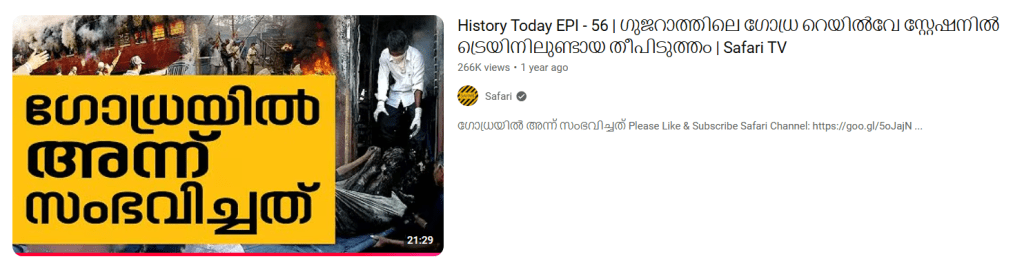
For Malayalees who prefer not to watch The Sabarmati Report, I recommend a documentary on YouTube by the Sanchari channel. It’s in Malayalam and provides a detailed account of the Godhra train burning. I am attaching a screenshot of the video below.

The documentary is likely one of the first of its kind in Malayalam. It offers a detailed look at the various angles of the Godhra train burning, the different reports that emerged, the political maneuvering involved, and the final conclusions drawn. If you are a Malayalee interested in research and fact-checking, I highly recommend watching this video.

Naturally, Congress is supporting Empuraan, just as the BJP backs right-wing films when they are released. Even if Empuraan turns out to be entirely pro-Congress, I support the creator’s right to make and release such a film. Several right-wing movies have been produced in India recently, so a left-leaning perspective is equally valid in a democratic space. However, as viewers, we must avoid taking any movie as absolute truth. Instead, we should conduct independent research, considering both left-leaning and right-leaning sources to develop a balanced understanding of the subject.