From India-Pakistan to Gaza: Exploring the Duality of War

Fire explosion with smoke

Personal observation: In almost every war, there’s always someone who doesn’t want it to end.

In the India–Pakistan war, many in India didn’t want the fighting to stop because they felt Pakistan hadn’t learned its lesson yet. Some even wanted the government to reclaim PoK (Pakistan-occupied Kashmir) during this time (which I strongly oppose).

When Israel attacked Iran’s nuclear sites, many anti-regime Iranians wanted the war to continue because they hoped the regime would fall.

The Israel–Gaza conflict is even more unusual. Many who kept calling for a ceasefire suddenly went quiet or were openly against it when finally announced. Maybe they had expected Israel to be driven out and a new Palestinian state to rise “from the river to the sea.” But that idea is unrealistic and only calls for more violence. Just like India will never give up Kashmir, Israel will never give up its land. Both countries get a lot of criticism for putting their own interests first. But, over the years, Jews and Indians have learned an important lesson: if they want their interests protected, they can’t rely on anyone else. When Indians get murdered in America, there’s next to no backlash. It’s the same case with Jews. History is also proof that when Hindus face persecution or genocide (Kashmiri Pandits, Sandeshkhali, Bangladeshi, and Pakistani Hindus), the world stays silent. In a world shaped by selective activism, these two communities have gradually learned to shed their passivity and docile nature, standing up for themselves without guilt. Indians, in my view, are still learning. Our tendency to stay silent runs deep. But since 2014, that’s starting to change, much to the annoyance of some. Apparently, a “good” Indian is still largely expected to be a silent one in the face of persecution and bigotry.

Anyway, the point is that in any war, there’s always duality. Those who push for the conflict to continue aren’t always on the “far-right.” Sometimes, they are far-left or far-right figures from other communities, disguised as leftist liberals. Take, for example, the India-Pakistan war. Many leftists in India wanted it to end and for peace to prevail. Yet recently, some of those same voices wanted Hamas to reject the peace deal, even at the cost of many lives.

I’ve often felt that the far-left and far-right are just two sides of the same coin. The recent wars and reactions to them over the years only validate this claim.

***

Photo by Pixabay

An Ode to Lok Sabha Elections 2024 (Part 2): Congress taking credit for the alliance’s victory

Lok Sabha Election Results 2024

The Congress party’s performance in the Lok Sabha Elections 2024, with a win of 99 seats, is a notable improvement from 2019. However, it still pales in comparison to the BJP’s reduced 240 seats. The alliance, as a whole, played a pivotal role in forming a strong opposition. Yet, it is evident that no single party can claim sole credit for the alliance’s success.

Samajwadi Party (SP) – The Unsung Hero

In Uttar Pradesh, it was the Samajwadi Party (SP) that was the game-changer with its 37 seats. BJP came a close second with 33 seats. Congress managed 6. In the end, it is not how many seats you gained or lost that matters, but whether you won. I have my grievances with the SP, but if credit is to be given to any party, it should go to the SP. It was Akhilesh Yadav who turned things around.

Despite Congress’ lackluster performance (this was its third-worst performance overall), you often hear the party nowadays boasting about its “achievements” and how Rahul Gandhi single-handedly saved democracy. Ironically, this narrative has also been picked up by the West.

It seems that the party is trying to present this as a Congress victory as a way to save Rahul Gandhi. This may have been his final opportunity to get things right, and by insinuating that Rahul was the driving force behind the alliance’s success, Congress managed to secure his leadership position.

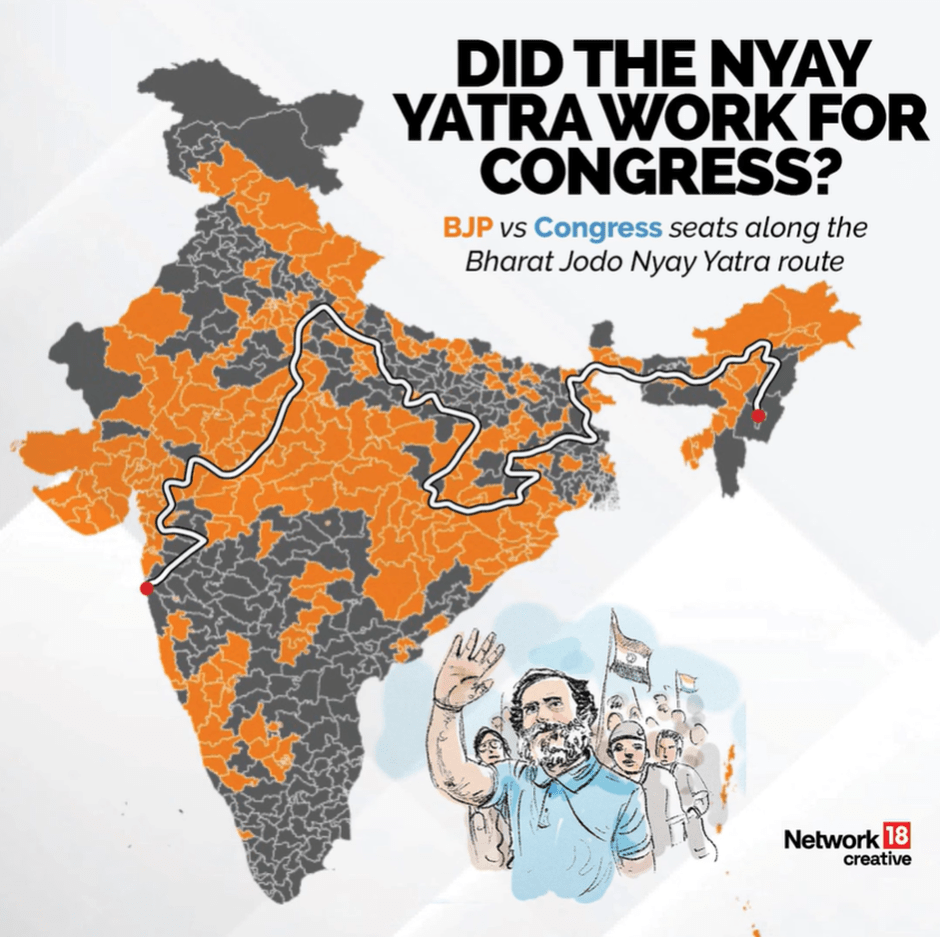
Nyay Yatra Results

If you look at the route of Rahul’s Nyay Yatra, you will see that BJP won most of the areas where Rahul Gandhi campaigned. This map was shared by Moneycontrol.

Nyay Yatra Congress Results 2024

The white line was the route taken by Rahul Gandhi. It went well in Manipur, but as his journey progressed, his yatra seemed to have had less impact on the common man.

This is BJP’s performance in the same areas for comparison purposes:

Nyay Yatra BJP Results 2024

As you can see, most of the areas were dominated by the BJP.

Questioning Congress’ Performance

The irony is that no journalist has questioned his performance and is projecting him as a hero. I am pointing this out because Congress prefers to believe that Rahul Gandhi is the best Prime Ministerial candidate. However, if you replace him with someone much more competent, votes will flow from the BJP to Congress naturally without much work or unending yatras. Many I know only opt for the BJP because they dislike the Gandhis, a sentiment that could be leveraged by a stronger Congress leader.

In India, there is a lack of a strong opposition party (not an alliance) with consistent and solid ideologies that do not vary among party members. Consistency brings confidence. Personally, I was not sure if I was voting for the left’s or Congress’ ideologies in the INDI alliance. The manifesto of CPI(M), one of the members of the INDI alliance, is one of the most dangerous I have ever seen. It does not inspire confidence. If I support the Congress but not the CPI(M), should I still vote for the INDI alliance? This is the skepticism I feel.

The question remains whether Congress is planning to continue working with an alliance and take credit for the alliance’s victories. We should question the party and demand improvements. Celebrating the current situation as a victory could prevent the emergence of a much more competent opposition party. The citizens of India deserve more.