
Dhurandhar Lingers Long After the Credits Roll

Dhurandhar Movie Poster

I watched Dhurandhar a few days back, and it has stayed with me ever since. It keeps running in my head – the songs, the action sequences, the passion for the country. The nationalist in me is satisfied.

For the first time in a long while, an Indian spy movie moved away from humanizing terrorism. That shift feels bold and necessary. The film forces you to sit with harsh truths instead of offering easy heroes and neat endings. It does not try to make violence look noble or harmless. That honesty is what makes Dhurandhar powerful, and also hard to shake off.

Personally, I felt a quiet mix of angst and sorrow when I saw some people brush the film off as propaganda or political. This view is subjective, but it still made me uneasy. The events shown are not opinions or theories. They happened. Calling a film like Dhurandhar propaganda does a disservice to the people who lost their lives in terrorist attacks. It dismisses real events that happened and real pain that was lived. These truths were not addressed openly for years, often out of fear or sheer convenience. When cinema finally creates space to tell these stories, the instinct should be to listen, not reject. The strong box office response shows that many people are ready to face uncomfortable realities. That response matters. Aditya Dhar deserves credit for choosing honesty over comfort. I have admired his films for consistently daring to tell stories most would rather avoid.

When the screen turned red, I could not hold back my tears. It made me emotional. But I also wondered if anyone watched that moment and felt nothing at all. That thought itself felt disturbing. Not feeling the pain of fellow Indians, or even a flicker of anger, says something deeper. In a country where apathy is already common, it is easy to believe some viewers saw it with blank eyes. For them, everything uncomfortable becomes propaganda, dismissed as an attempt to show Pakistan in a bad light.

Sometimes it feels like a lost cause to expect people to stand firmly with the country, without hesitation or filters. Many of us avoid the truth because it feels uncomfortable. We prefer to hide behind safe words like peace and love. But years of doing that came at a cost. We were taken for granted. Our suffering was questioned. Our stories were dismissed as lies or branded as conspiracy theories.

I think it is time for India to stand up for itself. We need to acknowledge our truth and stop looking away. Facing reality head-on is not hatred or extremism. It is honesty. Only when we accept what went wrong can we learn from it. Growth does not come from denial. It comes from clarity, courage, and accountability.

Now there are people who argue that this much truth does not belong on screen. If that were true, then why do we make social films like Homebound at all? Those films are also hard-hitting and deeply uncomfortable. Cinema has always helped bring difficult issues to the public in a more digestible way. Stopping that only pushes reality back into silence.

The violence in the movie is also being criticised, but real-world events prove how close such scenes are to the truth. The recent lynching of a Hindu man in Bangladesh is a grim reminder that brutality is not exaggerated fiction. Dhurandhar does not sugarcoat this reality, and that honesty is exactly why it matters.

Coming to the performances, while many are praising Akshaye Khanna, for me it was Ranveer Singh who truly stood out. His eyes did most of the talking, and it was brilliant to watch. There was a quiet intensity in his acting that stayed with me. Sara Arjun also impressed me with her performance and screen presence. She brought both grace and emotional weight to her role. The music deserves special mention too. It lingers in your mind and pulls you back into the world of Dhurandhar long after the film ends.

Overall, I would say Dhurandhar is a must-watch. It is not an easy film, but it is an important one. It stays with you long after the credits roll. I most probably would end up watching it again.
From 26/11 to Delhi Blasts: Why the “False Flag” Narrative Must End in India

What surprises me more than the terror attacks in India is the speed with which some Indians dismiss them as “false flag operations.” For instance, a look at the comments under Faye D’Souza’s Instagram post about the Delhi terror blasts shows several users mocking the incident and blaming the Indian government instead of the perpetrators. Many genuinely seem to believe it’s a political ploy to influence votes rather than an act of terror.

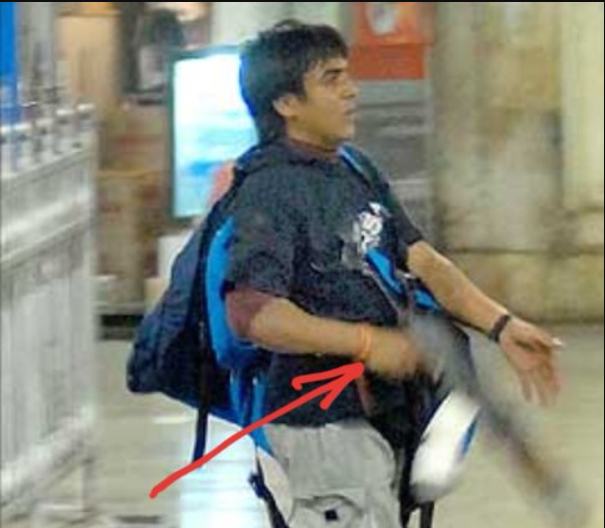
The “false flag” narrative isn’t new. It has surfaced after nearly every major terror attack in India. Even the 26/11 Mumbai attacks were, at first, misrepresented by some as an internal operation. The claim gained attention mainly because Ajmal Kasab, one of the attackers, wore a saffron thread on his wrist. Those spreading the theory strangely assumed such a thread could only belong to members of BJP or RSS. They overlooked the possibility that it might have been deliberately used to mislead investigators.

Ajmal Kasab with Saffron Thread on His Wrist

Kasab’s real plan, as later revealed, was to die appearing as a “Hindu” and thus shift suspicion away from Pakistan-based handlers, reinforcing the myth of “saffron terror.” Thankfully, due to the extraordinary courage and sacrifice of Assistant Sub-Inspector Tukaram Omble, Kasab was captured alive and later confessed to being a Pakistani national trained by terrorists.

Tukaram Omble and Mumbai 26/11 Attacks
Tukaram Omble

By then, however, the false-flag theory had already gained widespread circulation. Well-known public figures even released a book titled 26/11: RSS ki Saazish? that promoted the “false flag” theory surrounding the attacks.

Influential Figures Promoting RSS ki Saazish Book
Influential Indian Figures Promoting “26/11: RSS ki Saazish?” Book

The “false flag” narrative resurfaced after the Pulwama terror attack, when a suicide bomber from Jaish-e-Mohammed (JeM) drove an explosive-laden vehicle into a CRPF convoy in Pulwama, Jammu & Kashmir, killing 40 soldiers. Following the attack, some voices in Pakistan, including senior officials, suggested that India might have staged the incident to influence the upcoming 2019 elections. Commentators in India echoed similar theories online, framing the tragedy as politically motivated rather than acknowledging it as an act of cross-border terrorism.

Then came the recent Pahalgam attacks, where Pakistani media outlets and online commentators claimed that India had staged the incident to divert attention from domestic issues and influence elections. They described it as part of an alleged “Indian playbook” of false-flag operations. Soon after, similar talking points appeared in sections of Indian social media and commentary spaces.

In each case, claims of “false flag operations” lacked credible evidence and were primarily rooted in conspiracy theories first circulated in Pakistan and later amplified by certain opinion groups in India.

The Global “False Flag” Obsession

It’s worrying that many people in India tend to believe external narratives about terror attacks rather than trusting verified investigations at home.

This pattern might have been up for serious debate if it only happened locally, but the deflection from religious extremism appears to be a global trend. To cite a few examples:

  • The 9/11 attacks are still viewed by some as a “false flag” orchestrated by the U.S. or Israel to malign Muslims. This is a theory long disproved but still used by extremist groups to recruit followers. They thrive on anger, convincing vulnerable minds that violence is the only response to perceived oppression. In India, extremist recruiters have similarly exploited stories like the Babri Masjid while dismissing events like the Godhra train burning as conspiracies, weaving grievance into a tool for radicalization.
  • The October 7 attacks in Israel were also met with widespread conspiracy claims, framed as a false flag operation meant to discredit certain groups.
  • Likewise, criticism of regimes such as Iran’s leadership, the Taliban, or Hamas is often dismissed as Western propaganda. This is another form of deflection that prevents honest introspection.

Conspiracies Shield Extremists

It’s time to move past the overused “false flag” narrative.

Each time a terror attack is dismissed as a conspiracy, it insults the victims, weakens trust, and blurs the line between truth and propaganda. These baseless claims don’t protect anyone. They only embolden extremists and deepen divisions.

Real courage and national unity will come from confronting facts, condemning violence without bias, and demanding accountability from those who spread hate, no matter where it comes from.

Ending the false flag obsession is the first step toward restoring integrity in how we respond to terrorism.