One thing I have learned is that there are different standards for different people.
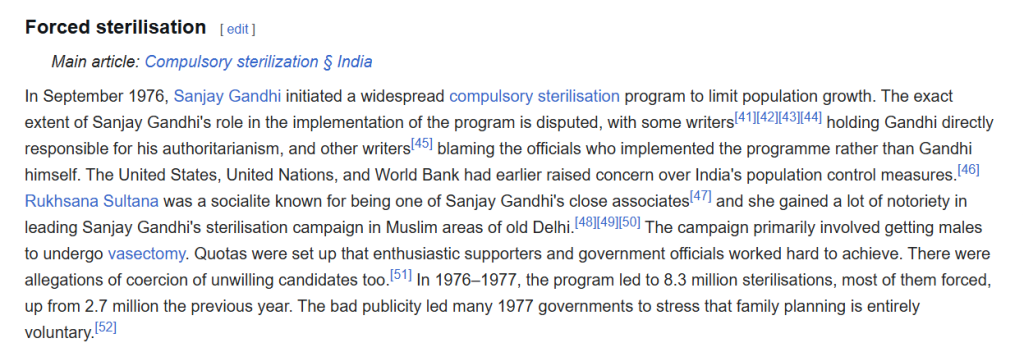
We have forgiven Congress for the 1984 Sikh riots and the Emergency, a period during which thousands were killed and many were forcefully sterilized as part of a population control measure.
A Snippet from “The Emergency (India)” Wikipedia Article
We also forgave all the anti-Hindu attacks that occurred in the country, such as the genocide of Kashmiri Pandits, the Godhra train burning, the 1992 Ajmer rape case, and the Moplah riots. The left attempted to whitewash these events, but historians like Ambedkar provided a different narrative.
We tell ourselves, “Why bring up the past?” But we are not ready to forgive or let go of the past when it comes to the Gujarat riots and the Babri Masjid demolition.
What makes certain communal riots more unforgivable and unforgettable than others, when all are equally horrendous?
Today, we see similar attempts at whitewashing, where any films addressing attacks on Hindus are immediately dismissed as propaganda. Why is it that every one of these events is labeled a lie, without any anomalies? What criteria must be met for an attack on Hindus to be acknowledged?
Recently, Khalistanis in Canada attacked a Hindu temple, but this was not given enough attention either. In their efforts to downplay attacks on Hindus to prevent riots, the left has caused many in the community to turn towards far-right ideologies. There’s no balance or consistency in beliefs. If you believe violence is bad, speak up against all types of violence. But, often we see, one type of violence being justified, whereas others are condemned.
A simple glance around is enough to recognize this hypocrisy. Observe how people around you react when there are attacks against Hindus. Are they condemning or justifying it?
Ultimately, it revolves around politicians, media, and agenda-driven propagandists manipulating people’s emotions. They dictate how you should feel about various issues, which riots deserve attention and remembrance, and which should be overlooked or forgotten.
The US elections are done. Trump has emerged as the clear winner. For Indians like me, while it’s an election in a different country, the reactions to his victory feel close to home.
Liberals in the USA are angry. They are accusing Trump supporters of being fascists and anti-LGBTQ. This is similar to how the Indian left reacts when BJP wins an election. They accuse the voters and label them as stupid, uneducated fascists.
I can understand the intense emotions. It’s human to react strongly to causes you care deeply about. However, the liberals in both the USA and India are unable to grasp why the right wing is getting votes. They seem unwilling to hold open discussions to find out the drawbacks of the party they support. It’s only when you acknowledge the mistakes that you can rectify them and ensure the party’s victory in the next election.
In the USA, from what I learned, the right-wing Republican party got votes because they catered to the ordinary American’s issues, such as inflation, immigration influx, border security issues, Biden’s handling of the Middle East war, rising antisemitism, and the democrat’s stoic silence about the Bangladeshi Hindu genocide and Khalistani issues. The last two issues mattered to American Hindus, whereas the Middle East war affected American Muslims. Some American Jews I follow observed with pain how the far-left held college campuses hostage, even going to the extent of attacking Jewish students and setting the American flag on fire.
The reasons for Trump’s win were in front of all to see, but somehow, people chose to ignore it.
Trump got votes not because the majority of Americans are anti-abortion or anti-LGBTQ. It had more to do with the Biden government’s handling of core concerns. By choosing to concentrate only on niche issues, the Democrats distanced themselves from the ordinary American. This is why Democrats won in cosmopolitan cities with more diverse populations, whereas Republicans won the remaining places.
In India, the trend is similar. When the BJP wins, the anti-BJP group resorts to insulting the voter’s intellect. They are labeled fascists, and no effort is made to understand the reasons that led them to vote for a right-wing party. For instance, I see many who were once left-leaning becoming comfortable with the BJP after the Waqf land issues started. In case this issue changes the political dynamics of the country, the anti-BJP clan would still place the blame on the BJP voters, calling them communal, uneducated, and fascists instead of looking inward. There’s always more uproar and less introspection.
A party cannot grow if it refuses to acknowledge its mistakes. Liberals won’t be able to defeat right-wing parties if they continue to ignore important issues.
600 families in a small coastal area in Kerala risk losing the properties they paid for. Reason: The Waqf claims the land is theirs.
What is Waqf?
A waqf is an Islamic endowment of property or assets designated for religious, charitable, or social purposes.
In India, waqf properties are managed by the Waqf Board, a government body responsible for overseeing and regulating these endowments.
What is the Munambam Waqf Issue?
The Munambam Waqf issue is a complicated land dispute. This land, which covers approximately 404 acres, is located in a place called Munambam in the Ernakulam district of Kerala.
Historically, the land belonged to the Kutchi Memon community. They migrated to Kerala for trade and were granted this land by the Travancore kingdom. In 1950, part of the land was donated to Farook College as Waqf property, intended for educational purposes. Farook College went on to sell this land to the current property owners of Munambam.
In recent years, the Kerala Waqf Board has claimed ownership of the land. This has led to significant tensions among local residents, most of whom are Christian families and fishermen who have lived there for decades with legal ownership. This is not a communal issue, as even Muslim families have been affected by Waqf.
The claims by the Waqf Board have prevented the residents from managing their properties. They cannot pay taxes or sell their land to meet personal needs, such as funding their child’s education or obtaining health treatments. The residents assert that the claims by the Waqf Board are invalid, as they fairly paid for the property.
Politicians from Congress and CPI(M) insist the property is not Waqf to console the residents. However, the Waqf Board says the land is indeed Waqf and the 600 Munambam families are encroachers who need to eventually vacate the area.
The Munambam residents were initially told to approach the Waqf tribunal to fight their case, as the court is unauthorized to handle Waqf land matters. This requirement is enabled by the current Waqf Act introduced by Congress, forcing victims to seek justice from the perpetrators themselves. Across India, there are 70,000 such cases pending, which the court cannot address until the Act is reformed.
How to Resolve this Issue?
To prevent this issue from escalating, political parties must ensure that the vulnerable families in Munambam are provided justice. If they paid for the property, it is theirs to keep. Another community’s beliefs should not be imposed on them. It will lead to matters turning communal.
Concerns
This is not the only Waqf dispute in the country. The Waqf Board is claiming acres of land in other states of India, one of which houses a temple that is older than Islam itself.
The opposition parties, especially Congress, need to ensure the poor do not suffer because of discriminatory laws. For that to happen, all political parties need to work together to reform the existing Waqf law in India that allows such unfair claims.
I’m observing that the Waqf issue in Munambam is causing more Christians in Kerala to support the BJP. The matter has also drawn the attention of churches, which are advocating for reforms to protect property rights in cases like this.
If the reforms do not get passed in the winter session of parliament due to the appeasement politics of the opposition parties, the political landscape might shift significantly in favor of the BJP. It might change the political beliefs of many, who until now used to treat the BJP as untouchables.
The opposition parties’ best course of action is to back the Waqf reforms and avoid misleading the underprivileged with false promises. Words are not enough at this moment. The parties need to proactively initiate a discussion with the Waqf Board and ensure the poor get justice.
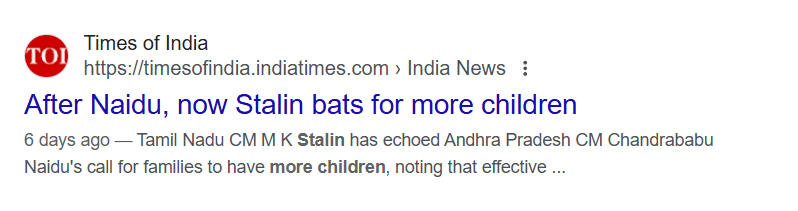
Why are South Indian leaders, like Stalin and Chandrababu Naidu, all of a sudden, pushing women to have more children? It’s not to combat the aging population as they make it seem. It’s all politics!
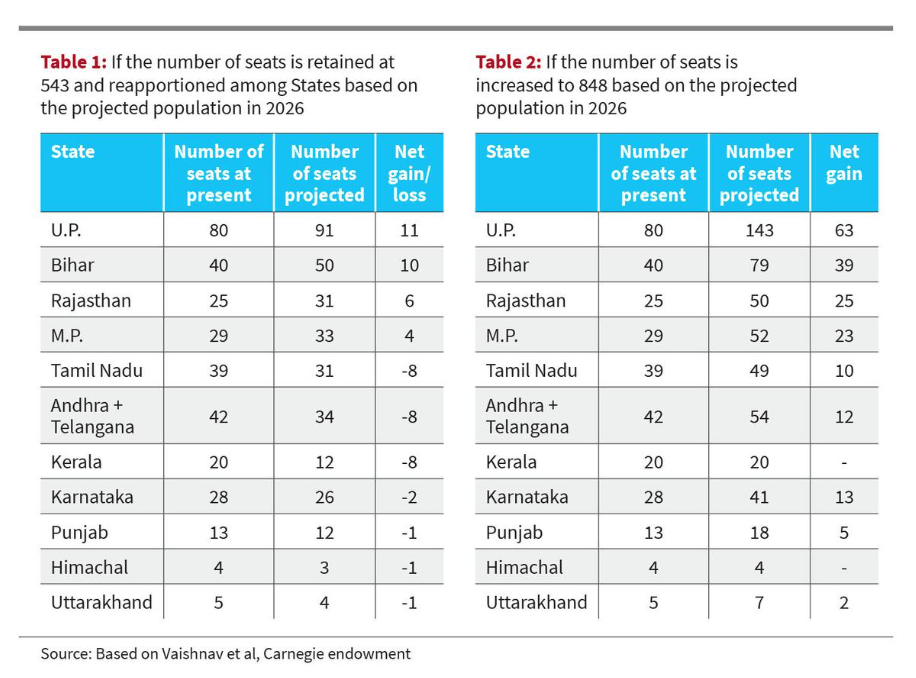
In India, there’s something called Delimitation. It’s a process of redrawing the boundaries of constituencies based on population. States with more population will get more constituencies, whereas those with low populations, like southern states, will get fewer seats. Basically, the exercise is to ensure each constituency has an equal number of people.
Since South India’s population growth is decreasing, plus migration, it won’t need as many constituencies. The total number of constituencies in Lok Sabha has been frozen since the 70s and is in place until 2026. 2026 is almost here! This is why politicians in South India are worried about women not having enough children. They don’t want to lose their seats.
As per The Hindu newspaper, Kerala, Tamil Nadu, Andhra + Telangana, all of which are South Indian states, stand to lose 8 seats each, if the current number of seats in Lok Sabha (543) is maintained.
We can expect Pinarayi Vijayan, the CM of Kerala, to make a similar statement next.
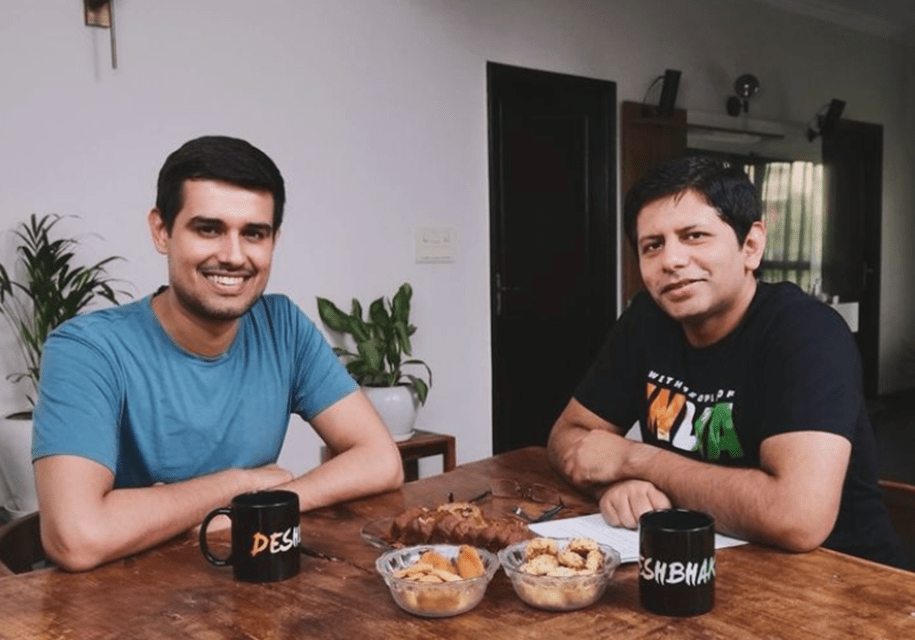
We have observed the significant rise of left-leaning political commentators on social media, particularly YouTubers, during this election. Dhruv Rathee and Ravish have amassed massive views, surpassing even mainstream news channels. It was believed that they would have a significant impact on the Lok Sabha Elections.
Dhruv, who typically maintains a neutral tone, noticeably shifted his approach in the months leading up to the election, embracing a more polarized political viewpoint. I use the term “polarized” because he blatantly overlooked several important issues during this time, such as the Sandeshkhali rapes in West Bengal and the Sidharthan case in Kerala, primarily because these cases put the opposition in a poor light. Personally, I felt his demeanor change from that of a regular YouTuber to that of a politician.
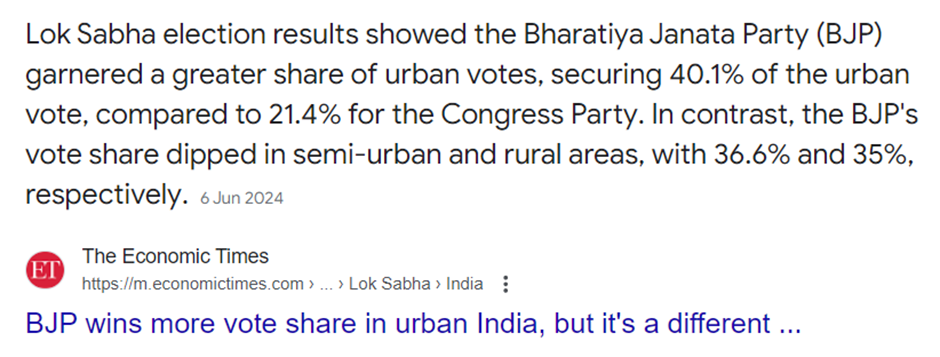
After months of running intense social media campaigns, were these left-leaning YouTubers successful? In a previous post, I mentioned how Dhruv Rathee is unlikely to have a significant impact on the Lok Sabha elections. The echo chamber angle aside, the answer lies in the data collected from the CSDS-Lokniti Post Poll Survey. It shows how the BJP performed well in urban areas while lagging in rural areas.
How much influence do YouTubers have in rural areas? Unless a proper survey is conducted that asks people living in villages, “Did Dhruv Rathee or any other YouTuber influence you to change your voting pattern this time?” we will never know for sure. Another way to analyze the impact is by examining video statistics. Content creators can share their video statistics, including the regions where their videos were most viewed. Did they receive significant viewership from rural areas?
Huge rallies were conducted in villages where Dhruv’s videos were played. However, it’s safe to say that people in rural areas do not vote based on social media activism. Instead, they vote based on their personal experiences, caste-based politics, and the help they receive. They are unlikely to resort to the Internet to research the pros and cons of political parties.
To summarize, any success resulting from YouTube videos should have primarily been reflected in urban areas, but that was not the case. BJP performed considerably well in cities.
It’s the election season again in India, the largest democracy in the world. Politicians are tirelessly running hither and thither promoting their campaigns, often resorting to divisive tactics to seal their votes. As a layman, you find yourself wondering during these times whether the political parties’ agenda is to divide citizens rather than win elections.
Over the past ten years, there’s been a steady rise in discomfort over the rising popularity of the right wing. Most minorities and leftists want the BJP to be voted out this year. There’s a sense of dread about what would happen if the BJP takes control for the third consecutive term. You see and read incidents of Christians and Muslims in rural areas crying, “Hindus will kill us if they come into power. Please don’t vote for the BJP.” This cry for help is alarming. Minorities do face discrimination in India, but to make it sound like a genocide is far-fetched. Most people live in harmony with each other, while some tyrants across communities try to create problems. However, the negative stories are most prominently highlighted making it look like the norm. It is not a systematic persecution, as seen in neighboring countries.
Who is spreading this hate narrative? Who is inflicting this unfound fear on everyone? Politicians and the media are to blame—both the right and left. One makes controversial statements, and the other spreads hate and discord by amplifying them out of context. The reasons are purely agenda-driven. I say this with confidence because of the ease with which they seem to overlook their own preferred party’s faults, irrespective of the severity. The bias is crystal clear.
Someone like me, who is engrossed in reading both left and right narratives day in and out, can now finally figure out when a party/media/journalist is playing games to drive their agenda. I have acquired a sense of indifference to polarizing or pseudo-secularist words. But an apolitical person, which many are, might not understand the game and fall prey to the hate narrative set by both sides. Ultimately, the narrative with the most media outreach wins: the right-wing within India and the left wing globally.
The opposition parties in India are going all out to convince everyone why democracy is in trouble in the country, resorting to fearmongering tactics, such as drilling down the point that there won’t be an election next time if BJP wins. The Western media is also trying to help the opposition by pushing the narratives of the leftist ecosystem to the world at large. An outsider might have already read several articles slamming the situation in India on popular portals like the BBC, Al Jazeera, and CNN. Rarely do you see a right-wing viewpoint, probably because the right wing is, by default, considered problematic. So, you never know precisely why the right wing has gained popularity in any country. You only get to see the uncomfortable outcomes of it.
A satire post from @the_fauxy
Is BJP a Far-Right Party?
Let’s get this straight: BJP being a “far-right” party is highly debated and contradicted by the actual far-right in India. They feel Modi is “soft,” so they label him “center-right.” According to them, he hasn’t yet reclaimed all the lost temple properties or got the temples out of government control; his party suspended Nupur Sharma when she made blasphemous comments in response to an equally blasphemous comment by a guest panelist, and the party hasn’t restricted welfare benefits to Muslims. For the hardliners, a legit far-right politician is someone like Geert Wilders.
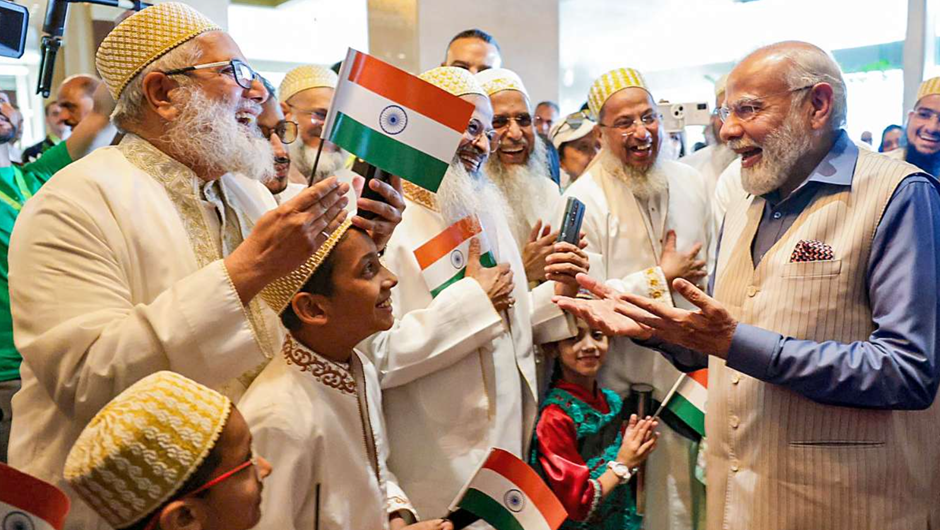
You often see Modi making problematic statements to woo his far-right fan base and keep them happy. But his words don’t usually translate into actions. Muslims remain the biggest beneficiaries of welfare schemes under the BJP rule, Muslim businesses in Gujarat have prospered, Shias are now able to practice their religious rituals in Kashmir openly, and oppressive rules like the Triple Talaq have been banned, earning him a small but dedicated Muslim fan following in the country who have started to realize that Modi isn’t all that bad as he’s made out to be. In Kashmir, a Muslim-majority state, the Ayushman Bharat scheme is available to all citizens irrespective of social and economic status, a privilege not extended to other states in the country.
Narendra Modi with Bohra Muslims
These examples defy the popular notion that Modi is anti-Muslim. Some rightists jokingly call him “Moulana Modi” for the help he has extended to Muslims, especially the Pasmanda community, who had been ignored by other political parties to date in favor of the more prosperous Muslim elites.
Yes, Modi is serious about reclaiming revered temple properties lost during the Mughal rule, the ones that are highly deemed by the Hindu community, but he is offering an alternative, more spacious land for the construction of a new mosque as compensation to the Muslims. This is a trait characteristic of a practicing religious Hindu but not an Islamophobe who would not have offered, without doubt, any land as compensation.
However, the party doesn’t do much to contradict such claims of it being an anti-Muslim party. They don’t openly highlight the good they have done for the Muslim community. It appears as if they want this “anti-Islam” label to prevail. Probably because it pleases their far-right voters. A large number of individuals vote for Modi with the belief that he prioritizes Hinduism. Why would he want to tarnish that image? This is a primary con of democracy – you support narratives, even misleading ones, to consolidate a win by hook or crook. The focus is on power, not the people. The result is this: you end up winning by dividing the people further. The essence of “One India” becomes fainter as each election campaign ends.
Reasons for Rising Support
The reasons why the majority in India prefer Modi are multifold. It is not as straightforward as outsiders like to believe. There are primarily three types of BJP supporters:
Centrists: They dislike BJP’s communal politics but admire the party’s pro-development approach, solid implementation of social schemes, zero tolerance for terrorist activities/groups, no appeasement politics, increase in FDI, improved relationships with foreign countries that can prove beneficial to India, improved economic rankings, etc.
Anti-Opposition: They support the BJP primarily because they think the opposition is incompetent and not strong enough to take the country forward. They vehemently dislike the opposition’s weakness when it comes to tackling radical groups (something we are increasingly seeing in Western countries nowadays). The opposition was unable to control Kashmir’s terrorist activities or ban anti-national groups like PFI while they were in power. If given a better choice, the “Anti-Opposition” clan would gladly opt out of BJP. Currently, there are none.
Far Right: They like BJP’s communal politics and their pro-Hindu, capitalistic approach. They were highly unsatisfied with the opposition’s appeasement politics in the previous years. They felt their needs were unmet or unanswered when the opposition was in power, such as getting the temples out of government control. BJP gives them hope.
BJP rose to fame because of these three main target groups whose grievances were left unresolved by the opposition parties. For them, BJP is the only viable option. To defeat the BJP, the opposition parties should first seriously address the concerns of these groups. As long as they keep denying their negatives and gaslighting the concerns of voters, the right-wing will continue to reign supreme.
Conclusion
It is a trend we are seeing worldwide. Far-right parties are winning in Europe and are finding support in the US. This could be attributed mainly to the incompetency of the leftist ecosystems to curb extremism and violence, pushing people to support the right. When the issues are addressed and resolved, voters will likely shift their support towards a centrist political party. Till then, we await more concrete actions from the left to prove they can protect the country and its social fabric as reliably as the right.




 The Monkey Dilemma
You must be logged in to post a comment.