From 26/11 to Delhi Blasts: Why the “False Flag” Narrative Must End in India

What surprises me more than the terror attacks in India is the speed with which some Indians dismiss them as “false flag operations.” For instance, a look at the comments under Faye D’Souza’s Instagram post about the Delhi terror blasts shows several users mocking the incident and blaming the Indian government instead of the perpetrators. Many genuinely seem to believe it’s a political ploy to influence votes rather than an act of terror.

The “false flag” narrative isn’t new. It has surfaced after nearly every major terror attack in India. Even the 26/11 Mumbai attacks were, at first, misrepresented by some as an internal operation. The claim gained attention mainly because Ajmal Kasab, one of the attackers, wore a saffron thread on his wrist. Those spreading the theory strangely assumed such a thread could only belong to members of BJP or RSS. They overlooked the possibility that it might have been deliberately used to mislead investigators.

Ajmal Kasab with Saffron Thread on His Wrist

Kasab’s real plan, as later revealed, was to die appearing as a “Hindu” and thus shift suspicion away from Pakistan-based handlers, reinforcing the myth of “saffron terror.” Thankfully, due to the extraordinary courage and sacrifice of Assistant Sub-Inspector Tukaram Omble, Kasab was captured alive and later confessed to being a Pakistani national trained by terrorists.

Tukaram Omble and Mumbai 26/11 Attacks
Tukaram Omble

By then, however, the false-flag theory had already gained widespread circulation. Well-known public figures even released a book titled 26/11: RSS ki Saazish? that promoted the “false flag” theory surrounding the attacks.

Influential Figures Promoting RSS ki Saazish Book
Influential Indian Figures Promoting “26/11: RSS ki Saazish?” Book

The “false flag” narrative resurfaced after the Pulwama terror attack, when a suicide bomber from Jaish-e-Mohammed (JeM) drove an explosive-laden vehicle into a CRPF convoy in Pulwama, Jammu & Kashmir, killing 40 soldiers. Following the attack, some voices in Pakistan, including senior officials, suggested that India might have staged the incident to influence the upcoming 2019 elections. Commentators in India echoed similar theories online, framing the tragedy as politically motivated rather than acknowledging it as an act of cross-border terrorism.

Then came the recent Pahalgam attacks, where Pakistani media outlets and online commentators claimed that India had staged the incident to divert attention from domestic issues and influence elections. They described it as part of an alleged “Indian playbook” of false-flag operations. Soon after, similar talking points appeared in sections of Indian social media and commentary spaces.

In each case, claims of “false flag operations” lacked credible evidence and were primarily rooted in conspiracy theories first circulated in Pakistan and later amplified by certain opinion groups in India.

The Global “False Flag” Obsession

It’s worrying that many people in India tend to believe external narratives about terror attacks rather than trusting verified investigations at home.

This pattern might have been up for serious debate if it only happened locally, but the deflection from religious extremism appears to be a global trend. To cite a few examples:

  • The 9/11 attacks are still viewed by some as a “false flag” orchestrated by the U.S. or Israel to malign Muslims. This is a theory long disproved but still used by extremist groups to recruit followers. They thrive on anger, convincing vulnerable minds that violence is the only response to perceived oppression. In India, extremist recruiters have similarly exploited stories like the Babri Masjid while dismissing events like the Godhra train burning as conspiracies, weaving grievance into a tool for radicalization.
  • The October 7 attacks in Israel were also met with widespread conspiracy claims, framed as a false flag operation meant to discredit certain groups.
  • Likewise, criticism of regimes such as Iran’s leadership, the Taliban, or Hamas is often dismissed as Western propaganda. This is another form of deflection that prevents honest introspection.

Conspiracies Shield Extremists

It’s time to move past the overused “false flag” narrative.

Each time a terror attack is dismissed as a conspiracy, it insults the victims, weakens trust, and blurs the line between truth and propaganda. These baseless claims don’t protect anyone. They only embolden extremists and deepen divisions.

Real courage and national unity will come from confronting facts, condemning violence without bias, and demanding accountability from those who spread hate, no matter where it comes from.

Ending the false flag obsession is the first step toward restoring integrity in how we respond to terrorism.

From India-Pakistan to Gaza: Exploring the Duality of War

Fire explosion with smoke

Personal observation: In almost every war, there’s always someone who doesn’t want it to end.

In the India–Pakistan war, many in India didn’t want the fighting to stop because they felt Pakistan hadn’t learned its lesson yet. Some even wanted the government to reclaim PoK (Pakistan-occupied Kashmir) during this time (which I strongly oppose).

When Israel attacked Iran’s nuclear sites, many anti-regime Iranians wanted the war to continue because they hoped the regime would fall.

The Israel–Gaza conflict is even more unusual. Many who kept calling for a ceasefire suddenly went quiet or were openly against it when finally announced. Maybe they had expected Israel to be driven out and a new Palestinian state to rise “from the river to the sea.” But that idea is unrealistic and only calls for more violence. Just like India will never give up Kashmir, Israel will never give up its land. Both countries get a lot of criticism for putting their own interests first. But, over the years, Jews and Indians have learned an important lesson: if they want their interests protected, they can’t rely on anyone else. When Indians get murdered in America, there’s next to no backlash. It’s the same case with Jews. History is also proof that when Hindus face persecution or genocide (Kashmiri Pandits, Sandeshkhali, Bangladeshi, and Pakistani Hindus), the world stays silent. In a world shaped by selective activism, these two communities have gradually learned to shed their passivity and docile nature, standing up for themselves without guilt. Indians, in my view, are still learning. Our tendency to stay silent runs deep. But since 2014, that’s starting to change, much to the annoyance of some. Apparently, a “good” Indian is still largely expected to be a silent one in the face of persecution and bigotry.

Anyway, the point is that in any war, there’s always duality. Those who push for the conflict to continue aren’t always on the “far-right.” Sometimes, they are far-left or far-right figures from other communities, disguised as leftist liberals. Take, for example, the India-Pakistan war. Many leftists in India wanted it to end and for peace to prevail. Yet recently, some of those same voices wanted Hamas to reject the peace deal, even at the cost of many lives.

I’ve often felt that the far-left and far-right are just two sides of the same coin. The recent wars and reactions to them over the years only validate this claim.

***

Photo by Pixabay

The Striking Similarities Between The Left & Right in USA & India

The US elections are done. Trump has emerged as the clear winner. For Indians like me, while it’s an election in a different country, the reactions to his victory feel close to home.

Liberals in the USA are angry. They are accusing Trump supporters of being fascists and anti-LGBTQ. This is similar to how the Indian left reacts when BJP wins an election. They accuse the voters and label them as stupid, uneducated fascists.

I can understand the intense emotions. It’s human to react strongly to causes you care deeply about. However, the liberals in both the USA and India are unable to grasp why the right wing is getting votes. They seem unwilling to hold open discussions to find out the drawbacks of the party they support. It’s only when you acknowledge the mistakes that you can rectify them and ensure the party’s victory in the next election.

In the USA, from what I learned, the right-wing Republican party got votes because they catered to the ordinary American’s issues, such as inflation, immigration influx, border security issues, Biden’s handling of the Middle East war, rising antisemitism, and the democrat’s stoic silence about the Bangladeshi Hindu genocide and Khalistani issues. The last two issues mattered to American Hindus, whereas the Middle East war affected American Muslims. Some American Jews I follow observed with pain how the far-left held college campuses hostage, even going to the extent of attacking Jewish students and setting the American flag on fire.

The reasons for Trump’s win were in front of all to see, but somehow, people chose to ignore it.

Trump got votes not because the majority of Americans are anti-abortion or anti-LGBTQ. It had more to do with the Biden government’s handling of core concerns. By choosing to concentrate only on niche issues, the Democrats distanced themselves from the ordinary American. This is why Democrats won in cosmopolitan cities with more diverse populations, whereas Republicans won the remaining places.  

In India, the trend is similar. When the BJP wins, the anti-BJP group resorts to insulting the voter’s intellect. They are labeled fascists, and no effort is made to understand the reasons that led them to vote for a right-wing party. For instance, I see many who were once left-leaning becoming comfortable with the BJP after the Waqf land issues started. In case this issue changes the political dynamics of the country, the anti-BJP clan would still place the blame on the BJP voters, calling them communal, uneducated, and fascists instead of looking inward. There’s always more uproar and less introspection.

A party cannot grow if it refuses to acknowledge its mistakes. Liberals won’t be able to defeat right-wing parties if they continue to ignore important issues.

***

Photo source:  Mark Wilson/Getty Images

Biggest Surprises in Jammu Kashmir and Haryana Elections 2024

Jammu & Kashmir Election Results
Courtesy: ECI Website

While reading today’s newspapers, an interesting trend caught my eye. Most newspapers in India are left-leaning, so election results are primarily presented in a way that props up the left-leaning parties. For example, “NC got a thumping victory,” in contrast to a more subdued “BJP earned a hat-trick in Haryana.” No fancy adjectives. Another example is “J&K has rejected BJP’s politics” while failing to report that BJP’s vote share has been increasing in J&K with every passing election. In some newspapers, Vinesh Phogat’s win was highlighted more than the overall performances of individual parties.

The election results declared on 8th October have been filled with surprises. However, due to the media’s own biased leanings, not every fact made it to the papers. Here are some of the top surprises from the Haryana and J&K Elections 2024.

BJP getting more seats than Mehbooba Mufti’s PDP in J&K

From a party that used to get single-digit votes in Kashmir, BJP’s vote count has now risen to four digits. The party came second in J&K, beating Mehbooba Mufti’s PDP.

PDP is an indigenous Kashmiri political party. The party has been on the political scene in Kashmir for ages. This time, most of the PDP’s votes went to NC in the Kashmir region. PDP’s association with the BJP in the recent past proved to be its undoing. Interestingly, this camaraderie did not have the same effect on the BJP, as its vote share increased from the 2014 elections.

Jammu & Kashmir Seats and Vote Share
Courtesy: The Hindu

No one, including BJP members, ever countered the fact that BJP would not win a single seat in Kashmir. It was reported that even the people of Jammu, along with Kashmiri Pandits, BJP’s primary vote base, were dissatisfied with the saffron party as their demands were left unaddressed.

Considering that politicians like Omar Abdullah were saying there was intense anger brewing in the valley beneath the surface of peace and tranquility, it was surprising to see the BJP not only increase its number of seats without an alliance but also its overall vote share in J&K albeit marginally, as compared to the 2014 elections.

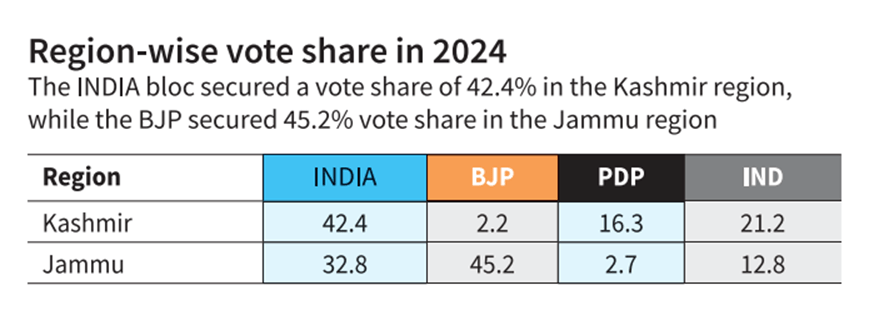
If we were to analyze just Kashmir alone, the BJP neither lost nor gained its vote share (2.2%) in the region. So, in summary, the BJP increased its seats/vote share in Jammu while maintaining its vote share in Kashmir. If the Abrogation of Section 370 was indeed a major point of discontent for J&K locals, we should have seen a drastic decrease in BJP’s seat count/vote share. But that’s not what happened.

Jammu & Kashmir Region-wise Vote Share
Courtesy: The Hindu

The media and politicians might paint the Kashmir election results as a big loss for the BJP and a “befitting reply to BJP by the people for the Abrogation of 370”, but the data seems to indicate otherwise. Yes, they did not win a seat, but the fact that in many seats of Muslim-dominated Kashmir, BJP came second, beating Congress and PDP, implies there’s far more to the story than what meets the eye.  

BJP losing Gurez in Baramulla by a mere 1132 votes

Gurez is a seat that is 98% Muslim and where the BJP did not have any presence till now. Faqeer Mohammad Khan from the BJP lost by a mere 1132 votes to NC’s Nazir Ahmad Khan.

This close contest has been the biggest shocker from the Kashmir region, considering the BJP is always portrayed as an “anti-Muslim” party.

Gurez Kashmir
Courtesy: ECI Website

BJP’s Shagun Parihar winning Muslim-dominated Kishtwar seat

Shagun Parihar BJP
Shagun Parihar

There is a misconception that Jammu is a “Hindu-only” area and Kashmir is a “Muslim-only” area. Jammu has areas with a significant Muslim population. One such area is Kishtwar, a district that has long been a hotbed of militant activities.

Shagun’s father and uncle were murdered by Hizbul Mujahideen terrorists in 2018. She initially had no plan to join politics, but after the murder of her father and uncle, she felt the need to bring about a change. Her victory, albeit by a small margin, proved to be sweet revenge.

Speaking to the media after the verdict, she said: “We have lost a large number of our soldiers. I have lost my father, and some have lost their brothers and sons. My first effort will be to ensure that every child here has the shadow of a father over his head and that there is peace and prosperity in the area. My efforts will be to bring happiness to every home.

Jamaat-e-Islami and former separatists faced a big loss in J&K

When members from banned radical groups like Jamaat-e-Islami and former separatists were allowed to contest this election individually, many were worried.

As Kashmir continues to be a sensitive zone, analysts questioned the motive behind this move and the consequences of having radical elements elected into power. However, the people of J&K answered this pressing question through their votes, resoundingly rejecting the radicals and choosing a party like the National Conference instead, which believes in working democratically within the rules of the Indian constitution. This has come as a relief for many, especially since Engineer Rashid was elected as MP in the Lok Sabha elections.

The loss of Engineer Rashid’s party in the J&K election has provided ample proof that his victory in the Lok Sabha elections was a case of sympathy voting. His sons had extensively campaigned for him before general elections, saying the only way their father could escape jail was if he became an MP. However, in the case of the J&K elections, Kashmiris seemed to have drawn a line, and Rashid was unable to replicate his victorious stint in the general elections.

Congress in a way lost both Haryana and J&K

Even though Congress is an ally of the NC in J&K, their standalone performance proved to be lackluster. Congress managed to earn only 6 seats in J&K, compared to BJP’s 29. This cannot be considered a victory for Congress. In Jammu, too, an area where they were stationed to put up a strong fight against the BJP, they managed to win only one seat.

NC leader Omar Abdullah admitted post-election that, in hindsight, the alliance was unnecessary as they would have won the election anyway without the help of Congress.

Haryana outcome

Haryana’s election results came as a shock to everyone, including right-wingers. The trend was overwhelmingly leaning towards anti-incumbency in the state. BJP has been ruling Haryana for over a decade, and there were a plethora of issues surrounding “farmers, soldiers, and wrestlers” plaguing the state.

However, around a month back, it was reported that the non-Jats were having second thoughts about Jats supporting Congress and gaining power. This led to a consolidation of non-Jat votes against Congress. It is a simple case of caste-based politics gone wrong for the party.

Haryana Election Results
Courtesy: The Hindu

RSS played a huge role in BJP’s victory

Reportedly, RSS went above and beyond in Haryana, campaigning door to door, distributing pamphlets that highlighted the dangers of caste-based divisive politics, ensuring everyone got their voter slips on time, and organizing outreach programs.

In the Lok Sabha Elections, it was reported that there had been a fallout between the BJP and RSS, which led to RSS members not making any effort to help the BJP. BJP seems to have realized its blunder post-election and made a conscious effort to re-establish connection with RSS, which is undeniably its backbone. Several changes were made in Haryana based on RSS’ recommendations. It ended up proving effective.

Conclusion

Yet again, Exit polls in India have turned out to be a disaster. You never know what the janta is thinking. There are silent voters who make their stance known only through their votes. Exit polls have been unable to infiltrate that section.

One thing is clear: this election has been a big win for democracy, especially in the Kashmir valley. The turnout was impressive. The trust they placed in the Indian democratic process is noteworthy. As Modi mentioned, the peaceful conduct of the J&K election has proven to be a victory in itself.

An Ode to Lok Sabha Elections 2024 (Part 2): Congress taking credit for the alliance’s victory

Lok Sabha Election Results 2024

The Congress party’s performance in the Lok Sabha Elections 2024, with a win of 99 seats, is a notable improvement from 2019. However, it still pales in comparison to the BJP’s reduced 240 seats. The alliance, as a whole, played a pivotal role in forming a strong opposition. Yet, it is evident that no single party can claim sole credit for the alliance’s success.

Samajwadi Party (SP) – The Unsung Hero

In Uttar Pradesh, it was the Samajwadi Party (SP) that was the game-changer with its 37 seats. BJP came a close second with 33 seats. Congress managed 6. In the end, it is not how many seats you gained or lost that matters, but whether you won. I have my grievances with the SP, but if credit is to be given to any party, it should go to the SP. It was Akhilesh Yadav who turned things around.

Despite Congress’ lackluster performance (this was its third-worst performance overall), you often hear the party nowadays boasting about its “achievements” and how Rahul Gandhi single-handedly saved democracy. Ironically, this narrative has also been picked up by the West.

It seems that the party is trying to present this as a Congress victory as a way to save Rahul Gandhi. This may have been his final opportunity to get things right, and by insinuating that Rahul was the driving force behind the alliance’s success, Congress managed to secure his leadership position.

Nyay Yatra Results

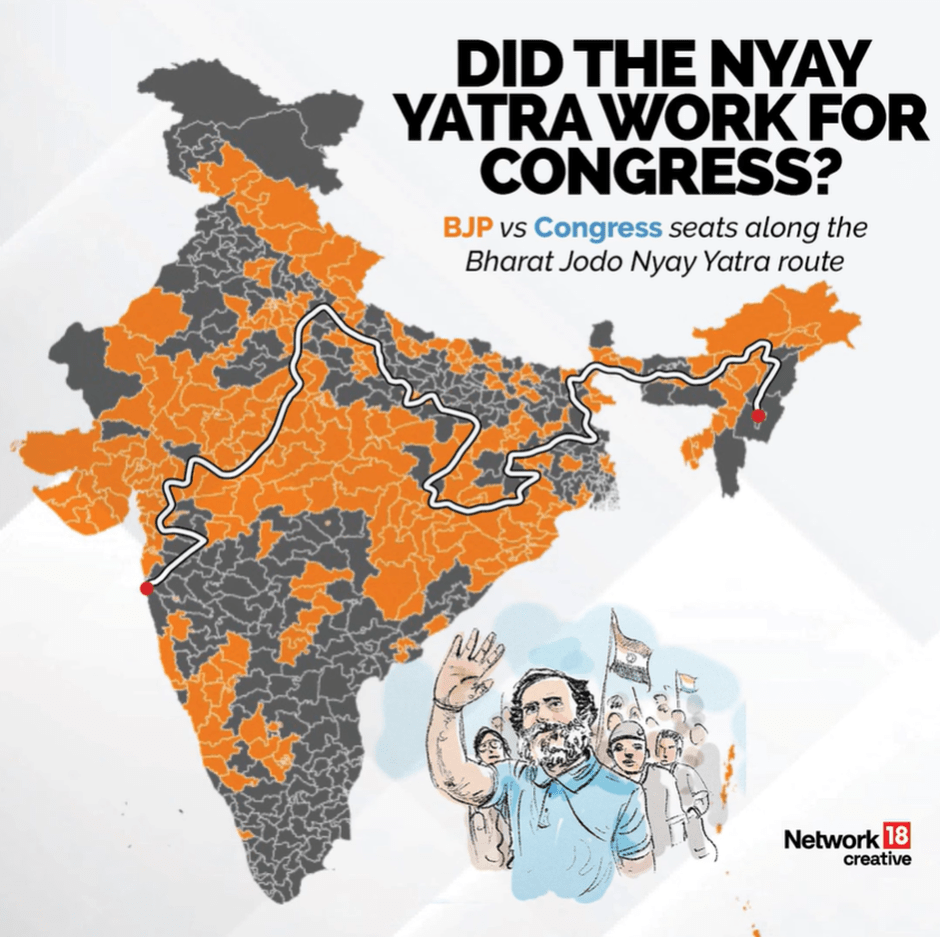
If you look at the route of Rahul’s Nyay Yatra, you will see that BJP won most of the areas where Rahul Gandhi campaigned. This map was shared by Moneycontrol.

Nyay Yatra Congress Results 2024

The white line was the route taken by Rahul Gandhi. It went well in Manipur, but as his journey progressed, his yatra seemed to have had less impact on the common man.

This is BJP’s performance in the same areas for comparison purposes:

Nyay Yatra BJP Results 2024

As you can see, most of the areas were dominated by the BJP.

Questioning Congress’ Performance

The irony is that no journalist has questioned his performance and is projecting him as a hero. I am pointing this out because Congress prefers to believe that Rahul Gandhi is the best Prime Ministerial candidate. However, if you replace him with someone much more competent, votes will flow from the BJP to Congress naturally without much work or unending yatras. Many I know only opt for the BJP because they dislike the Gandhis, a sentiment that could be leveraged by a stronger Congress leader.

In India, there is a lack of a strong opposition party (not an alliance) with consistent and solid ideologies that do not vary among party members. Consistency brings confidence. Personally, I was not sure if I was voting for the left’s or Congress’ ideologies in the INDI alliance. The manifesto of CPI(M), one of the members of the INDI alliance, is one of the most dangerous I have ever seen. It does not inspire confidence. If I support the Congress but not the CPI(M), should I still vote for the INDI alliance? This is the skepticism I feel.

The question remains whether Congress is planning to continue working with an alliance and take credit for the alliance’s victories. We should question the party and demand improvements. Celebrating the current situation as a victory could prevent the emergence of a much more competent opposition party. The citizens of India deserve more.

Why the Far-Right is Gaining Support in India

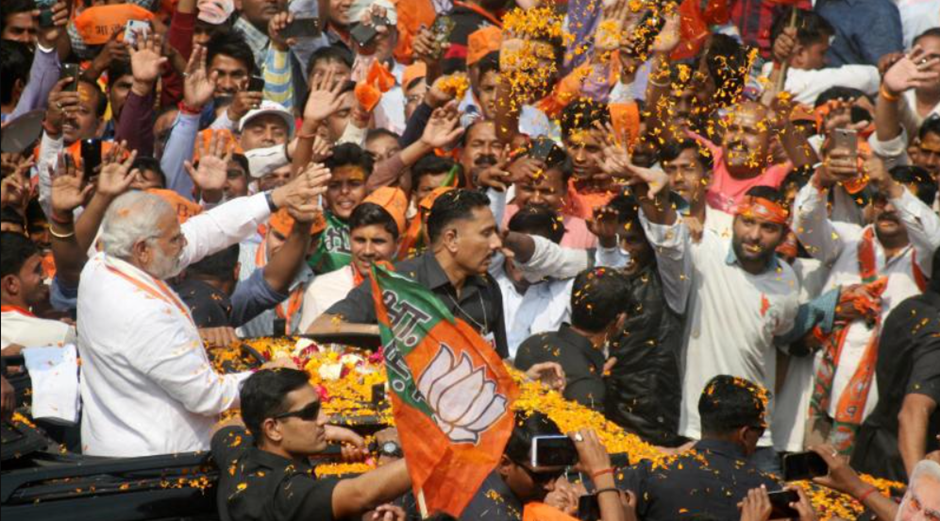
Narendra Modi Waving to Supporters

It’s the election season again in India, the largest democracy in the world. Politicians are tirelessly running hither and thither promoting their campaigns, often resorting to divisive tactics to seal their votes. As a layman, you find yourself wondering during these times whether the political parties’ agenda is to divide citizens rather than win elections.

Over the past ten years, there’s been a steady rise in discomfort over the rising popularity of the right wing. Most minorities and leftists want the BJP to be voted out this year. There’s a sense of dread about what would happen if the BJP takes control for the third consecutive term. You see and read incidents of Christians and Muslims in rural areas crying, “Hindus will kill us if they come into power. Please don’t vote for the BJP.” This cry for help is alarming. Minorities do face discrimination in India, but to make it sound like a genocide is far-fetched. Most people live in harmony with each other, while some tyrants across communities try to create problems. However, the negative stories are most prominently highlighted making it look like the norm. It is not a systematic persecution, as seen in neighboring countries.

Who is spreading this hate narrative? Who is inflicting this unfound fear on everyone? Politicians and the media are to blame—both the right and left. One makes controversial statements, and the other spreads hate and discord by amplifying them out of context. The reasons are purely agenda-driven. I say this with confidence because of the ease with which they seem to overlook their own preferred party’s faults, irrespective of the severity. The bias is crystal clear.

Someone like me, who is engrossed in reading both left and right narratives day in and out, can now finally figure out when a party/media/journalist is playing games to drive their agenda. I have acquired a sense of indifference to polarizing or pseudo-secularist words. But an apolitical person, which many are, might not understand the game and fall prey to the hate narrative set by both sides. Ultimately, the narrative with the most media outreach wins: the right-wing within India and the left wing globally.

The opposition parties in India are going all out to convince everyone why democracy is in trouble in the country, resorting to fearmongering tactics, such as drilling down the point that there won’t be an election next time if BJP wins. The Western media is also trying to help the opposition by pushing the narratives of the leftist ecosystem to the world at large. An outsider might have already read several articles slamming the situation in India on popular portals like the BBC, Al Jazeera, and CNN. Rarely do you see a right-wing viewpoint, probably because the right wing is, by default, considered problematic. So, you never know precisely why the right wing has gained popularity in any country. You only get to see the uncomfortable outcomes of it.

Narendra Modi and Kim Jong Un
A satire post from @the_fauxy

Is BJP a Far-Right Party?

Let’s get this straight: BJP being a “far-right” party is highly debated and contradicted by the actual far-right in India. They feel Modi is “soft,” so they label him “center-right.” According to them, he hasn’t yet reclaimed all the lost temple properties or got the temples out of government control; his party suspended Nupur Sharma when she made blasphemous comments in response to an equally blasphemous comment by a guest panelist, and the party hasn’t restricted welfare benefits to Muslims. For the hardliners, a legit far-right politician is someone like Geert Wilders.

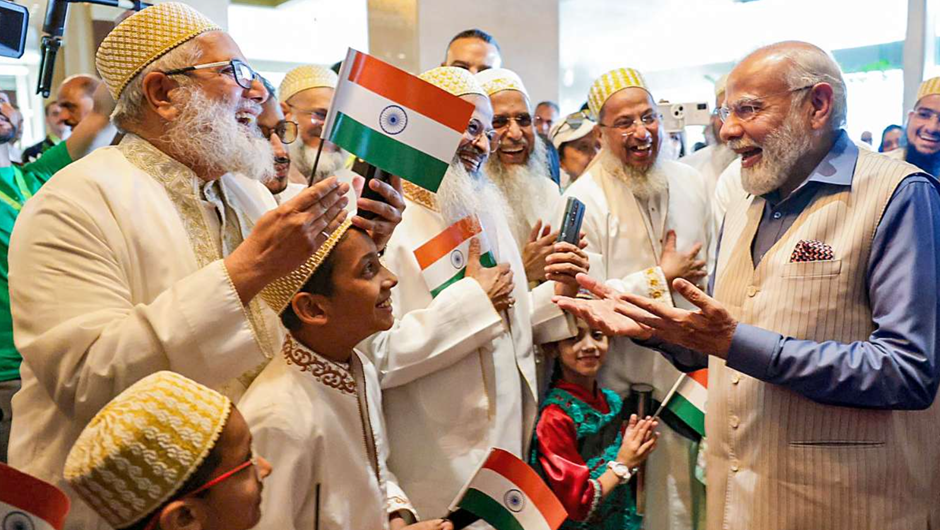
You often see Modi making problematic statements to woo his far-right fan base and keep them happy. But his words don’t usually translate into actions. Muslims remain the biggest beneficiaries of welfare schemes under the BJP rule, Muslim businesses in Gujarat have prospered, Shias are now able to practice their religious rituals in Kashmir openly, and oppressive rules like the Triple Talaq have been banned, earning him a small but dedicated Muslim fan following in the country who have started to realize that Modi isn’t all that bad as he’s made out to be. In Kashmir, a Muslim-majority state, the Ayushman Bharat scheme is available to all citizens irrespective of social and economic status, a privilege not extended to other states in the country.

Narendra Modi and Bohra Muslims
Narendra Modi with Bohra Muslims

These examples defy the popular notion that Modi is anti-Muslim. Some rightists jokingly call him “Moulana Modi” for the help he has extended to Muslims, especially the Pasmanda community, who had been ignored by other political parties to date in favor of the more prosperous Muslim elites.

Yes, Modi is serious about reclaiming revered temple properties lost during the Mughal rule, the ones that are highly deemed by the Hindu community, but he is offering an alternative, more spacious land for the construction of a new mosque as compensation to the Muslims. This is a trait characteristic of a practicing religious Hindu but not an Islamophobe who would not have offered, without doubt, any land as compensation.

However, the party doesn’t do much to contradict such claims of it being an anti-Muslim party. They don’t openly highlight the good they have done for the Muslim community. It appears as if they want this “anti-Islam” label to prevail. Probably because it pleases their far-right voters. A large number of individuals vote for Modi with the belief that he prioritizes Hinduism. Why would he want to tarnish that image? This is a primary con of democracy – you support narratives, even misleading ones, to consolidate a win by hook or crook. The focus is on power, not the people. The result is this: you end up winning by dividing the people further. The essence of “One India” becomes fainter as each election campaign ends.

Reasons for Rising Support

The reasons why the majority in India prefer Modi are multifold. It is not as straightforward as outsiders like to believe. There are primarily three types of BJP supporters:

  • Centrists: They dislike BJP’s communal politics but admire the party’s pro-development approach, solid implementation of social schemes, zero tolerance for terrorist activities/groups, no appeasement politics, increase in FDI, improved relationships with foreign countries that can prove beneficial to India, improved economic rankings, etc.
  • Anti-Opposition: They support the BJP primarily because they think the opposition is incompetent and not strong enough to take the country forward. They vehemently dislike the opposition’s weakness when it comes to tackling radical groups (something we are increasingly seeing in Western countries nowadays). The opposition was unable to control Kashmir’s terrorist activities or ban anti-national groups like PFI while they were in power. If given a better choice, the “Anti-Opposition” clan would gladly opt out of BJP. Currently, there are none.
  • Far Right: They like BJP’s communal politics and their pro-Hindu, capitalistic approach. They were highly unsatisfied with the opposition’s appeasement politics in the previous years. They felt their needs were unmet or unanswered when the opposition was in power, such as getting the temples out of government control. BJP gives them hope.

BJP rose to fame because of these three main target groups whose grievances were left unresolved by the opposition parties. For them, BJP is the only viable option. To defeat the BJP, the opposition parties should first seriously address the concerns of these groups. As long as they keep denying their negatives and gaslighting the concerns of voters, the right-wing will continue to reign supreme.

Conclusion

It is a trend we are seeing worldwide. Far-right parties are winning in Europe and are finding support in the US. This could be attributed mainly to the incompetency of the leftist ecosystems to curb extremism and violence, pushing people to support the right. When the issues are addressed and resolved, voters will likely shift their support towards a centrist political party. Till then, we await more concrete actions from the left to prove they can protect the country and its social fabric as reliably as the right.