An Ode to Lok Sabha Elections 2024 (Part 3): Did YouTube’s political commentators impact votes?

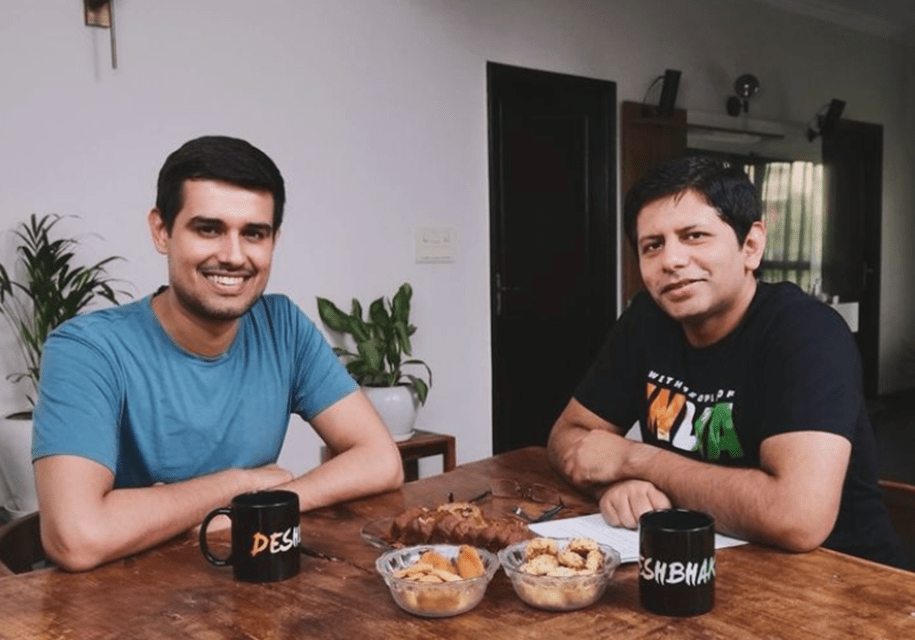
Dhruv Rathee and Akash Banerjee

We have observed the significant rise of left-leaning political commentators on social media, particularly YouTubers, during this election. Dhruv Rathee and Ravish have amassed massive views, surpassing even mainstream news channels. It was believed that they would have a significant impact on the Lok Sabha Elections.

Top political commentators on YouTube

Dhruv, who typically maintains a neutral tone, noticeably shifted his approach in the months leading up to the election, embracing a more polarized political viewpoint. I use the term “polarized” because he blatantly overlooked several important issues during this time, such as the Sandeshkhali rapes in West Bengal and the Sidharthan case in Kerala, primarily because these cases put the opposition in a poor light. Personally, I felt his demeanor change from that of a regular YouTuber to that of a politician.

After months of running intense social media campaigns, were these left-leaning YouTubers successful? In a previous post, I mentioned how Dhruv Rathee is unlikely to have a significant impact on the Lok Sabha elections. The echo chamber angle aside, the answer lies in the data collected from the CSDS-Lokniti Post Poll Survey. It shows how the BJP performed well in urban areas while lagging in rural areas.
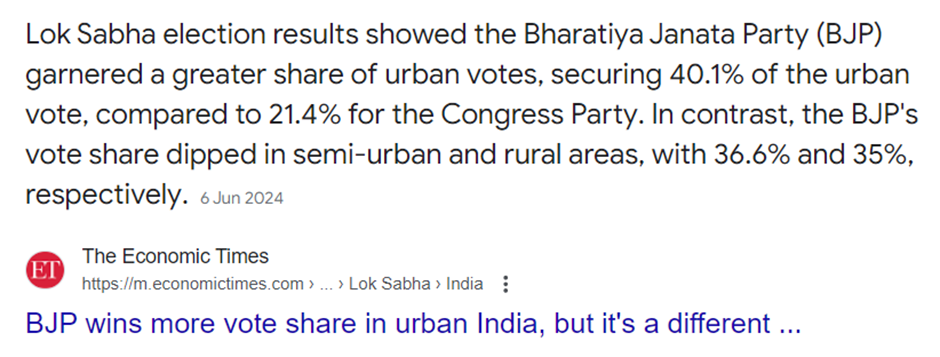
BJP did well in urban areas

How much influence do YouTubers have in rural areas? Unless a proper survey is conducted that asks people living in villages, “Did Dhruv Rathee or any other YouTuber influence you to change your voting pattern this time?” we will never know for sure. Another way to analyze the impact is by examining video statistics. Content creators can share their video statistics, including the regions where their videos were most viewed. Did they receive significant viewership from rural areas?

Huge rallies were conducted in villages where Dhruv’s videos were played. However, it’s safe to say that people in rural areas do not vote based on social media activism. Instead, they vote based on their personal experiences, caste-based politics, and the help they receive. They are unlikely to resort to the Internet to research the pros and cons of political parties.

To summarize, any success resulting from YouTube videos should have primarily been reflected in urban areas, but that was not the case. BJP performed considerably well in cities.

***

Main Picture Courtesy: Instagram/akashbanerjee.in

An Ode to Lok Sabha Elections 2024 (Part 2): Congress taking credit for the alliance’s victory

Lok Sabha Election Results 2024

The Congress party’s performance in the Lok Sabha Elections 2024, with a win of 99 seats, is a notable improvement from 2019. However, it still pales in comparison to the BJP’s reduced 240 seats. The alliance, as a whole, played a pivotal role in forming a strong opposition. Yet, it is evident that no single party can claim sole credit for the alliance’s success.

Samajwadi Party (SP) – The Unsung Hero

In Uttar Pradesh, it was the Samajwadi Party (SP) that was the game-changer with its 37 seats. BJP came a close second with 33 seats. Congress managed 6. In the end, it is not how many seats you gained or lost that matters, but whether you won. I have my grievances with the SP, but if credit is to be given to any party, it should go to the SP. It was Akhilesh Yadav who turned things around.

Despite Congress’ lackluster performance (this was its third-worst performance overall), you often hear the party nowadays boasting about its “achievements” and how Rahul Gandhi single-handedly saved democracy. Ironically, this narrative has also been picked up by the West.

It seems that the party is trying to present this as a Congress victory as a way to save Rahul Gandhi. This may have been his final opportunity to get things right, and by insinuating that Rahul was the driving force behind the alliance’s success, Congress managed to secure his leadership position.

Nyay Yatra Results

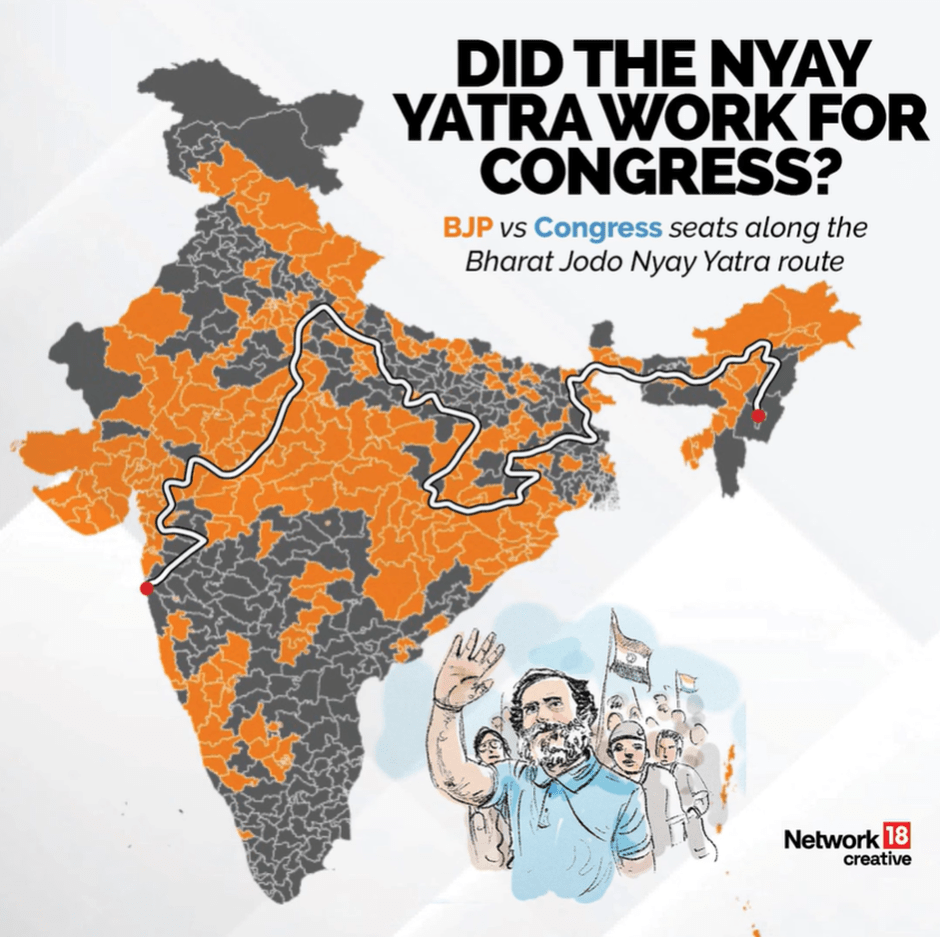
If you look at the route of Rahul’s Nyay Yatra, you will see that BJP won most of the areas where Rahul Gandhi campaigned. This map was shared by Moneycontrol.

Nyay Yatra Congress Results 2024

The white line was the route taken by Rahul Gandhi. It went well in Manipur, but as his journey progressed, his yatra seemed to have had less impact on the common man.

This is BJP’s performance in the same areas for comparison purposes:

Nyay Yatra BJP Results 2024

As you can see, most of the areas were dominated by the BJP.

Questioning Congress’ Performance

The irony is that no journalist has questioned his performance and is projecting him as a hero. I am pointing this out because Congress prefers to believe that Rahul Gandhi is the best Prime Ministerial candidate. However, if you replace him with someone much more competent, votes will flow from the BJP to Congress naturally without much work or unending yatras. Many I know only opt for the BJP because they dislike the Gandhis, a sentiment that could be leveraged by a stronger Congress leader.

In India, there is a lack of a strong opposition party (not an alliance) with consistent and solid ideologies that do not vary among party members. Consistency brings confidence. Personally, I was not sure if I was voting for the left’s or Congress’ ideologies in the INDI alliance. The manifesto of CPI(M), one of the members of the INDI alliance, is one of the most dangerous I have ever seen. It does not inspire confidence. If I support the Congress but not the CPI(M), should I still vote for the INDI alliance? This is the skepticism I feel.

The question remains whether Congress is planning to continue working with an alliance and take credit for the alliance’s victories. We should question the party and demand improvements. Celebrating the current situation as a victory could prevent the emergence of a much more competent opposition party. The citizens of India deserve more.

For the Love of India, Let’s Stop the Fearmongering

India Love and Peace

There was a time when I used to hear “Hindu khatre mein hain” (translation: “Hindus are in danger“) quite often in India. Now, I hear it from other communities – that they are in trouble.

Most of our fears stem from what the media selectively shows us. They put sensationalist headlines, which can scare even the most courageous. However, if you do more research, you realize there is always another side to the story.

Just now, I read a post on social media that minorities are in trouble. A line read, “Time to pack our bags and leave.” Most of us might not have faced any discrimination ourselves, but we will still choose to believe a piece of news we cannot personally verify. Unfortunately, the media is not the best place to get reliable news from nowadays. Everyone is so biased that you cannot know the actual truth unless you’re on the ground to witness everything with your own eyes.

Media often leaves the “before” and “after,” so we cannot always trust it to show the complete picture. Instead of blindly believing every negative news we are subjected to, our default emotion should be skepticism – “Are you telling the truth? Or do you have an agenda?” How do you know if they have an agenda? It is easy. Someone exclusively blaming the left or right, without ever mentioning their plus points, can be considered unreliable. They could be too brainwashed to look at the positives, not the type of people you should be getting the complete picture from.

Please note almost every news platform (and journalist) has an agenda nowadays. They consistently choose the negative news to highlight and then try to manipulate the information in such a way that you end up believing there is no other side to the story.

Election time is nearing. The left will try to project the right as communal, and the right will accuse the left of caste-based divisive politics. It’s up to us, the citizens, to be wary of hatemongering and fearmongering. If we have to choose between fear and peace, choose peace. If we have to pick between empathy or anger, choose empathy. This can only happen if we consider each other as a part of one big family – India – and not as separate entities.

No political party should be allowed to divide us on the basis of religion, caste, region, and other factors. Our aim should be to work towards the development of the country. This can only happen if we are empathetic to each other. We should be strictly against any extremist entities that can disrupt the peace and harmony of our nation and be careful not to spread more hatred or fear.

If we hate a party, we can show our disagreement using the most powerful tool in our possession – our votes. We can also take the legal route. However, resorting to fearmongering online can polarize us further. This is one of the several banes of a world increasingly becoming digital. We are becoming more informed, more than required sometimes, and also becoming increasingly polarized.

Once we accept the fact that “we are one,” political parties and media will stop playing such hatemongering politics. They will realize that every attempt to divide us will only end in failure. We should reach that point one day. For that to happen, a collective, conscious effort toward peace and harmony is needed.

***

Photo by Lucky Trips

Quick Bytes: Indian Journalists Should Stop Being Lazy

Indian Journalists Should Do More Research To Help Voters

Why are our Indian journalists so lazy? They refurbish stuff from news agencies like Reuters, hold some debates, and consider their job done. After a year or two, they forget what they reported in the past and make contradictory claims. Most are not well informed. They stick to one viewpoint. In the process, their viewers, i.e., us, suffer as we do not get a well-rounded perspective of current events, only a biased one.

When will we get a journalist who actually wants to help us understand the complete picture? At the moment, we have to resort to using multiple news sources for left, right, and centrist views. We are in dire need of a journalist who is pro-India in the sense they do not conduct any irresponsible journalism through hatemongering that can affect the social fabric of the country. Someone who gives us a side-by-side comparison of the rightist and leftist viewpoints and lets us, the viewer, decide what is right and wrong instead of feeding it to us in the form of polarizing “opinions”?

It’s almost election time, and no journalist or news media outlet has yet come out with a detailed study on what the parties have done for each state and its districts over the past five years. Where are the pros and cons? How many items in manifestos have been fulfilled so far?

We have so many journalists in this country. Yet, no one has made a detailed, well-researched, balanced list of achievements and criticisms of the various parties in the country. We get to see only the plain ol’ (but easy) hatemongering. They leave it upon us to do the hurdlesome, yet important, research.

I wish Indian journalists spent less time on debates and more time studying and providing citizens with material to help us, the voters, understand the actual work done by our politicians. By that, I mean a balanced take. Not a biased communal one. A tabled list of all the infra projects, health care, education facilities, and other tangible developments in the country, along with promises that weren’t fulfilled.

Do better, Indian media!

***

Photo by Pixabay