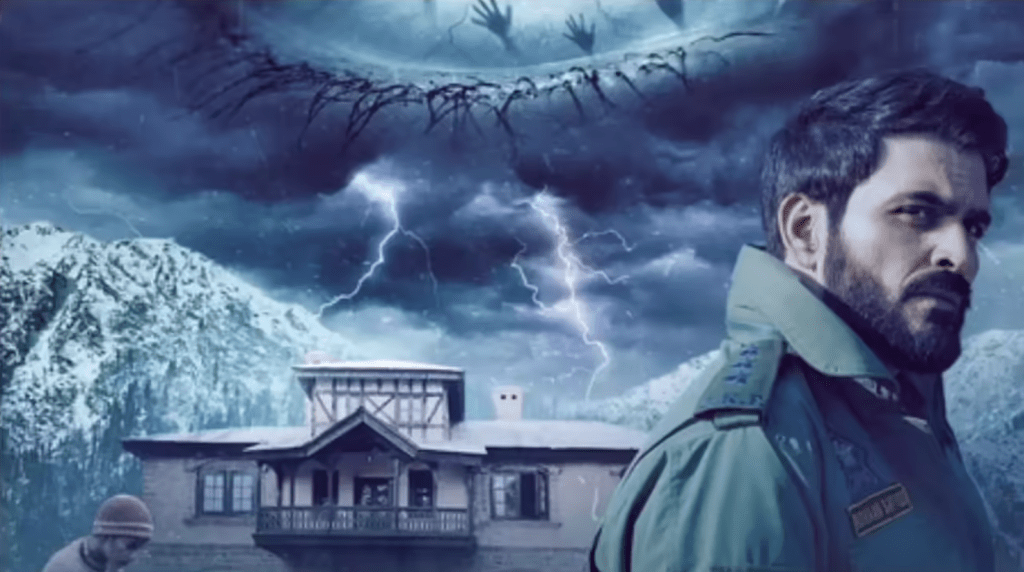
Netflix Movie Spotlight: Baramulla

Baramulla Movie Poster

What defines horror? We often think of ghosts, possessed souls, or strange creatures with no clear form. Yet I realized there’s another type of horror that hits harder. The ones that combine these supernatural ideas with the harsh truths of real life. This is a type of blend that creates an impact, which stays with you long after the movie is over. This is where Baramulla is about.

What’s It About?

Baramulla opens with a policeman who moves to Kashmir and stays in an old house filled with secrets. He is there to investigate the disappearance of children in the area. Strange events start to unfold at once. The elder daughter senses a foul, “dog-like” smell in the house, even if there are no dogs. The caretaker carries a plate of food every day to a locked room. What lies behind these mysteries? Why are children vanishing? These questions drive the heart of the story.

Thoughts

I can’t, unfortunately, share everything I felt without giving away the main plot. Since I wanted to share my thoughts in full, I placed them in a separate “Spoilers Ahead” block after this section. You can skip it if you prefer to avoid spoilers.

Baramulla left me with many emotions. I was genuinely amazed by how the team crafted it.

The movie tries something that Indian cinema, to my knowledge, hasn’t attempted before in a horror movie. That is, blending the past and the present into a story that’s rooted in historical events. It reminds you that horror has layers. It’s not only about the unknown, but also the known. The horror of trust turning into betrayal. The horror of being dismissed or gaslit. The horror of violence, both mental and physical. Baramulla captures all of this with sharp clarity.

The performances are strong across the board. Personally, I would say it’s a must-watch.

Baramulla is now streaming on Netflix.

**Spoilers Ahead**

I felt emotional through many scenes. The acting was powerful and honest. The pain never felt exaggerated.

By now, you probably know that the film draws from the suffering Kashmiri Hindus faced in the late ’80s and ’90s. Many cast members are Kashmiri Hindus who had to flee their homes. Manav Kaul is one of them. He left Kashmir when he was in grade 4. He moved on to become a competitive swimmer in his late teenage years and participated in state and national-level championships. He has more than 14 national medals in swimming to his credit.

The end scenes also show Sanjay Suri, which is befitting, since his father was killed by terrorists in Srinagar when Suri was just 19. He moved to Delhi after that and became a known face in the film industry.

The producer and writer, Aditya Dhar, who is also Yami Gautam’s husband, is a Kashmiri Pandit. He has been using his craft to share Kashmir’s story with care and technical prowess.

Some Kashmiri Pandit celebrities, like Kunal Khemu, have chosen not to explore their past, and that is their personal choice. In an interview with Smita Prakash, he said he doesn’t know much about that period, even though his own family lived through it.

I feel it’s important for us to understand our history so we don’t repeat old mistakes. Stories like these should be passed from one generation to the next. My only regret is not asking my grandfather about his experiences—how Kerala felt during the Indian freedom struggle, and what life was like then. Those anecdotes have been lost forever, as he did not pass on the stories to his children as well.

It’s remarkable that so many Kashmiri Hindus who had to flee the valley are using art to express their experiences instead of resorting to violence. Their goal is empathy and understanding, something they were denied for a long time, not provocation. Choosing storytelling over violence is admirable, especially in a world where violence is often justified in the name of resistance.

There are also a few Kashmiri Hindus with left-leaning views who defend problematic groups and take part in “Free Kashmir” sloganeering, similar to how a very small number of non-Zionist Israelis speak in ways that don’t reflect the wider population.

Most Kashmiri Hindus (and some Kashmiri Muslims) have appreciated the movie. However, left-leaning Hindus are also criticizing the movie for “propaganda,” even though the events have been well documented. Films that depict and educate the viewers on crimes against Muslims in India are welcomed, while films showing crimes against Hindus are often dismissed as Islamophobic, nationalist, or propaganda. This imbalance is where many activists struggle. They accept one truth but not the other.

People like me have slowly stepped out of that mindset to face the whole truth.

It may take a while, but I really believe the truth will eventually reach wider acceptance sooner or later. And the stories can’t stop until the pain is finally acknowledged. They need to be told, retold, and carried forward. Only then will they finally find the place they deserve.

The Kerala Story Everyone Hesitates to Acknowledge

The Kerala Story

The Kerala Story is back in the limelight. The right wing insists the movie is a must-watch, while the left wing is actively discouraging viewership. However, both sides could not have foreseen unexpected support emerging from unlikely sources – church factions in Kerala.

On Sunday, the Idukki Diocese of Syro-Malabar Catholic Church screened the movie for Class 10-12 children. Other factions are considering similar actions, although this remains unconfirmed at present.

Many seem to have taken offense to this move by the Church and are calling it “Islamophobic.” This opinion is indeed subjective. Personally, I do not think openly talking about extremist groups and their nefarious intentions is Islamophobic. It should not be eyed as such. When someone criticizes the RSS, it is not considered Hinduphobic. In the same way, openness to constructive criticism should be encouraged within all communities. Labeling discussions with terms like “phobia” can hinder healthy discourse about important issues. It’s essential to acknowledge and address problems, even if some individuals attempt to deny them.

Common Takes and Counter-Arguments

Here are a few common retaliations against The Kerala Story and my counter-arguments.

Take #1: The Kerala Story is all lies and propaganda

People who say this probably haven’t watched the movie or made an effort to fact-check the claims individually. Granted, the extrapolated count shown in the trailer was unnecessary. The makers have removed the count in the final cut. The acting and storytelling felt amateurish. There are other misleading claims in the movie. For instance, the movie makes it seem CM Achuthanthan predicted Kerala would become an Islamic state in 20 years. On the contrary, he was talking about PFI’s plan. He said, “They (PFI) want to turn Kerala into a Muslim-majority state in 20 years. They are using money and other inducements to convert people to Islam. They even marry women from outside their community in order to increase the Muslim population.

That said, to dismiss the entire movie as a lie and propaganda is dangerous, considering there is evidence to show there are indeed some anti-national elements in the state who are actively working to convert and recruit members for not-so-peaceful intentions.

The Shahan Sha case file includes many of the atrocities portrayed in the movie. The following details are mentioned in the PDF, “The inquiry by the Special Branch reveals that fundamental outfits like NDF, PFI, and Campus Front have roots in the college campuses in the City referred to therein. Referring to Campus Front, it is stated in the report thus: As per the available information, the plan of this organization is to trap brilliant upper caste Hindu and Christian girls from well to do family, especially those who are studying for professional courses and employed in IT sectors.

So, to say the entire story is a lie and propaganda is lazy reporting at its best.

As Ambedkar said, we cannot hide our heads in the sand just because the thought of it hurts our sentiments. The first step to resolving an issue is acknowledgment. Only then can there be proactive steps to prevent cases like Nimisha’s and Sonia’s from happening again. By outright denial, we risk leaving more people vulnerable to similar incidents, as they may not fully grasp the seriousness of the situation.

Take #2: The movie is Islamophobic

Is criticizing terrorists Islamophobic? Why is it that whenever a movie comes out that talks of terrorists, the left wing immediately calls it Islamophobic?

Terrorism has no religion. We should stop equating the two. I would say it’s Islamophobic to correlate the two – terrorism and religion – which is what the left often does with movies like The Kerala Story and Kashmir Files. Kashmir Files, in fact, starts with a Muslim child helping a Hindu child escape terrorists. The Kerala Story predominantly focuses on a radicalized group, not all Muslims. So, to claim the story as Islamophobic is unfair to the Muslims who have no part to play in all of this.

I would even go on to say that even Muslims should watch the movie as they are the most vulnerable. It’s crucial for individuals to recognize that there are extremist groups within the community who are determined to radicalize them. As per the PFI document, “Popular Front of India (PFI) is confident that even if 10% of the total Muslim population rally behind it, PFI would subjugate the coward majority community to their knees.”

TP Sulfath, the BJP member from Malappuram, bravely talked about such groups in Kerala in a video. Alas, the original Marunadan video was blocked or removed. The clip can now only be watched from a Reddit group.

Take #3: Only 2 or 3 cases have been recorded in Kerala

No one has an actual count. The existing ISIS cases in Kerala came to the limelight only when parents filed police cases. Many family members do not openly reveal such things out of shame and prestige issues. However, if you actively google for cases, you will find many. There are sufficient YouTube videos of Malayalee victims, not just two or three. Parents of radicalized children do not go to the police; instead, they seek help from centers like Arshya Vidya Samajam, as they wish to keep their concerns out of the limelight.

The official count of converts is taken from authorized conversion centers in Malappuram and Kozhikode in Kerala. These are state-approved centers. However, conversions happen outside such registered centers, so it is impossible to give an accurate number.

Take #4: We are too educated to fall for such traps, so we don’t need the guidance

I see the new generation saying this. However, love can make us, including the most educated, do illogical things. Anyone who has fallen in love madly and profoundly knows what it is like. We stop becoming rational. I often tell youngsters, “Follow your heart, but take your mind with you.” Love is at its most intense when we are teenagers. This is what radical groups look to exploit. They want you to fall so deep in love that you are ready to do anything, including convert, to be with them.

Maturity involves being open to advice from all sources, even those you may not initially consider necessary, as it equips you with the knowledge to handle similar situations that may arise in the future. The Kerala Story gives away the advice that in love you do not need to convert. If it does, it ceases to become love and more of a “You will get this, only if you do that” kind of transaction deal.

Take #5: The movie is vulgar and has adult scenes

I recently saw a politician saying this. The scenes are sourced from reality. The extremist group is known to enslave and rape women as they think it’s their right. It is a horrifying reality depicted in accounts like Nadia Murad’s The Last Girl. Further reading can offer more profound insight into the atrocities committed by ISIS.

Take #6: The Kerala Story has been released to make Kerala look bad

As a proud Keralite, I didn’t feel offended by the movie; instead, it made me more cautious.

We should reach a stage where not even one Keralite gets radicalized and joins ISIS. Then, we can claim victory as ours. Till then, we should be open to criticism and look for ways to rectify such problems, not hide them. What can we do to stop radicalization? How can we stop terrorist modules from cropping up in our state now and then (even as early as this year, 2024)? How can we stop Malayalee women like Nimisha and Sonia from joining such groups? Should we talk to our youngsters and spread awareness, or would we rather they find it out themselves (if at all they do)?

It’s like teaching kids the difference between good touch and bad touch. You cannot force anyone to follow your rulebook, but you can definitely advise them on what is good and bad. The decision on which route to take ultimately falls on them, but by encouraging active discussions, you are helping them to see through things that they would otherwise have failed to do on their own. At the same time, care should be taken not to generalize an entire community for the sins of a few. A nuanced approach is the need of the hour.