Some Indian Muslims like Arfa, Rana, Zubair, and Naseeruddin Shah feel India is intolerant and unsafe for Muslims.
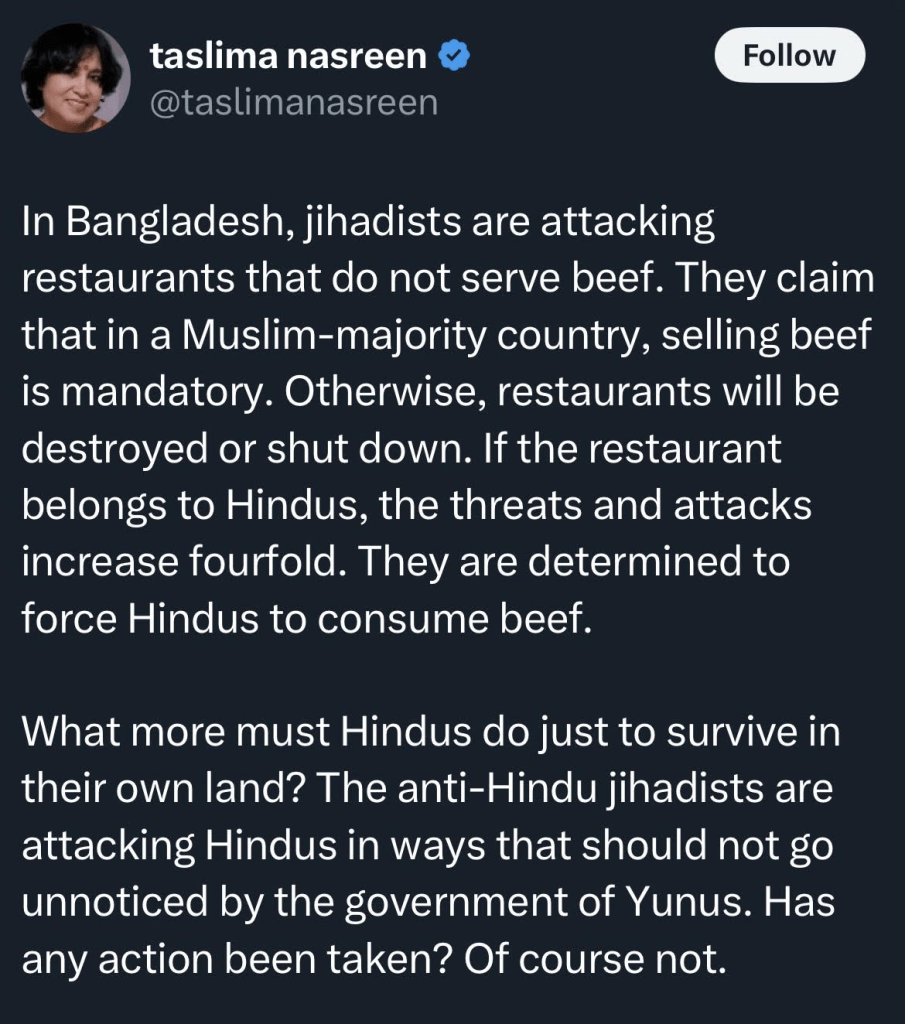
Yet, Muslims like Taslima Nasreen and Sheikh Hasina feel safer in India than in their own Muslim-majority countries. They have escaped their countries to avoid getting persecuted and can openly criticize extremists in India.
Souce: x.com/taslimanasreen
In India, you can criticize any religion freely, like PC George in Kerala targeting Islam, or Stalin in Tamil Nadu attacking Sanatana Dharma.
Source: livelaw.in
But at the same time, mocking/disrespecting Hinduism or Islam can also lead to lynching or beheading.
This shows the complicated nature of India’s religious tolerance. It’s not fully black or white; there are many layers of grey.
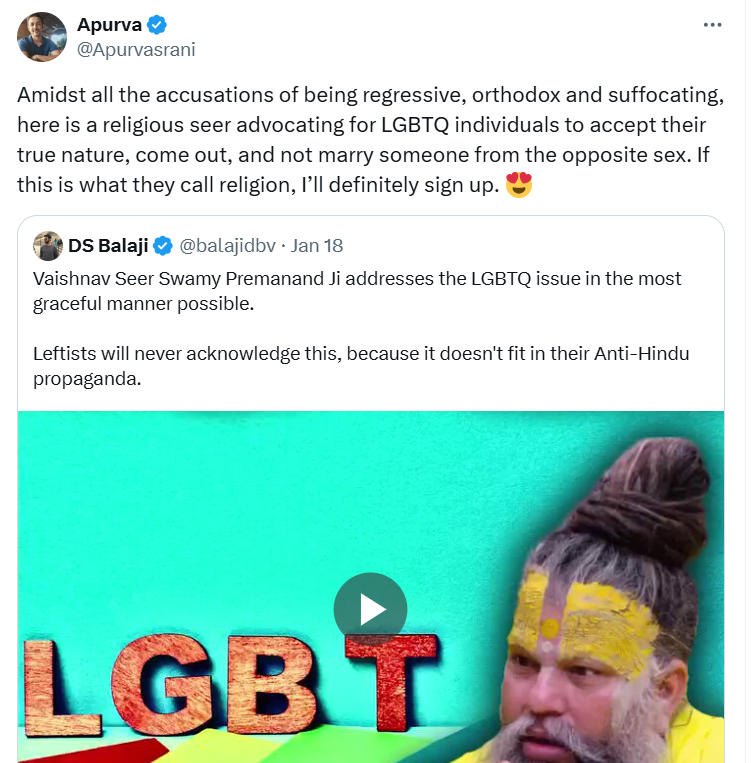
A country, accused of religious intolerance, is also a country where seers like Swamy Premanand Ji openly advocate for LGBTQ issues. He advises young members of the LGBTQ community not to succumb to parental pressure to marry according to societal norms, as it could harm both their own life and that of their partner.
From these examples, it is quite clear that India is a nation with diverse perspectives. Yet international media often portrays it as a regressive and intolerant society, probably because they rely heavily on left-leaning biased sources for their information. This depiction is unfair to the country’s social fabric, which embraces various ideologies.
It is important to note that much of the left-leaning media in India tends to present only one side of the story, resulting in incomplete or biased information. In an era where media bias is prevalent, it is strongly recommended to read news from both left- and right-leaning sources to gain a comprehensive understanding of the issue. Without this balanced approach, people may remain unaware of where genuine reforms are needed and could be misled by those with specific agendas.
The downside of one-sided stories is that they can foster an extreme victim mentality, making people believe that any violence or attack is justified due to past suffering. For instance, some celebrated the LA fires, posting that the USA deserved it for funding weapons for Israel, without considering that pro-Palestinians could have lost their homes too. If a tragedy strikes India, similar comments might surface. This is partly due to media narratives that fuel such sentiments and intensify hatred.
In an increasingly polarized world, it is crucial to report news with accountability. Both extremes are harmful—religious extremism that forces others to conform through coercion and an extreme victim mentality that blinds individuals to any positive aspects, making them focus solely on negative narratives. Currently, in India, I am seeing more of the latter than the former. Media is partly responsible for this.
One thing I have learned is that there are different standards for different people.
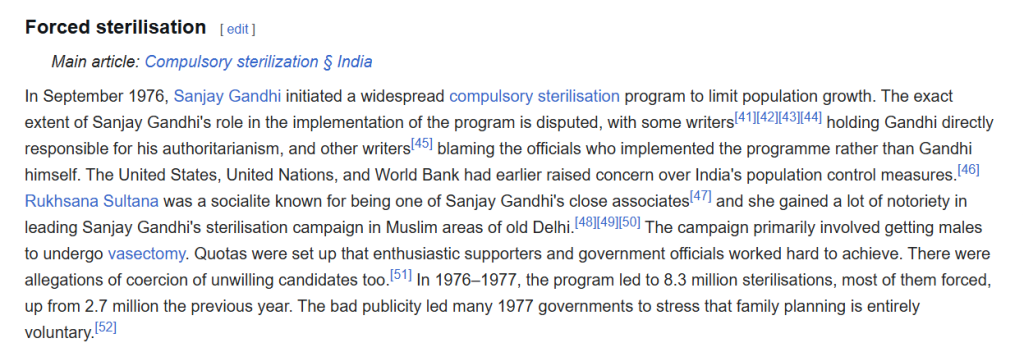
We have forgiven Congress for the 1984 Sikh riots and the Emergency, a period during which thousands were killed and many were forcefully sterilized as part of a population control measure.
A Snippet from “The Emergency (India)” Wikipedia Article
We also forgave all the anti-Hindu attacks that occurred in the country, such as the genocide of Kashmiri Pandits, the Godhra train burning, the 1992 Ajmer rape case, and the Moplah riots. The left attempted to whitewash these events, but historians like Ambedkar provided a different narrative.
We tell ourselves, “Why bring up the past?” But we are not ready to forgive or let go of the past when it comes to the Gujarat riots and the Babri Masjid demolition.
What makes certain communal riots more unforgivable and unforgettable than others, when all are equally horrendous?
Today, we see similar attempts at whitewashing, where any films addressing attacks on Hindus are immediately dismissed as propaganda. Why is it that every one of these events is labeled a lie, without any anomalies? What criteria must be met for an attack on Hindus to be acknowledged?
Recently, Khalistanis in Canada attacked a Hindu temple, but this was not given enough attention either. In their efforts to downplay attacks on Hindus to prevent riots, the left has caused many in the community to turn towards far-right ideologies. There’s no balance or consistency in beliefs. If you believe violence is bad, speak up against all types of violence. But, often we see, one type of violence being justified, whereas others are condemned.
A simple glance around is enough to recognize this hypocrisy. Observe how people around you react when there are attacks against Hindus. Are they condemning or justifying it?
Ultimately, it revolves around politicians, media, and agenda-driven propagandists manipulating people’s emotions. They dictate how you should feel about various issues, which riots deserve attention and remembrance, and which should be overlooked or forgotten.
I was once a leftist. However, at that time, I didn’t consider all sides of a story. Even though I am a Hindu, I was often dismissive of conflicts in which Hindus were victims in India, such as the Kashmiri Pandit genocide, the 1992 Ajmer rapes, the Moplah riots, and others. I coldly labeled the narratives as right-wing propaganda. I was radicalized to the extent I wasn’t open to other perspectives.
On October 7th, 2023, I experienced a significant shift in my perspective. I witnessed people justifying acts of violence, including rape and saw secular politicians in my country referring to it as resistance. This left me shocked. It wasn’t the BJP that influenced my change, but rather the people around me. The only individuals expressing outrage about these events were from the right wing, which took me by surprise.
Over the next couple of months, I underwent a monumental shift in my ideology that startled me. It felt like old layers of my beliefs were peeling away, making way for new understandings—a painful process. I came to realize that the principles of fairness and equality I had believed in until then were merely a façade. I also understood that I would likely be alone in this revelation.
The world operates in a contradictory and troubling way. People often expect unwavering support from others, yet when it’s their turn to show empathy, they respond with scoffing, mockery, and belittlement towards heinous crimes. They easily justify acts of violence, murder, and rape with statements like, “So what? They deserved it.”
It took me months to calm my anger and process the betrayal I felt when I discovered that some of my friends had become radicalized to the point of believing that rapes were justified. Until that moment, I had viewed the world through rose-colored glasses, believing it to be a kind place.
I then looked at my country with a fresh perspective and realized that similar patterns were at play here. Hindus seemed to have to compromise more than other communities in the name of secularism. I observed that many conflicts where the victims were predominantly Hindus were dismissed as propaganda, belittled, mocked, or invalidated, much like the rapes of Israelis on October 7.
I now identify as a right-winger. I consider myself center-right and hold no animosity toward anyone. In the past, I hesitated to label myself as a right-winger because almost everyone I know leans left. However, over time, I’ve moved past the fear of labels. People can judge or categorize me as they wish; as we age, labels become less significant. My shift in ideology is not due to any political party or its propaganda, but rather my observations of people’s behavior and their viciousness.
I have become more patriotic and now want everyone in India to adopt a “nation first” mentality. This is something I missed when I was a leftist; I felt that people weren’t sufficiently pro-India. I realize now that the center-right community is where I truly belong.
We, the center-right, believe in the following principles:
We are patriotic and uphold a “nation first” mentality.
We reject extremism from both the far-right and the far-left.
We take pride in the achievements of India.
We advocate for equal rights for everyone, regardless of their community.
We oppose appeasement politics.
We strongly support enhanced security measures.
We have zero tolerance for radical groups.
There are several negative aspects of the far-right that frustrate people like me. They should be held accountable by the government. However, I still feel positive about my country under strong leadership that has the courage to confront extremism.
Unfortunately, in India, when you openly call out extremism, you are declared Islamophobic. When radicals get arrested due to active participation in extremist groups, the country is declared Islamophobic. The global media often gets their news about India from the local left-leaning media which is notorious for giving one-sided stories. In this day and age of media bias, it is imperative to refer to both the left and right-wing channels to get a full balanced view.
It’s true that Islamophobia exists in India and the country should do more to protect its minorities. However, even if the BJP takes positive steps, it is unlikely to reduce the extreme victim mentality prevalent in the community that refuses to acknowledge any good done by the party. For example, the BJP introduced the Shadi Shagun Yojana scheme in which a Muslim girl is given Rs 51000/ when she marries after her graduation (BA, BSc, BCom, BE etc.). BJP banned the Triple Talaq. This is for Muslims alone. Most of the recipients of other welfare schemes have been members of the Muslim community. No ruler would have tried to uplift the Muslim community if they were Islamophobic. Riots and young children getting murdered due to terrorist activities in Kashmir have also drastically reduced. But these plus points are often blatantly ignored and many choose to judge Modi by the actions of the far-right.
A question to consider is: If Modi is still judged for the 2002 Gujarat riots, why isn’t Congress held accountable for the 1984 Sikh riots that they enabled, which were equally horrific? Politicians have contributed to deepening societal divisions by fueling narratives. Riots and violence instigated by one party are often deemed forgivable, while those provoked by another are considered unforgivable.
My political ideology is not fixed. I may shift from center-right to center-left in the future if I find that the center-left in India has become bold enough to openly oppose Islamist extremism as well, not just Hindutva. As of now, they do not meet that standard.
To end with a quote on pseudo-secularism in India:
To those who claim we are now living in a totalitarian, fascist, Hindu Rashtra, one must ask:
What kind of Hindu Rashtra is this where Ram Navami, Hanuman Jayanti, Durga pooja processions, and even Garba celebrations, are attacked and stoned with impunity?
What kind of Hindu Rashtra is this where Hindus are forced to be refugees in their own land, where one can settle 40,000 Rohingya Muslims but not 700,000 Kashmiri Hindus, the land’s original inhabitants; where the judiciary says it is too late to prosecute those who raped, murdered, and ethnically cleansed lacs of Hindus?
What kind of Hindu Rashtra is this where Hindu temples are exclusively controlled by the State, and where the government usurps hundreds of thousands of acres of temple land and is responsible for more than 100,000 temples losing lakhs of crores in rental income?
What kind of Hindu Rashtra is this where the Right to Education Act discriminates only against Hindus and their schools, forcing tens of thousands of them to shut down?
What kind of Hindu Rashtra is this where a communal violence law was about to be enacted through with only the Hindus would have been held guilty in a communal riot even if they were in a minority for example in Kashmir?
What kind of Hindu Rashtra is this where court judgments like the Sabarimala and legislative enactments like the Hindu Code Bill purport to reform only Hindu religious practices but dare not touch practices of other religions, and if they do, the decisions are promptly reversed like in the Shah Bano case?
What kind of Hindu Rashtra is this where the Waqf Act gives overarching powers to Muslims to declare a 1500-year-old Hindu temple to be on Islamic land when Islam is only 1300 years old?
If this is how a Hindu is rewarded in a Hindu Rashtra, he’d much rather be in a Muslim Rashtra because then at least there’d be no pretence of equality.
I purchased A Thousand Cuts because I wanted to know Professor T.J. Joseph’s side of the story. Those who don’t closely follow news from South India might not have heard of him. I will offer an introduction before moving on to the quotes from his book.
Who is Professor TJ Joseph?
Professor T.J. Joseph is a retired college professor from Kerala, India. He gained significant attention after he became a victim of religious extremism. The tragedy that occurred in 2010 shook Kerala to the core and impacted the communal harmony of the state. Never had Kerala witnessed such a radical act in modern history. How and why did this happen?
The Tragic 2010 Incident
In 2010, while working as a Malayalam professor at Newman College in Kerala, Professor Joseph set up a question paper for an exam. One of the questions unexpectedly became viral due to its controversial nature. Professor T.J. Joseph did not mean any harm when he drafted the question. He had simply taken influence from a book that he had read. But alas, many misunderstood the actual intention behind the question and accused the Professor of blasphemy.
Despite offering an apology, communal tensions refused to die down. The religious were angry. Fearing for his life, and feeling utterly unsafe in his surroundings, he ran away from home. After moving from one district to another, he finally decided there was no point in hiding, especially when he had done no wrong. He returned home, only to be eventually attacked by PFI members. He was mercilessly beaten up, and his right hand, which the extremists accused of writing the “dreaded” question, was severed in front of his family, neighbors, and other village folk who stood shellshocked, too scared to intervene. It took multiple complex surgical procedures to re-attach his hand.
Kerala is a state that is renowned for its communal harmony. But it is also known for its appeasement politics. The state government, politicians, and media did little to help Professor TJ Joseph. His Church abandoned him out of fear and ego. The Professor ended up losing his job in the college on the grounds of misconduct, although he was later reinstated after public outcry and intervention by authorities. He was the sole breadwinner in his family, and his wife and children had to endure many hardships due to his job loss. His wife, Salomi, slowly went into depression and died by suicide. The chapter on his wife is the only chapter without a title. It’s as if words aren’t enough to encapsulate the depth of his grief.
I bought his book because I had only heard the media’s version of his story till now. We all know by now how the media often tries to cover up facts based on their own biases. The present state of mainstream media made me purchase the book. I am glad I did it. The details are chilling. The points I am giving are only a summary of the things that happened. When you read the book, you are transported into Professor Joseph’s world of art, cinema, poetry, desperation, fear, courage, and resolve. He explains every little incident in vibrant detail. You can’t help but shed a few tears. I feel Kerala collectively failed him. Yet, his optimism and his dry sense of humor prevail and serve as a source of inspiration. Here’s a teacher who is teaching everyone in his own unique way how to combat the extremes that life throws at you.
Professor T.J. Joseph’s case remains one of the most shocking cases of religiously motivated violence in Kerala. The incident sparked widespread anger and discussions about freedom of expression and religious intolerance. The PFI members involved were later arrested and convicted. But, sadly, as a society, we still remain religiously intolerant. If you take a peek at the comments under any of his videos or news articles, you will know what I mean.
Quotes from Professor TJ Joseph’s Book
In an apology of a democracy, the interests of the mob got weightage over anything else, even if those interests were born out of ignorance, against truth and flagrantly unethical. Vote banks comprise such mobs. They shoulder the chair of power.
Marital life is a kind of war. An extraordinary war that lasts a lifetime. In a normal war, the one who defeats the opponent wins the war. In a marriage, the one who defeats the other will also lose. Therefore, marriage is a war where one must win without defeating the significant other.
My rationale was that as I had taught thousands of students, a large number of whom were Muslims, even if some misguided elements wanted to harm me, wouldn’t they first ask my students, and wouldn’t my students stand up for me and disabuse them of their wrong notions about me?
The mind of a student of literature must be dispassionate. Only in a place where there is no entrenched emotion can all emotion enter. Only in spaces where no one belief has nested itself can enlightenment enter and soar.
As I lay there accepting gifts and graces, I thought I must not merely forgive my attackers but thank them as well. For until then, I had never received so much love and care.
The attack on me was condemned even by Muslim organizations. The Church authorities alone remained silent.
I have been told that the gang that attacked me was made up of active members of an organization called Popular Front of India (PFI) and its political wing known as the Social Democratic Party of India (SDPI). All the members of the attack gang were then sent to various safe houses and shifted from one to another frequently with the help of many sympathizers.
The fish seller in our area in Muvattupuzha was a Muslim. Earlier, if we asked for half a kilo, we would receive exactly half a kilo. That has changed since: when we ask for half a kilo, we get at least three-fourths of a kilo. Only when I threatened to stop buying his fish if he didn’t accept payment did he, very reluctantly, start to accept money from me again.
Pinarayi Vijayan said that the whole of Kerala was on my side and that there was no difference between the extremists from PFI who had chopped off my hand and the church diocese that owned and managed the college.
At one time, having run out of funds, when I was at the end of my tether, Yukthivadi Sanghatana (Rationalists Organization) turned up with the money they had collected for me. I asked myself, why would they need other gods when they are themselves playing the role of God?
After I was attacked and maimed, I appealed to the state chief minister and home minister to withdraw the blasphemy case filed by the police against me of their own accord. The government had no will or courage to withdraw a case they had got instituted for communal appeasement.
The view that the suicide was caused by the unjust and immoral ways of the Newman College authorities predominated. One thing is certain, a dead Salomi is more powerful than a live Salomi. Because what she couldn’t achieve while alive, she could, by dying—bring the management to change their mind.
I’ve always viewed Hinduism as a mainstream religion. However, I recently learned that there are people, especially outside India, who consider Hinduism as “pagan.” Surprisingly, even within India, some Hindus refer to themselves as “the last polytheistic pagans remaining on earth.”
However, an article on Scroll by Arvind Sharma presented an interesting explanation of why Hinduism cannot be considered Pagan.
This pluralistic nature of Hinduism could explain why India, a Hindu-majority country, is able to embrace the beliefs of diverse communities. Communal clashes happen, but everyone is free to complain. There is no existential threat. The freedom to complain is in itself an underrated freedom. People in several countries cannot question their government or the majority religion. Sadly, we often take this freedom for granted.
Currently, there is no self-declared Hindu nation; all nations with a Hindu majority identify as secular. Even if a country were to declare itself a “Hindu nation” in the future, the principle of secularism would likely endure, as the idea of secularism is deeply embedded within Hinduism itself. So, a Hindu nation will not be one that would force people into converting to Hinduism, but one that is already in effect and on full display in Hindu-majority nations. Take the case of India. LGBT couples can have a joint bank account in India, abortion is legal, and atheism is tolerated. You are free to worship your god, not worship a god, or go to any religious place of your choice. No one is going to force you to wear a religious symbol or yank it off you.
Is India perfect? Definitely not. It’s like any other pluralistic nation. There is discrimination, but not to the extent the media, especially Western media, reports. Some even peddle fake news as the reality, without hearing both sides of the story.
The problem with religious propaganda is that it attracts the wrong kind of people. Recently, Rahul Gandhi said that Sikhs are unable to practice their religion freely in India. This came as a shock to many, including Sikhs in the country, as there have been no such allegations in the last decade from the community. However, the leader of a separatist group was happy and quoted Rahul’s words to reinforce the group’s agenda to form an independent nation for Sikhs that spans parts of India. Similarly, allegations against India of being Islamophobic have triggered radical Islamist groups like ISIS. The group frequently references India (particularly Hindus) in their newsletters, using the country’s internal clashes to advance its agenda and emphasize to its followers the need for “disciplining” us.
Seeking justice is acceptable. However, I hope people, especially Indians, are mindful of exaggerating communal events in the country, as they often end up catching the attention of extremists, who then use the news to create propaganda videos and material for fueling hatred and recruiting new members to their groups. When the time comes, extremists do not look at political party affiliations, religion, race, color, caste, region, or language before they cause havoc. Everyone is the same for them. Being wary of social media activism is essential for our country’s well-being. We should double-check details from both left-wing and right-wing sources to get a full idea of the story. Most journalists in India today are biased, which is why due diligence is required before endorsing/believing stories.
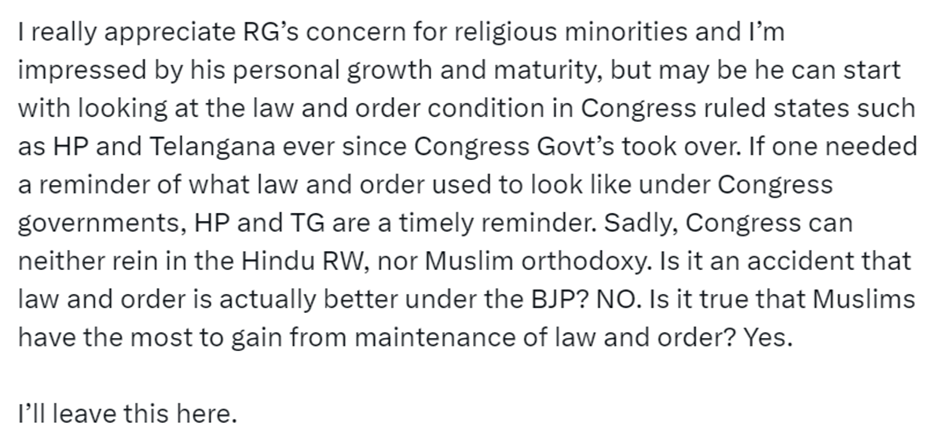
Before signing off, I wish to share this tweet by Shehla Rashid, which beautifully debunks the communal allegations against India.
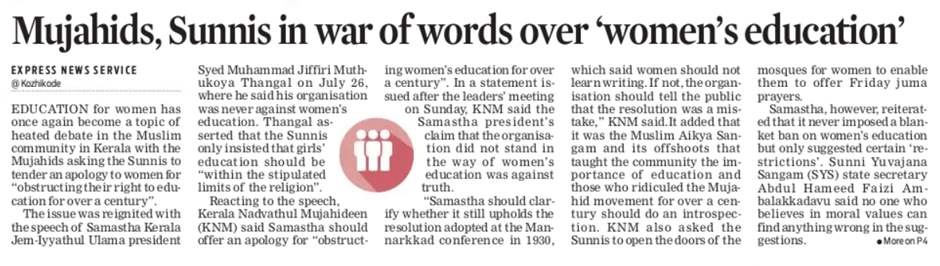
I came across this news today. It is comforting to know that there are members of the Muslim community in India who are fighting for unrestricted women’s education.
Samastha earlier had conveyed that a Muslim woman’s education should be encouraged but within religious restrictions. This became a point of debate across the state of Kerala, with many progressives calling it problematic. However, the most striking response came from a group within the community – the KNM. The organization is demanding that Samastha apologize for its take. KNM is not without its faults, but the stand they took on this particular issue is noteworthy.
Samastha and KNM
To the uninitiated, the “Samastha” group in Kerala refers to “Samastha Kerala Jamiyyathul Ulama,” an influential Sunni Muslim scholarly body in the state. Samastha plays a significant role in managing religious and educational institutions, including madrasas and mosques, and often issues guidelines on religious matters.
The term “Mujahids” in the context of Kerala typically refers to the Kerala Nadvathul Mujahideen (KNM), a prominent Islamic reformist organization in the state. The KNM often contrasts with traditionalist groups like Samastha, promoting a more modern interpretation of Islam, such as advocating the opening of the doors of mosques for Muslim women to enable them to offer Friday juma prayers.
Restricting Women’s Education on Religious Lines
If we connect religion with education, the progress of women in our country will be hindered. Afghanistan is a live example of this. Currently, girls in Afghanistan are generally allowed to attend school only up to the sixth grade. The Taliban, who regained control of the country in August 2021, have imposed severe restrictions on girls’ education beyond this level. Secondary education for girls (grades 7-12) has been largely suspended, and there have also been significant restrictions on female university students, including the closure of universities to women in late 2022. These measures have been widely condemned by international organizations and human rights groups. The global campaign #LetHerLearn, which advocates for Afghan women’s right to education, is gaining traction.
India is no Afghanistan. Here, women are allowed to study without restrictions regardless of religion. Women who are limited to religious studies may face challenges in the corporate world. It would severely restrict their job opportunities in a secular country like India, where well-paid corporate jobs often require you to engage with a global audience and follow strict academic and professional protocols that might not always adhere to religious lines.
Jobs cannot be built around religion in a democracy. Corporate jobs often require specific skills such as critical thinking, teamwork, leadership, and digital literacy. Religious studies may not always focus on developing these skills, which can impact the ability to perform effectively in a corporate setting.
Unfortunate Consequences
What happens when there are limited job opportunities for women due to religious restrictions? They will end up staying at home. Marriage becomes the only option. Financial independence becomes a distant dream.
It is ultimately up to the Indian Muslim woman to decide. If she wishes to pursue further studies, she should not be shamed.
Indian Muslim women deserve quality education, just like anyone else in India. We should have more Indian Muslim women in top positions in the corporate world. Currently, they are practically non-existent outside of Muslim countries. However, to make this happen, there need to be some reforms within the community that will help the women integrate more seamlessly into the existing corporate structure.
***
Picture Courtesy: The New Indian Express (July 2nd 2024, Kerala Edition)







You must be logged in to post a comment.