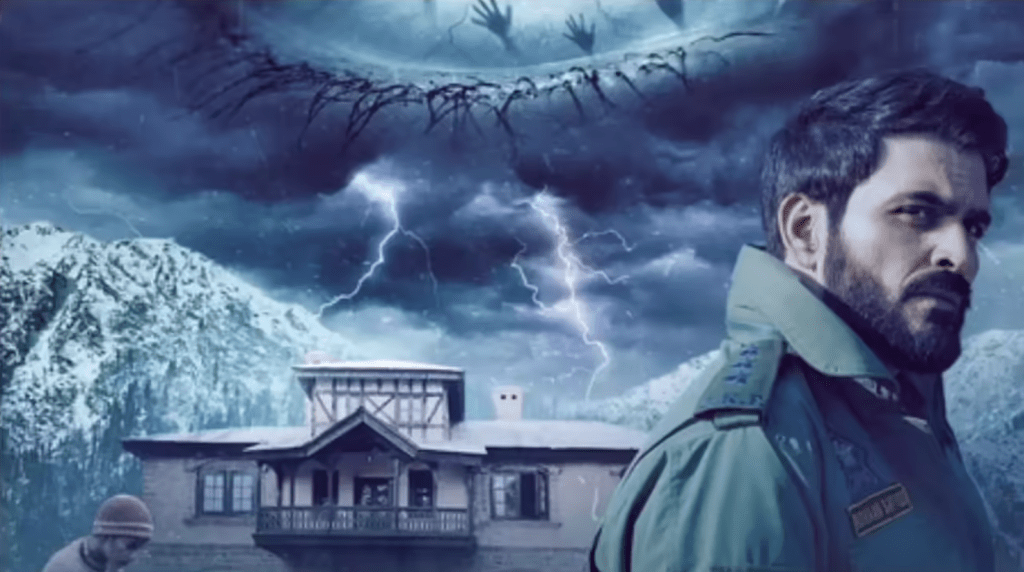
Netflix Movie Spotlight: Baramulla

Baramulla Movie Poster

What defines horror? We often think of ghosts, possessed souls, or strange creatures with no clear form. Yet I realized there’s another type of horror that hits harder. The ones that combine these supernatural ideas with the harsh truths of real life. This is a type of blend that creates an impact, which stays with you long after the movie is over. This is where Baramulla is about.

What’s It About?

Baramulla opens with a policeman who moves to Kashmir and stays in an old house filled with secrets. He is there to investigate the disappearance of children in the area. Strange events start to unfold at once. The elder daughter senses a foul, “dog-like” smell in the house, even if there are no dogs. The caretaker carries a plate of food every day to a locked room. What lies behind these mysteries? Why are children vanishing? These questions drive the heart of the story.

Thoughts

I can’t, unfortunately, share everything I felt without giving away the main plot. Since I wanted to share my thoughts in full, I placed them in a separate “Spoilers Ahead” block after this section. You can skip it if you prefer to avoid spoilers.

Baramulla left me with many emotions. I was genuinely amazed by how the team crafted it.

The movie tries something that Indian cinema, to my knowledge, hasn’t attempted before in a horror movie. That is, blending the past and the present into a story that’s rooted in historical events. It reminds you that horror has layers. It’s not only about the unknown, but also the known. The horror of trust turning into betrayal. The horror of being dismissed or gaslit. The horror of violence, both mental and physical. Baramulla captures all of this with sharp clarity.

The performances are strong across the board. Personally, I would say it’s a must-watch.

Baramulla is now streaming on Netflix.

**Spoilers Ahead**

I felt emotional through many scenes. The acting was powerful and honest. The pain never felt exaggerated.

By now, you probably know that the film draws from the suffering Kashmiri Hindus faced in the late ’80s and ’90s. Many cast members are Kashmiri Hindus who had to flee their homes. Manav Kaul is one of them. He left Kashmir when he was in grade 4. He moved on to become a competitive swimmer in his late teenage years and participated in state and national-level championships. He has more than 14 national medals in swimming to his credit.

The end scenes also show Sanjay Suri, which is befitting, since his father was killed by terrorists in Srinagar when Suri was just 19. He moved to Delhi after that and became a known face in the film industry.

The producer and writer, Aditya Dhar, who is also Yami Gautam’s husband, is a Kashmiri Pandit. He has been using his craft to share Kashmir’s story with care and technical prowess.

Some Kashmiri Pandit celebrities, like Kunal Khemu, have chosen not to explore their past, and that is their personal choice. In an interview with Smita Prakash, he said he doesn’t know much about that period, even though his own family lived through it.

I feel it’s important for us to understand our history so we don’t repeat old mistakes. Stories like these should be passed from one generation to the next. My only regret is not asking my grandfather about his experiences—how Kerala felt during the Indian freedom struggle, and what life was like then. Those anecdotes have been lost forever, as he did not pass on the stories to his children as well.

It’s remarkable that so many Kashmiri Hindus who had to flee the valley are using art to express their experiences instead of resorting to violence. Their goal is empathy and understanding, something they were denied for a long time, not provocation. Choosing storytelling over violence is admirable, especially in a world where violence is often justified in the name of resistance.

There are also a few Kashmiri Hindus with left-leaning views who defend problematic groups and take part in “Free Kashmir” sloganeering, similar to how a very small number of non-Zionist Israelis speak in ways that don’t reflect the wider population.

Most Kashmiri Hindus (and some Kashmiri Muslims) have appreciated the movie. However, left-leaning Hindus are also criticizing the movie for “propaganda,” even though the events have been well documented. Films that depict and educate the viewers on crimes against Muslims in India are welcomed, while films showing crimes against Hindus are often dismissed as Islamophobic, nationalist, or propaganda. This imbalance is where many activists struggle. They accept one truth but not the other.

People like me have slowly stepped out of that mindset to face the whole truth.

It may take a while, but I really believe the truth will eventually reach wider acceptance sooner or later. And the stories can’t stop until the pain is finally acknowledged. They need to be told, retold, and carried forward. Only then will they finally find the place they deserve.

From India-Pakistan to Gaza: Exploring the Duality of War

Fire explosion with smoke

Personal observation: In almost every war, there’s always someone who doesn’t want it to end.

In the India–Pakistan war, many in India didn’t want the fighting to stop because they felt Pakistan hadn’t learned its lesson yet. Some even wanted the government to reclaim PoK (Pakistan-occupied Kashmir) during this time (which I strongly oppose).

When Israel attacked Iran’s nuclear sites, many anti-regime Iranians wanted the war to continue because they hoped the regime would fall.

The Israel–Gaza conflict is even more unusual. Many who kept calling for a ceasefire suddenly went quiet or were openly against it when finally announced. Maybe they had expected Israel to be driven out and a new Palestinian state to rise “from the river to the sea.” But that idea is unrealistic and only calls for more violence. Just like India will never give up Kashmir, Israel will never give up its land. Both countries get a lot of criticism for putting their own interests first. But, over the years, Jews and Indians have learned an important lesson: if they want their interests protected, they can’t rely on anyone else. When Indians get murdered in America, there’s next to no backlash. It’s the same case with Jews. History is also proof that when Hindus face persecution or genocide (Kashmiri Pandits, Sandeshkhali, Bangladeshi, and Pakistani Hindus), the world stays silent. In a world shaped by selective activism, these two communities have gradually learned to shed their passivity and docile nature, standing up for themselves without guilt. Indians, in my view, are still learning. Our tendency to stay silent runs deep. But since 2014, that’s starting to change, much to the annoyance of some. Apparently, a “good” Indian is still largely expected to be a silent one in the face of persecution and bigotry.

Anyway, the point is that in any war, there’s always duality. Those who push for the conflict to continue aren’t always on the “far-right.” Sometimes, they are far-left or far-right figures from other communities, disguised as leftist liberals. Take, for example, the India-Pakistan war. Many leftists in India wanted it to end and for peace to prevail. Yet recently, some of those same voices wanted Hamas to reject the peace deal, even at the cost of many lives.

I’ve often felt that the far-left and far-right are just two sides of the same coin. The recent wars and reactions to them over the years only validate this claim.

***

Photo by Pixabay

An Ode to The Last Girl

Nadia Murad had luck on her side the day she escaped ISIS. The door was unlocked, and no guards surrounded the area. She says their negligence could have stemmed from the assumption that she was too weak, both physically and mentally, to attempt an escape. To add to the luck factor, the family she eventually sought help from while on the move turned out to be empathetic rather than deceitful, a fortunate outcome not experienced by most Yazidi women who tried to escape.

Keeping luck aside, Nadia exhibited a quality that day uncommon for someone in her position – courage. To muster the strength and determination to capitalize on an opportunity, especially when you are exhausted, is heart-wrenchingly admirable.

The Last Girl chronicles the harrowing journey of a woman who had to go through hell on earth as the perpetrators sought heaven on “the other side.”

Nadia’s story serves as a lesson – never take your peace or soldiers of the nation for granted. You are safe because the soldiers of your country are spending countless hours and energy to ensure no harm comes your way. You realize the importance of this only when you read and research extensively, go through history, and pay attention to actions.

The book is heartbreaking. You feel incredible sadness for Yazidis. But you also feel sorry for the people who get radicalized to the extent that they end up thinking violence is the answer. How can we save them? How can we protect our youngsters? How can we extinguish their hate and make them realize we are all, ultimately, children of the same universe?

Reader discretion is advised: The following content may contain sensitive or mature themes that could be distressing to some individuals.

Here are some of the quotes from the book that caught my attention:

People say that Yazidism isn’t a “real” religion because we have no official book like the Bible or the Koran. Because we pray toward the sun, we are called pagans. Our belief in reincarnation, which helps us cope with death and keep our community together, is rejected. Some Yazidis avoid certain foods, like lettuce, and are mocked for their strange habits. Others don’t wear blue because they see it as the color of Tawusi Melek and too holy for a human, and even that choice is ridiculed.

We (Yazidis) would, over generations, get used to a small pain or injustice until it became normal enough to ignore. I imagine this must be why we had come to accept certain insults, like our food being refused, that probably felt like a crime to whoever first noticed it. Even the threat of another firman was something Yazidis had gotten used to, although that adjustment was more like a contortion. It hurt.

I used to pray for my own future—to finish school and open my salon—and the futures of my siblings and my mother. Now I pray for the survival of my religion and my people.

For a young Yazidi girl, life only got better after the Americans and the Kurds took over. Kocho was expanding, I was going to school, and we were gradually lifting ourselves out of poverty. A new constitution gave more power to the Kurds and demanded that minorities be part of the government. I knew that my country was at war, but it didn’t seem like it was our fight.

I still think that being forced to leave your home out of fear is one of the worst injustices a human being can face. Everything you love is stolen, and you risk your life to live in a place that means nothing to you and where, because you come from a country now known for war and terrorism, you are not really wanted. So you spend the rest of your years longing for what you left behind while praying not to be deported.

Rape has been used throughout history as a weapon of war. I never thought I would have something in common with women in Rwanda—before all this, I didn’t know that a country called Rwanda existed—and now I am linked to them in the worst possible way, as a victim of a war crime that is so hard to talk about that no one in the world was prosecuted for committing it until just sixteen years before ISIS came to Sinjar.

Everyone thinks Yazidi women are weak because we are poor and live outside the cities, and I have heard people say female fighters with ISIS are, in their own way, proving their strength among men. But none of them—not Morteja’s mother, not even a suicide bomber—was a fraction as strong as my mother, who overcame so many struggles and who never would have let another woman be sold into slavery, no matter her religion.

Fear was better. With fear, there is the assumption that what is happening isn’t normal. Hopelessness is close to death.

I was quickly learning that my story, which I still thought of as a personal tragedy, could be someone else’s political tool, particularly in a place like Iraq. I would have to be careful what I said, because words mean different things to different people, and your story can easily become a weapon to be turned on you.

Every time I tell my story, I feel that I am taking some power away from the terrorists.

I have begged Sunni leaders to more strongly denounce ISIS publicly; they have so much power to stop the violence. I have worked alongside all the men and women with Yazda to help survivors like me who have to live every day with what we have been through, as well as to convince the world to recognize what happened to the Yazidis as genocide and to bring ISIS to justice.

I told them I wasn’t raised to give speeches. I told them that it was in their power to help protect vulnerable people all over the world. I told them that I wanted to look the men who raped me in the eye and see them brought to justice. More than anything else, I said, I want to be the last girl in the world with a story like mine.