Personal observation: In almost every war, there’s always someone who doesn’t want it to end.
In the India–Pakistan war, many in India didn’t want the fighting to stop because they felt Pakistan hadn’t learned its lesson yet. Some even wanted the government to reclaim PoK (Pakistan-occupied Kashmir) during this time (which I strongly oppose).
When Israel attacked Iran’s nuclear sites, many anti-regime Iranians wanted the war to continue because they hoped the regime would fall.
The Israel–Gaza conflict is even more unusual. Many who kept calling for a ceasefire suddenly went quiet or were openly against it when finally announced. Maybe they had expected Israel to be driven out and a new Palestinian state to rise “from the river to the sea.” But that idea is unrealistic and only calls for more violence. Just like India will never give up Kashmir, Israel will never give up its land. Both countries get a lot of criticism for putting their own interests first. But, over the years, Jews and Indians have learned an important lesson: if they want their interests protected, they can’t rely on anyone else. When Indians get murdered in America, there’s next to no backlash. It’s the same case with Jews. History is also proof that when Hindus face persecution or genocide (Kashmiri Pandits, Sandeshkhali, Bangladeshi, and Pakistani Hindus), the world stays silent. In a world shaped by selective activism, these two communities have gradually learned to shed their passivity and docile nature, standing up for themselves without guilt. Indians, in my view, are still learning. Our tendency to stay silent runs deep. But since 2014, that’s starting to change, much to the annoyance of some. Apparently, a “good” Indian is still largely expected to be a silent one in the face of persecution and bigotry.
Anyway, the point is that in any war, there’s always duality. Those who push for the conflict to continue aren’t always on the “far-right.” Sometimes, they are far-left or far-right figures from other communities, disguised as leftist liberals. Take, for example, the India-Pakistan war. Many leftists in India wanted it to end and for peace to prevail. Yet recently, some of those same voices wanted Hamas to reject the peace deal, even at the cost of many lives.
I’ve often felt that the far-left and far-right are just two sides of the same coin. The recent wars and reactions to them over the years only validate this claim.
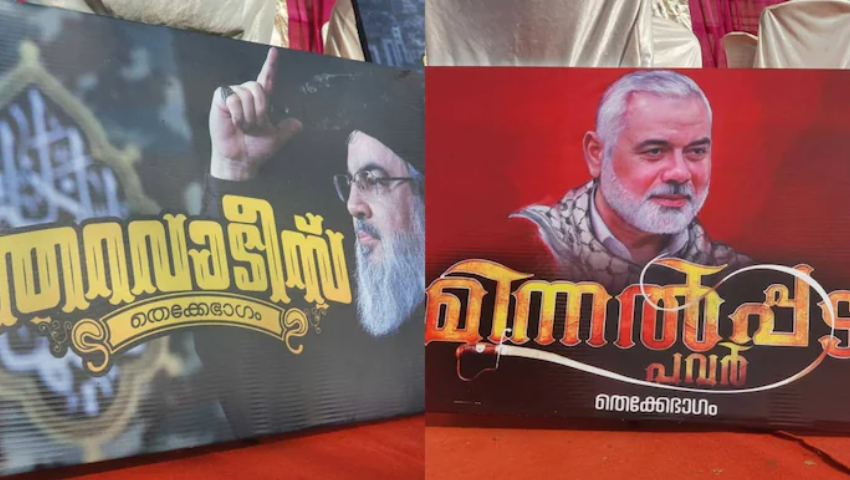
For the uninitiated, in February 2025, during the annual Uroos festival at a mosque in Thrithala, Palakkad district, Kerala, a procession featured banners displaying images of Hamas and Hezbollah leaders.
These banners were prominently displayed atop elephants. The event drew over 3,000 participants and sparked widespread controversy and discussions on social media. Critics questioned the organizers’ decision to include images of individuals associated with designated terrorist organizations. The participation of local political figures, including Congress leader VT Balram and Minister MB Rajesh, further intensified the debate. They maintained the status quo of excusing terror sympathizers by criticizing media outlets for allegedly using the incident to target the Muslim community and Kerala at a national level.
During a News18 Kerala debate, a Malayalee Muslim from Palakkad admitted that what happened at the Uroos was wrong. However, he dismissed concerns by saying, “The event was organized by kids who randomly picked images from the Internet. They had no idea who these people were, so we shouldn’t make a big deal out of it.”
This raises an important question: Why is it that when left to “randomly” select images, they chose figures linked to terror groups instead of respected Muslim leaders, scientists, or sports personalities? A former Indian Army officer who was stationed in Kashmir responded thoughtfully: “If they were simply Googling, why not Abdul Kalam, cricketers like Siraj or Shami, or Muslim soldiers who died protecting our nation? Why did they choose a group in cahoots with Pakistani militant groups like LeT and JeM? Instead of dismissing this, we should educate young people about who should be admired and who should not. Only then can our nation progress. We also cannot keep excusing such incidents as the actions of innocent children. Recently in Europe, a teenager attempted a suicide bombing, and in another case, four children from the same family were radicalized into extremism.”
The Malayalee panelist logged out before responding, but a Muslim League leader acknowledged the need for change. However, like many others accused of spreading hate, he quickly shifted the discussion, saying, “Yes, all of this is bad, BUT Israel is committing genocide.”
This pattern of deflection is becoming more common. When doctors in Australia were suspended for their hate speech, the response from left-leaning supporters and a major Australian Muslim group was, “They should not have been suspended because Israel is committing genocide.” When California faced wildfires, some even claimed, “Well deserved because the U.S. supplies arms to Israel.”
The Israel-Hamas war is being used to justify hate and extremism worldwide. While criticism of geopolitical events is valid, it cannot be a shield for promoting radicalism or excusing problematic behavior.
If we applied the same logic, we could say, “Islamophobia is wrong, BUT Islamist groups like ISIS have mass-murdered people.” That would be an absurd and dangerous argument, just as deflecting discussions on extremism with geopolitical grievances is.
Condemning violence and radicalization should not come with conditions. No ifs or buts—wrong is wrong, no matter who commits it.
Why don’t we see progressive Muslim nations like the UAE and Bahrain glorify Hamas on the streets, unlike India? Because they understand the consequences— supporting such groups could destabilize their own countries and invite extremism. They firmly recognize the Muslim Brotherhood, the group from which Hamas originated, as a terrorist organization and have banned it, seeing it as a source of extremism. In contrast, many Western countries have not taken similar action in their attempt to uphold secular values. This could also explain why leaders of many Muslim nations maintain ties with Modi, meeting him and discussing business, decorating him with awards and honors, instead of ostracizing him. They likely recognize where some of the propaganda against him stems from.
Surprisingly, many Indians are unaware that Hamas is anti-India. I’ve seen people glorify the group as “freedom fighters who are only interested in the Palestinian cause,” but a little research makes it clear that Hamas is also pro-Pakistan and anti-India.
I found Hamas problematic from the moment the October 7 attacks happened. Left-leaning friends tried to convince me they were simply fighting oppression, but I couldn’t support a group that used rape as a weapon of resistance. As a feminist, I believe in defending women’s rights universally, not selectively. I refuse to justify rape and violence when it suits one cause while condemning it elsewhere.
October 7 changed my perspective. It exposed the hypocrisy of some so-called “feminists” who speak up only when it aligns with their politics. They remain silent on Iran oppressing women, Yazidis being taken as sex slaves by ISIS, Afghanistan restricting women’s rights, or Hamas using sexual violence as a weapon. Their activism is not about justice—it’s just political.
Why Indians Should Stop Glorifying Hamas
Hamas has expressed support for Pakistan’s claim over Kashmir, viewing it as a cause similar to the Palestinian struggle. They have engaged in discussions with Pakistani leaders about Kashmir. For instance, in 2023, reports indicated that Hamas leaders met with Pakistani officials to discuss mutual concerns, including the situation in Kashmir. This alignment underscores Hamas’s willingness to support actions that could harm innocents in India.
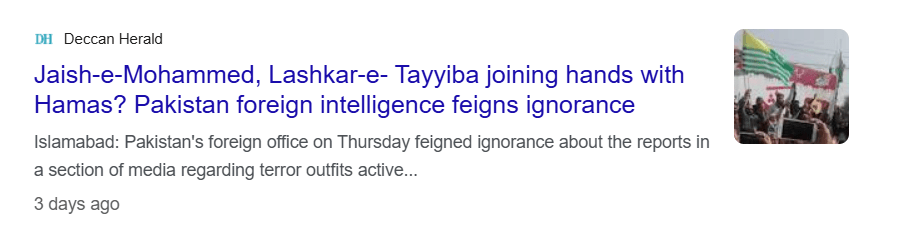
In February 2025, Hamas leaders landed in Pakistan for the first time to talk about Kashmir with Jaish-e-Mohammed and Lashkar-e-Tayyiba, groups notorious for carrying out several terrorist attacks in India. Pakistan’s foreign intelligence feigned ignorance, making it clear they support harboring anti-India terrorists on their soil.
Radical groups often shift focus when their primary battleground becomes difficult to operate in. Radicals thrive on violence—it’s a cycle they cannot break. As Son of Hamas mentions in his book, the moment peace prevails in Palestine, terror groups seek new ways to stir conflict. This keeps their funding networks active, especially from supporters abroad.
With Hamas now struggling to regroup in Gaza, could India become the next target in this Israel-Hamas lull period?
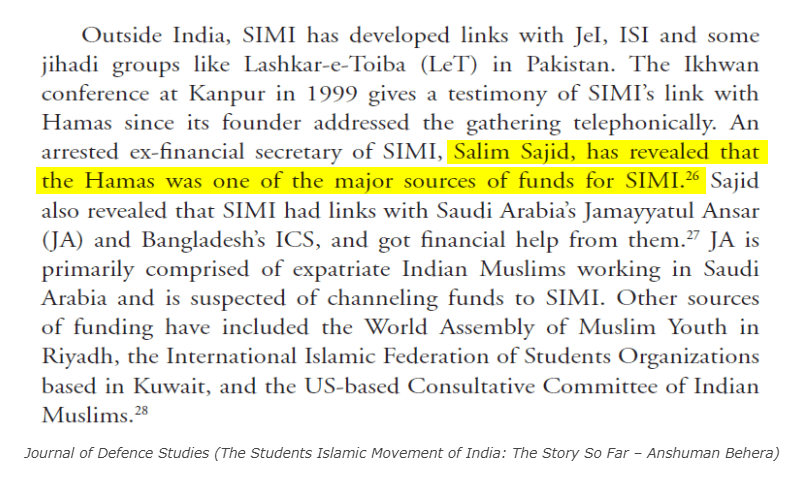
Hamas Funded Radical Group SIMI in India
An old research paper published by SSPC in 2006 mentioned the following about Hamas’ link with SIMI, the Jamaat-e-Islami’s banned student radical group whose aim was to establish Islamic rule in India:
Page 2 of The Society for the Study of Peace and Conflict (SSPC)’s Terrorism Monitor published in 2006. SSPC is considered credible within academic and research circles. It publishes well-researched papers and articles on global security, conflict resolution, and peace studies to inform scholars, policymakers, and the public.
SIMI morphed into the current PFI after it was banned.
So when I say Hamas is anti-India and pro-Pakistan, this is what I mean. Mainstream media rarely highlights this, and older reports on the subject have either been removed or are difficult to find. Articles from 2006 that covered Hamas’s stance on Kashmir have disappeared, and reference links in publications are now inactive.
This suggests a deliberate effort to portray Hamas as an organization with only good intentions. Right now, Hamas is heavily focused on the Palestinian cause, but if circumstances allowed, it would likely attempt to destabilize India as well.
Palestinians Openly Endorsing Hate and Attacks Against Hindus
In a video shared extensively online, a group of Palestinians are seen openly endorsing hate and attacks against Hindus. The speaker calls on Pakistan to attack the “filthy Hindus” to teach them a lesson for “oppressing Muslims”.
He says: “The only way to deal with the cow-worshipping Hindus is by eradicating them.”
However, it’s a credit to Indians that despite this extreme hate, most are moderate in their stance, and do not endorse violence.
How India Should Deal with Hamas
Now that Hamas has openly aligned with Pakistani terrorists, the Indian government must take steps to curb its influence in India.
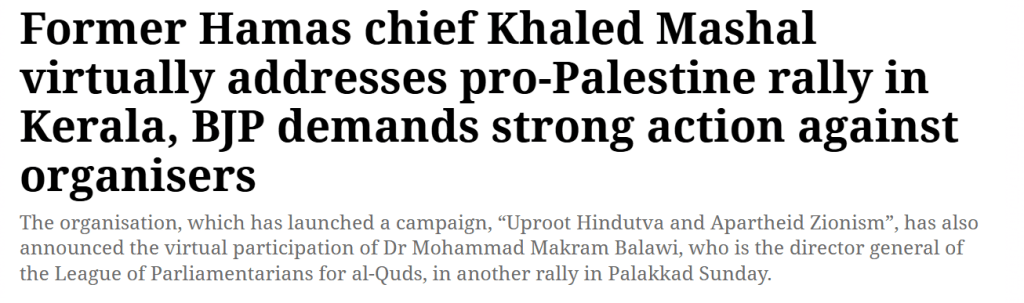
In December 2023, a Hamas leader virtually addressed a pro-Palestinian event in a Muslim-majority area of Kerala, raising serious concerns. Such events should never be allowed on Indian soil, as they carry the risk of radicalizing impressionable youth and promoting violence. The government must act decisively to prevent extremist narratives from gaining ground in India.
Hamas should be immediately designated as a terrorist organization as a precautionary measure, rather than waiting for a threat to materialize. Banning it would also prevent Indians from glorifying a group that has openly aligned with Pakistani terrorists and poses a potential threat to India.
While people are free to sympathize with any cause, it should never come at the cost of national security.
A ceasefire and hostage deal is close to being reached, with plans to start on Monday. However, some people on both sides want the situation to stay the same.
The ceasefire has not yet started and a journalist from Gaza is already talking about destroying Israel.
Source: x.com/bayanpalestine
Meanwhile, a far-right Israeli politician wants the Gaza war to continue.
Source: The Times of Israel
How long can this hate continue?
One thing is clear: things cannot go on as they are. Israel must implement the two-state solution right away and remove illegal settlements. This doesn’t mean Israel should give up its land, but rather stick to the established boundaries.
If Gaza wants peace, they must abandon the idea of revenge. Israelis are unlikely to give up their land without a fight. They would rather use extreme measures, including nuclear weapons, to destroy their land themselves than give it up. They are driven by strong nationalist sentiments.
Many countries have lost land due to disputes. India lost territory to Pakistan, and Pakistan lost land to Bangladesh. The Kashmiri Pandits were displaced from their homes. Now, imagine if these countries and communities harbored the same revenge mentality and resorted to violence to reclaim their lost land. It would lead to chaos worldwide, including in Muslim countries, with countless lives lost. At some point, peace with reality must be made and the past let go. Constantly planning the next bombing or uprising only results in more innocent lives being lost.
The only way forward is peace. A two-state solution should be established, and both countries must learn to coexist. The benefits are clear: Gaza could leverage Israel’s expertise to develop infrastructure and technology that could improve life for its people. Israel, in turn, could benefit from employing Gazan workers, as it did before October 7. Left to its own devices, Gaza would likely be under Hamas, whose focus is primarily on warfare rather than development.
Supporters worldwide, rather than calling for constant war, should recognize the importance of peace and coexistence.
Yet, all this seems like a distant dream.
If serious measures are not implemented to change the status quo, both Israel and Gaza will continue to live without peace. It’s easy for us to sit in our comfortable armchairs in distant countries, encouraging war and violence on social media, while those living in the conflict zones become the true casualties.
We support violence, only to condemn it later. It’s a vicious cycle that repeats, leading to the loss of many lives, yet we fail to learn from our mistakes.
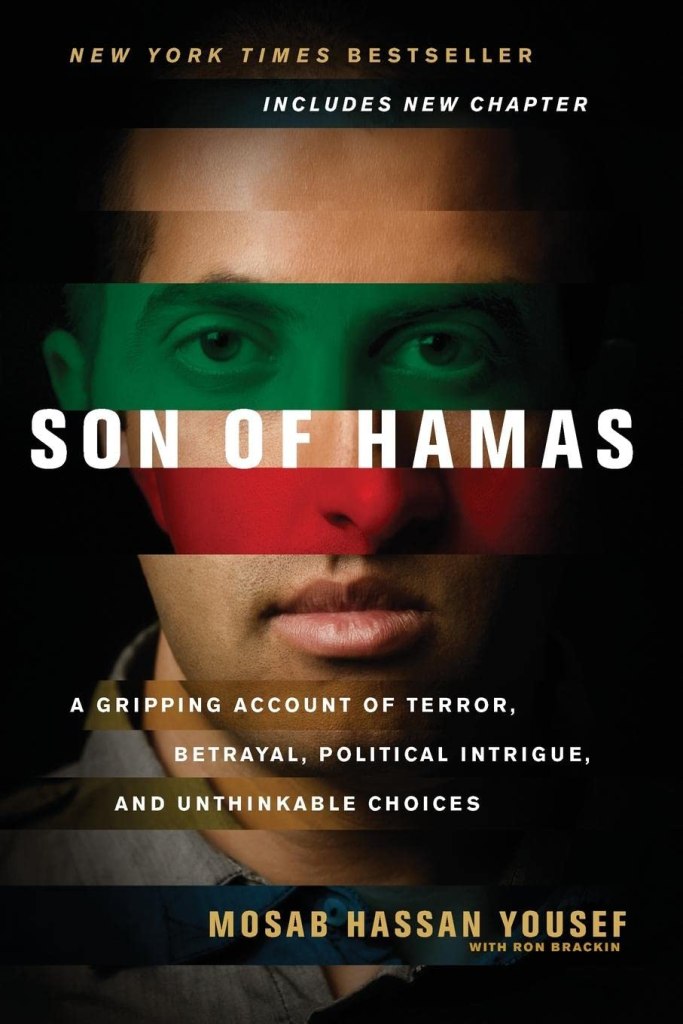
An acquaintance recommended “Son of Hamas” to me. As the title clearly gives away, it is a book by the son of a Hamas founding member named Mosab Hassan Yousef, nicknamed the “Green Prince.”
Son of Hamas is a controversial book in that it has Mosab openly criticizing Hamas. He started off as a radicalized youngster, ready to kill Israeli troops for revenge, but soon, his experience over the years with Hamas ended up being an eye-opener. Many Hamas sympathizers consider him a traitor to the Palestinian cause, but he has his reasons. I would suggest getting the book for further details.
Mosab does not in any way undermine the struggle of the Palestinian people. He, in fact, starts the book by narrating the oppression his people face on a day-to-day basis. Your heart aches for the Palestinians after reading his account. He wanted only the best for them, so over time, he started resenting the questionable morality of the extremist group he was affiliated with.
Mosab has been giving several interviews on news channels these days, vociferously lashing out at Hamas. You might find a couple of them on YouTube. His youngest brother, too, left the group recently.
Before I begin, I would like to make my stance clear. I am pro-civilian. I condemn the horrible October 7 attacks that took place in Israel, and I equally condemn the death of innocent civilians in Gaza. Several things can be true at once. I feel incredibly sorry for everyone involved in this mess. A lot of pain, fear, anger, and hatred spanning several years has led everyone to this moment. However, I will not use any excuses to justify the deaths from either side. No one deserves to die in such a cruel way. Personally, I feel any rationalizations and reasonings belittle the suffering of the people going through a loss.
I am also anti-Hamas. I am against their charter that calls for the complete annihilation of Israel. After watching several interviews featuring Hamas leaders, I have come to the conclusion that Gazans deserve better—a life that is peaceful, sustainable, and prosperous, things that Hamas cannot give them.
Disclaimer: If you are pro-Hamas, this page may not be for you. Instead of putting yourself in a sensitive spot, I request you stop reading right here. The quotes on this page are for those who are curious about why Mosab thinks Hamas is neither good for Palestinians nor Israelis. If you have already made up your mind that Hamas is a freedom fighter or resistance movement, I humbly request you to exit this page.
So, let’s get started.
Here are some of the controversial quotes from the book:
Truth and forgiveness are the only solution for the Middle East. The challenge, especially between Israelis and Palestinians, is not to findthe solution. The challenge is to be the first courageous enough to embraceit.
Peaceful coexistence would mean the end of Hamas. From their perspective, the organization could not thrive in a peaceful atmosphere. Other resistance groups also had a stake in the continuation of conflict. It’s hard to achieve peace in a place where so many have different goals and interests.
And it would be many painful years before they would begin to understand that Hamas was not an organization as most people understood organizations, with rules and a hierarchy. It was a ghost. An idea. You can’t destroy an idea; you can only stimulate it. Hamas was like a flatworm. Cut off its head, and it just grew another.
Even as a young boy, I saw the PLO as corrupt and self-serving. Its leaders sent people, many of whom were just teenagers, to carry out one or two high-profile terrorist attacks a year in order to justify fund-raising for the struggle against Israel. The young feda’iyeen were little more than fuel to stoke the fires of anger and hatred and to keep the donations flowing into the personal bank accounts of PLO leaders.
I understood that we all share the same common enemies: greed, pride, and all the bad ideas and the darkness of the devil that live inside us.
I asked myself what Palestinians would do if Israel disappeared—if everything not only went back to the way it was before 1948 but if all the Jewish people abandoned the Holy Land and were scattered again. And for the first time, I knew the answer. We would still fight. Over nothing. Over a girl without a head scarf. Over who was toughest and most important. Over who would make the rules and who would get the best seat.
Tit for tat, the reciprocal killing continued. An eye for an eye—and there was no shortage of eyes.
My father didn’t care if Hamas fielded candidates. He just didn’t want to fill the ticket with high-profile leaders like himself who were loved and admired by the people. If that happened, he feared, Hamas would win. And he knew a Hamas victory could prove to be a disaster for the people. Events proved him right.
As I sat on the plane, I thought about what I had just left behind, both good and bad—my family and friends as well as the endless bloodshed, waste, and futility. It took a while to get used to the idea of being really free—free to be myself, free of clandestine meetings and Israeli prisons, free from always looking over my shoulder. It was weird. And wonderful.
As long as we continue to search for enemies anywhere but inside ourselves, there will always be a Middle East problem. Religion is not the solution. Freedom from oppression will not resolve things either. It is a cliché, but it’s still true: hurt people, unless they are healed, hurt people.
The events of this last year have shown me again that friendship and love are stronger than agency, policy, and tradition. No matter what happens, I will continue to speak out with firm conviction that unconditional love for the “other” side and forgiveness for those who have hurt us are the only principles that will lead to healing and a better way for us all.






 The Monkey Dilemma
You must be logged in to post a comment.