
Co-Ed Season 1 Review: A Warm, Surprising Gem That Won My Heart

Co-Ed Prime Season 1 Poster

It is by chance that I stumbled on the Co-Ed series on Amazon MX Player. The algorithm showed the trailer to me and I thought I would give it a try. I wasn’t expecting much but I was in for a surprise.

Co-Ed looks like a simple school drama at first, but it quickly turns into a lively mix of humour, friendship, and small twists that keep you curious. The writing feels fresh, and the young cast brings an energy that makes every episode, lasting around 20-30 minutes, easy to watch. I found myself hitting the next episode button without even thinking.

What’s It About?

Two twins step into a new chapter when their all-boys and all-girls schools merge to form a co-ed campus. The boy is nervous about sharing space with girls for the first time, while his sister walks in with full confidence. As they try to adjust to this sudden shift, their parents are also dealing with their own set of challenges at home. The mix of teenage chaos and family moments gives the series a relatable, everyday charm that keeps you curious about what happens next.

Thoughts

Co-Ed Season 1 took me by surprise. I didn’t expect to enjoy it this much.

Every actor in the series delivers a heartfelt performance. Honestly, they outshone many big names I watched this year. That says a lot. You slip into the world of the characters so easily that their joys and troubles feel like your own. You laugh with them and you end up tearing up with them too.

The parents in the story add another layer of emotion. Their struggles feel raw and real. I could sense the mother’s pain as she tries to hold everything together while staying proud of her small business. The question is, does her family see the same value in it? On the outside, the parents look like the perfect couple who split chores and support each other. But life is rarely that simple. It is often the quiet moments, the unsaid thoughts and the tiny frustrations that shape a home. Co-Ed captures all of this with surprising depth.

Rajeshwari Sachdev, Varun Badola, Adrija Sinha, Vedant Sinha, and Stuti Sahijwani are impressive in their respective roles. They complemented each other perfectly.

Shows like Co-Ed deserve a lot more attention. Viewers who enjoy warm, slice-of-life stories often find these gems by luck, not because they are promoted by popular reviewers.

For me, this one is a must-watch. You can stream it for free with ads on Amazon MX Player.
Short Film Spotlight: Anuja

Anuja Short Film Poster

I was craving to watch a slice-of-life drama. Something simple, not too heavy or filled with dread. I honestly thought Anuja would be intense, given how the synopsis sounded. Plus, it’s a Hindi short film that was an Academy Award nominee.

Now, why would I mention the Academy Award nomination like it’s a bad thing? I have my reasons.

To be honest, Oscar nominees have rarely worked for me. In Malayalam, we call such films “award padam.” The kind that feels too abstract or complex for ordinary viewers (like yours truly). There was a time in my life, long ago, when I pretended to enjoy such films just to seem intellectual in front of my then-partner. But I couldn’t keep up the act, and that image fell apart the moment that relationship ended. Now, it seems I’m making up for that lost time. All I want to watch are feel-good films.

So when I saw that Anuja was an Oscar nominee, it didn’t excite me enough to hit play right away. It actually made me hesitate. After all, the Oscars have a reputation for picking Indian films that focus on pain and poverty, what many call “poverty porn,” which does not fully represent what India is today.

Still, I decided to give it a chance.

What’s It About?

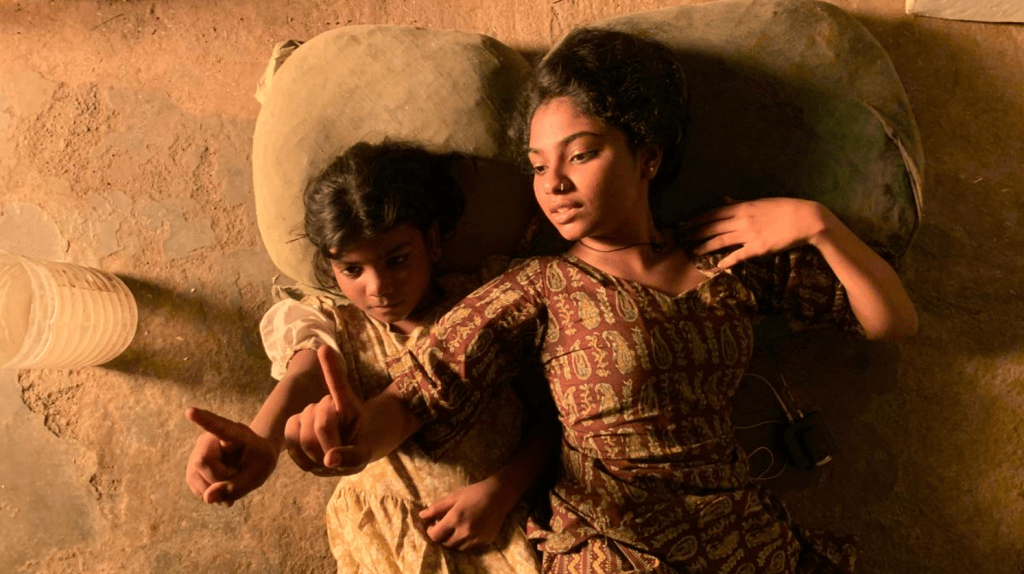
A 9-year-old girl works with her sister in a garment factory in India. Despite being naturally bright and curious, she doesn’t attend school because of financial struggles. And, truthfully, she doesn’t want to either. Her elder sister, however, recognizes her potential and dreams of giving her the education she deserves.

Thoughts

The film was a pleasant surprise. I loved it. It was just 22 minutes, but packed with emotions.

It tells the story of child labourers. They are presented not as helpless victims, but as resilient children who find joy even in hardship. The truth is, we often see others through our own lens and may view them as “helpless.” But for them, this is simply life. They know no other kind of life, and they’re doing their best with what they have. That’s what the movie captures so beautifully — life as they see it, not as we do.

It’s a social hierarchy. Someone wealthier might be looking at me with pity, thinking I’m suffering. Yet I’m making the most of what I have, because that’s the life I know. We suffer mostly when we lose something we once had, when we can compare the before and after, and we truly miss the before.

I’ve often felt that those not well-off often make the best of what little they have, which is why they find happiness in the smallest things, like a bag of jalebi, for instance. Anuja captures that spirit beautifully: “The present may not be bright, but we can strive for a better tomorrow.

The film avoids moral preaching or lecturing. It’s simply about two sisters supporting each other in a harsh world.

The most moving part of the film is that Sajda Pathan, who plays Anuja, was once a child labourer in Delhi before being rescued by the Salaam Baalak Trust (SBT). She now lives at the NGO’s Day Care Center, founded in 1988 by filmmaker Mira Nair, who, interestingly, is also the mother of New York’s new Mayor, Zohran Mamdani.

Ananya Shanbhag also delivers an excellent performance as the elder sister, Palak.

I would definitely recommend the short film. Anuja is streaming on Netflix.

An Ode to Unrestricted Quality Education for Indian Muslim Women

Indian Muslim Women Education

I came across this news today. It is comforting to know that there are members of the Muslim community in India who are fighting for unrestricted women’s education.

Samastha earlier had conveyed that a Muslim woman’s education should be encouraged but within religious restrictions. This became a point of debate across the state of Kerala, with many progressives calling it problematic. However, the most striking response came from a group within the community – the KNM. The organization is demanding that Samastha apologize for its take. KNM is not without its faults, but the stand they took on this particular issue is noteworthy.

Samastha and KNM

To the uninitiated, the “Samastha” group in Kerala refers to “Samastha Kerala Jamiyyathul Ulama,” an influential Sunni Muslim scholarly body in the state. Samastha plays a significant role in managing religious and educational institutions, including madrasas and mosques, and often issues guidelines on religious matters.

The term “Mujahids” in the context of Kerala typically refers to the Kerala Nadvathul Mujahideen (KNM), a prominent Islamic reformist organization in the state. The KNM often contrasts with traditionalist groups like Samastha, promoting a more modern interpretation of Islam, such as advocating the opening of the doors of mosques for Muslim women to enable them to offer Friday juma prayers.

Restricting Women’s Education on Religious Lines

If we connect religion with education, the progress of women in our country will be hindered. Afghanistan is a live example of this. Currently, girls in Afghanistan are generally allowed to attend school only up to the sixth grade. The Taliban, who regained control of the country in August 2021, have imposed severe restrictions on girls’ education beyond this level. Secondary education for girls (grades 7-12) has been largely suspended, and there have also been significant restrictions on female university students, including the closure of universities to women in late 2022. These measures have been widely condemned by international organizations and human rights groups. The global campaign #LetHerLearn, which advocates for Afghan women’s right to education, is gaining traction.

India is no Afghanistan. Here, women are allowed to study without restrictions regardless of religion. Women who are limited to religious studies may face challenges in the corporate world. It would severely restrict their job opportunities in a secular country like India, where well-paid corporate jobs often require you to engage with a global audience and follow strict academic and professional protocols that might not always adhere to religious lines.

Jobs cannot be built around religion in a democracy. Corporate jobs often require specific skills such as critical thinking, teamwork, leadership, and digital literacy. Religious studies may not always focus on developing these skills, which can impact the ability to perform effectively in a corporate setting.

Unfortunate Consequences

What happens when there are limited job opportunities for women due to religious restrictions? They will end up staying at home. Marriage becomes the only option. Financial independence becomes a distant dream.

It is ultimately up to the Indian Muslim woman to decide. If she wishes to pursue further studies, she should not be shamed.

Indian Muslim women deserve quality education, just like anyone else in India. We should have more Indian Muslim women in top positions in the corporate world. Currently, they are practically non-existent outside of Muslim countries. However, to make this happen, there need to be some reforms within the community that will help the women integrate more seamlessly into the existing corporate structure.

***

Picture Courtesy: The New Indian Express (July 2nd 2024, Kerala Edition)