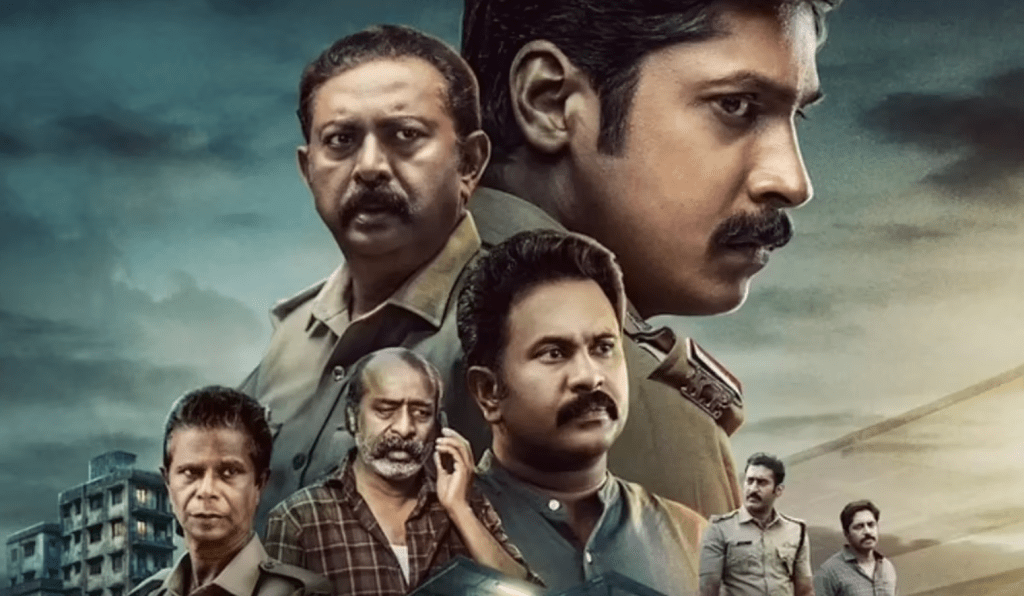
Thriller Series Review: Kerala Crime Files

Kerala Crime Files

If you haven’t yet watched Kerala Crime Files on JioHotstar, I would recommend doing it now. It’s a Malayalam-language Indian crime series set in Kerala, and it delivers on every front: gripping treatment that matches international standards, solid performances, and fresh storylines. I binged both seasons back-to-back over the weekend and thoroughly enjoyed them.

What’s It About?

Season 1 of Kerala Crime Files revolves around the murder of a sex worker found in a dingy lodge. The police, initially indifferent due to the victim’s profession, treat it as just another case. In one telling scene, a woman asks her police officer husband, “So there’s discrimination in cases too?” What begins as apathy turns into an ego-driven pursuit. The officers are frustrated by their inability to crack the case quickly. Though the victim is a sex worker and the case is treated casually at first, their bruised egos and the complicated nature of the case push them to dig deeper.

The heart and soul of Kerala Crime Files Season 2 are the dogs. They are present from the very first frame to the last. Set in a quiet town in Kerala, the story begins with a police officer going missing. As the investigation unfolds, the plot thickens with unexpected twists. What sets this season apart is its demand for viewer engagement. You need to connect the dots yourself. There’s no spoon feeding. I’ll admit, I had to rely on Reddit to fully piece things together, since I usually go into passive mode while watching fiction. The performances are exceptional, especially Indrans and Harisree Ashokan. Known for comedy, they prove their mettle in intense, dramatic roles too.

Kerala Crime Files is streaming on JioHotstar. Both seasons have just 6 short episodes, each around 20–30 minutes. You can easily finish them in one sitting. In a time when attention spans are shrinking and many shows drag episodes beyond an hour, this crisp format is a welcome change. I hope to see more dramas adopting this format.

Book Review: Convenience Store Woman

The protagonist of Convenience Store Woman by Sayaka Murata is unlike anyone I’ve encountered in any book. Keiko is quietly charming, yet deeply unconventional. She’s content with her simple routine at a convenience store, a place she has worked for over 18 years. This does not gel well with people around her who expect her to climb the career ladder, or “at least get married”, instead of sticking to this “lowly” job. They are unable to comprehend her happiness or her emotional detachment in situations where strong feelings are typically expected. In her own words, she’s a “foreign object.”

There are parts of Keiko’s personality I could relate to, especially her tendency to operate more from the brain than the heart. I’ve often questioned this trait in myself, particularly in political matters, where I naturally lean toward a calculated, strategic view rather than reacting emotionally. This sometimes makes people see me as cold. But that’s where my similarities with Keiko end.

I tend to get deeply emotional about things that may not always move others in the same way. My responses aren’t absent, like Keiko’s. I cry easily when I see children being affectionate with their parents or when animals are hurt. I feel emotional and distraught when I see small children picking up guns or stones in conflict zones. I want them to study and grow up contributing to society in peaceful ways. I well up seeing warmth in society. For example, when the visually impaired children sang “Happy Birthday” to our Indian President Murmu, she cried, I cried, we all cried. I’m also deeply moved by the struggles of elderly people, perhaps because I’ve spent time with them and seen what many others, especially those living far from their parents, often overlook. I do feel deeply, just not always in ways others expect, a bit like Keiko.

If you are wondering what makes Keiko strange, this snippet from the book gives an idea:

I wouldn’t say I loved Convenience Store Woman, but it was certainly thought-provoking, especially how society treats you as a “foreign object” that needs to be discarded if you don’t follow the rules. Society insists Keiko must adapt to its norms to be seen as “normal.” It does not matter to them how fulfilled or happy she is. Keiko’s struggle to meet societal expectations forms the core of the novel. Many of us might relate to this struggle with conformity. Not everyone is wired to follow every rule or expectation to the letter.

Ending this post with some thought-provoking quotes from the book:

The normal world has no room for exceptions and always quietly eliminates foreign objects. Anyone who is lacking is disposed of.

He seemed to have this odd circuitry in his mind that allowed him to see himself only as the victim and never the perpetrator l thought as I watched him.

It occurred to me that it wasn’t such a stretch to say that contemporary society was still stuck in the Stone Age after all. So the manual for life already existed. It was just that it was already ingrained in everyone’s heads, and there wasn’t any need to put it in writing. The specific form of what is considered an “ordinary person” had been there all along, unchanged since prehistoric times I finally realized.

“Look, anyone who doesn’t fit in with the village loses any right to privacy. They’ll trample all over you as they please. You either get married and have kids or go hunting and earn money, and anyone who doesn’t contribute to the village in one of these forms is a heretic.”

***

Photo by Caio

Book Review: “I Am A Troll” by Swati Chaturvedi

I finished I Am a Troll by Swati Chaturvedi last night. It’s an insightful read if you’re unaware that the BJP, like all major parties, has a dedicated IT cell.

I am a Troll by Swati Chaturvedi

However, if you’re already familiar with the BJP’s IT cell, the book doesn’t offer much new, apart from a few interviews with former BJP insiders who strongly criticize the party. But in Indian politics, this isn’t unusual. Members who leave any party, be it the BJP or Congress, often openly highlight its flaws. This trend isn’t unique to the BJP.

The book also points out that Modi’s official Twitter handle follows some controversial right-wing accounts like OpIndia, which is a valid observation. This is somewhat unusual; I’m not aware of any left-leaning political leader or party officially following social media influencers or accounts considered far-left. In that sense, this could be something unique to the BJP, and worth re-evaluating if it raises credibility concerns.

All that aside, the author’s pro-Congress bias is evident. She claims Rahul Gandhi was becoming as popular as Modi and predicted strong results for the Congress in the 2019 elections (the book was published in 2017). She lays emphasis on Rahul Gandhi’s social media growth, rather than his on-ground political performance. Chaturvedi presents his increasing followers and engagement as indicators of his strength and popularity, which feels selective and somewhat misleading. To appear balanced, she briefly mentions 2–3 false narratives that were pushed by the Congress IT cell, but downplays their impact.

The writing has its issues. Critiquing someone’s views is fine, but body-shaming, stereotyping Indian men, and mocking someone’s English skills feels unprofessional, especially from a journalist aiming to be objective. For example, consider the sample below, where she generalizes right-wing “trolls”.

Chaturvedi also complains that trolls refuse to engage with her reasoning on why the BJP is problematic, yet admits she zones out when they begin to speak. This contradiction weakens her argument and suggests a similar unwillingness to listen.

Interestingly, the book indirectly acknowledges that mainstream media was largely pro-Congress in 2014 (and still is in states like Kerala), which made it difficult for the BJP to be heard without strong social media outreach (reference to this is below).

These are a few minor concerns I had with the book, but overall, it provides a revealing look into political online warfare, though not without its caveats.

Book Review: “Pretty Girls” by Karin Slaughter

Karin Slaughter Pretty Girls

It took some time to complete Karin Slaughter’s Pretty Girls. This is not because the plot wasn’t interesting, but because I was trying to divide my time equally among other interests in life. The storytelling is intense, descriptive, and graphic. So, I had to take breaks. Anyone who cannot handle violence should stay away from the book. It’s by far the most violent book I have ever read.

The crime thriller follows the story of three sisters. One of them has been missing for years, while the other two navigate their lives without their eldest sister’s presence. Their parents are separated, unable to cope with their daughter’s absence. What happened to their eldest? Why aren’t the cops providing clear answers? This mystery forms the crux of the story.

If you enjoy thrillers, I’d highly recommend Pretty Girls. Personally, I felt the descriptions were a bit lengthy at times, which slowed the pace for me. However, readers who appreciate detailed scenes and emotional depth may find that aspect especially engaging.

Ending this review with some interesting quotes from the book:

That she ended up with a boy who had grown up less than twenty miles from her childhood home was just further proof that no matter how far you ran, you always ended up back where you started.

People did not change their basic, core personalities. Their values tended to stay the same.

“The world stops for you when you’re pretty. That’s why women spend billions on crap for their faces. Their whole life, they’re the center of attention. People want to be around them just because they’re attractive. Their jokes are funnier. Their lives are better. And then suddenly, they get bags under their eyes or they put on a little weight and no one cares about them anymore. They cease to exist.”

“Reductio ad Hitlerum.” Claire couldn’t stop quoting Paul. “It’s when you compare someone to Hitler to win an argument.”

“Dyadic Completion,” Paul would’ve told Claire. “The human brain tends to assume that, if there’s a victim, there has to be a villain.”

He reminds me of the worst kind of student I used to have—the kind who is certain that they already know everything worth knowing

7 Memorable Quotes from The Love Queen of Malabar

Kamala Surayya

The Love Queen of Malabar is a captivating exploration of the life of Kamala Das, also known as Kamala Surayya, one of India’s most celebrated poets. Written by Merrily Weisbord, the book is thought-provoking, highly controversial, poetic, melancholic, and at times, shocking.

Kamala Das shares her deepest emotions with Merrily, treating her as a confidante in revealing thoughts that range from lyrical to unexpected. While the book may not appeal to everyone, it left a lasting impression on me—an eye-opener that offered a rare glimpse into the intimate world of a literary icon.

I have carefully selected some non-controversial quotes from the book. Not everything Kamala says can be shared publicly due to its sensitive nature. However, the quotes listed here provide insight into Kamala’s thoughtful persona and capture the essence of Merrily’s book.

“A writer moves away from family, old relationships, very far with the speed of a falling star,” she says. “Otherwise the writer is destroyed, and only the member of the family remains: the mother, sister, daughter, wife. The writer at some point must ask, Do I want to be a well-loved member of the family? Or do I want to be a good writer? You can’t be both at the same time. The days when you are with the children and are being a very good mother, you cease to be the writer. You feel repelled by the pen and the paper, which are definitely going to come between you and your loved ones.”

“Because the writer can give all of herself only to that task of writing. She will have to write against her loved one, put him under the microscope, dissect him, analyze his thoughts, his words. After a while he is no longer the man you held in your arms at night. You have cut him into little slivers, everything is burst open, he is seeds and pulp and juice all spread out in little bits on your writer’s table. After that, you can’t go to his arms the same way.”

If I had not learned to write how would I have written away my loneliness or grief? Garnering them within my heart would have grown heavy as a vault, one that only death might open, a release then I would not be able to feel or sense.

“Ask the books that I read why I changed,” she says. “Ask the authors dead and alive who communicated with me and gave me the courage to be myself.”

“Make a woman laugh, then make her cry, that is the secret of a good film. Not make her cry, cry, cry. What message is that for women today?”

Her dislike of organized religion is so much more pronounced than on my last visit that I wonder if any beliefs remain to comfort her. “Yes,” she answers. “A concept of God. A presence in my room. I’m not alone. I visualize a shower of moonlight falling on someone in prayer. It is a soothing exercise. I feel bathed in light, and I know there is a God.”

She tells me that even in Kerala, which prides itself on religious coexistence, she is still being attacked from both sides. The Hindu Sangh Parivar, an association of Hindu nationalist organizations, protests her ownership of the snake shrine on her own ancestral property at Nalapat because she is a Muslim. The Muslims are “disgusted” with her because she speaks against their practices and clergy, refusing to support sectarian politics she finds unpalatable. “They feel they are losing their grip on me.”

An Ode to 26 Thought-Provoking Life Quotes from Fredrik Backman’s Anxious People

Anxious People

I recently completed Fredrik Backman’s Anxious People. The book is about a failed bank robbery that turns into a hostage situation during an open-house apartment viewing. The story unfolds as a group of diverse characters, each with their own personal struggles and secrets, are brought together in an unexpected and tense situation.

“Anxious People” includes dollops of humor and empathy. Backman delves into the complexities of human emotions, vulnerabilities, and how human connection and shared experiences can bind even the most distinct characters. Ultimately, humanity and kindness win.

Fredrik Backman has a knack for words. His quotes in Beartown were a class apart and remain one of the most popular pages on this blog. His writing in Anxious People is no different. In no time, he captures your heart with his words to describe emotions that are generally not easy to translate into words.

Here are some of my most favorite quotes from the book:

This story is about a lot of things, but mostly about idiots. So it needs saying from the outset that it’s always very easy to declare that other people are idiots, but only if you forget how idiotically difficult being human is.

Our hearts are bars of soap that we keep losing hold of; the moment we relax, they drift off and fall in love and get broken, all in the wink of an eye. We’re not in control.

He presses his thumbs hard against his eyebrows, as if he hopes they’re two buttons and if he keeps them pressed at the same time for ten seconds he’ll be able to restore life to its factory settings.

Because you’ve probably been depressed yourself, you’ve had days when you’ve been in terrible pain in places that don’t show up in X-rays, when you can’t find the words to explain it even to the people who love you.

At the end of your career you’re trying to find a point to it all, and at the start of it you’re looking for a purpose.

Older men rarely know what to say to younger men to let them know that they care. It’s so hard to find the words when all you really want to say is: ‘I can see you’re hurting.’

‘Do you know what the worst thing about being a parent is? That you’re always judged by your worst moments. You can do a million things right, but if you do one single thing wrong you’re for ever that parent who was checking his phone in the park when your child was hit in the head by a swing. We don’t take our eyes off them for days at a time, but then you read just one text message and it’s as if all your best moments never happened. No one goes to see a psychologist to talk about all the times they weren’t hit in the head by a swing as a child. Parents are defined by their mistakes.’

She said you can’t protect your kids from life, because life gets us all in the end.

That’s an impossible thing for sons to grasp, and a source of shame for fathers to have to admit: that we don’t want our children to pursue their own dreams or walk in our footsteps. We want to walk in their footsteps while they pursue our dreams.

There was a time when a bank was a bank. But now there are evidently ‘cashless’ banks, banks without any money, which is surely something of a travesty? It’s hardly surprising that people get confused and society is going to the dogs when it’s full of caffeine-free coffee, gluten-free bread, alcohol-free beer.

We give those we love nicknames, because love requires a word that belongs to us alone.

Good grief, no one could cope with being newly infatuated, year after year. When you’re infatuated you can’t think about anything else, you forget about your friends, your work, your lunch. If we were infatuated all the time we’d starve to death. And being in love means being infatuated … from time to time. You have to be sensible.

The problem is that everything is relative, happiness is based on expectations, and we have the Internet now. A whole world constantly asking us: ‘But is your life as perfect as this? Well? How about now? Is it as perfect as this? If it isn’t, change it!’

The worst thing a divorce does to a person isn’t that it makes all the time you devoted to the relationship feel wasted, but that it steals all the plans you had for the future.

‘And … winners earn a lot of money, which is also important, I assume? What do you do with yours?’

‘I buy distance from other people.’

The psychologist had never heard that response before. ‘How do you mean?’

‘Expensive restaurants have bigger gaps between the tables. First class on aeroplanes has no middle seats. Exclusive hotels have separate entrances for guests staying in suites. The most expensive thing you can buy in the most densely populated places on the planet is distance.’

You can always tell by the way people who love each other argue: the longer they’ve been together, the fewer words they need to start a fight.

When you’re a child you long to be an adult and decide everything for yourself, but when you’re an adult you realize that’s the worst part of it.

We can’t change the world, and a lot of the time we can’t even change people. No more than one bit at a time. So we do what we can to help whenever we get the chance, sweetheart. We save those we can.

We do our best. Then we try to find a way to convince ourselves that that will just have to … be enough. So we can live with our failures without drowning.

One of the most human things about anxiety is that we try to cure chaos with chaos. Someone who has got themselves into a catastrophic situation rarely retreats from it, we’re far more inclined to carry on even faster. We’ve created lives where we can watch other people crash into the wall but still hope that somehow we’re going to pass straight through it. The closer we get, the more confidently we believe that some unlikely solution is miraculously going to save us, while everyone watching us is just waiting for the crash.

Boats that stay in the harbour are safe, sweetheart, but that’s not what boats were built for.

Young people today. You’re so aware of how you affect your children. I heard a paediatrician say on television that a generation ago, parents used to come to him and say, “Our child’s wetting the bed, what’s wrong with him?” Now, a generation later, they come to him and say, “Our child’s wetting the bed, what’s wrong with us?” You take the blame for everything.

Nothing must happen to you

No, what am I saying

Everything must happen to you

And it must be wonderful

They say that a person’s personality is the sum of their experiences. But that isn’t true, at least not entirely, because if our past was all that defined us, we’d never be able to put up with ourselves. We need to be allowed to convince ourselves that we’re more than the mistakes we made yesterday. That we are all of our next choices, too, all of our tomorrows.

Perhaps it’s true what they say, that up to a certain age a child loves you unconditionally and uncontrollably for one simple reason: you’re theirs. Your parents and siblings can love you for the rest of your life, too, for precisely the same reason.

Not knowing is a good place to start.

***

Picture Courtesy: cottonbro studio