The US elections are done. Trump has emerged as the clear winner. For Indians like me, while it’s an election in a different country, the reactions to his victory feel close to home.
Liberals in the USA are angry. They are accusing Trump supporters of being fascists and anti-LGBTQ. This is similar to how the Indian left reacts when BJP wins an election. They accuse the voters and label them as stupid, uneducated fascists.
I can understand the intense emotions. It’s human to react strongly to causes you care deeply about. However, the liberals in both the USA and India are unable to grasp why the right wing is getting votes. They seem unwilling to hold open discussions to find out the drawbacks of the party they support. It’s only when you acknowledge the mistakes that you can rectify them and ensure the party’s victory in the next election.
In the USA, from what I learned, the right-wing Republican party got votes because they catered to the ordinary American’s issues, such as inflation, immigration influx, border security issues, Biden’s handling of the Middle East war, rising antisemitism, and the democrat’s stoic silence about the Bangladeshi Hindu genocide and Khalistani issues. The last two issues mattered to American Hindus, whereas the Middle East war affected American Muslims. Some American Jews I follow observed with pain how the far-left held college campuses hostage, even going to the extent of attacking Jewish students and setting the American flag on fire.
The reasons for Trump’s win were in front of all to see, but somehow, people chose to ignore it.
Trump got votes not because the majority of Americans are anti-abortion or anti-LGBTQ. It had more to do with the Biden government’s handling of core concerns. By choosing to concentrate only on niche issues, the Democrats distanced themselves from the ordinary American. This is why Democrats won in cosmopolitan cities with more diverse populations, whereas Republicans won the remaining places.
In India, the trend is similar. When the BJP wins, the anti-BJP group resorts to insulting the voter’s intellect. They are labeled fascists, and no effort is made to understand the reasons that led them to vote for a right-wing party. For instance, I see many who were once left-leaning becoming comfortable with the BJP after the Waqf land issues started. In case this issue changes the political dynamics of the country, the anti-BJP clan would still place the blame on the BJP voters, calling them communal, uneducated, and fascists instead of looking inward. There’s always more uproar and less introspection.
A party cannot grow if it refuses to acknowledge its mistakes. Liberals won’t be able to defeat right-wing parties if they continue to ignore important issues.
600 families in a small coastal area in Kerala risk losing the properties they paid for. Reason: The Waqf claims the land is theirs.
What is Waqf?
A waqf is an Islamic endowment of property or assets designated for religious, charitable, or social purposes.
In India, waqf properties are managed by the Waqf Board, a government body responsible for overseeing and regulating these endowments.
What is the Munambam Waqf Issue?
The Munambam Waqf issue is a complicated land dispute. This land, which covers approximately 404 acres, is located in a place called Munambam in the Ernakulam district of Kerala.
Historically, the land belonged to the Kutchi Memon community. They migrated to Kerala for trade and were granted this land by the Travancore kingdom. In 1950, part of the land was donated to Farook College as Waqf property, intended for educational purposes. Farook College went on to sell this land to the current property owners of Munambam.
In recent years, the Kerala Waqf Board has claimed ownership of the land. This has led to significant tensions among local residents, most of whom are Christian families and fishermen who have lived there for decades with legal ownership. This is not a communal issue, as even Muslim families have been affected by Waqf.
The claims by the Waqf Board have prevented the residents from managing their properties. They cannot pay taxes or sell their land to meet personal needs, such as funding their child’s education or obtaining health treatments. The residents assert that the claims by the Waqf Board are invalid, as they fairly paid for the property.
Politicians from Congress and CPI(M) insist the property is not Waqf to console the residents. However, the Waqf Board says the land is indeed Waqf and the 600 Munambam families are encroachers who need to eventually vacate the area.
The Munambam residents were initially told to approach the Waqf tribunal to fight their case, as the court is unauthorized to handle Waqf land matters. This requirement is enabled by the current Waqf Act introduced by Congress, forcing victims to seek justice from the perpetrators themselves. Across India, there are 70,000 such cases pending, which the court cannot address until the Act is reformed.
How to Resolve this Issue?
To prevent this issue from escalating, political parties must ensure that the vulnerable families in Munambam are provided justice. If they paid for the property, it is theirs to keep. Another community’s beliefs should not be imposed on them. It will lead to matters turning communal.
Concerns
This is not the only Waqf dispute in the country. The Waqf Board is claiming acres of land in other states of India, one of which houses a temple that is older than Islam itself.
The opposition parties, especially Congress, need to ensure the poor do not suffer because of discriminatory laws. For that to happen, all political parties need to work together to reform the existing Waqf law in India that allows such unfair claims.
I’m observing that the Waqf issue in Munambam is causing more Christians in Kerala to support the BJP. The matter has also drawn the attention of churches, which are advocating for reforms to protect property rights in cases like this.
If the reforms do not get passed in the winter session of parliament due to the appeasement politics of the opposition parties, the political landscape might shift significantly in favor of the BJP. It might change the political beliefs of many, who until now used to treat the BJP as untouchables.
The opposition parties’ best course of action is to back the Waqf reforms and avoid misleading the underprivileged with false promises. Words are not enough at this moment. The parties need to proactively initiate a discussion with the Waqf Board and ensure the poor get justice.
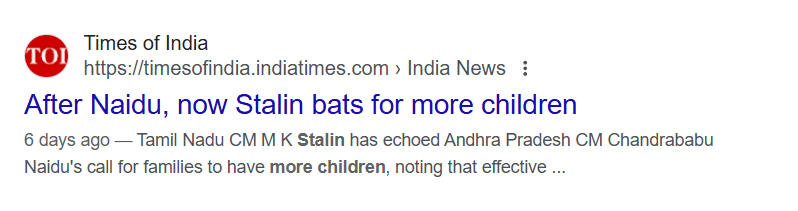
Why are South Indian leaders, like Stalin and Chandrababu Naidu, all of a sudden, pushing women to have more children? It’s not to combat the aging population as they make it seem. It’s all politics!
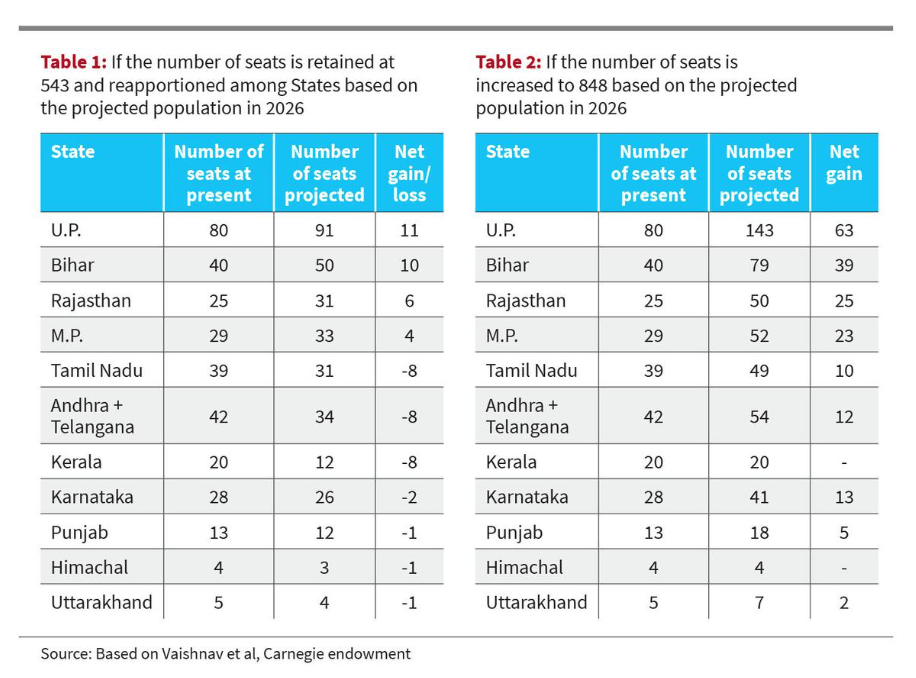
In India, there’s something called Delimitation. It’s a process of redrawing the boundaries of constituencies based on population. States with more population will get more constituencies, whereas those with low populations, like southern states, will get fewer seats. Basically, the exercise is to ensure each constituency has an equal number of people.
Since South India’s population growth is decreasing, plus migration, it won’t need as many constituencies. The total number of constituencies in Lok Sabha has been frozen since the 70s and is in place until 2026. 2026 is almost here! This is why politicians in South India are worried about women not having enough children. They don’t want to lose their seats.
As per The Hindu newspaper, Kerala, Tamil Nadu, Andhra + Telangana, all of which are South Indian states, stand to lose 8 seats each, if the current number of seats in Lok Sabha (543) is maintained.
We can expect Pinarayi Vijayan, the CM of Kerala, to make a similar statement next.
While reading today’s newspapers, an interesting trend caught my eye. Most newspapers in India are left-leaning, so election results are primarily presented in a way that props up the left-leaning parties. For example, “NC got a thumping victory,” in contrast to a more subdued “BJP earned a hat-trick in Haryana.” No fancy adjectives. Another example is “J&K has rejected BJP’s politics” while failing to report that BJP’s vote share has been increasing in J&K with every passing election. In some newspapers, Vinesh Phogat’s win was highlighted more than the overall performances of individual parties.
The election results declared on 8th October have been filled with surprises. However, due to the media’s own biased leanings, not every fact made it to the papers. Here are some of the top surprises from the Haryana and J&K Elections 2024.
BJP getting more seats than Mehbooba Mufti’s PDP in J&K
From a party that used to get single-digit votes in Kashmir, BJP’s vote count has now risen to four digits. The party came second in J&K, beating Mehbooba Mufti’s PDP.
PDP is an indigenous Kashmiri political party. The party has been on the political scene in Kashmir for ages. This time, most of the PDP’s votes went to NC in the Kashmir region. PDP’s association with the BJP in the recent past proved to be its undoing. Interestingly, this camaraderie did not have the same effect on the BJP, as its vote share increased from the 2014 elections.
Courtesy: The Hindu
No one, including BJP members, ever countered the fact that BJP would not win a single seat in Kashmir. It was reported that even the people of Jammu, along with Kashmiri Pandits, BJP’s primary vote base, were dissatisfied with the saffron party as their demands were left unaddressed.
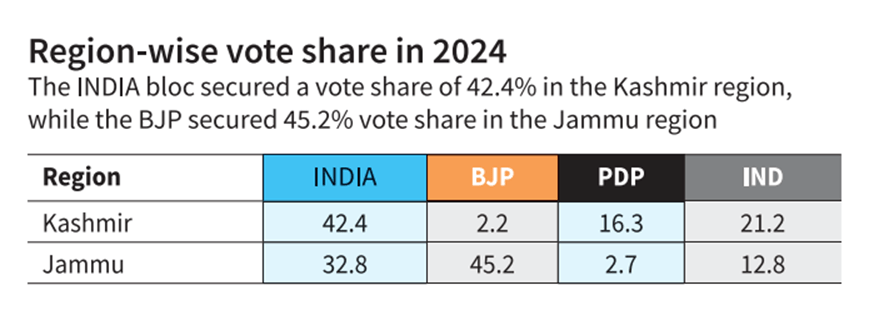
Considering that politicians like Omar Abdullah were saying there was intense anger brewing in the valley beneath the surface of peace and tranquility, it was surprising to see the BJP not only increase its number of seats without an alliance but also its overall vote share in J&K albeit marginally, as compared to the 2014 elections.
If we were to analyze just Kashmir alone, the BJP neither lost nor gained its vote share (2.2%) in the region. So, in summary, the BJP increased its seats/vote share in Jammu while maintaining its vote share in Kashmir. If the Abrogation of Section 370 was indeed a major point of discontent for J&K locals, we should have seen a drastic decrease in BJP’s seat count/vote share. But that’s not what happened.
Courtesy: The Hindu
The media and politicians might paint the Kashmir election results as a big loss for the BJP and a “befitting reply to BJP by the people for the Abrogation of 370”, but the data seems to indicate otherwise. Yes, they did not win a seat, but the fact that in many seats of Muslim-dominated Kashmir, BJP came second, beating Congress and PDP, implies there’s far more to the story than what meets the eye.
BJP losing Gurez in Baramulla by a mere 1132 votes
Gurez is a seat that is 98% Muslim and where the BJP did not have any presence till now. Faqeer Mohammad Khan from the BJP lost by a mere 1132 votes to NC’s Nazir Ahmad Khan.
This close contest has been the biggest shocker from the Kashmir region, considering the BJP is always portrayed as an “anti-Muslim” party.
There is a misconception that Jammu is a “Hindu-only” area and Kashmir is a “Muslim-only” area. Jammu has areas with a significant Muslim population. One such area is Kishtwar, a district that has long been a hotbed of militant activities.
Shagun’s father and uncle were murdered by Hizbul Mujahideen terrorists in 2018. She initially had no plan to join politics, but after the murder of her father and uncle, she felt the need to bring about a change. Her victory, albeit by a small margin, proved to be sweet revenge.
Speaking to the media after the verdict, she said: “We have lost a large number of our soldiers. I have lost my father, and some have lost their brothers and sons. My first effort will be to ensure that every child here has the shadow of a father over his head and that there is peace and prosperity in the area. My efforts will be to bring happiness to every home.”
Jamaat-e-Islami and former separatists faced a big loss in J&K
When members from banned radical groups like Jamaat-e-Islami and former separatists were allowed to contest this election individually, many were worried.
As Kashmir continues to be a sensitive zone, analysts questioned the motive behind this move and the consequences of having radical elements elected into power. However, the people of J&K answered this pressing question through their votes, resoundingly rejecting the radicals and choosing a party like the National Conference instead, which believes in working democratically within the rules of the Indian constitution. This has come as a relief for many, especially since Engineer Rashid was elected as MP in the Lok Sabha elections.
The loss of Engineer Rashid’s party in the J&K election has provided ample proof that his victory in the Lok Sabha elections was a case of sympathy voting. His sons had extensively campaigned for him before general elections, saying the only way their father could escape jail was if he became an MP. However, in the case of the J&K elections, Kashmiris seemed to have drawn a line, and Rashid was unable to replicate his victorious stint in the general elections.
Congress in a way lost both Haryana and J&K
Even though Congress is an ally of the NC in J&K, their standalone performance proved to be lackluster. Congress managed to earn only 6 seats in J&K, compared to BJP’s 29. This cannot be considered a victory for Congress. In Jammu, too, an area where they were stationed to put up a strong fight against the BJP, they managed to win only one seat.
NC leader Omar Abdullah admitted post-election that, in hindsight, the alliance was unnecessary as they would have won the election anyway without the help of Congress.
Haryana outcome
Haryana’s election results came as a shock to everyone, including right-wingers. The trend was overwhelmingly leaning towards anti-incumbency in the state. BJP has been ruling Haryana for over a decade, and there were a plethora of issues surrounding “farmers, soldiers, and wrestlers” plaguing the state.
However, around a month back, it was reported that the non-Jats were having second thoughts about Jats supporting Congress and gaining power. This led to a consolidation of non-Jat votes against Congress. It is a simple case of caste-based politics gone wrong for the party.
Courtesy: The Hindu
RSS played a huge role in BJP’s victory
Reportedly, RSS went above and beyond in Haryana, campaigning door to door, distributing pamphlets that highlighted the dangers of caste-based divisive politics, ensuring everyone got their voter slips on time, and organizing outreach programs.
In the Lok Sabha Elections, it was reported that there had been a fallout between the BJP and RSS, which led to RSS members not making any effort to help the BJP. BJP seems to have realized its blunder post-election and made a conscious effort to re-establish connection with RSS, which is undeniably its backbone. Several changes were made in Haryana based on RSS’ recommendations. It ended up proving effective.
Conclusion
Yet again, Exit polls in India have turned out to be a disaster. You never know what the janta is thinking. There are silent voters who make their stance known only through their votes. Exit polls have been unable to infiltrate that section.
One thing is clear: this election has been a big win for democracy, especially in the Kashmir valley. The turnout was impressive. The trust they placed in the Indian democratic process is noteworthy. As Modi mentioned, the peaceful conduct of the J&K election has proven to be a victory in itself.
The recent election in India was proof that the BJP is not invincible. Despite the party’s considerable efforts in improving the economy, it failed to connect with the people at the grassroots level. Voters ultimately prioritized free benefits and voted based on caste and religion in rural areas, where the BJP performed poorly. These are the exact issues the government had been working to avoid because they do not contribute to India’s growth in any way.
The election outcome cannot be blamed on the voters, as it is understandable why promises of freebies and jobs with guaranteed 1 lakh salaries were more alluring than infrastructure or development, no matter how burdensome such things might prove for the exchequer. Saying no to such promises is a luxury reserved for the privileged.
It needs to be acknowledged that all political parties, not just the BJP, have played a role in fueling discontent, animosity, and disharmony among communities. It is a collective failure that we, as a society, allowed ourselves to be divided along religious lines. The INDI alliance, too, resorted to fear tactics and misinformation in the name of secularism to further their agendas. As the opposition parties relentlessly worked on propagating their “savior” image, people were quick to believe that the answer to all their solutions, like poverty and joblessness, was the INDI alliance.
I have always been of the belief that one should judge a party/politician by the work they do, not the words they utter. But unfortunately, we are quick to believe hate narratives and forget that in this big bad world of politics, there is no savior, only megalomaniacs greedy for power.
To gain back confidence, the coalition NDA government needs to pull up its socks. Things are far from gloomy for the BJP, as they still are the party with the most seats (240) in India. Congress comes a distant second with their 99 seats. However, BJP’s performance was still a big disappointment to its supporters who expected their party to get more support, especially in Uttar Pradesh, where the sacred Ayodhya temple was built after a long period of wait.
Some changes are in need of the hour. What can the Indian coalition government do to improve its performance? Here are my takes.
Don’t take success for granted
Undoubtedly, this has been the biggest lesson for the ruling party that you should never take your success for granted. The BJP became overconfident with their “400 paar” declarations, which resulted in them not doing enough groundwork.
Many reasons are mentioned for voter dissatisfaction in places like Uttar Pradesh, but the parties would have more accurate insights than us, the speculators. RSS workers allegedly did not campaign extensively or help voters reach the booth, there is also an allegation of missing votes, not enough compensation for people who lost their homes to make way for the temple, etc. Regardless of the issue, the fact remains that the BJP and RSS did not make an effort to connect with voters in rural areas and understand their issues. Instead of providing justifications, the BJP should regroup and focus on the areas where it faltered.
Outreach programs for minorities
Most Christians and Muslims I know are frightened of the BJP. This is where the opposition party made a resounding impact, albeit in a negative/divisive manner. The local politicians went around, scaring people into thinking they would be evicted if the BJP came into power. Elderly, economically disadvantaged Muslims who were approached by news channels were seen pleading to the general public with teary eyes, “Please don’t vote for the BJP. If they come into power, they will kill us.”
Who is responsible for this fearmongering? The “Hindu vs other religions” narrative has gained such solid ground that it seems next to impossible to convince minorities that Hindus mean no harm to anyone. Media, too, has a huge role to play in spreading this fear. Due to their irresponsible journalism, done solely to put Modi in a poor light, they ended up creating irreparable damage.
It became easier for the opposition to spread hatred after the emergence of the Ayodhya Temple. No one from the ruling party made an effort to explain to the minorities that these sites are as important to religious Hindus as Mecca or Medina for Muslims or the Vatican for Christians. Justice was denied to the Hindu community since the Mughal era when temples were brutally demolished to make way for mosques. A few Muslims realized this, such as the archaeologist KK Muhammed (the one who studied the site and came to the conclusion that the mosque was brazenly built over a temple) and the BJP Malappuram candidate Dr. Abdul Salam. Both of them have openly said on news channels how other communities should show empathy to “our Hindu brothers and sisters” as the community was subjected to extreme unfairness in the past, so much so that even their most sacred sites were denied to them. It takes a great deal of empathy to acknowledge someone else’s turbulent past, and you can’t help but feel gratitude for such people.
As no effort was made by the ruling party to bridge misunderstandings, political parties milked the opportunity for what its worth. Rest assured, they will continue to use the sacred temple as a tool for playing politics, further increasing the divide between Hindus and other communities. BJP should realize communication is key and work towards improving the skill to effectively clear misunderstandings.
The BJP team in Thrissur (Kerala) appeared to have been effective in their communication, which may explain why the party received Christian votes despite the opposition’s efforts to portray the Manipur issue as a communal clash. Interestingly, it was only after the elections did priests and bishops in Kerala clarified that the Manipur issue is not communal but rather ethnic. However, by that time some individuals on the ground had already done enough research to discover this on their own.
BJP often lags in countering allegations or taking strict action against the hatemongers. They never communicate their side of the story or a simple “you are safe with us,” the absence of which leads to speculations and uncertainty. They need to interact more with minorities at the ground level and induce confidence in them by clearing their misconceptions. This can come only with proper effort.
Offer financial relief to citizens
In rural areas or for those with low income, freebies are highly valued. However, it’s important to note that these freebies are often funded by taxing the middle class. The government should find a way to carefully balance the two – providing assistance to the poor without burdening the middle class. While investing in infrastructure and development projects is beneficial for the economy, it’s crucial to also provide some relief to ordinary citizens.
Avoid polarizing language
In order to gain the trust of more people, the BJP needs to use more restrained language. While Modi’s “ghuspetiyas” comment was aimed at illegal immigrants, it was twisted by the opposition for their own benefit, leading to fear-mongering.
Many people now understand that words uttered by politicians often mean nothing and are solely used as a tool to sway voters. They understand it’s a game. However, others may take it more seriously. To prevent this, simple language should be used, and the intention should be clearly specified.
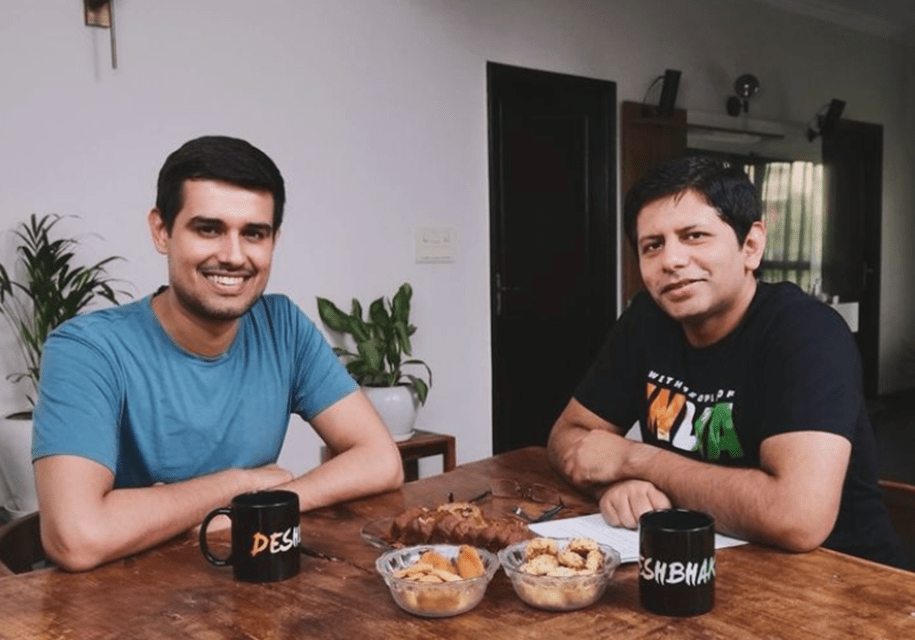
We have observed the significant rise of left-leaning political commentators on social media, particularly YouTubers, during this election. Dhruv Rathee and Ravish have amassed massive views, surpassing even mainstream news channels. It was believed that they would have a significant impact on the Lok Sabha Elections.
Dhruv, who typically maintains a neutral tone, noticeably shifted his approach in the months leading up to the election, embracing a more polarized political viewpoint. I use the term “polarized” because he blatantly overlooked several important issues during this time, such as the Sandeshkhali rapes in West Bengal and the Sidharthan case in Kerala, primarily because these cases put the opposition in a poor light. Personally, I felt his demeanor change from that of a regular YouTuber to that of a politician.
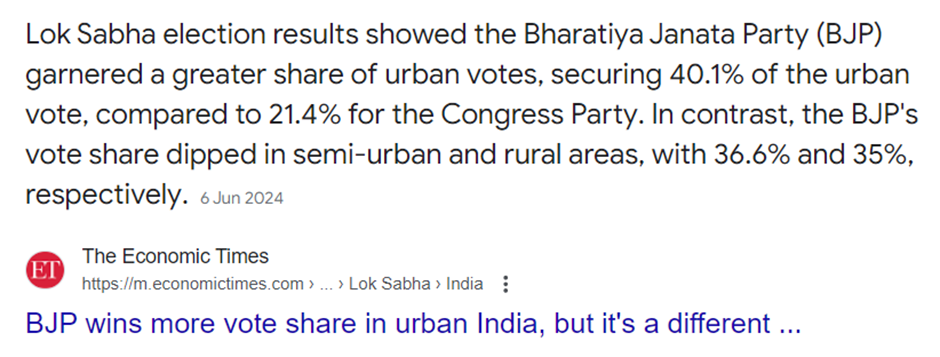
After months of running intense social media campaigns, were these left-leaning YouTubers successful? In a previous post, I mentioned how Dhruv Rathee is unlikely to have a significant impact on the Lok Sabha elections. The echo chamber angle aside, the answer lies in the data collected from the CSDS-Lokniti Post Poll Survey. It shows how the BJP performed well in urban areas while lagging in rural areas.
How much influence do YouTubers have in rural areas? Unless a proper survey is conducted that asks people living in villages, “Did Dhruv Rathee or any other YouTuber influence you to change your voting pattern this time?” we will never know for sure. Another way to analyze the impact is by examining video statistics. Content creators can share their video statistics, including the regions where their videos were most viewed. Did they receive significant viewership from rural areas?
Huge rallies were conducted in villages where Dhruv’s videos were played. However, it’s safe to say that people in rural areas do not vote based on social media activism. Instead, they vote based on their personal experiences, caste-based politics, and the help they receive. They are unlikely to resort to the Internet to research the pros and cons of political parties.
To summarize, any success resulting from YouTube videos should have primarily been reflected in urban areas, but that was not the case. BJP performed considerably well in cities.







 The Monkey Dilemma
You must be logged in to post a comment.