One thing I have learned is that there are different standards for different people.
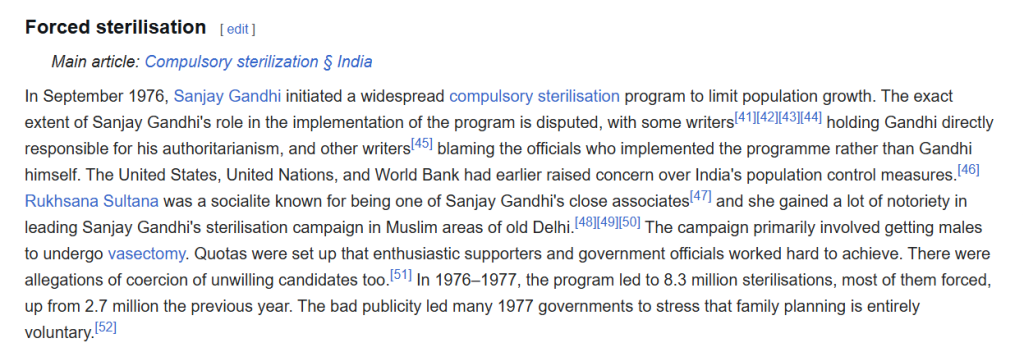
We have forgiven Congress for the 1984 Sikh riots and the Emergency, a period during which thousands were killed and many were forcefully sterilized as part of a population control measure.
A Snippet from “The Emergency (India)” Wikipedia Article
We also forgave all the anti-Hindu attacks that occurred in the country, such as the genocide of Kashmiri Pandits, the Godhra train burning, the 1992 Ajmer rape case, and the Moplah riots. The left attempted to whitewash these events, but historians like Ambedkar provided a different narrative.
We tell ourselves, “Why bring up the past?” But we are not ready to forgive or let go of the past when it comes to the Gujarat riots and the Babri Masjid demolition.
What makes certain communal riots more unforgivable and unforgettable than others, when all are equally horrendous?
Today, we see similar attempts at whitewashing, where any films addressing attacks on Hindus are immediately dismissed as propaganda. Why is it that every one of these events is labeled a lie, without any anomalies? What criteria must be met for an attack on Hindus to be acknowledged?
Recently, Khalistanis in Canada attacked a Hindu temple, but this was not given enough attention either. In their efforts to downplay attacks on Hindus to prevent riots, the left has caused many in the community to turn towards far-right ideologies. There’s no balance or consistency in beliefs. If you believe violence is bad, speak up against all types of violence. But, often we see, one type of violence being justified, whereas others are condemned.
A simple glance around is enough to recognize this hypocrisy. Observe how people around you react when there are attacks against Hindus. Are they condemning or justifying it?
Ultimately, it revolves around politicians, media, and agenda-driven propagandists manipulating people’s emotions. They dictate how you should feel about various issues, which riots deserve attention and remembrance, and which should be overlooked or forgotten.
I was once a leftist. However, at that time, I didn’t consider all sides of a story. Even though I am a Hindu, I was often dismissive of conflicts in which Hindus were victims in India, such as the Kashmiri Pandit genocide, the 1992 Ajmer rapes, the Moplah riots, and others. I coldly labeled the narratives as right-wing propaganda. I was radicalized to the extent I wasn’t open to other perspectives.
On October 7th, 2023, I experienced a significant shift in my perspective. I witnessed people justifying acts of violence, including rape and saw secular politicians in my country referring to it as resistance. This left me shocked. It wasn’t the BJP that influenced my change, but rather the people around me. The only individuals expressing outrage about these events were from the right wing, which took me by surprise.
Over the next couple of months, I underwent a monumental shift in my ideology that startled me. It felt like old layers of my beliefs were peeling away, making way for new understandings—a painful process. I came to realize that the principles of fairness and equality I had believed in until then were merely a façade. I also understood that I would likely be alone in this revelation.
The world operates in a contradictory and troubling way. People often expect unwavering support from others, yet when it’s their turn to show empathy, they respond with scoffing, mockery, and belittlement towards heinous crimes. They easily justify acts of violence, murder, and rape with statements like, “So what? They deserved it.”
It took me months to calm my anger and process the betrayal I felt when I discovered that some of my friends had become radicalized to the point of believing that rapes were justified. Until that moment, I had viewed the world through rose-colored glasses, believing it to be a kind place.
I then looked at my country with a fresh perspective and realized that similar patterns were at play here. Hindus seemed to have to compromise more than other communities in the name of secularism. I observed that many conflicts where the victims were predominantly Hindus were dismissed as propaganda, belittled, mocked, or invalidated, much like the rapes of Israelis on October 7.
I now identify as a right-winger. I consider myself center-right and hold no animosity toward anyone. In the past, I hesitated to label myself as a right-winger because almost everyone I know leans left. However, over time, I’ve moved past the fear of labels. People can judge or categorize me as they wish; as we age, labels become less significant. My shift in ideology is not due to any political party or its propaganda, but rather my observations of people’s behavior and their viciousness.
I have become more patriotic and now want everyone in India to adopt a “nation first” mentality. This is something I missed when I was a leftist; I felt that people weren’t sufficiently pro-India. I realize now that the center-right community is where I truly belong.
We, the center-right, believe in the following principles:
We are patriotic and uphold a “nation first” mentality.
We reject extremism from both the far-right and the far-left.
We take pride in the achievements of India.
We advocate for equal rights for everyone, regardless of their community.
We oppose appeasement politics.
We strongly support enhanced security measures.
We have zero tolerance for radical groups.
There are several negative aspects of the far-right that frustrate people like me. They should be held accountable by the government. However, I still feel positive about my country under strong leadership that has the courage to confront extremism.
Unfortunately, in India, when you openly call out extremism, you are declared Islamophobic. When radicals get arrested due to active participation in extremist groups, the country is declared Islamophobic. The global media often gets their news about India from the local left-leaning media which is notorious for giving one-sided stories. In this day and age of media bias, it is imperative to refer to both the left and right-wing channels to get a full balanced view.
It’s true that Islamophobia exists in India and the country should do more to protect its minorities. However, even if the BJP takes positive steps, it is unlikely to reduce the extreme victim mentality prevalent in the community that refuses to acknowledge any good done by the party. For example, the BJP introduced the Shadi Shagun Yojana scheme in which a Muslim girl is given Rs 51000/ when she marries after her graduation (BA, BSc, BCom, BE etc.). BJP banned the Triple Talaq. This is for Muslims alone. Most of the recipients of other welfare schemes have been members of the Muslim community. No ruler would have tried to uplift the Muslim community if they were Islamophobic. Riots and young children getting murdered due to terrorist activities in Kashmir have also drastically reduced. But these plus points are often blatantly ignored and many choose to judge Modi by the actions of the far-right.
A question to consider is: If Modi is still judged for the 2002 Gujarat riots, why isn’t Congress held accountable for the 1984 Sikh riots that they enabled, which were equally horrific? Politicians have contributed to deepening societal divisions by fueling narratives. Riots and violence instigated by one party are often deemed forgivable, while those provoked by another are considered unforgivable.
My political ideology is not fixed. I may shift from center-right to center-left in the future if I find that the center-left in India has become bold enough to openly oppose Islamist extremism as well, not just Hindutva. As of now, they do not meet that standard.
To end with a quote on pseudo-secularism in India:
To those who claim we are now living in a totalitarian, fascist, Hindu Rashtra, one must ask:
What kind of Hindu Rashtra is this where Ram Navami, Hanuman Jayanti, Durga pooja processions, and even Garba celebrations, are attacked and stoned with impunity?
What kind of Hindu Rashtra is this where Hindus are forced to be refugees in their own land, where one can settle 40,000 Rohingya Muslims but not 700,000 Kashmiri Hindus, the land’s original inhabitants; where the judiciary says it is too late to prosecute those who raped, murdered, and ethnically cleansed lacs of Hindus?
What kind of Hindu Rashtra is this where Hindu temples are exclusively controlled by the State, and where the government usurps hundreds of thousands of acres of temple land and is responsible for more than 100,000 temples losing lakhs of crores in rental income?
What kind of Hindu Rashtra is this where the Right to Education Act discriminates only against Hindus and their schools, forcing tens of thousands of them to shut down?
What kind of Hindu Rashtra is this where a communal violence law was about to be enacted through with only the Hindus would have been held guilty in a communal riot even if they were in a minority for example in Kashmir?
What kind of Hindu Rashtra is this where court judgments like the Sabarimala and legislative enactments like the Hindu Code Bill purport to reform only Hindu religious practices but dare not touch practices of other religions, and if they do, the decisions are promptly reversed like in the Shah Bano case?
What kind of Hindu Rashtra is this where the Waqf Act gives overarching powers to Muslims to declare a 1500-year-old Hindu temple to be on Islamic land when Islam is only 1300 years old?
If this is how a Hindu is rewarded in a Hindu Rashtra, he’d much rather be in a Muslim Rashtra because then at least there’d be no pretence of equality.
The US elections are done. Trump has emerged as the clear winner. For Indians like me, while it’s an election in a different country, the reactions to his victory feel close to home.
Liberals in the USA are angry. They are accusing Trump supporters of being fascists and anti-LGBTQ. This is similar to how the Indian left reacts when BJP wins an election. They accuse the voters and label them as stupid, uneducated fascists.
I can understand the intense emotions. It’s human to react strongly to causes you care deeply about. However, the liberals in both the USA and India are unable to grasp why the right wing is getting votes. They seem unwilling to hold open discussions to find out the drawbacks of the party they support. It’s only when you acknowledge the mistakes that you can rectify them and ensure the party’s victory in the next election.
In the USA, from what I learned, the right-wing Republican party got votes because they catered to the ordinary American’s issues, such as inflation, immigration influx, border security issues, Biden’s handling of the Middle East war, rising antisemitism, and the democrat’s stoic silence about the Bangladeshi Hindu genocide and Khalistani issues. The last two issues mattered to American Hindus, whereas the Middle East war affected American Muslims. Some American Jews I follow observed with pain how the far-left held college campuses hostage, even going to the extent of attacking Jewish students and setting the American flag on fire.
The reasons for Trump’s win were in front of all to see, but somehow, people chose to ignore it.
Trump got votes not because the majority of Americans are anti-abortion or anti-LGBTQ. It had more to do with the Biden government’s handling of core concerns. By choosing to concentrate only on niche issues, the Democrats distanced themselves from the ordinary American. This is why Democrats won in cosmopolitan cities with more diverse populations, whereas Republicans won the remaining places.
In India, the trend is similar. When the BJP wins, the anti-BJP group resorts to insulting the voter’s intellect. They are labeled fascists, and no effort is made to understand the reasons that led them to vote for a right-wing party. For instance, I see many who were once left-leaning becoming comfortable with the BJP after the Waqf land issues started. In case this issue changes the political dynamics of the country, the anti-BJP clan would still place the blame on the BJP voters, calling them communal, uneducated, and fascists instead of looking inward. There’s always more uproar and less introspection.
A party cannot grow if it refuses to acknowledge its mistakes. Liberals won’t be able to defeat right-wing parties if they continue to ignore important issues.
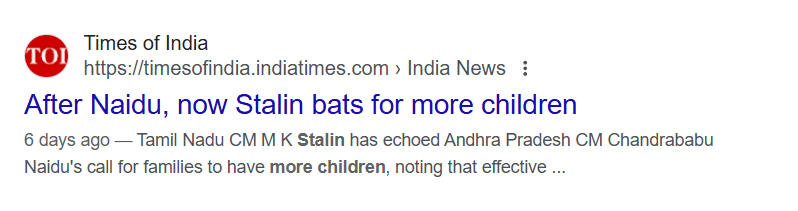
Why are South Indian leaders, like Stalin and Chandrababu Naidu, all of a sudden, pushing women to have more children? It’s not to combat the aging population as they make it seem. It’s all politics!
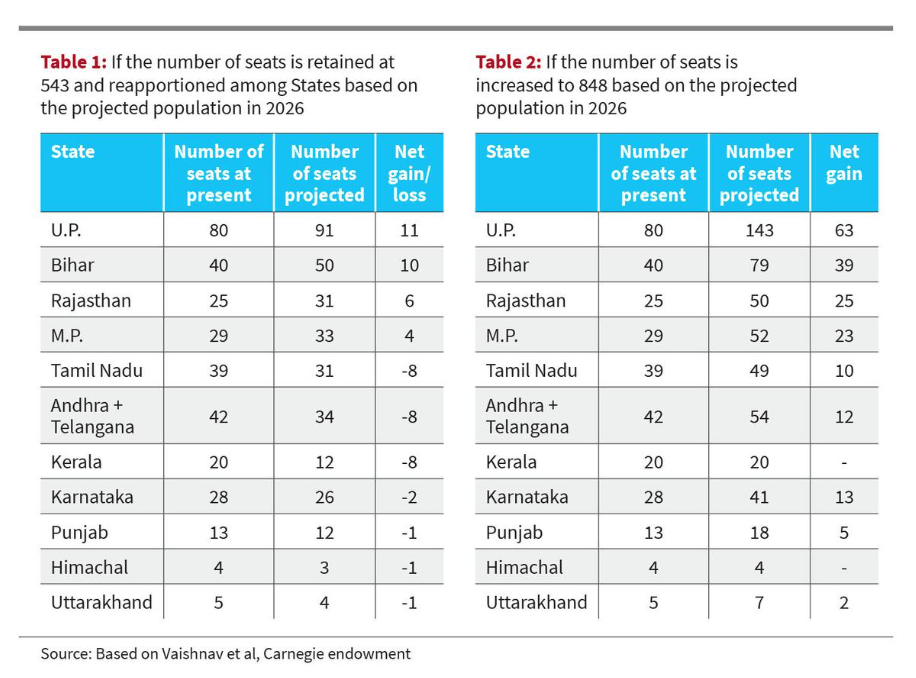
In India, there’s something called Delimitation. It’s a process of redrawing the boundaries of constituencies based on population. States with more population will get more constituencies, whereas those with low populations, like southern states, will get fewer seats. Basically, the exercise is to ensure each constituency has an equal number of people.
Since South India’s population growth is decreasing, plus migration, it won’t need as many constituencies. The total number of constituencies in Lok Sabha has been frozen since the 70s and is in place until 2026. 2026 is almost here! This is why politicians in South India are worried about women not having enough children. They don’t want to lose their seats.
As per The Hindu newspaper, Kerala, Tamil Nadu, Andhra + Telangana, all of which are South Indian states, stand to lose 8 seats each, if the current number of seats in Lok Sabha (543) is maintained.
We can expect Pinarayi Vijayan, the CM of Kerala, to make a similar statement next.
While reading today’s newspapers, an interesting trend caught my eye. Most newspapers in India are left-leaning, so election results are primarily presented in a way that props up the left-leaning parties. For example, “NC got a thumping victory,” in contrast to a more subdued “BJP earned a hat-trick in Haryana.” No fancy adjectives. Another example is “J&K has rejected BJP’s politics” while failing to report that BJP’s vote share has been increasing in J&K with every passing election. In some newspapers, Vinesh Phogat’s win was highlighted more than the overall performances of individual parties.
The election results declared on 8th October have been filled with surprises. However, due to the media’s own biased leanings, not every fact made it to the papers. Here are some of the top surprises from the Haryana and J&K Elections 2024.
BJP getting more seats than Mehbooba Mufti’s PDP in J&K
From a party that used to get single-digit votes in Kashmir, BJP’s vote count has now risen to four digits. The party came second in J&K, beating Mehbooba Mufti’s PDP.
PDP is an indigenous Kashmiri political party. The party has been on the political scene in Kashmir for ages. This time, most of the PDP’s votes went to NC in the Kashmir region. PDP’s association with the BJP in the recent past proved to be its undoing. Interestingly, this camaraderie did not have the same effect on the BJP, as its vote share increased from the 2014 elections.
Courtesy: The Hindu
No one, including BJP members, ever countered the fact that BJP would not win a single seat in Kashmir. It was reported that even the people of Jammu, along with Kashmiri Pandits, BJP’s primary vote base, were dissatisfied with the saffron party as their demands were left unaddressed.
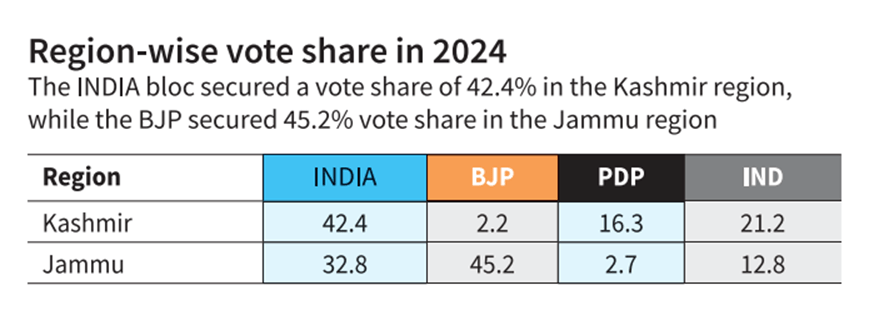
Considering that politicians like Omar Abdullah were saying there was intense anger brewing in the valley beneath the surface of peace and tranquility, it was surprising to see the BJP not only increase its number of seats without an alliance but also its overall vote share in J&K albeit marginally, as compared to the 2014 elections.
If we were to analyze just Kashmir alone, the BJP neither lost nor gained its vote share (2.2%) in the region. So, in summary, the BJP increased its seats/vote share in Jammu while maintaining its vote share in Kashmir. If the Abrogation of Section 370 was indeed a major point of discontent for J&K locals, we should have seen a drastic decrease in BJP’s seat count/vote share. But that’s not what happened.
Courtesy: The Hindu
The media and politicians might paint the Kashmir election results as a big loss for the BJP and a “befitting reply to BJP by the people for the Abrogation of 370”, but the data seems to indicate otherwise. Yes, they did not win a seat, but the fact that in many seats of Muslim-dominated Kashmir, BJP came second, beating Congress and PDP, implies there’s far more to the story than what meets the eye.
BJP losing Gurez in Baramulla by a mere 1132 votes
Gurez is a seat that is 98% Muslim and where the BJP did not have any presence till now. Faqeer Mohammad Khan from the BJP lost by a mere 1132 votes to NC’s Nazir Ahmad Khan.
This close contest has been the biggest shocker from the Kashmir region, considering the BJP is always portrayed as an “anti-Muslim” party.
There is a misconception that Jammu is a “Hindu-only” area and Kashmir is a “Muslim-only” area. Jammu has areas with a significant Muslim population. One such area is Kishtwar, a district that has long been a hotbed of militant activities.
Shagun’s father and uncle were murdered by Hizbul Mujahideen terrorists in 2018. She initially had no plan to join politics, but after the murder of her father and uncle, she felt the need to bring about a change. Her victory, albeit by a small margin, proved to be sweet revenge.
Speaking to the media after the verdict, she said: “We have lost a large number of our soldiers. I have lost my father, and some have lost their brothers and sons. My first effort will be to ensure that every child here has the shadow of a father over his head and that there is peace and prosperity in the area. My efforts will be to bring happiness to every home.”
Jamaat-e-Islami and former separatists faced a big loss in J&K
When members from banned radical groups like Jamaat-e-Islami and former separatists were allowed to contest this election individually, many were worried.
As Kashmir continues to be a sensitive zone, analysts questioned the motive behind this move and the consequences of having radical elements elected into power. However, the people of J&K answered this pressing question through their votes, resoundingly rejecting the radicals and choosing a party like the National Conference instead, which believes in working democratically within the rules of the Indian constitution. This has come as a relief for many, especially since Engineer Rashid was elected as MP in the Lok Sabha elections.
The loss of Engineer Rashid’s party in the J&K election has provided ample proof that his victory in the Lok Sabha elections was a case of sympathy voting. His sons had extensively campaigned for him before general elections, saying the only way their father could escape jail was if he became an MP. However, in the case of the J&K elections, Kashmiris seemed to have drawn a line, and Rashid was unable to replicate his victorious stint in the general elections.
Congress in a way lost both Haryana and J&K
Even though Congress is an ally of the NC in J&K, their standalone performance proved to be lackluster. Congress managed to earn only 6 seats in J&K, compared to BJP’s 29. This cannot be considered a victory for Congress. In Jammu, too, an area where they were stationed to put up a strong fight against the BJP, they managed to win only one seat.
NC leader Omar Abdullah admitted post-election that, in hindsight, the alliance was unnecessary as they would have won the election anyway without the help of Congress.
Haryana outcome
Haryana’s election results came as a shock to everyone, including right-wingers. The trend was overwhelmingly leaning towards anti-incumbency in the state. BJP has been ruling Haryana for over a decade, and there were a plethora of issues surrounding “farmers, soldiers, and wrestlers” plaguing the state.
However, around a month back, it was reported that the non-Jats were having second thoughts about Jats supporting Congress and gaining power. This led to a consolidation of non-Jat votes against Congress. It is a simple case of caste-based politics gone wrong for the party.
Courtesy: The Hindu
RSS played a huge role in BJP’s victory
Reportedly, RSS went above and beyond in Haryana, campaigning door to door, distributing pamphlets that highlighted the dangers of caste-based divisive politics, ensuring everyone got their voter slips on time, and organizing outreach programs.
In the Lok Sabha Elections, it was reported that there had been a fallout between the BJP and RSS, which led to RSS members not making any effort to help the BJP. BJP seems to have realized its blunder post-election and made a conscious effort to re-establish connection with RSS, which is undeniably its backbone. Several changes were made in Haryana based on RSS’ recommendations. It ended up proving effective.
Conclusion
Yet again, Exit polls in India have turned out to be a disaster. You never know what the janta is thinking. There are silent voters who make their stance known only through their votes. Exit polls have been unable to infiltrate that section.
One thing is clear: this election has been a big win for democracy, especially in the Kashmir valley. The turnout was impressive. The trust they placed in the Indian democratic process is noteworthy. As Modi mentioned, the peaceful conduct of the J&K election has proven to be a victory in itself.
I recently bought a book titled Kashmir Narratives. It is authored by Colonel Ajay Raina, a retired Indian Army officer. To quote his bio on Amazon, “I am the only son of refugee parents who were young kids when the 1947 bloodied partition saw the creation of two new States of India and Pakistan and when the biggest ever migration of humans took place on this earth. Post my education, I got commissioned into the Indian Army as an officer in 1990 and served till the end of 2017.“
I happened to see his interview somewhere and decided to buy the book. It has a lot of information on Kashmir, focusing on its history, but what I found particularly interesting was the information on the condition of the plebiscite in Kashmir. Before we get to that, let’s understand what a plebiscite is.
What is a plebiscite?
A plebiscite is a direct vote by the people of a region (in this case, Kashmir) on an important public issue. In simpler words, in relation to Kashmir, a plebiscite allows Kashmiris to vote for its future – specifically, whether the region would join India or Pakistan. Interestingly, only these two options were presented, with no option explicitly listed of allowing Kashmir to function as an independent state.
How did the idea of a plebiscite in Kashmir emerge?
The idea of a plebiscite came into effect following the partition of British India in 1947 when the princely states were given the option to join either India or Pakistan.
Jammu and Kashmir initially chose to remain independent. However, after an invasion by tribal forces from Pakistan, Maharaja Hari Singh sought military assistance from India and signed the Instrument of Accession, formally acceding to India. This led to the first Indo-Pakistani war in 1947-48.
To resolve the conflict, the UN intervened, and the United Nations Security Council (UNSC) passed Resolution 47 in 1948. This resolution called for a ceasefire, the withdrawal of Pakistani forces from the region, and a significant reduction of Indian army officers. This was to allow for a free and fair plebiscite under UN supervision without any sort of intimidation. The plebiscite was supposed to let the people of Jammu and Kashmir decide their allegiance to either India or Pakistan. The result of the plebiscite would have depended on the majority vote.
However, the plebiscite was never conducted due to several reasons, including disagreements between India and Pakistan over the conditions set by the UN.
Clause (a) in Resolution 47
Most of us aren’t aware of Clause (a) in Resolution 47 passed by the UNSC. It states the condition of a plebiscite in Kashmir. Refer to UN Digital Library – Resolution 47 (1948) – Page 4:
To secure the withdrawal from the State of Jammu and Kashmir of tribesmen and Pakistani nationals not normally resident therein who have entered the State for the purpose of fighting, and to prevent any intrusion into the State of such elements and any furnishing of material aid to those fighting in the State.
The clause requires the complete withdrawal of Pakistani forces from the region. However, this condition remains unfulfilled as militants keep infiltrating the area.
Interestingly, India keeps getting the majority of the blame for not allowing a plebiscite, while it’s clear that Pakistan hasn’t fulfilled its part of the resolution. The resolution placed initial responsibility on Pakistan to withdraw its forces from the region. Only after this withdrawal was India supposed to reduce its military presence. This was then to be followed by a plebiscite. Because neither side fully complied with the conditions set out in the resolution, the situation has remained unresolved.
Final thoughts
I can’t help but wonder, had the “freedom seekers” in Kashmir known about this condition for a plebiscite, would they have applied more force on Pakistani militants to move out of the region? As stated, the first step toward a plebiscite is to ensure the Pakistani militants have withdrawn completely.
The UN has not formally retracted Resolution 47. It is currently in a dormant state. However, there is a possibility of Resolution 47 being re-invoked if the UNSC decides to revisit it.






 The Monkey Dilemma
You must be logged in to post a comment.