Some Indian Muslims like Arfa, Rana, Zubair, and Naseeruddin Shah feel India is intolerant and unsafe for Muslims.
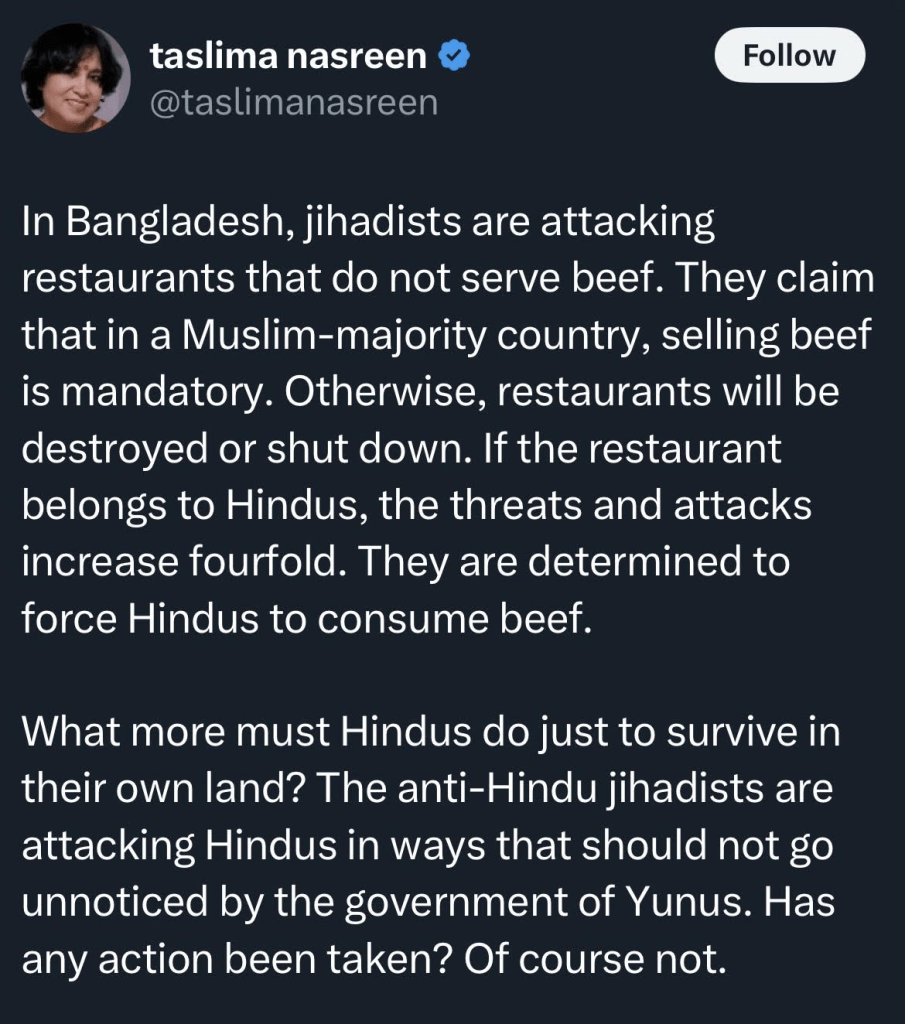
Yet, Muslims like Taslima Nasreen and Sheikh Hasina feel safer in India than in their own Muslim-majority countries. They have escaped their countries to avoid getting persecuted and can openly criticize extremists in India.
Souce: x.com/taslimanasreen
In India, you can criticize any religion freely, like PC George in Kerala targeting Islam, or Stalin in Tamil Nadu attacking Sanatana Dharma.
Source: livelaw.in
But at the same time, mocking/disrespecting Hinduism or Islam can also lead to lynching or beheading.
This shows the complicated nature of India’s religious tolerance. It’s not fully black or white; there are many layers of grey.
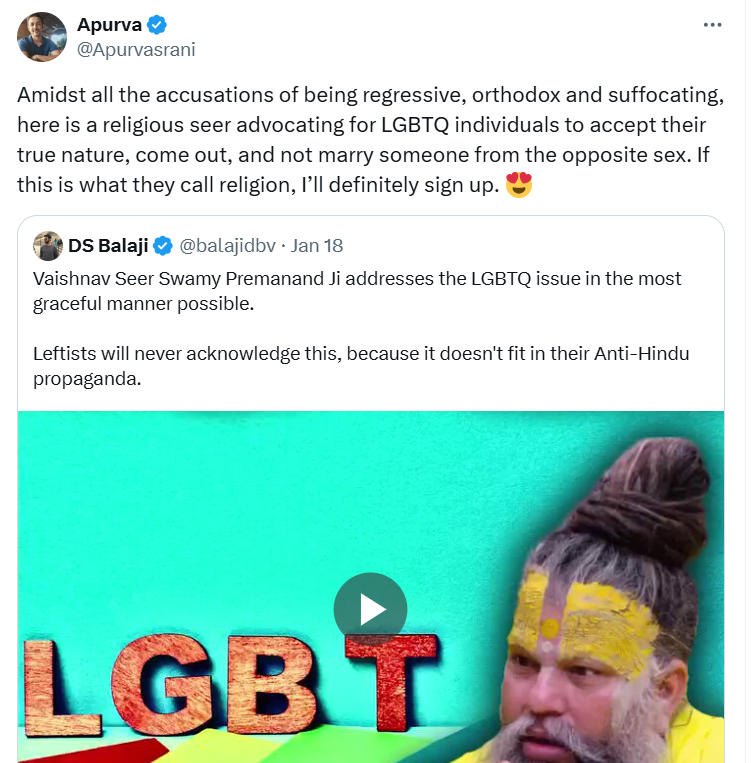
A country, accused of religious intolerance, is also a country where seers like Swamy Premanand Ji openly advocate for LGBTQ issues. He advises young members of the LGBTQ community not to succumb to parental pressure to marry according to societal norms, as it could harm both their own life and that of their partner.
From these examples, it is quite clear that India is a nation with diverse perspectives. Yet international media often portrays it as a regressive and intolerant society, probably because they rely heavily on left-leaning biased sources for their information. This depiction is unfair to the country’s social fabric, which embraces various ideologies.
It is important to note that much of the left-leaning media in India tends to present only one side of the story, resulting in incomplete or biased information. In an era where media bias is prevalent, it is strongly recommended to read news from both left- and right-leaning sources to gain a comprehensive understanding of the issue. Without this balanced approach, people may remain unaware of where genuine reforms are needed and could be misled by those with specific agendas.
The downside of one-sided stories is that they can foster an extreme victim mentality, making people believe that any violence or attack is justified due to past suffering. For instance, some celebrated the LA fires, posting that the USA deserved it for funding weapons for Israel, without considering that pro-Palestinians could have lost their homes too. If a tragedy strikes India, similar comments might surface. This is partly due to media narratives that fuel such sentiments and intensify hatred.
In an increasingly polarized world, it is crucial to report news with accountability. Both extremes are harmful—religious extremism that forces others to conform through coercion and an extreme victim mentality that blinds individuals to any positive aspects, making them focus solely on negative narratives. Currently, in India, I am seeing more of the latter than the former. Media is partly responsible for this.
A ceasefire and hostage deal is close to being reached, with plans to start on Monday. However, some people on both sides want the situation to stay the same.
The ceasefire has not yet started and a journalist from Gaza is already talking about destroying Israel.
Source: x.com/bayanpalestine
Meanwhile, a far-right Israeli politician wants the Gaza war to continue.
Source: The Times of Israel
How long can this hate continue?
One thing is clear: things cannot go on as they are. Israel must implement the two-state solution right away and remove illegal settlements. This doesn’t mean Israel should give up its land, but rather stick to the established boundaries.
If Gaza wants peace, they must abandon the idea of revenge. Israelis are unlikely to give up their land without a fight. They would rather use extreme measures, including nuclear weapons, to destroy their land themselves than give it up. They are driven by strong nationalist sentiments.
Many countries have lost land due to disputes. India lost territory to Pakistan, and Pakistan lost land to Bangladesh. The Kashmiri Pandits were displaced from their homes. Now, imagine if these countries and communities harbored the same revenge mentality and resorted to violence to reclaim their lost land. It would lead to chaos worldwide, including in Muslim countries, with countless lives lost. At some point, peace with reality must be made and the past let go. Constantly planning the next bombing or uprising only results in more innocent lives being lost.
The only way forward is peace. A two-state solution should be established, and both countries must learn to coexist. The benefits are clear: Gaza could leverage Israel’s expertise to develop infrastructure and technology that could improve life for its people. Israel, in turn, could benefit from employing Gazan workers, as it did before October 7. Left to its own devices, Gaza would likely be under Hamas, whose focus is primarily on warfare rather than development.
Supporters worldwide, rather than calling for constant war, should recognize the importance of peace and coexistence.
Yet, all this seems like a distant dream.
If serious measures are not implemented to change the status quo, both Israel and Gaza will continue to live without peace. It’s easy for us to sit in our comfortable armchairs in distant countries, encouraging war and violence on social media, while those living in the conflict zones become the true casualties.
We support violence, only to condemn it later. It’s a vicious cycle that repeats, leading to the loss of many lives, yet we fail to learn from our mistakes.
One thing I have learned is that there are different standards for different people.
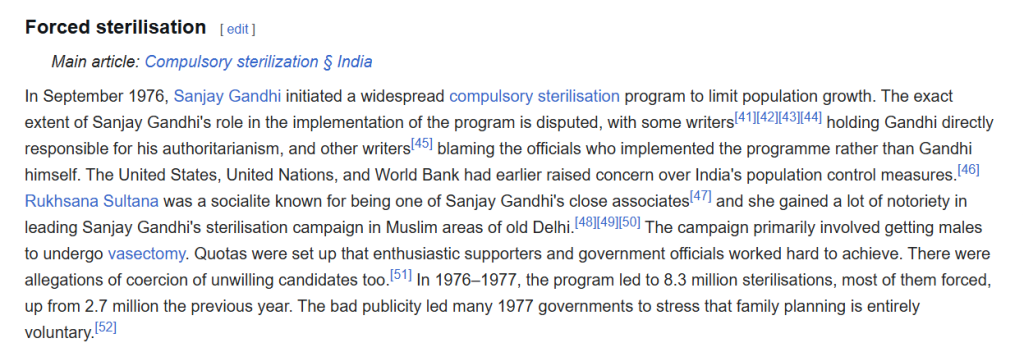
We have forgiven Congress for the 1984 Sikh riots and the Emergency, a period during which thousands were killed and many were forcefully sterilized as part of a population control measure.
A Snippet from “The Emergency (India)” Wikipedia Article
We also forgave all the anti-Hindu attacks that occurred in the country, such as the genocide of Kashmiri Pandits, the Godhra train burning, the 1992 Ajmer rape case, and the Moplah riots. The left attempted to whitewash these events, but historians like Ambedkar provided a different narrative.
We tell ourselves, “Why bring up the past?” But we are not ready to forgive or let go of the past when it comes to the Gujarat riots and the Babri Masjid demolition.
What makes certain communal riots more unforgivable and unforgettable than others, when all are equally horrendous?
Today, we see similar attempts at whitewashing, where any films addressing attacks on Hindus are immediately dismissed as propaganda. Why is it that every one of these events is labeled a lie, without any anomalies? What criteria must be met for an attack on Hindus to be acknowledged?
Recently, Khalistanis in Canada attacked a Hindu temple, but this was not given enough attention either. In their efforts to downplay attacks on Hindus to prevent riots, the left has caused many in the community to turn towards far-right ideologies. There’s no balance or consistency in beliefs. If you believe violence is bad, speak up against all types of violence. But, often we see, one type of violence being justified, whereas others are condemned.
A simple glance around is enough to recognize this hypocrisy. Observe how people around you react when there are attacks against Hindus. Are they condemning or justifying it?
Ultimately, it revolves around politicians, media, and agenda-driven propagandists manipulating people’s emotions. They dictate how you should feel about various issues, which riots deserve attention and remembrance, and which should be overlooked or forgotten.
I was once a leftist. However, at that time, I didn’t consider all sides of a story. Even though I am a Hindu, I was often dismissive of conflicts in which Hindus were victims in India, such as the Kashmiri Pandit genocide, the 1992 Ajmer rapes, the Moplah riots, and others. I coldly labeled the narratives as right-wing propaganda. I was radicalized to the extent I wasn’t open to other perspectives.
On October 7th, 2023, I experienced a significant shift in my perspective. I witnessed people justifying acts of violence, including rape and saw secular politicians in my country referring to it as resistance. This left me shocked. It wasn’t the BJP that influenced my change, but rather the people around me. The only individuals expressing outrage about these events were from the right wing, which took me by surprise.
Over the next couple of months, I underwent a monumental shift in my ideology that startled me. It felt like old layers of my beliefs were peeling away, making way for new understandings—a painful process. I came to realize that the principles of fairness and equality I had believed in until then were merely a façade. I also understood that I would likely be alone in this revelation.
The world operates in a contradictory and troubling way. People often expect unwavering support from others, yet when it’s their turn to show empathy, they respond with scoffing, mockery, and belittlement towards heinous crimes. They easily justify acts of violence, murder, and rape with statements like, “So what? They deserved it.”
It took me months to calm my anger and process the betrayal I felt when I discovered that some of my friends had become radicalized to the point of believing that rapes were justified. Until that moment, I had viewed the world through rose-colored glasses, believing it to be a kind place.
I then looked at my country with a fresh perspective and realized that similar patterns were at play here. Hindus seemed to have to compromise more than other communities in the name of secularism. I observed that many conflicts where the victims were predominantly Hindus were dismissed as propaganda, belittled, mocked, or invalidated, much like the rapes of Israelis on October 7.
I now identify as a right-winger. I consider myself center-right and hold no animosity toward anyone. In the past, I hesitated to label myself as a right-winger because almost everyone I know leans left. However, over time, I’ve moved past the fear of labels. People can judge or categorize me as they wish; as we age, labels become less significant. My shift in ideology is not due to any political party or its propaganda, but rather my observations of people’s behavior and their viciousness.
I have become more patriotic and now want everyone in India to adopt a “nation first” mentality. This is something I missed when I was a leftist; I felt that people weren’t sufficiently pro-India. I realize now that the center-right community is where I truly belong.
We, the center-right, believe in the following principles:
We are patriotic and uphold a “nation first” mentality.
We reject extremism from both the far-right and the far-left.
We take pride in the achievements of India.
We advocate for equal rights for everyone, regardless of their community.
We oppose appeasement politics.
We strongly support enhanced security measures.
We have zero tolerance for radical groups.
There are several negative aspects of the far-right that frustrate people like me. They should be held accountable by the government. However, I still feel positive about my country under strong leadership that has the courage to confront extremism.
Unfortunately, in India, when you openly call out extremism, you are declared Islamophobic. When radicals get arrested due to active participation in extremist groups, the country is declared Islamophobic. The global media often gets their news about India from the local left-leaning media which is notorious for giving one-sided stories. In this day and age of media bias, it is imperative to refer to both the left and right-wing channels to get a full balanced view.
It’s true that Islamophobia exists in India and the country should do more to protect its minorities. However, even if the BJP takes positive steps, it is unlikely to reduce the extreme victim mentality prevalent in the community that refuses to acknowledge any good done by the party. For example, the BJP introduced the Shadi Shagun Yojana scheme in which a Muslim girl is given Rs 51000/ when she marries after her graduation (BA, BSc, BCom, BE etc.). BJP banned the Triple Talaq. This is for Muslims alone. Most of the recipients of other welfare schemes have been members of the Muslim community. No ruler would have tried to uplift the Muslim community if they were Islamophobic. Riots and young children getting murdered due to terrorist activities in Kashmir have also drastically reduced. But these plus points are often blatantly ignored and many choose to judge Modi by the actions of the far-right.
A question to consider is: If Modi is still judged for the 2002 Gujarat riots, why isn’t Congress held accountable for the 1984 Sikh riots that they enabled, which were equally horrific? Politicians have contributed to deepening societal divisions by fueling narratives. Riots and violence instigated by one party are often deemed forgivable, while those provoked by another are considered unforgivable.
My political ideology is not fixed. I may shift from center-right to center-left in the future if I find that the center-left in India has become bold enough to openly oppose Islamist extremism as well, not just Hindutva. As of now, they do not meet that standard.
To end with a quote on pseudo-secularism in India:
To those who claim we are now living in a totalitarian, fascist, Hindu Rashtra, one must ask:
What kind of Hindu Rashtra is this where Ram Navami, Hanuman Jayanti, Durga pooja processions, and even Garba celebrations, are attacked and stoned with impunity?
What kind of Hindu Rashtra is this where Hindus are forced to be refugees in their own land, where one can settle 40,000 Rohingya Muslims but not 700,000 Kashmiri Hindus, the land’s original inhabitants; where the judiciary says it is too late to prosecute those who raped, murdered, and ethnically cleansed lacs of Hindus?
What kind of Hindu Rashtra is this where Hindu temples are exclusively controlled by the State, and where the government usurps hundreds of thousands of acres of temple land and is responsible for more than 100,000 temples losing lakhs of crores in rental income?
What kind of Hindu Rashtra is this where the Right to Education Act discriminates only against Hindus and their schools, forcing tens of thousands of them to shut down?
What kind of Hindu Rashtra is this where a communal violence law was about to be enacted through with only the Hindus would have been held guilty in a communal riot even if they were in a minority for example in Kashmir?
What kind of Hindu Rashtra is this where court judgments like the Sabarimala and legislative enactments like the Hindu Code Bill purport to reform only Hindu religious practices but dare not touch practices of other religions, and if they do, the decisions are promptly reversed like in the Shah Bano case?
What kind of Hindu Rashtra is this where the Waqf Act gives overarching powers to Muslims to declare a 1500-year-old Hindu temple to be on Islamic land when Islam is only 1300 years old?
If this is how a Hindu is rewarded in a Hindu Rashtra, he’d much rather be in a Muslim Rashtra because then at least there’d be no pretence of equality.
As the year comes to a close, it’s time to reflect on the lessons learned this year. I have the utmost gratitude for those who showered me with love, kindness, and patience. However, I also felt discomfort knowing that not everyone who greets me with gifts, smiles, and sweet words considers me as someone worth their time.
Small things that irked me this year:
A relative who never supported my writing ventures expected me to support her new Instagram page.
People being frighteningly okay with one kind of death over another based on religion, beliefs, and ideologies.
When people whom I consider dear went to events without informing me.
The lessons I learned from each of these:
You need not feel guilt for treating people like they treat you. You are not a holy saint but a living, breathing, ordinary human being who harbors a myriad of emotions. Having expectations from people you care about is healthy so that boundaries aren’t crossed. Consistent compromises can affect your mental health and even bring down your self-esteem.
People are inherently biased. This fact is uncomfortable and dark but true. The way we look at anything is colored by our upbringing, our own experiences, and our way of life. So, for example, when you see someone advocating for human rights, you need to be wary of their agenda – is it genuine? Do they advocate for the rights of all humans or only a select few?
We have to accept that we are not everyone’s cup of tea. This holds more true for someone like me, an unmarried woman who says the most unorthodox things and is a social hermit by nature. When you live a life that is the most authentic to you, you will not gain many friends, as you are largely unrelatable. This self-realization will help reduce unnecessary expectations from people who genuinely require something else from the people around them, not what you have to offer.
Instead of blaming people, the solution often lies within. It’s impossible to change everyone and everything to your liking. The answer sometimes is to accept the reality and move on. Maybe in this quest, you will find your tribe that understands and accepts the person that you are, and things will feel less forced and more genuine.
For me, it’s often not the acts, like seasonal gift-giving, that show someone’s true nature, but in the little things – remembering you and asking you to tag along to events they know you would enjoy, uninhibited support to passions that mean a lot to you, and not finding you weird when you show your vulnerable side. It’s also the acknowledgment of the fact that you expected something more and them making an effort to meet that expectation the next time around. Touch wood, I have a select few who understand me the way I want to be understood. But being a hypersensitive individual could mean you get disturbed when people you expected to cheer you take a step back and treat you and the things you love with indifference.
But such is life. Every year, you learn new lessons and new aspects of people around you that you never observed before. You communicate your grievances. But if the subpar treatment continues, you accept, adapt, and move on. It’s the only way to live. The disappointment may linger for some time, but then the lessons merge and become a part of you, and eventually, you start embracing the new normal. That is until you learn your next lesson.
P.S.: This would be my last post for the month and year. Holidays beckon. I wish you and your family a happy, joyous new year!
I have only completed one episode of Zard Patton Ka Bunn (I have no idea what this means) so far on YouTube, but I already have a feeling I will like this Pakistani drama better than Kabhi Main Kabhi Tum. Sharjeena and Mustafa were cute and the series started off well but I didn’t find the story engrossing enough towards the end.
The first episode of ZPKB is endearing. A girl is praying intensely that she passes her exams, while the Maulawi (religious scholar) requests everyone through the mic in the mosque to pray for her. He says it’s admirable that a girl in the village wants to study more.
This Maulawi is hilarious! When a village officer visits the mosque to announce a population control drive, the Maulawi asks, “What’s the population of Pakistan?” The officer replies, “It’s now 22 crore.” The Maulawi then mumbles to himself in a lighthearted moment, “What’s the use of these 22 crore people if they can’t even sponsor one motor for the mosque well!”
It’s funny how the Maulawi is shown as a comical character who no one in the village takes seriously. It’s surprising because I always thought Maulawis were treated with utmost respect. On the contrary, this series treats the Maulawi exactly like how some Indian movies show swamis and gurus in a funny light. In the first episode, the villagers are shown berating him for overusing the mosque mic. He’s on it every other minute, asking for donations for the motor.
Now, the shocking part was how casually a female character scolded her husband for waking up late, saying, “You’re a Muslim, not a kafir,” as if it were normal, everyday language. The way the word “kafir” (non-believer) was used so casually suggests it’s deeply ingrained in the cultural discourse. To a Hindu, like me, the word hit me like a jolt. In contemporary times, the word kafir can be seen as an insult by non-Muslims, especially when it is used to highlight the superiority of one religion over another. As a tolerant kafir, I’ll let it slide and move on, but it does make me wonder about its impact, especially among impressionable Indian youth who are into Pakistani dramas. My concern is that it could reinforce divisive ideas, encouraging people to see others through a binary lens of “believers” and “kafirs”. That’s a troubling thought in any diverse, multi-faith society. But here’s hoping Pakistani dramas will be more mindful of such polarized language in the future. As the world becomes more interconnected and local entertainment reaches a global audience, paying attention to details like language can help ensure you don’t alienate anyone who appreciates your work.
That said, I have no intention of boycotting the series. I look forward to watching the remaining episodes on YouTube. It’s not every day you come across such feel-good wholesome witty content. I will savor every moment of it.







You must be logged in to post a comment.