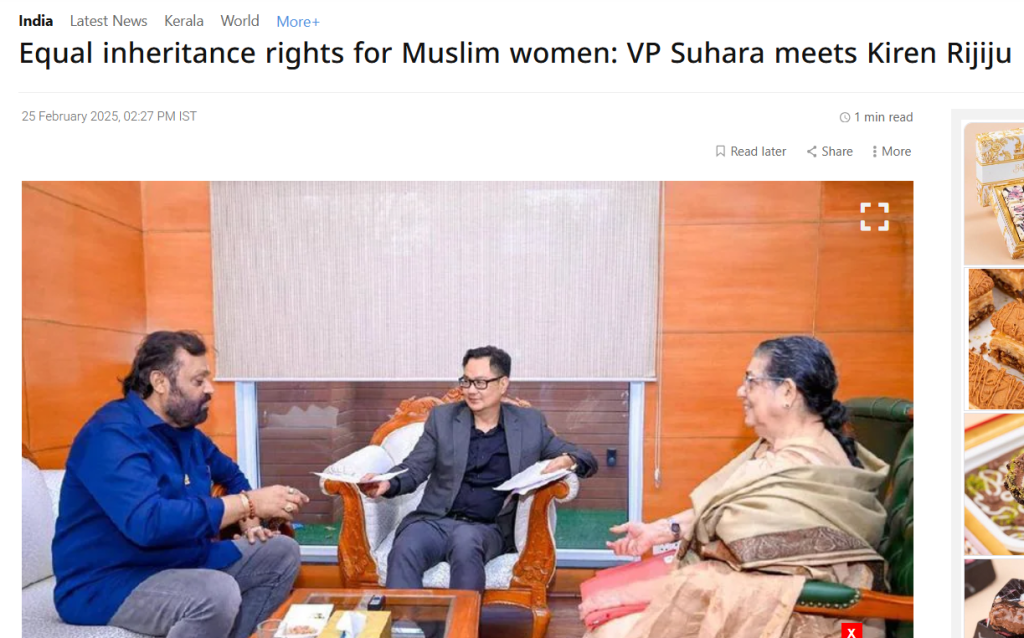
Social activist and NISA founder V.P. Suhara met Indian Minister Kiren Rijiju to demand equal inheritance rights for Muslim women in India, similar to those of Muslim men. Actor and BJP leader Suresh Gopi was also present at the meeting.
V.P. Suhara had earlier launched an indefinite hunger strike at Delhi’s Jantar Mantar, advocating for equal inheritance rights for Muslim women. However, the protest was forcibly stopped by the police. Before returning to Kerala, she announced plans to discuss the issue with key leaders in Delhi.
Did you see anyone in Kerala supporting her? Likely not. Instead, you’ll hear women with internalized misogyny saying, “We don’t want such reforms.” But these reforms aren’t for them. They are for women who seek more. Women who wish to follow traditional rules can continue to do so. Reforms do not prevent anyone from adhering to their beliefs, just as Triple Talaq is still practiced in India despite being banned. However, these reforms give Muslim women the legal option to seek justice if they are forced into following restrictive rules against their will.
When Muslim progressives like Suhara fight for women’s rights, you would expect so-called secular voices in India to stand with them. But these voices only seem to speak up when it comes to reforming Hinduism—whether it’s elephants in festivals, casteism, regressive practices, or allowing women in Brahmachari temples—because, let’s be honest, it’s far safer to push for changes in Hinduism. You see people from all communities, whether Hindu, Christian, or Muslim, openly advocate for these changes with confidence, knowing they face no serious repercussions. However, if you question some of the regressive practices in other communities, suddenly, you’re a bigot. The moment you point out that some proselytization techniques are predatory, you’re immediately accused of supporting the “restriction of religious freedom.” If you take a moment to observe people, you’ll notice countless little things that suddenly jolt you out of your slumber. You won’t need any political party to point this out to you. The double standards are there for the world to see.
When asked why the Muslim community largely does not openly advocate support for such reforms, progressive Muslims argue that it is dangerous to challenge established rules, unlike in other communities. They believe real change requires both internal and external pressure. While I acknowledge that speaking out within the Muslim community comes with risks, how long should we wait? Another century? Would it ever happen in our lifetime? Until then, are we expected to remain silent and unquestioning?
If the Indian government applies the “external pressure” suggested, it would inevitably lead to accusations of Islamophobia, further damaging the global perception of Indian Hindus and India’s image as a whole. Any attempt at reform would be spun as targeting a particular community, making meaningful change even harder to achieve.
Now, another group conveniently refuses to support this cause simply because the BJP—“the communal party”—is handling it. But name one other party that has ever stood up for Muslim women’s rights. The Opposition has always catered to Muslim men, not women, and will continue to dance to their tunes. This isn’t new; it has been the pattern for decades, ever since the Shah Bano case. If the BJP doesn’t take up the issue raised by Suhara, I can say with 100% certainty that no other party in India will.
***
Pic Source: Mathrubhumi.com (auto-translated from Malayalam)




 The Monkey Dilemma
You must be logged in to post a comment.