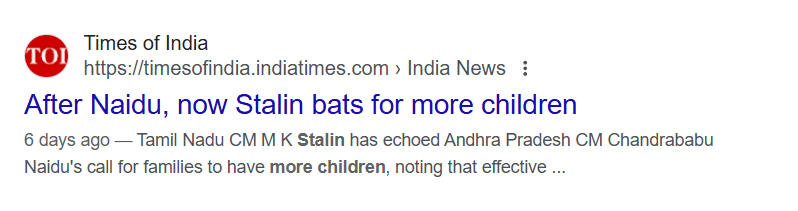
Why are South Indian leaders, like Stalin and Chandrababu Naidu, all of a sudden, pushing women to have more children? It’s not to combat the aging population as they make it seem. It’s all politics!
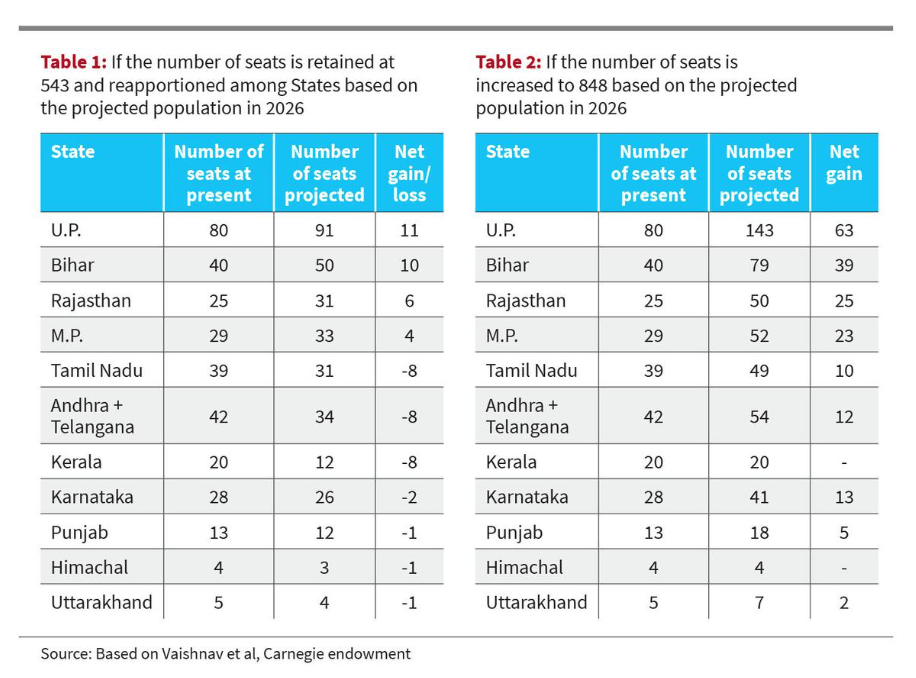
In India, there’s something called Delimitation. It’s a process of redrawing the boundaries of constituencies based on population. States with more population will get more constituencies, whereas those with low populations, like southern states, will get fewer seats. Basically, the exercise is to ensure each constituency has an equal number of people.
Since South India’s population growth is decreasing, plus migration, it won’t need as many constituencies. The total number of constituencies in Lok Sabha has been frozen since the 70s and is in place until 2026. 2026 is almost here! This is why politicians in South India are worried about women not having enough children. They don’t want to lose their seats.
As per The Hindu newspaper, Kerala, Tamil Nadu, Andhra + Telangana, all of which are South Indian states, stand to lose 8 seats each, if the current number of seats in Lok Sabha (543) is maintained.
We can expect Pinarayi Vijayan, the CM of Kerala, to make a similar statement next.
Recently, I watched the Korean drama “No Gain No Love” on Amazon Prime. I was going through a Korean drama slump, so I was unsure if I would be able to complete the drama. However, the cute chemistry between the lead characters kept me going.
What’s It About?
No Gain No Love is precisely what the name implies – if there’s no gain involved, don’t expect any love.
An ambitious woman, Son Hae-yeong, decides to enter into a fake marriage with a younger man, Kim Ji-uk, to claim office benefits. The man has his own share of secrets that he needs to safeguard from Son Hae-yeong.
Thoughts
I adored the chemistry between Shin Min-a and Kim Young-dae. Their pairing appeared fresh and different, accentuated by Shin Min-a’s perfect comedy timing and Kim Young-dae’s boyish charms.
Surprisingly, the series is bold in the sense it navigates different characters commonly unexplored in family-oriented Korean dramas. You have the leads indulging in mature, flirty conversations at the start, a departure from the usual cutesy romantic lines we are subjected to. Then, you have a writer who authors erotic books. Plus, there’s another couple engaged in an unconventional love story. The effort is commendable.
The newness of the characters aside, the story could have been written better. The plot is predictable and drags in the later episodes. However, the superlative performances save the series. It was Shin Min-a’s show through and through.
Another grievance is the considerable effort to portray the lead actress as someone younger than her age. Shin Min-a is 40 years old, whereas the character in the series is around 32-33. The smoothening filter felt overdone. Despite that flaw, the chemistry still worked for me, unlike “The Idea of You”, which had a much older character, played by Anne Hathaway, falling for a flirtatious, BTS-que boy band singer, played by Nicholas Galitzine. As long as the story and the chemistry make sense, the age difference does not matter. In “The Idea of You” the chemistry nor the story was convincing enough, but in “No Gain No Love” it was.
No Gain No Love is streaming on Amazon Prime. The series has 12 episodes, with each episode lasting roughly an hour.
I decided to watch “Nobody Wants This”, starring Adam Brody and Kristen Bell, after reading positive reviews by friends and acquaintances on social media. The synopsis on Netflix initially failed to interest me, so it never made it to my watchlist. However, after going through reviews, I decided to give it a try. “I could always stop if I didn’t enjoy it,” I reasoned. Thankfully, I found the romcom drama refreshing.
I enjoyed the side characters more than the main leads, especially the Jewish family members. They were quirky, hilarious, and surprisingly felt close to home. My country, India, is not exactly the most open when it comes to interfaith relationships. Sure, it is happening more than ever, but some questions persist.
“How will the two adjust to different religious beliefs?”
“Whose religion would the kids inherit?”
“Would we lose our child to another religion?”
These are some common questions that arise in the minds of many Hindu families when their child’s interfaith relationship progresses to the marriage stage.
Netflix’s ‘Nobody Wants This’ interestingly tackles a subject that not many interfaith romcoms have done before – conversion. Should you convert if your partner from another faith insists on it, claiming (or emotionally blackmailing) marriage is impossible otherwise? I will be honest. I do not think one has to sacrifice their identity in love. Requiring conversion as a condition for marriage feels manipulative and unfair. If your partner truly loves you, why would they expect you to change your identity?
I wouldn’t have hesitated to convert for love in my younger days. Back then, love mattered more to me than anything else, even religion. However, as I matured and understood life better, I realized you can follow your heart without leaving your brain behind. You don’t have to bend over backward in love. That’s the beauty of aging – you realize that sacrificing your identity is never an option. Your partner has to accept the way you are.
Yet, some people, unable to disappoint their parents, push their partners to take this extreme step. If they can’t disagree with their parents over an important issue such as the partner’s identity, how will they ever be able to support the partner when issues involving parents over less important matters pop up in the future? Once you let go of your identity, more demands pour in – you are expected to raise your children following only one belief and break off all ties with your “old” religion. It is an overwhelming decision no one should be subjected to, especially on the people you love. One sacrifice is often followed by umpteen other sacrifices.
I am glad this aversion to conversion is gaining traction in India, with many refusing to convert for marriage. In fact, some people are even choosing to end their relationships over it. Why convert when our legal system allows couples from different faiths to marry in court?
The romcom touches on this sensitive topic of conversion and the ideological differences between the two communities. One is liberal, the other conservative. How to tackle differing opinions? The main characters aspire to provide you with an answer.
‘Nobody Wants This’ is streaming on Netflix. It has a total of 10 episodes, with each lasting around 30 minutes.
While reading today’s newspapers, an interesting trend caught my eye. Most newspapers in India are left-leaning, so election results are primarily presented in a way that props up the left-leaning parties. For example, “NC got a thumping victory,” in contrast to a more subdued “BJP earned a hat-trick in Haryana.” No fancy adjectives. Another example is “J&K has rejected BJP’s politics” while failing to report that BJP’s vote share has been increasing in J&K with every passing election. In some newspapers, Vinesh Phogat’s win was highlighted more than the overall performances of individual parties.
The election results declared on 8th October have been filled with surprises. However, due to the media’s own biased leanings, not every fact made it to the papers. Here are some of the top surprises from the Haryana and J&K Elections 2024.
BJP getting more seats than Mehbooba Mufti’s PDP in J&K
From a party that used to get single-digit votes in Kashmir, BJP’s vote count has now risen to four digits. The party came second in J&K, beating Mehbooba Mufti’s PDP.
PDP is an indigenous Kashmiri political party. The party has been on the political scene in Kashmir for ages. This time, most of the PDP’s votes went to NC in the Kashmir region. PDP’s association with the BJP in the recent past proved to be its undoing. Interestingly, this camaraderie did not have the same effect on the BJP, as its vote share increased from the 2014 elections.
Courtesy: The Hindu
No one, including BJP members, ever countered the fact that BJP would not win a single seat in Kashmir. It was reported that even the people of Jammu, along with Kashmiri Pandits, BJP’s primary vote base, were dissatisfied with the saffron party as their demands were left unaddressed.
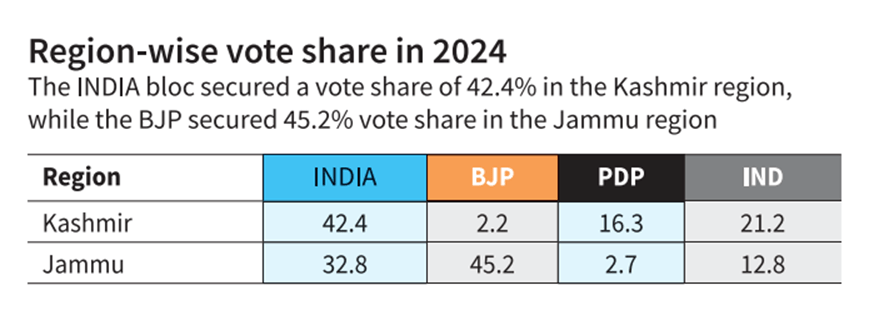
Considering that politicians like Omar Abdullah were saying there was intense anger brewing in the valley beneath the surface of peace and tranquility, it was surprising to see the BJP not only increase its number of seats without an alliance but also its overall vote share in J&K albeit marginally, as compared to the 2014 elections.
If we were to analyze just Kashmir alone, the BJP neither lost nor gained its vote share (2.2%) in the region. So, in summary, the BJP increased its seats/vote share in Jammu while maintaining its vote share in Kashmir. If the Abrogation of Section 370 was indeed a major point of discontent for J&K locals, we should have seen a drastic decrease in BJP’s seat count/vote share. But that’s not what happened.
Courtesy: The Hindu
The media and politicians might paint the Kashmir election results as a big loss for the BJP and a “befitting reply to BJP by the people for the Abrogation of 370”, but the data seems to indicate otherwise. Yes, they did not win a seat, but the fact that in many seats of Muslim-dominated Kashmir, BJP came second, beating Congress and PDP, implies there’s far more to the story than what meets the eye.
BJP losing Gurez in Baramulla by a mere 1132 votes
Gurez is a seat that is 98% Muslim and where the BJP did not have any presence till now. Faqeer Mohammad Khan from the BJP lost by a mere 1132 votes to NC’s Nazir Ahmad Khan.
This close contest has been the biggest shocker from the Kashmir region, considering the BJP is always portrayed as an “anti-Muslim” party.
There is a misconception that Jammu is a “Hindu-only” area and Kashmir is a “Muslim-only” area. Jammu has areas with a significant Muslim population. One such area is Kishtwar, a district that has long been a hotbed of militant activities.
Shagun’s father and uncle were murdered by Hizbul Mujahideen terrorists in 2018. She initially had no plan to join politics, but after the murder of her father and uncle, she felt the need to bring about a change. Her victory, albeit by a small margin, proved to be sweet revenge.
Speaking to the media after the verdict, she said: “We have lost a large number of our soldiers. I have lost my father, and some have lost their brothers and sons. My first effort will be to ensure that every child here has the shadow of a father over his head and that there is peace and prosperity in the area. My efforts will be to bring happiness to every home.”
Jamaat-e-Islami and former separatists faced a big loss in J&K
When members from banned radical groups like Jamaat-e-Islami and former separatists were allowed to contest this election individually, many were worried.
As Kashmir continues to be a sensitive zone, analysts questioned the motive behind this move and the consequences of having radical elements elected into power. However, the people of J&K answered this pressing question through their votes, resoundingly rejecting the radicals and choosing a party like the National Conference instead, which believes in working democratically within the rules of the Indian constitution. This has come as a relief for many, especially since Engineer Rashid was elected as MP in the Lok Sabha elections.
The loss of Engineer Rashid’s party in the J&K election has provided ample proof that his victory in the Lok Sabha elections was a case of sympathy voting. His sons had extensively campaigned for him before general elections, saying the only way their father could escape jail was if he became an MP. However, in the case of the J&K elections, Kashmiris seemed to have drawn a line, and Rashid was unable to replicate his victorious stint in the general elections.
Congress in a way lost both Haryana and J&K
Even though Congress is an ally of the NC in J&K, their standalone performance proved to be lackluster. Congress managed to earn only 6 seats in J&K, compared to BJP’s 29. This cannot be considered a victory for Congress. In Jammu, too, an area where they were stationed to put up a strong fight against the BJP, they managed to win only one seat.
NC leader Omar Abdullah admitted post-election that, in hindsight, the alliance was unnecessary as they would have won the election anyway without the help of Congress.
Haryana outcome
Haryana’s election results came as a shock to everyone, including right-wingers. The trend was overwhelmingly leaning towards anti-incumbency in the state. BJP has been ruling Haryana for over a decade, and there were a plethora of issues surrounding “farmers, soldiers, and wrestlers” plaguing the state.
However, around a month back, it was reported that the non-Jats were having second thoughts about Jats supporting Congress and gaining power. This led to a consolidation of non-Jat votes against Congress. It is a simple case of caste-based politics gone wrong for the party.
Courtesy: The Hindu
RSS played a huge role in BJP’s victory
Reportedly, RSS went above and beyond in Haryana, campaigning door to door, distributing pamphlets that highlighted the dangers of caste-based divisive politics, ensuring everyone got their voter slips on time, and organizing outreach programs.
In the Lok Sabha Elections, it was reported that there had been a fallout between the BJP and RSS, which led to RSS members not making any effort to help the BJP. BJP seems to have realized its blunder post-election and made a conscious effort to re-establish connection with RSS, which is undeniably its backbone. Several changes were made in Haryana based on RSS’ recommendations. It ended up proving effective.
Conclusion
Yet again, Exit polls in India have turned out to be a disaster. You never know what the janta is thinking. There are silent voters who make their stance known only through their votes. Exit polls have been unable to infiltrate that section.
One thing is clear: this election has been a big win for democracy, especially in the Kashmir valley. The turnout was impressive. The trust they placed in the Indian democratic process is noteworthy. As Modi mentioned, the peaceful conduct of the J&K election has proven to be a victory in itself.
Gyeongseong Creature captivates you with every frame. The intricate storytelling, excellent performances, and impeccable cinematography hook you from the start.
I completed Season 1 the day it was released on Netflix. I did not leave a review on this website even if I enjoyed it as laziness got the better of me. When Season 2 was released, I knew I had to watch it, but I thought of taking it a bit slow and spread it over the course of a week so I would not spend too much time glued to my couch. However, once I started, I couldn’t stop, and I binge-watched it in a day. This, in short, gives you an idea of how I felt about the series.
What’s It About?
Gyeongseong Creature, as the name gives away, is a creature born in the labs of power-hungry monsters. Their sinister motive makes them more repulsive and horrifying than the Najin they created. The first season, which starts in 1945 during the late stages of the Japanese occupation of Korea, explores this origin story in detail. The second season takes place in a free Korea, where the evil elements are still at play.
Thoughts
Season 2 isn’t as perfect as Season 1, but it still has much to offer. Park Seo Jun and Han So Hee shine in both seasons. Special mention to Claudia Kim, who played Lady Maeda. She portrayed the character with such finesse that you cannot help but admire and loathe her at the same time. I also liked the new character in Season 2, Seung-Jo. Like Lady Maeda, Seung-Jo is a complicated character with many layers. His angelic looks contrast his duality.
Once I compeleted the series, I couldn’t help but relate it to the current world. We aren’t even remotely close to what is shown in the drama. Yet, you can’t help but consider the possibility of this absurdity getting executed in a smaller, intangible capacity in the wrong hands. In their pursuit of power, some leaders may be willing to sacrifice lives to achieve their goals. If a time comes when leaders cease to distinguish between right and wrong, how will ordinary civilians cope? Gyeongseong Creature offers a thought-provoking message in that sense.
Gyeongseong Creature is streaming on Netflix. The first season has ten episodes, and the second has seven. Each episode lasts roughly an hour.






 The Monkey Dilemma
You must be logged in to post a comment.