An Ode to Kabhi Main Kabhi Tum

Kabhi Main Kabhi Tum
Hania Aamir plays the character of Sharjeena in Kabhi Main Kabhi Tum

I came to know about the Pakistani drama Kabhi Main Kabhi Tum from YouTube recommendations. This was one of those times when YouTube got its algorithm right.

I wasn’t initially sure whether I would like the drama, but once I started, I was hooked. It is no surprise that Kabhi Main Kabhi Tum has gained popularity in India. The reasons are plenty.

Focus on Relationships

The story focuses on everyday relationships. It does not aim to convey any profound social message. The drama is not entirely progressive, but as the audience, the onus lies on us to accept the fictional world of those characters.

We are at an age where we look into political correctness in every movie or drama. This mentality somehow has ruined the movie-watching experience for people like me who prefer rawness over perfection. Indian filmmakers have become too cautious and afraid to offend, which is understandable considering the polarized times we live in. However, they can still develop unique story ideas that are family-oriented.

Most Indian movies and dramas getting appreciated nowadays are dark. If, by chance, a love story gets released, people are quick to dismiss it as cringe, misogynistic, or fake. Box office numbers also reveal that romantic movies have lost their appeal in India. Or maybe it’s because we are not coming up with a captivating love story. Due to this, many filmmakers stay away from making out-and-out romantic, feel-good movies.

So, considering the lack of romantic content, it’s understandable why many Indians are drifting towards Korean and Pakistani dramas like Kabhi Main Kabhi Tum that keep the old-world romance and family-centered stories alive.

The primary takers of romance are women. Most of us understand that the romance shown in movies is make-believe and not realistic, yet we crave a world that we can deep-dive into when we are stressed. Unfortunately, there are not enough choices for us nowadays. This is why dramas like Kabhi Main Kabhi Tum come as a refresher.

Clean Love Story

Kabhi Main Kabhi Tum meets the bill of sweet, clean love stories that we used to enjoy in the past. No one is making out the moment they meet; no one has an “I am cooler than you” attitude. The chemistry is there for your eyes to see. They look lovingly at each other with slight smiles, enjoy quiet dinners sitting on their bedroom floor, and mesh into each other’s lifestyles even if they are poles apart. Small things that make a significant impact.

Beautiful and Relatable Styling

I absolutely love Sharjeena’s free-flowing Pakistani outfits. The styling gives you a feeling that you, too, can pull off the outfit. The hair is not overstyled; the fit is comfortable and suitable for all body sizes, and there is a feeling of relatability when you see it. Nothing seems out of reach for the regular person.

No Realism Fatigue

I personally do not wish to experience realism fatigue while watching a movie or drama, so a good balance of relatability and aesthetics is ideal. To clarify, you might have seen several scenes in Indian dramas/movies shot in the bathroom where the main character is shown answering nature’s calls. They are realistic but not aesthetic. So, in my opinion, such scenes are better avoided in a make-believe world. We don’t need to know if the character peed or pooped or has a runny nose or sweaty face. Some things are better left for the real world.

Conclusion

I believe Indian filmmakers should take note of the popularity of Korean and Pakistani dramas in India. They should recognize that there is a market for such content, which they are currently neglecting to cater to. To create such wholesome dramas or movies, first and foremost, we need better storytellers. Korean dramas are written by female writers, which brings a unique female perspective to the stories. Perhaps Indian filmmakers should consider hiring female writers to bring back the charm of feel-good content in our films.

Is Hinduism a Pagan Religion? Is a “Hindu State” Dangerous?

I’ve always viewed Hinduism as a mainstream religion. However, I recently learned that there are people, especially outside India, who consider Hinduism as “pagan.” Surprisingly, even within India, some Hindus refer to themselves as “the last polytheistic pagans remaining on earth.” 

However, an article on Scroll by Arvind Sharma presented an interesting explanation of why Hinduism cannot be considered Pagan.

Arvind Sharma Book Quote

This pluralistic nature of Hinduism could explain why India, a Hindu-majority country, is able to embrace the beliefs of diverse communities. Communal clashes happen, but everyone is free to complain. There is no existential threat. The freedom to complain is in itself an underrated freedom. People in several countries cannot question their government or the majority religion. Sadly, we often take this freedom for granted.

Currently, there is no self-declared Hindu nation; all nations with a Hindu majority identify as secular. Even if a country were to declare itself a “Hindu nation” in the future, the principle of secularism would likely endure, as the idea of secularism is deeply embedded within Hinduism itself. So, a Hindu nation will not be one that would force people into converting to Hinduism, but one that is already in effect and on full display in Hindu-majority nations. Take the case of India. LGBT couples can have a joint bank account in India, abortion is legal, and atheism is tolerated. You are free to worship your god, not worship a god, or go to any religious place of your choice. No one is going to force you to wear a religious symbol or yank it off you. 

Is India perfect? Definitely not. It’s like any other pluralistic nation. There is discrimination, but not to the extent the media, especially Western media, reports.  Some even peddle fake news as the reality, without hearing both sides of the story.

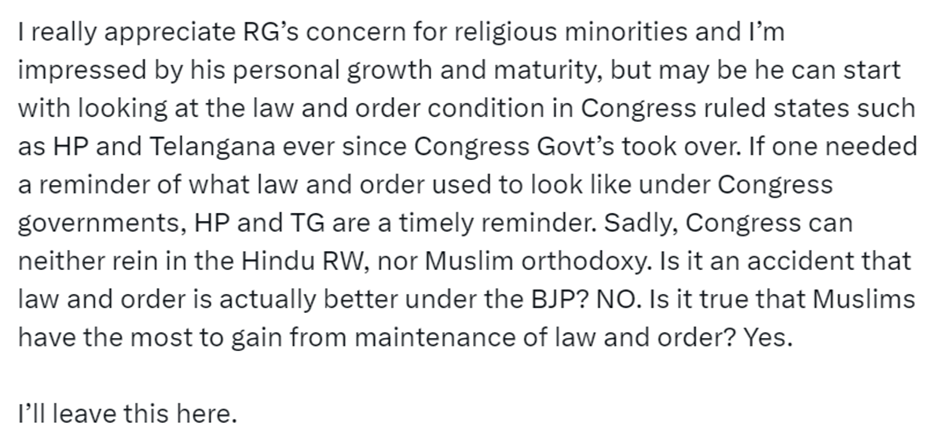
The problem with religious propaganda is that it attracts the wrong kind of people. Recently, Rahul Gandhi said that Sikhs are unable to practice their religion freely in India. This came as a shock to many, including Sikhs in the country, as there have been no such allegations in the last decade from the community. However, the leader of a separatist group was happy and quoted Rahul’s words to reinforce the group’s agenda to form an independent nation for Sikhs that spans parts of India. Similarly, allegations against India of being Islamophobic have triggered radical Islamist groups like ISIS. The group frequently references India (particularly Hindus) in their newsletters, using the country’s internal clashes to advance its agenda and emphasize to its followers the need for “disciplining” us.

Seeking justice is acceptable. However, I hope people, especially Indians, are mindful of exaggerating communal events in the country, as they often end up catching the attention of extremists, who then use the news to create propaganda videos and material for fueling hatred and recruiting new members to their groups. When the time comes, extremists do not look at political party affiliations, religion, race, color, caste, region, or language before they cause havoc. Everyone is the same for them. Being wary of social media activism is essential for our country’s well-being. We should double-check details from both left-wing and right-wing sources to get a full idea of the story. Most journalists in India today are biased, which is why due diligence is required before endorsing/believing stories.

Before signing off, I wish to share this tweet by Shehla Rashid, which beautifully debunks the communal allegations against India.

Shehla Rashid Tweet

Korean Drama Spotlight: Itaewon Class

Itaewon Class

It has been a while since I completed a Korean drama. I fell into a slump after watching Doctor Slump (pure coincidence). I am not exactly sure why. It is not that I didn’t start any new ones. I did, but I never completed them. I was probably missing the crackling chemistry I witnessed in the first few Korean dramas, or it was K-romance fatigue. I’m unsure. However, finally, that dry spell has been broken.

I had been holding back on watching Itaewon Class because I wasn’t sure if it would be my cup of tea. I’m happy to report I enjoyed it. The good reviews are justified.

What’s It About?

An ambitious ex-convict starts a new pub in the busy streets of Itaewon with the main motive of seeking revenge. The series focuses on how he and his loyal staff work together to fulfill the seemingly impossible dream of beating the best pub in town.

Thoughts

I am convinced Park Seo Joon is the best Korean actor out there. I am yet to feel underwhelmed seeing his performance. He not only handles the nuances of his characters perfectly, but his understated charisma has the power to keep you hooked. Itaewon Class is no different.

However, the main star for me in Itaewon Class was Kim Da-mi. Her character is beautifully sketched, a total badass woman who doesn’t resort to the stereotypes of the “modern woman” we see on the big screen. Usually, in new-age cinema, a woman of today is depicted as someone promiscuous and flippant. But in Itaewon Class, the female characters have different shades, they aren’t black or white, they are all sorts of grey. Kim Da-mi plays someone who is, in her own words, a “social psychopath,” yet she feels deeply for her boss and his painful past.

Soo-ah, played by Kwon Nara, is ambitious and a go-getter who does not believe in making sacrifices, such as leaving her cushy job to maintain relationships. She has a “my way or the highway” aura about her, yet she’s soft. Ambitious women are often portrayed in a villainous way, but kudos to the writer for showing how a woman can follow her dreams and still be vulnerable, and that it’s okay if she wants more.

It was interesting to watch such multilayered female characters in a series because it’s not something I often come across in Indian cinema.

Itaewon Class is streaming on Netflix. It has 16 episodes, with each episode lasting over an hour.

Hindus Least Likely to Migrate, India Is Top Source and Destination Country: Pew Survey

Did you know that around 3.6% of the world’s population lives outside their country of origin? The Pew Research Center has come up with some interesting insights on the religious composition of the world’s migrants in their latest survey. Who migrates more? What are the top three origin and destination countries for each community? Which country hosts the most number of immigrants? The survey answers all these pertinent questions and more with detailed insights.

This post includes infographics created by the CNN-News18 creative team.

Reasons for migration

Why do people migrate? The survey reveals several reasons, such as the need to find jobs, to live with other family members, or for better education. However, religion also plays a part in migration. Migrants have often moved to escape persecution. There is also the need to live with people with similar religious beliefs.

Migrant Groups by Religion

To quote the survey, “Many migrants have moved to escape religious persecution or to live among people who hold similar religious beliefs. Often people move and take their religion with them, contributing to gradual changes in their new country’s religious makeup.

Worldwide migrant counts have increased for all major religious groups

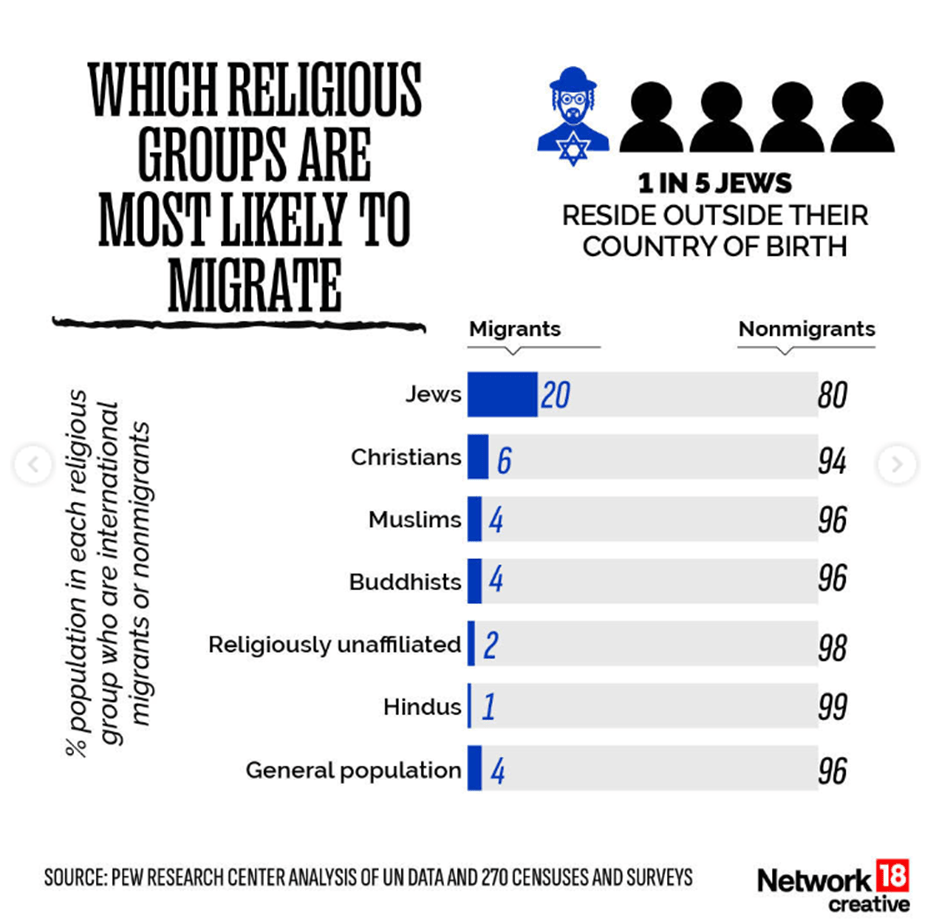
Religious groups most and least likely to migrate

Hindus tend to migrate less as compared to other religious groups and Christians are most likely to migrate from their place of origin.  

Hindus are less likely to migrate

As per the survey, “Christians are the largest migrant group, but Jews are most likely to have migrated.”

Jews are most likely to migrate

The top source and destination country for Christian migrants

To quote the survey, Christians make up a much larger share of migrants (47%) than they do of the world’s population (30%). Mexico is the most common origin country for Christian migrants, and the United States is their most common destination.

Top source and destination countries for Christian migrants

The top source and destination country for Muslim migrants

In relation to Muslim migrants, the survey says, “Muslims account for a slightly larger share of migrants (29%) than of the world’s population (25%). Syria is the most common origin country for Muslim migrants, and Muslims often move to places in the Middle East-North Africa region, like Saudi Arabia.” Interestingly, Muslims tend to prefer migrating to “richer” regions that follow their religion. The top destinations for the community are Muslim-majority nations, such as Turkey, Saudi Arabia, and UAE.

Top source and destination countries for Muslim migrants

The top source and destination country for Hindu migrants

As per the survey, “Hindus are starkly underrepresented among international migrants (5%) compared with their share of the global population (15%). India is both the most common country of origin and the top destination for Hindu migrants.” Hindu migrants to India are most likely to originate from neighboring regions like Afghanistan, Pakistan, and Bangladesh, where minorities face severe persecution. This is evident from statistics indicating a drastic decrease in minority numbers within these regions over the years.

Top source and destination countries for Hindu migrants

The Pew Survey offers a lot more detailed insights, so I would highly recommend going through it.