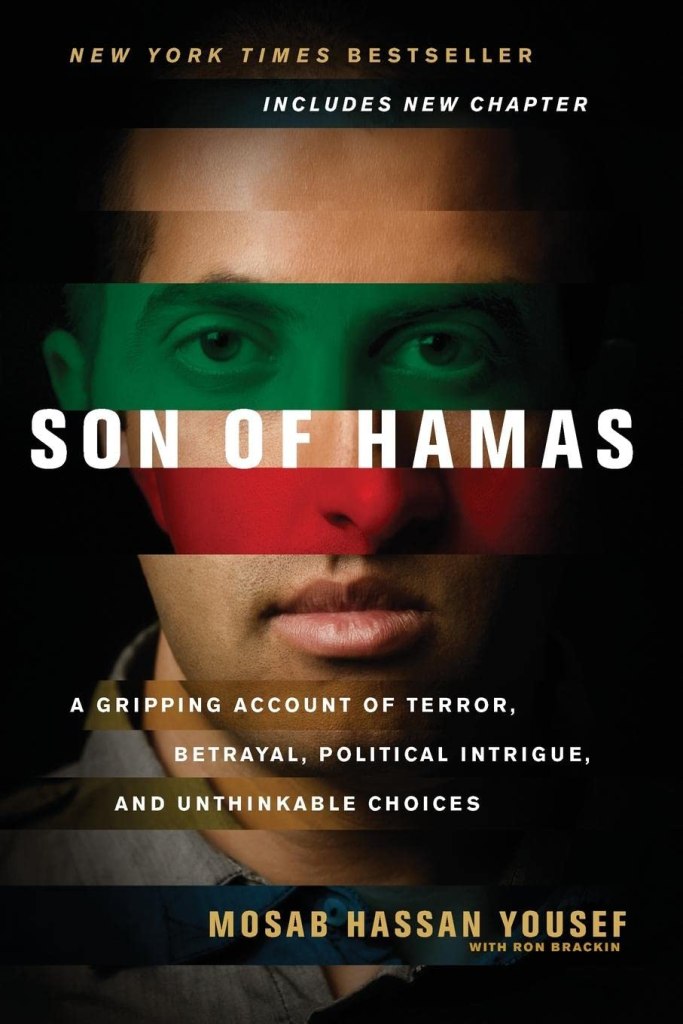
An acquaintance recommended “Son of Hamas” to me. As the title clearly gives away, it is a book by the son of a Hamas founding member named Mosab Hassan Yousef, nicknamed the “Green Prince.”
Son of Hamas is a controversial book in that it has Mosab openly criticizing Hamas. He started off as a radicalized youngster, ready to kill Israeli troops for revenge, but soon, his experience over the years with Hamas ended up being an eye-opener. Many Hamas sympathizers consider him a traitor to the Palestinian cause, but he has his reasons. I would suggest getting the book for further details.
Mosab does not in any way undermine the struggle of the Palestinian people. He, in fact, starts the book by narrating the oppression his people face on a day-to-day basis. Your heart aches for the Palestinians after reading his account. He wanted only the best for them, so over time, he started resenting the questionable morality of the extremist group he was affiliated with.
Mosab has been giving several interviews on news channels these days, vociferously lashing out at Hamas. You might find a couple of them on YouTube. His youngest brother, too, left the group recently.
Before I begin, I would like to make my stance clear. I am pro-civilian. I condemn the horrible October 7 attacks that took place in Israel, and I equally condemn the death of innocent civilians in Gaza. Several things can be true at once. I feel incredibly sorry for everyone involved in this mess. A lot of pain, fear, anger, and hatred spanning several years has led everyone to this moment. However, I will not use any excuses to justify the deaths from either side. No one deserves to die in such a cruel way. Personally, I feel any rationalizations and reasonings belittle the suffering of the people going through a loss.
I am also anti-Hamas. I am against their charter that calls for the complete annihilation of Israel. After watching several interviews featuring Hamas leaders, I have come to the conclusion that Gazans deserve better—a life that is peaceful, sustainable, and prosperous, things that Hamas cannot give them.
Disclaimer: If you are pro-Hamas, this page may not be for you. Instead of putting yourself in a sensitive spot, I request you stop reading right here. The quotes on this page are for those who are curious about why Mosab thinks Hamas is neither good for Palestinians nor Israelis. If you have already made up your mind that Hamas is a freedom fighter or resistance movement, I humbly request you to exit this page.
So, let’s get started.
Here are some of the controversial quotes from the book:
Truth and forgiveness are the only solution for the Middle East. The challenge, especially between Israelis and Palestinians, is not to find the solution. The challenge is to be the first courageous enough to embrace it.
Peaceful coexistence would mean the end of Hamas. From their perspective, the organization could not thrive in a peaceful atmosphere. Other resistance groups also had a stake in the continuation of conflict. It’s hard to achieve peace in a place where so many have different goals and interests.
And it would be many painful years before they would begin to understand that Hamas was not an organization as most people understood organizations, with rules and a hierarchy. It was a ghost. An idea. You can’t destroy an idea; you can only stimulate it. Hamas was like a flatworm. Cut off its head, and it just grew another.
Even as a young boy, I saw the PLO as corrupt and self-serving. Its leaders sent people, many of whom were just teenagers, to carry out one or two high-profile terrorist attacks a year in order to justify fund-raising for the struggle against Israel. The young feda’iyeen were little more than fuel to stoke the fires of anger and hatred and to keep the donations flowing into the personal bank accounts of PLO leaders.
I understood that we all share the same common enemies: greed, pride, and all the bad ideas and the darkness of the devil that live inside us.
I asked myself what Palestinians would do if Israel disappeared—if everything not only went back to the way it was before 1948 but if all the Jewish people abandoned the Holy Land and were scattered again. And for the first time, I knew the answer. We would still fight. Over nothing. Over a girl without a head scarf. Over who was toughest and most important. Over who would make the rules and who would get the best seat.
Tit for tat, the reciprocal killing continued. An eye for an eye—and there was no shortage of eyes.
My father didn’t care if Hamas fielded candidates. He just didn’t want to fill the ticket with high-profile leaders like himself who were loved and admired by the people. If that happened, he feared, Hamas would win. And he knew a Hamas victory could prove to be a disaster for the people. Events proved him right.
As I sat on the plane, I thought about what I had just left behind, both good and bad—my family and friends as well as the endless bloodshed, waste, and futility. It took a while to get used to the idea of being really free—free to be myself, free of clandestine meetings and Israeli prisons, free from always looking over my shoulder. It was weird. And wonderful.
As long as we continue to search for enemies anywhere but inside ourselves, there will always be a Middle East problem. Religion is not the solution. Freedom from oppression will not resolve things either. It is a cliché, but it’s still true: hurt people, unless they are healed, hurt people.
The events of this last year have shown me again that friendship and love are stronger than agency, policy, and tradition. No matter what happens, I will continue to speak out with firm conviction that unconditional love for the “other” side and forgiveness for those who have hurt us are the only principles that will lead to healing and a better way for us all.

 The Monkey Dilemma
One thought on “11 Controversial Quotes by the Son of Hamas”
Comments are closed.