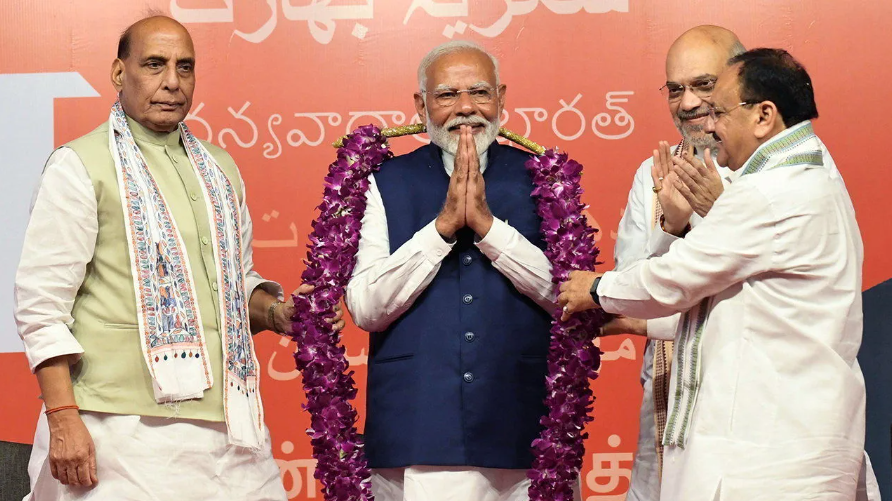
The recent election in India was proof that the BJP is not invincible. Despite the party’s considerable efforts in improving the economy, it failed to connect with the people at the grassroots level. Voters ultimately prioritized free benefits and voted based on caste and religion in rural areas, where the BJP performed poorly. These are the exact issues the government had been working to avoid because they do not contribute to India’s growth in any way.
The election outcome cannot be blamed on the voters, as it is understandable why promises of freebies and jobs with guaranteed 1 lakh salaries were more alluring than infrastructure or development, no matter how burdensome such things might prove for the exchequer. Saying no to such promises is a luxury reserved for the privileged.
It needs to be acknowledged that all political parties, not just the BJP, have played a role in fueling discontent, animosity, and disharmony among communities. It is a collective failure that we, as a society, allowed ourselves to be divided along religious lines. The INDI alliance, too, resorted to fear tactics and misinformation in the name of secularism to further their agendas. As the opposition parties relentlessly worked on propagating their “savior” image, people were quick to believe that the answer to all their solutions, like poverty and joblessness, was the INDI alliance.
I have always been of the belief that one should judge a party/politician by the work they do, not the words they utter. But unfortunately, we are quick to believe hate narratives and forget that in this big bad world of politics, there is no savior, only megalomaniacs greedy for power.
To gain back confidence, the coalition NDA government needs to pull up its socks. Things are far from gloomy for the BJP, as they still are the party with the most seats (240) in India. Congress comes a distant second with their 99 seats. However, BJP’s performance was still a big disappointment to its supporters who expected their party to get more support, especially in Uttar Pradesh, where the sacred Ayodhya temple was built after a long period of wait.
Some changes are in need of the hour. What can the Indian coalition government do to improve its performance? Here are my takes.
Don’t take success for granted
Undoubtedly, this has been the biggest lesson for the ruling party that you should never take your success for granted. The BJP became overconfident with their “400 paar” declarations, which resulted in them not doing enough groundwork.
Many reasons are mentioned for voter dissatisfaction in places like Uttar Pradesh, but the parties would have more accurate insights than us, the speculators. RSS workers allegedly did not campaign extensively or help voters reach the booth, there is also an allegation of missing votes, not enough compensation for people who lost their homes to make way for the temple, etc. Regardless of the issue, the fact remains that the BJP and RSS did not make an effort to connect with voters in rural areas and understand their issues. Instead of providing justifications, the BJP should regroup and focus on the areas where it faltered.
Outreach programs for minorities
Most Christians and Muslims I know are frightened of the BJP. This is where the opposition party made a resounding impact, albeit in a negative/divisive manner. The local politicians went around, scaring people into thinking they would be evicted if the BJP came into power. Elderly, economically disadvantaged Muslims who were approached by news channels were seen pleading to the general public with teary eyes, “Please don’t vote for the BJP. If they come into power, they will kill us.”
Who is responsible for this fearmongering? The “Hindu vs other religions” narrative has gained such solid ground that it seems next to impossible to convince minorities that Hindus mean no harm to anyone. Media, too, has a huge role to play in spreading this fear. Due to their irresponsible journalism, done solely to put Modi in a poor light, they ended up creating irreparable damage.
It became easier for the opposition to spread hatred after the emergence of the Ayodhya Temple. No one from the ruling party made an effort to explain to the minorities that these sites are as important to religious Hindus as Mecca or Medina for Muslims or the Vatican for Christians. Justice was denied to the Hindu community since the Mughal era when temples were brutally demolished to make way for mosques. A few Muslims realized this, such as the archaeologist KK Muhammed (the one who studied the site and came to the conclusion that the mosque was brazenly built over a temple) and the BJP Malappuram candidate Dr. Abdul Salam. Both of them have openly said on news channels how other communities should show empathy to “our Hindu brothers and sisters” as the community was subjected to extreme unfairness in the past, so much so that even their most sacred sites were denied to them. It takes a great deal of empathy to acknowledge someone else’s turbulent past, and you can’t help but feel gratitude for such people.
As no effort was made by the ruling party to bridge misunderstandings, political parties milked the opportunity for what its worth. Rest assured, they will continue to use the sacred temple as a tool for playing politics, further increasing the divide between Hindus and other communities. BJP should realize communication is key and work towards improving the skill to effectively clear misunderstandings.
The BJP team in Thrissur (Kerala) appeared to have been effective in their communication, which may explain why the party received Christian votes despite the opposition’s efforts to portray the Manipur issue as a communal clash. Interestingly, it was only after the elections did priests and bishops in Kerala clarified that the Manipur issue is not communal but rather ethnic. However, by that time some individuals on the ground had already done enough research to discover this on their own.
BJP often lags in countering allegations or taking strict action against the hatemongers. They never communicate their side of the story or a simple “you are safe with us,” the absence of which leads to speculations and uncertainty. They need to interact more with minorities at the ground level and induce confidence in them by clearing their misconceptions. This can come only with proper effort.
Offer financial relief to citizens
In rural areas or for those with low income, freebies are highly valued. However, it’s important to note that these freebies are often funded by taxing the middle class. The government should find a way to carefully balance the two – providing assistance to the poor without burdening the middle class. While investing in infrastructure and development projects is beneficial for the economy, it’s crucial to also provide some relief to ordinary citizens.
Avoid polarizing language
In order to gain the trust of more people, the BJP needs to use more restrained language. While Modi’s “ghuspetiyas” comment was aimed at illegal immigrants, it was twisted by the opposition for their own benefit, leading to fear-mongering.
Many people now understand that words uttered by politicians often mean nothing and are solely used as a tool to sway voters. They understand it’s a game. However, others may take it more seriously. To prevent this, simple language should be used, and the intention should be clearly specified.
***
Picture Courtesy: Getty Images
 The Monkey Dilemma
You must be logged in to post a comment.