Ramayana: We Need to Talk About Ravan

Namit Malhotra's Ramayana Poster

Ever since I watched the Ramayana trailer in the theatre (this was during Spider-Man: Brand New Day), I knew it was going to be a visual treat. A must-watch in theatres. But with immense work pressure over the past week, I felt more inclined to rot at home and relax over the weekend than to head out. I had to push myself, mainly because I was worried the movie might not run for too long in Keralam.

I’m glad I made that decision. It’s also great to see the movie doing exceptionally well in Keralam and that my worries were unfounded. It has even surpassed Dhurandhar 2 in box office collections, making it the highest-grossing Bollywood movie in the state.

Getting back to the movie, what can I say? I was completely blown away by the CGI and VFX. If you haven’t watched it in theatres yet, OMG, what are you waiting for? It’s absolutely worth spending three hours on. So proud to see a movie of this scale come out of India (all the more reason to experience and support it on the big screen).

My favourite character in the movie wasn’t Ram (played by Ranbir Kapoor) or Ravan (played by Yash), but Lakshman. He’s such a charmer. Ravi Dubey, who plays Lakshman, has become an icon of sorts in Thailand, where the movie is breaking box office records.

I expected Sai Pallavi to recreate her Shyam Singha Roy look, where she looked drop-dead gorgeous with that stunning eye makeup and attire. I felt the makers could have done a lot more with her look. But I also dislike comments suggesting that another actress, basically someone “fairer”, would have looked better in the role. That’s colourism, right there. I love Sai Pallavi, and I felt she portrayed Sita with the innocence the character deserved.

Jatayu Stole the Show. Period.

The Jatayu fight scene is undoubtedly the highlight for me. It was mind-blowing. Seeing children cry after the fight scene made me realize the extent of the impact Jatayu had. Not to lie, I felt a bit emotional too. The visuals during the fight were extraordinary.

Jatayu Earth Centre Kerala
Jatayu Earth Center. Photo by Prakash Achari.

And yes, Jatayu fell in Keralam, not Andhra, at a place called Chadayamangalam in Kollam (which is where the Jatayu Earth Centre is located). The location is gaining immense popularity after the release of Ramayana. I’m in Kerala and have still not managed to visit this place. I had actually suggested this spot to my relatives several times in the past, but they weren’t particularly interested. Their reasons? It’s too far from where we stay, it would be too hot and humid, and there’s too much walking involved. I hope the movie has finally sparked some interest in them. Maybe they’ll agree to visit now.

Inspirations & Adaptations

Coming to the story, the movie doesn’t strictly follow the original Valmiki Ramayana. But the makers have already included a disclaimer at the beginning, stating that the film draws inspiration from various retellings of the epic. So it’s understandable that they’ve borrowed elements from modern adaptations.

Some of these adaptations portray Ravan as an oppressed figure (he and his clan were anything but oppressed in the original Valmiki Ramayana) and Sita as a fighter. These interpretations, which are also part of the movie, may not align with the original epic, but we can let some of it go by considering it as part of the filmmakers’ creative freedom.

Another noticeable departure is Sita Haran, or Sita’s abduction by Ravan. It wasn’t depicted in the way it happened in the original epic, where she was taken by force.

So, I would say there’s definitely an attempt to humanise Ravan, if not outright whitewash his character. Could Yash’s involvement as a co-producer have something to do with this? Maybe a more nuanced portrayal of Ravan was a creative choice. Probably they did not want an outright negative portrayal because it might not sit well with some of his fans. This is merely speculation. We might never get to know the full extent of the truth.

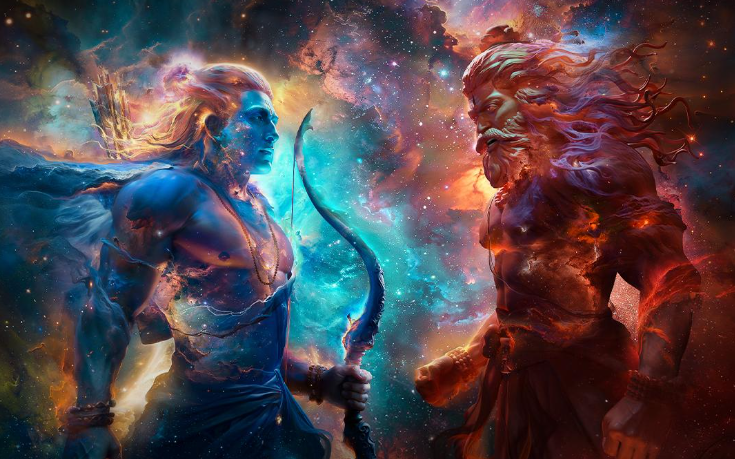
On a completely different note, I absolutely loved how the gods, Brahma, Vishnu and Shiva, were portrayed in the movie. I have always loved Naveen Concepts‘ artwork on Instagram and have often wished to see that kind of visual interpretation in movies, where gods are presented as celestial bodies rather than humanoids. Ramayana gave me exactly that. It was such a treat to watch.

One particularly interesting interpretation of Ravan: “The one big risk was Ravan’s ten heads. They literally made them ten personalities fighting inside his mind.” This was from another modern adaptation. Quite an innovative interpretation. I liked it!

Another interpretation I remember is from a book called The Palace of Illusions. The novel is a retelling of the Hindu epic Mahabharata from Draupadi’s perspective, essentially that of a woman navigating a patriarchal world. I did not particularly enjoy the language, so I couldn’t get past the first few pages. Yet, it’s immensely popular among readers with left-leaning views.

One thing that isn’t lost on me is that young children watching Ramayana today might come away with the impression that Ravan was an oppressed figure, someone who genuinely cared for his people and was misunderstood. The visuals shown at the beginning of the movie certainly create that impression. These children may not have read the original Ramayana to understand the larger context.

With parents today not always making the effort to pass these traditional stories down to their children, there’s a possibility that such portrayals could eventually become their understanding of the original epic.

That said, none of these observations take away from the fact that Ramayana is exceptionally well made. The visual spectacle, CGI, VFX and overall cinematic experience deserve all the appreciation.

How I Grew Up Learning about the Ramayana

My own knowledge of the Ramayana came primarily from Amar Chitra Katha comics, which are based on traditional versions of our epics, including Valmiki’s Ramayana. My parents weren’t really storytellers. But they got me these books, and I was genuinely interested in reading them. I must have gone through them several times, although I don’t remember every detail now.

My paternal grandmother also made a conscious effort to read stories from the original Ramayana and Mahabharata to us whenever we visited Kerala during our summer vacations from Bahrain. I still remember those days. She was a wonderful storyteller, and my sister and I would sit there, completely mesmerised.

Then there was a cousin’s husband who would narrate stories to all of us cousins. He would even conduct little quizzes at the end to test how much we had remembered. I used to ace those quizzes.

But, again, I don’t remember most of those stories now. I really need to get my hands on those Amar Chitra Katha books again and refresh my memory.

Some childhood memories are worth revisiting. This movie has given me the perfect reason to do just that.


Mollywood Times: Can You Really Write Your Own Destiny?

Mollywood Times Image Grab

How many times have we been told to “write our own destiny”? It sounds great in motivational speeches, LinkedIn posts, and social media captions. But I’m someone who has always believed that no matter how hard you try to shape your own future, life doesn’t always turn out the way you imagined. There is another factor that rarely gets enough credit: luck.

Think about it. You can fight against all odds, convince your parents, and marry the love of your life. That’s definitely an example of writing your own destiny. But whether that marriage turns out to be happy and fulfilling depends on many things that are completely outside your control. Sometimes, despite your best efforts, a toxic relationship simply cannot be fixed. It’s not always because you didn’t try hard enough. Sometimes, circumstances, timing, or plain luck have different plans.

The same applies to almost every part of life. Whether it’s your career, passion, business, or even a hobby, you can put in your heart and soul and still not get the outcome you hoped for. Success often depends on external factors that you simply cannot control. Effort matters, but so do timing, opportunity, and luck.

That’s exactly why Mollywood Times stood out to me. This Malayalam movie explores a similar idea, showing how life can take unexpected turns despite the choices we make. It’s built around a thought-provoking premise that feels relatable, and I was surprised that it didn’t receive the attention it deserved. In my opinion, it’s one of those underrated Malayalam movies that deserved much more recognition.

Naslen delivers another brilliant performance, and the supporting cast does a great job as well. The film also has a dark sense of humour that really worked for me. It balances serious themes with clever comedy without making either feel forced.

While browsing Reddit after watching the film, I noticed that many viewers believe the story is inspired by real-life events and have been trying to guess the filmmakers involved. That could very well be true, but we’ll never really know what happened behind closed doors.

Overall, Mollywood Times is an engaging Malayalam film that’s well worth watching at least once. It’s currently streaming on JioHotstar.

Do Deewane Seher Mein: Simple Love, Real Insecurities

Do Deewane Seher Main Poster

I recently watched Do Deewane Seher Mein on Netflix. Since it’s backed by Sanjay Leela Bhansali, I was naturally curious. We hardly get old-school romantic movies anymore, the kind where love feels simple, and tradition is not mocked. That’s also what pushed me to check out Bada Naam Karenge on Sony Liv, created by Sooraj Barjatya.

If you’ve grown up watching Barjatya and Bhansali films, both these productions will feel familiar in a comforting way. At a time when romance on screen often leans heavily into physicality, these stories bring back themes like family, matchmaking, and mutual respect. They are the kind of feel-good watches you’d pick for a relaxed weekend.

Coming back to Do Deewane Seher Mein, the story revolves around two individuals dealing with their own insecurities and how those insecurities affect their relationship. The female lead struggles with her appearance, shaped by years of comments and comparisons, especially with her sister. That part felt very real to me. Growing up, I was the “ugly duckling” in my family too. I had thick glasses, was painfully shy, and very thin. It was only in my 20s that I began to fit into what society considers “good-looking.” Even now, compliments feel a bit superficial to me. That’s what constant criticism during your formative years can do. So I completely understood her emotional journey.

The male lead’s insecurity is also relatable, but I wish the film had spent more time building these emotional layers. The foundation is there, but the depth feels slightly underdeveloped. Because of that, when the characters reach their breaking point, it doesn’t hit as hard as it could have. The story had strong potential but seemed to lose momentum along the way.

That said, both Siddhant Chaturvedi and Mrunal Thakur deliver solid performances and do justice to their roles.

Overall, Do Deewane Seher Mein is a decent one-time watch, especially if you enjoy classic-style romantic storytelling. It’s currently streaming on Netflix.

Accused (Netflix): A Promising Queer Romance That Loses Steam

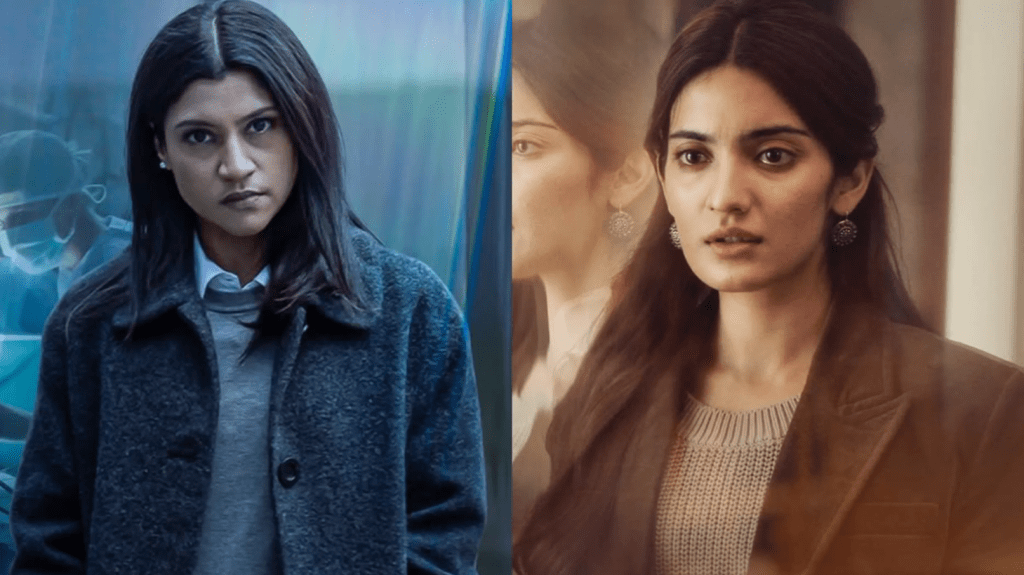
Konkona Sen Sharma and Pratibha Ranta in Accused Image

I knew I would be watching Accused on Netflix the moment I saw the lead pair: Konkona Sen Sharma and Pratibha Ranta. I have always liked both actors, so that alone was reason enough to hit the play button. But what really caught my attention was the theme of queer romance. In Indian cinema, stories about same-sex relationships are still relatively rare, which makes films like this especially interesting.

Over the past few years, India has slowly begun opening up to conversations about LGBTQ+ relationships. What once felt shocking to mainstream audiences is gradually becoming part of everyday discussion. That change did not happen overnight. It is the result of efforts from many sides: legal changes like the decriminalization of homosexuality in India, activists who have spent years spreading awareness, and filmmakers who are willing to tell stories about queer love on screen. Because of that collective push, movies exploring same-sex romance are finding space in Indian cinema.

I still remember when the Malayalam movie Kaathal: The Core was released. It remains one of the Malayalam films I feel proud of. I saw its impact firsthand at a family event we attended around that time. Some of my elderly relatives actually began discussing the theme of the film. It was clear they were still a bit uncomfortable talking about homosexuality, but the conversation itself was a big step. What surprised me most was that a few of them were able to acknowledge that homosexuality is real and not something a person can simply control or change. And the reason they were willing to even consider that perspective was simple: Mammootty was part of the film. Seeing an actor from their own generation portray such a character helped normalize the topic for them.

That moment reminded me of the real impact cinema can have. Movies are not just entertainment. Sometimes, they quietly open the door to conversations that people would otherwise avoid.

Getting back to the movie in question, Accused begins on a fast-paced note. The opening pulls you in immediately, and there is enough intrigue to keep you watching as the story unfolds. For a while, the film manages to hold that tension well. Unfortunately, the narrative loses some of its strength towards the end, and the impact is not quite as powerful as the beginning promised.

That said, the performances are a big highlight. Konkona Sen Sharma and Pratibha Ranta are both wonderful to watch. Pratibha, in particular, looked great throughout the film. I even found myself noticing her earrings more than once. She has mostly been seen in village girl roles so far, so it was refreshing to see her play a modern, city girl in this Netflix film. I am definitely looking forward to seeing more stories featuring her.

Konkona, as expected, delivers a strong performance. Her character is aggressive, ambitious, and very clear about what she wants. She does not soften her words to make others comfortable, and that confidence makes her come across as a true “boss girl” personality. At the same time, the film also shows how women like her often end up being judged or disliked for the same qualities that would be admired in men.

Overall, Accused starts off as a gripping Netflix drama with an interesting queer romance angle and strong performances. Even though the ending feels a bit underwhelming, the film is still worth watching for its lead actors and the way it brings conversations about same-sex relationships in India to a wider audience.

Short Film Spotlight: Anuja

Anuja Short Film Poster

I was craving to watch a slice-of-life drama. Something simple, not too heavy or filled with dread. I honestly thought Anuja would be intense, given how the synopsis sounded. Plus, it’s a Hindi short film that was an Academy Award nominee.

Now, why would I mention the Academy Award nomination like it’s a bad thing? I have my reasons.

To be honest, Oscar nominees have rarely worked for me. In Malayalam, we call such films “award padam.” The kind that feels too abstract or complex for ordinary viewers (like yours truly). There was a time in my life, long ago, when I pretended to enjoy such films just to seem intellectual in front of my then-partner. But I couldn’t keep up the act, and that image fell apart the moment that relationship ended. Now, it seems I’m making up for that lost time. All I want to watch are feel-good films.

So when I saw that Anuja was an Oscar nominee, it didn’t excite me enough to hit play right away. It actually made me hesitate. After all, the Oscars have a reputation for picking Indian films that focus on pain and poverty, what many call “poverty porn,” which does not fully represent what India is today.

Still, I decided to give it a chance.

What’s It About?

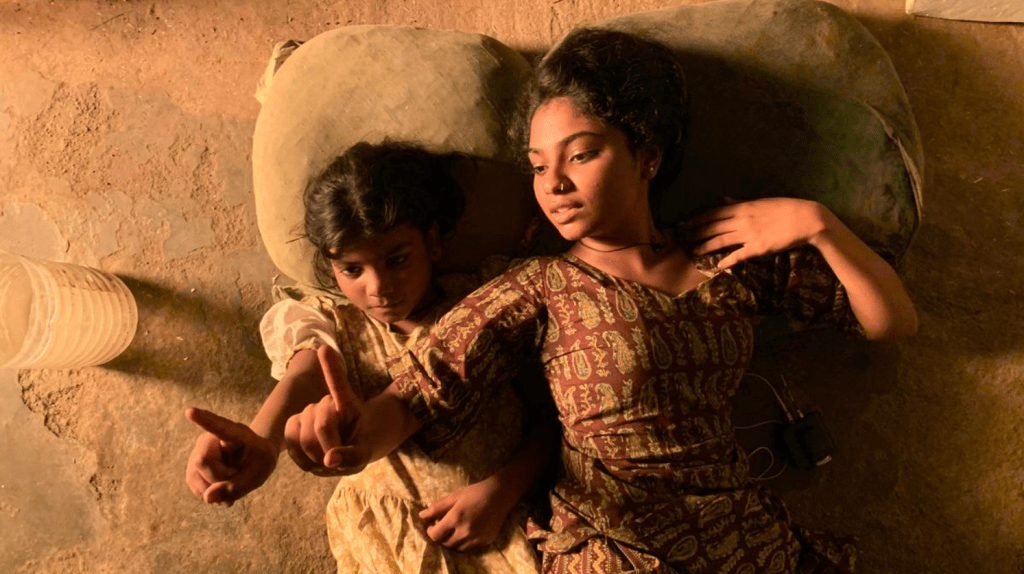
A 9-year-old girl works with her sister in a garment factory in India. Despite being naturally bright and curious, she doesn’t attend school because of financial struggles. And, truthfully, she doesn’t want to either. Her elder sister, however, recognizes her potential and dreams of giving her the education she deserves.

Thoughts

The film was a pleasant surprise. I loved it. It was just 22 minutes, but packed with emotions.

It tells the story of child labourers. They are presented not as helpless victims, but as resilient children who find joy even in hardship. The truth is, we often see others through our own lens and may view them as “helpless.” But for them, this is simply life. They know no other kind of life, and they’re doing their best with what they have. That’s what the movie captures so beautifully — life as they see it, not as we do.

It’s a social hierarchy. Someone wealthier might be looking at me with pity, thinking I’m suffering. Yet I’m making the most of what I have, because that’s the life I know. We suffer mostly when we lose something we once had, when we can compare the before and after, and we truly miss the before.

I’ve often felt that those not well-off often make the best of what little they have, which is why they find happiness in the smallest things, like a bag of jalebi, for instance. Anuja captures that spirit beautifully: “The present may not be bright, but we can strive for a better tomorrow.”

The film avoids moral preaching or lecturing. It’s simply about two sisters supporting each other in a harsh world.

The most moving part of the film is that Sajda Pathan, who plays Anuja, was once a child labourer in Delhi before being rescued by the Salaam Baalak Trust (SBT). She now lives at the NGO’s Day Care Center, founded in 1988 by filmmaker Mira Nair, who, interestingly, is also the mother of New York’s new Mayor, Zohran Mamdani.

Ananya Shanbhag also delivers an excellent performance as the elder sister, Palak.

I would definitely recommend the short film. Anuja is streaming on Netflix.

Netflix Movie Spotlight: Odum Kuthira Chaadum Kuthira

Odum Kuthira Chaadum Kuthira Movie Poster

Odum Kuthira Chaadum Kuthira is a Malayalam movie that didn’t get glowing reviews. Still, I decided to give it a shot, because over time, I’ve learned that my taste rarely matches what others say. I’ve liked movies that everyone else trashed, and I’ve dropped shows that got rave reviews.

Take Bads of Bollywood, for instance. I quit after three episodes. The humor just didn’t click with me. The Emmy winner, Severance, on Apple TV? I made it to five episodes before giving up. It was too slow for my liking, and yes, I shamelessly looked up the spoilers for both because I couldn’t sit through the rest.

Serious movie fans and critics might think my choices are questionable. And that’s fine. I’m not trying to be anyone’s go-to person for movie recommendations. I watch movies for one simple reason: to be entertained. If a film or show keeps me hooked, that’s all that matters. I’ve also noticed how people often get shamed for liking a movie that others dislike, or for disliking one that everyone praises. This makes many stay silent about their opinions. My attempt at being open is simply to break away from that.

So, with that mindset, I started watching Odum Kuthira Chaadum Kuthira. I didn’t expect much, but I ended up being pleasantly surprised.

What’s It About?

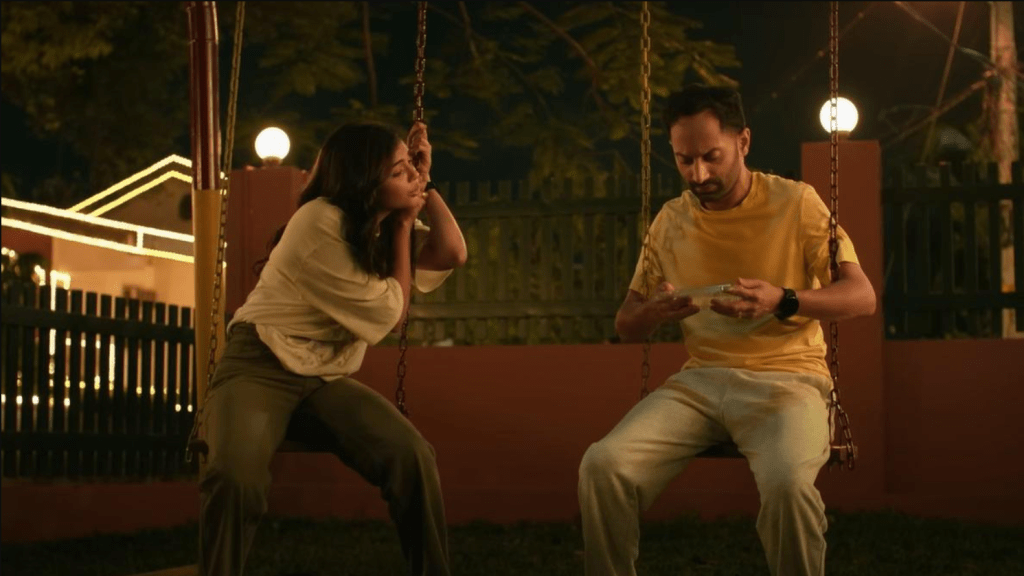
Odum Kuthira Chaadum Kuthira opens with the wedding preparations of a quirky couple. On the night before the wedding, the bride visits the groom with an unusual request: she wants him to arrive at the venue on a horse. It’s her dream, she says. Or rather, it’s something that keeps recurring in her dreams. She believes the dream will stop only if he makes that grand entry for real. The ever-romantic groom agrees without hesitation. But what follows is a chain of chaotic events that quickly spiral out of control.

Thoughts

Unlike most recent Malayalam movies, Odum Kuthira Chaadum Kuthira is not dark, intellectual, or overly smart. The type critics will rave about. And it’s not meant to be. It’s a crackpot of a film filled with quirky, eccentric characters, and that’s exactly why I liked it. I enjoy seeing wacky personalities on screen, the kind you’d find in Andaz Apna Apna. This kind of comedy works for me. It’s not vulgar, it doesn’t demean women, and it’s genuinely funny.

The movie feels like a group of friends coming together to create something chaotic just for fun. More like a personal, experimental project than a polished production. Kudos to Fahadh Faasil and the team for taking that risk. I especially liked Lal’s character as Fahadh’s father, and I thought Revathi Pillai shared better chemistry with Fahadh than Kalyani Priyadarshan did.

I wish the ending were better. It was underwhelming, but that did not take away the fact that I enjoyed the majority of the movie.

Watch it if you’re in the mood for something silly, unserious, and refreshingly offbeat. Don’t expect a masterpiece: just expect a fun, wacky ride to unwind after a long day at work. Odum Kuthira Chaadum Kuthira is now streaming on Netflix.