An Ode to Saving

Photo by maitree rimthong on Pexels

An excerpt from a book I am reading right now called “A Random Walk Down Wall Street“:

Two suggestions have been made to overcome people’s reluctance to save. The first is to overcome inertia and status quo bias by changing the framing of the choice. We know that if we ask employees actively to sign up for a 401(k) savings plan, many will decline to join. But if the problem is framed differently, so that one must actively “opt out” of the savings plan, participation rates will be much greater. Corporations that frame their 401(k) savings plans with an automatic enrollment feature (where a conscious decision must be made to fill out an “opt out” declaration) have far higher participation rates than do plans where employees must actively “opt in” to the plan.

There is this aversion to saving because it leaves us with less money to spend. Even if it’s a small amount like say $1, most would prefer to spend rather than save it. It is a never ending cycle that doesn’t change even with an increase in income. This explains why many of us are bad at saving. We are just not ready to take that first step, no matter how small it is. Psychological techniques like the one quoted above are then needed to motivate people to save.

I learnt “why” it was so essential to save by observing the people around me. I grew up in a home where budgeting never happened. We lived in the moment. That along with inflation left my parents next to nothing at the time of retirement. It kind of motivated me to learn more about personal finance, budgeting and investing.

I now take a note of all my credits and debits. I save some, I invest some. I also started investing in index funds, something my family never did before. I have no idea how successful I will be in this “new” personal finance route that has not been traditionally followed by my family, but you never know unless you try. I am reading a lot, not just books that compliment my current outlook, but the ones that thrash it as well, so I can see both sides of the story. I have never learnt so much about personal finance as I have now.

Getting back to the topic, why are people so averse to saving?

  • We are conditioned to believe that thinking about money is bad, that only greedy people think about money etc. We are then less inclined to learn about managing money.
  • We are not thinking about inflation. Our purchasing power is decreasing. It isn’t the same as it was 10 years ago. Not many understand the seriousness of this, leading to lack of motivation to save.
  • We think the interest we earn from our savings account is enough to get us through. But if you take inflation into consideration, you will realize that the money you invest in Fixed Deposits and Savings Accounts are giving us negative returns! We are actually losing money investing in these instruments. This “all is good” bubble that people (including me) thrive in makes them less motivated to save.
  • We do not wish to limit our spending. There is a constant internal struggle between wanting to buy it all and also wishing to save. More often that not, the latter wins.

These are just few points at the top of my mind but I am sure many financial experts would be able to cite more reasons.

It is always difficult to take that first step. It is always tough for me whenever I increase my savings. I struggle with that thought inside my head that reminds me my spending capital has reduced.

The trick is to get past that resistance. Once it becomes a way of life, you will realize it’s not so tough after all, and you will end up wishing that you had started sooner.

Edited to add: This wonderful advertisement from the 1960s that perfectly encapsulates the power of savings.
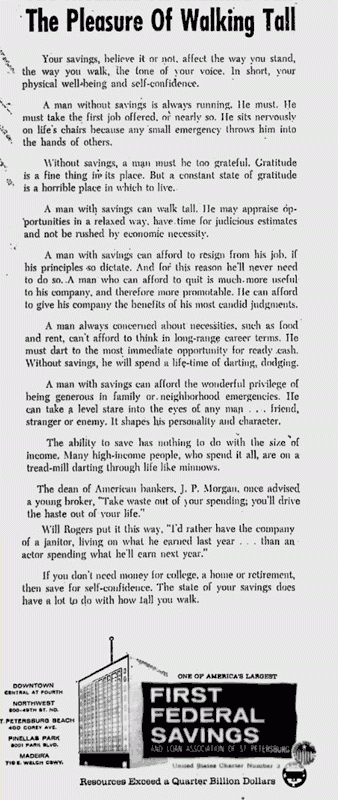
The Pleasure of Walking Tall

An Ode to Saying No to Dowry

Photo by Baljit Johal on Pexels

Yet another day in Kerala. Yet another dowry death.

Vismaya, a 23 year old, who died days after sharing her pics of abuse with a relative, has yet again prompted many to chant “A divorced daughter is better than a dead daughter.” Her parents were very much aware of the abuse she was going through, so was her brother and cousin, but unfortunately, not one of them could save her. There is no single person to blame here. Almost everyone is at fault, including the society.

I am a divorcee. Fortunately, my parents were super supportive, and gave my safety the utmost priority when I chose to leave my husband’s place after yet another episode of abuse. The day I left home was the day my parents came to know that I was facing physical and emotional trauma over many months. I did not want to worry them. Maybe Vismaya felt the same. The difference was, my parents did not tell me to compromise.

Mine was an arranged marriage. My parents and I were, are and always will be strictly against dowry. We always had made it clear when a proposal came by that no dowry would be given. My in-laws and husband said they had no demands, though traditionally their family practiced it.

On our wedding day, amidst all the flurry of activity, it felt odd when my husband quipped happily “(So and so) told me you are wearing a lot of jewelry; that I am a very lucky guy.” It was a hint of what was to come.

The emotional blackmail began on the first day of marriage. My ex-husband’s old relative, with a full authoritative tone, told me to put my jewelry in a locker at their chosen bank. When I naively told him that we usually put our jewelry in our own lockers, he was adamant that I keep it in a new one at the current location. This was odd to me, because I have never heard of such a thing happening in my family before. The women of the family always kept their jewelry in existing lockers. There was no question of transferring or shifting it to the husband’s place. Plus, it is so redundant – why open another locker when you already have one? There can only be one answer.

I consulted my mother, who panicked and told me not to do anything till they arrived. So I kept stalling their attempts to put my assets in their locker. My mother came to visit soon and took away the jewelry. This angered my ex-husband, and things (predictably) went downhill from then on. I remember asking him “Did you marry me for my money?

Physical abuse soon began. Not enough to get me hospitalized, but enough to give me bruises. “There are so many women getting hospitalized, that’s what real physical abuse is!” – he justified his actions to me. I forgave, but could never forget because he would keep repeating it. At the end, I ended the relationship and walked out. I realized my tears did not matter to him, nor my well being or happiness. I was married for just one year.

To all the unmarried women who are reading this, this is something you should note. You will hardly see anyone talk about this anywhere online – how dowry nowadays is rarely mentioned before marriage, camouflaged and hidden, all ready to make a move on its prey when the time is right. Many predators, cunning to the core, have realized that this right time to get what they are eyeing, is not before marriage but after it – when the woman is the most vulnerable, getting accustomed to a new place, confused and dazed. No one is explicitly going to use the word “dowry” but you will get to know from their actions.

Please remember, your current assets are yours alone. This needs to be strictly mentioned before marriage. You need to underline your deal breakers, so that there is no room for confusion. If after marriage, you decide to mutually hold future assets together, that is entirely up to you. But do not let anyone emotionally manipulate you into gaining access to your safety and security. Once you lose control of that, you lose control of your life.

I survived the worst phase of my life because I had solid support. Whenever I see a death or abuse case, it feels overwhelming. A lot of “if only” phrases come to mind.

  • If only, the family had supported her enough. Instead of telling her to compromise, they had told her to come home or “We are coming to pick you up” instead.
  • If only, the victim realized her life is not meant for suffering, to endure everything in silence. That staying married, even if toxic, is not the ultimate goal in life. Happiness is.
  • If only, the society made it easier for women to call it quits when her relationship with her partner becomes irreparable. Instead, mostly, we are told to compromise and adjust more.
  • If only, all men had the guts to strictly say no to dowry, go against tradition.
  • If only, a man’s parents did not put social status on such a high pedestal.

If only…

Many women, like Vismaya, would then still be alive.

An Ode to Questioning Biases

I have been increasingly questioning my biases lately.

Social Media Bias

How my opinions are largely formed by what the media is showing me. Sometimes, never bothering to look at the “other side.” A kind of blind faith that the news portals will show me only the truth and nothing but the absolute truth.

This belief was shaken up quite a bit when I understood that a lot of times, the media chooses to pick a side and highlight only that part of the story. We never get to know why “the other side” acted the way they did, said the things they did. It is well hidden. We never get to know the full picture. There are times I have made that extra effort to know more.. and have been amazed at how well the media hides bits and pieces of relevant information. The kind of information that wouldn’t have agitated the people so much if it were to be revealed alongside the flustering headline (or at least at the top of the news article). Add to that the social media’s personal opinions, which again, most often than not, do not give the complete picture.

With all this excessive one-sided information, a person who used to feel concerned about the issue in a healthy way before is left extremely agitated, angry and restless in a matter of minutes. The issue won’t leave your head. It stays with you when you sleep, it is the first thing you think of when you wake up. You snap at the drop of a hat, refusing to see any other angles. This keeps happening each time a new issue pops up. Imagine the stress your body has to go through, taking the world’s collective burden on your shoulders. In short, it just messes up your mental health.

I have had to log out of my social media accounts multiple times in the last one year just to calm myself down and to dissociate from all the noise. During such moments I often think, is social media a boon or a bane?

Information Bias

A large number of social media influencers (the ones who review movies) are largely influenced by critics and the media. If the critics say it is a good movie, they will say it is a good movie. If the critics thrash a movie, they will say it is the worst movie of the decade. I was so caught up in this information bias, that I was afraid of saying that I liked a movie that the majority hated. I was also afraid of saying I did not enjoy a movie that the majority liked. Because then, the movie shaming begins. Your taste in movies is questioned.

It is the case with almost anything, not just movies. If the general review of a product is positive or negative, you are expected to have the exact same view. Herd mentality in such cases is encouraged. If you step out of the box, you are questioned.

That was until I got out of that zone and said to myself “You know, I laughed watching this movie. It is funny. It worked for me. Why should I ashamed of something that kept me entertained throughout?” I started being open about liking the movies I really liked (even if they weren’t critically acclaimed) and not liking the movies that I truly did not (even if they were liked by the majority). I was being true to myself and that felt good.

I realized there were more people like me out there, shying away from voicing their true likes/dislikes, when I started getting messages (in private) that they liked/hated the same thing too.

Halo Effect

When you admire a person (it could also be a celebrity, politician or government), you tend to believe that everything the person does is justified – whether good or evil. We refuse to believe they are human after all – prone to mistakes. We forgive and forget. This is a bias I am trying to overcome as well. Trying consciously to notice and acknowledge those errors even if I like the entity very much. To hold them accountable if feelings were hurt, and not to give them the status of a superior being who is incapable of mistakes.

I have been reading up on biases and media bias is something that struck me the most. When you seek more information about something, weirdly enough, you start noticing these little things that you used to ignore before. You become aware of the biases that are now part and parcel of your daily life.

It is a scary thought to reflect on, that you can be manipulated into believing something that is constantly thrown in your face, as if there is no other truth.

An Ode to Cryptocurrency

Photo by Worldspectrum on Pexels.com

I have been staring at crypto news all week.

I have not yet invested in this “asset.” I would prefer calling it an “asset” over “currency” because in India it is not yet a legal tender.

My interest piqued when I heard of India’s involvement in Polygon/Matic. It was all over the news. A person who has not yet invested in crypto (i.e. yours truly) ended up watching a dozen new videos and reading comprehensive news articles on Matic (hello, patriotism), wondering dreamily when she will ever be able to invest in it confidently, without fearing the consequences of strict protocols that the government may or may not enforce later on. I even consumed with much interest a YouTube video on whether Matic would survive after Ethereum 2.0. All this makes zero sense to me as I am a new believer, but my curiosity seems to have taken over, wanting to know the future. All the answers I got were in the positive (for Matic). It has now become a forbidden fruit of sorts.

This is a big shift from how I was a few months back – an overconfident cynic who was pretty damn sure she would never buy crypto. “Too volatile, no regulations, weird names” My reasons were plenty. People change, so did I. Realizing the ever-growing power of virtual currency world over, it would surely be a step back, if India were to ban it completely.

I was proud that India got into the world of crypto (that too successfully), and also felt a bit dejected when the promoters of Matic said they couldn’t promote or advertise it in a way they would like to, because of India’s current stance on virtual currencies. Hopefully with crypto exchanges like WazirX fighting for #IndiaWantsCrypto, the officials will take notice, and newbies like me can also venture into a zone that has gained immense popularity worldwide. Call it FOMO or whatever you wish, but no one can negate the solid growth crypto is experiencing.

I still have to wait though, for the Indian government to make its stand clear. And this the story of many in India. Why?

Because, for a safe investor like me, playing by the government’s rulebook is of absolute importance. India does have a lot of crypto investors, who are fully aware of the risk factors that come with possessing an unregulated asset, but they continue to do so as they are ready to take that risk. Buying and selling crypto in India is not illegal, but the government sending across mixed signals makes it a bit tough for many like me to jump into the bandwagon with surety.

Hopefully, soon enough, we will get to know. Hopefully, by then, crypto would have not lost its charm.

An Ode to Humanity

Photo by fauxels on Pexels.com

I stumbled on a couple of YouTube videos recently. Posting 2 of them below.

Palestinians: Would you invite an Israeli Jew to Iftar meal?

Israelis: Would you invite a Palestinian to Shabbat or Passover meal?

Truth be told, every single “no” was painful to hear.

Circumstances force us to dislike even the humane, the innocents, people who have nothing to do with the terror attacks. It becomes difficult to separate a person from his religious identity.

In the videos, it doesn’t seem to matter if the invited person is of good character. An invite is extended based on religion alone, on a generalization that “If one person of a community is like this, then all of them might be similar.

I couldn’t help placing myself in such a situation – someone denying me an invite looking at my race, color, religion, caste and the actions taken by a group. It wouldn’t matter if I had raised my voice for the oppressed. At that moment, it only matters whether I am from “the other side”

It is not just restricted to Israel-Palestine, you can find similar cases world over.

The suspicions can’t be blamed either because time and again people have breached that trust. Suspicion is a natural form of self-defence. Better be safe than sorry. Yet mistrust can feel heavy when you are not personally to blame.

I pray for a world, where a person is judged by their own character, on humanity alone, and not from some unfair blanket generalization, even if such a hope seems far-fetched at the moment.

An Ode to Informed Opinions

Photo by Solen Feyissa on Pexels.com

You are supposed to have an opinion on everything nowadays.

If there is a hashtag trending on Twitter, where people are raging and showing their utter disappointment in something, you are considered indifferent or apathetic if you do not take an active part in the noise. You see posts akin to “Your silence speaks a lot” that curse you for being quiet.

You aren’t supposed to fall on a grey area. It should either be a concrete “Yes, I support this” or a “No, I do not support it” God forbid, you take a neutral stance. I have seen celebrities feeling burdened by this pressure to make a statement about any issue. At times, I have felt “Thank God, I am not a celebrity

What if it isn’t apathy or indifference? What if it’s plain fear – of upsetting your friends if you state your true, honest informed opinion?

Social media, unfortunately, isn’t always right. There’s a herd mentality at play most of the times. People go with the flow rather than doing proper research and making an informed opinion. There are people who protest, just for the sake of protesting. You ask them about the issue and they will have no clue about what’s going on.

It is sort of a ripple effect – when you see your friends taking part in it, you want to join in too, and then your friends see you doing it and they take part in it as well. A fear of missing out, or as the new gen would put it – FOMO. Everyone is too busy to do independent research though, so they trust their friends to have done it already.

You are also scared. You might be considered cold or distant if you do not support your friends in this hashtag trend. Even worse, you are not supposed to have an opinion that is different from theirs. “My way or the highway” is the motto. That confusion and fear stops a lot of people from really opening up. It can also make more people jump into the bandwagon, to add to the noise, impulsively without proper research.

There are times you give your 2 cents, supporting your friend’s opinion, because you trust them to be right. And later on, when you read up on the subject, you are utterly dismayed. You realize you shouldn’t have acted impulsively, and that there’s more to the issue than what meets the eye.

This is the bane of living online these days. You will be fired for having an opinion, you will be fired for having a different opinion, and you will also be fired if you do not have an opinion.

This shouldn’t stop us though, from making an informed opinion especially when it comes to sensitive issues. Your opinion will have an impact on your immediate circle – no matter how big or small that circle is. So why not do it right? Critical thinking has become the need of the hour. The facts are there for everyone to see. I do not mean the “facts” displayed on social media – which can be twisted to fit anyone’s agenda. A quick Google and YouTube search will display all the information you need. Go through multiple materials (from credible sources that are based on facts), read/hear from all sides, and you will definitely start seeing and filtering out the biases from your own knowledge base.

Here’s to more informed opinions, and may you never be stopped from making them.

P.S: I came across this old article “The Burden of an Informed Opinion” on LinkedIn. A very interesting (and much needed) take on learned opinions. Do give it a read to understand the necessity of critical thinking.